
Advanced Real Estate Deal Structuring: The CEO’s Blueprint for Institutional Scale
The syndication treadmill isn't a growth strategy; it's a high-stress job that caps your net worth while your limited partners reap the real rewards. If you're still relying on local bank lending and personal capital to fuel your acquisitions, you aren't building a firm; you're managing a series of isolated projects. True scale requires a shift toward advanced real estate deal structuring that prioritizes institutional-grade capital stacks and GP sovereignty. You've reached the ceiling of tactical flipping. It's time to architect a legacy.
You've likely realized that the complexity of multi-tier capital stacks is the only hurdle standing between your current portfolio and a 9-figure valuation. This briefing provides the blueprint to master sophisticated capital architectures and fund management models that attract the world's most discerning family offices. We'll explore the transition to SOFR-indexed debt, currently at 3.62%, the permanent 100% bonus depreciation benefits of the One Big Beautiful Bill Act, and the exit-ready structures necessary for institutional liquidity. You'll learn exactly how to move from chasing deals to commanding a high-performance investment machine that operates at the highest tiers of financial success.
Key Takeaways
- Transition from tactical deal-making to wealth architecture, prioritizing business permanence over the bottleneck of personal involvement.
- Engineer a sophisticated capital stack by utilizing mezzanine financing and preferred equity to bridge funding gaps and reduce personal equity requirements.
- Implement advanced real estate deal structuring through waterfall distributions and "catch-up" provisions that align GP rewards with institutional performance.
- Move beyond the syndication treadmill by adopting a fund management model that attracts lower-cost institutional debt and 8-figure valuations.
- Leverage the strategic proximity of elite peer advisory groups to audit your capital architecture and ensure your deals are optimized for institutional scale.
From Deal-Maker to Architect: The Shift to Wealth Architecture
Wealth Architecture is the strategic arrangement of assets and liabilities to ensure business permanence. It serves as the foundation for institutional-grade real estate scaling. Many operators remain trapped in a hustler mindset, perpetually chasing the next transaction to maintain momentum. This tactical approach inevitably fails at the 8-figure mark because personal involvement becomes the ultimate bottleneck. You cannot scale a firm if every advanced real estate deal structuring decision requires your direct, daily intervention. Growth demands a transition from tactical deal-making to strategic oversight of the entire capital stack.
Moving beyond the 7-figure ceiling requires you to stop viewing deals as isolated events. Instead, you must see them as components of a larger financial engine. This shift isn't just about bigger numbers; it's about shifting your identity from an operator to an architect who designs systems for predictable wealth. When you master the mechanics of Private equity real estate, you stop trading time for equity and start engineering structures that work independently of your presence.
The Operator vs. CEO Deal Perspective
The operator asks how much profit a single deal will generate. The CEO asks how much leverage that deal provides for the entire organization. A CEO views deal structure as a vehicle for systemic growth, not just a one-time paycheck. Managing these complex deal flows effectively requires a robust Business Operating System. Without these internal frameworks, the intricate requirements of advanced real estate deal structuring will quickly overwhelm your operational capacity and stall your progress.
Identifying the 7-Figure Ceiling in Your Current Structures
Signs of the 7-figure ceiling are obvious once you know where to look. If your current syndication model relies heavily on local bank lending or your own personal capital, you've reached your limit. Reaching 8 and 9-figure valuations requires Building a Leadership Team that can execute sophisticated capital architectures without your hand-holding. If the business stops the moment you step away, you haven't built an institutional-scale firm; you've simply built a high-paying, high-stress job.
Engineering the Capital Stack: Beyond Simple Debt and Equity
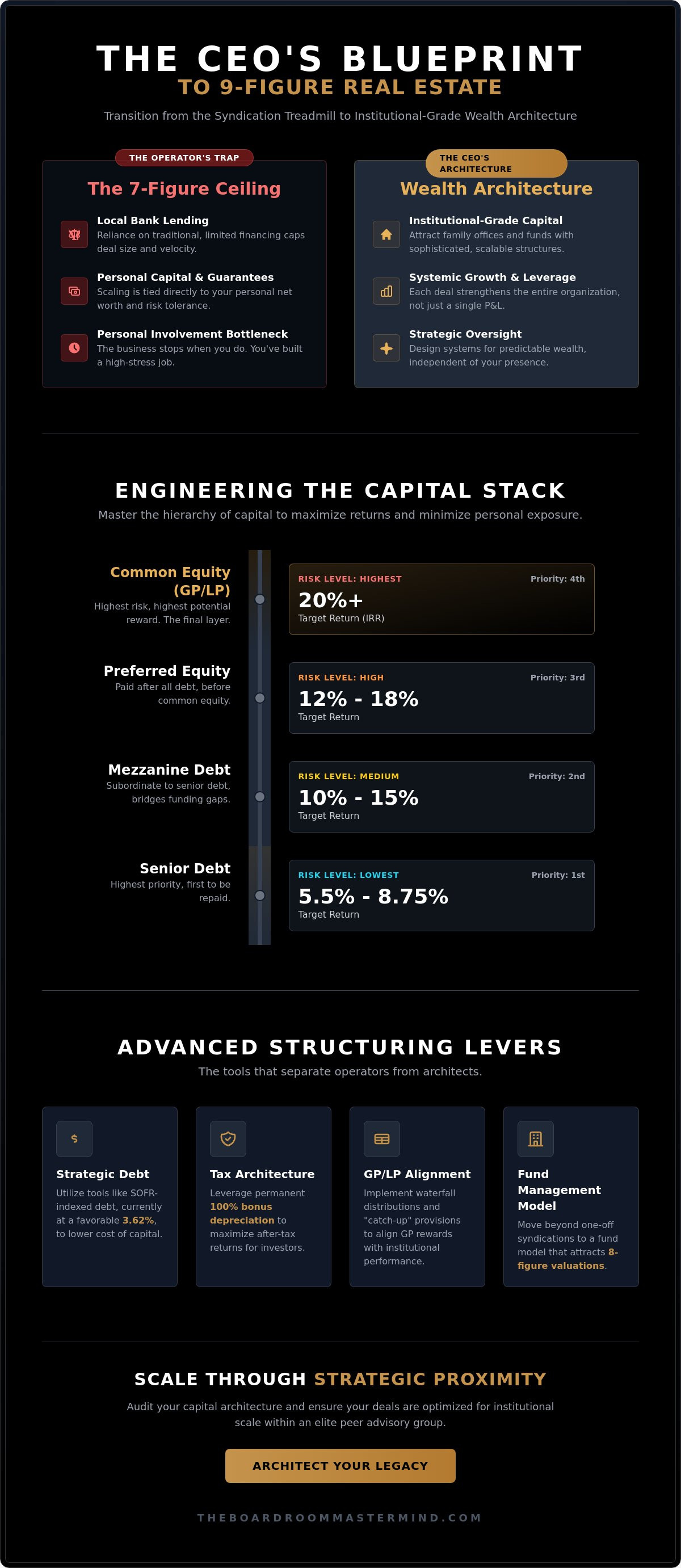
Institutional scale is not achieved through simple bank loans and personal savings. It requires a sophisticated understanding of the capital hierarchy. Each layer of the stack serves a specific purpose in risk mitigation and yield optimization. When you master advanced real estate deal structuring, you learn to manipulate these layers to maximize your return on equity while minimizing personal exposure. You're no longer just buying property; you're engineering a financial instrument.
| Layer | Priority | Risk Level | Target Return |
|---|---|---|---|
| Senior Debt | 1st (Highest) | Lowest | 5.5% - 8.75% |
| Mezzanine Debt | 2nd | Medium | 10% - 15% |
| Preferred Equity | 3rd | High | 12% - 18% |
| Common Equity | 4th (Lowest) | Highest | Variable (Upside) |
Sophisticated sponsors often use "Sponsor Equity" to retain significant control and upside while contributing a smaller percentage of the total capital. This approach aligns with Harvard Business School's investor perspective on deal structuring, which emphasizes the balance between investor protection and sponsor incentives. By utilizing mezzanine layers, you can bridge the gap between senior debt and common equity. This effectively reduces the amount of high-cost capital required to close the deal.
The Role of Mezzanine and Preferred Equity
Preferred equity is often the secret weapon for scaling without diluting GP control. Unlike common equity, it usually carries a fixed return and sits higher in the payment priority. Structuring your "Cost of Capital" correctly ensures your sponsor upside remains protected even in fluctuating markets. If you're ready to refine these frameworks, The Boardroom Mastermind Membership offers the strategic proximity needed to audit your current stack.
Institutional Debt Strategies
Reaching the 8-figure mark means outgrowing local banks. You must transition to CMBS or Life Company debt. These institutional sources offer non-recourse structures that protect your personal net worth from project-specific failures. It's about shifting from personal guarantees to asset-level performance. Moving to SOFR-indexed institutional debt allows for greater transparency and alignment with global financial benchmarks. The transition to institutional debt is a prerequisite for anyone serious about advanced real estate deal structuring at scale.
GP/LP Dynamics and Sophisticated Waterfall Distributions
Designing the relationship between a General Partner (GP) and a Limited Partner (LP) is an exercise in long-term alignment. It's not merely about the transaction today; it's about the partnership's permanence. When you engage in advanced real estate deal structuring, the goal is to create a symbiotic environment where interests are perfectly mirrored. You aren't just raising money; you're securing strategic partners who value your expertise as much as the asset's yield. A 20% carry with a defined hurdle rate aligns the CEO with institutional expectations by ensuring significant profit participation only occurs after the investors' capital is prioritized and protected.
To maintain this trust, the "Catch-Up" provision is essential. This mechanism ensures the GP is rewarded for hitting performance milestones once the LP has received their preferred return. It effectively bridges the gap between the preferred return and the agreed-upon carry percentage. Conversely, clawback provisions protect the integrity of the deal for LPs. These provisions ensure that if the total fund performance dips below the hurdle over time, the GP returns any over-distributed promote. This level of accountability is what separates the institutional leader from the tactical syndicator.
Structuring the Waterfall for Maximum GP Upside
Waterfalls are the engine of your wealth architecture. You must decide between American and European structures based on your growth trajectory. American waterfalls operate on a deal-by-deal basis, allowing for faster GP liquidity. European waterfalls require the return of all investor capital and hurdles across the entire fund before the GP receives a promote. While the American model fuels rapid expansion, the European model is often preferred by larger institutional partners for its risk mitigation. Using "Promote" structures allows you to capture outsized rewards for exceeding performance benchmarks, turning operational excellence into significant equity growth.
Attracting Family Offices and Institutional Partners
Family offices and Real Estate Private Equity firms look for deal structures that prioritize transparency and rigorous reporting. They need to see a sophisticated capital stack that handles complexity with ease. If your reporting is manual or your structures are opaque, you'll remain stuck in the retail syndication treadmill. Moving to 8-figure scale requires you to speak the shared vernacular of global high achievers. If you are ready to move beyond tactical management and lead a firm of this caliber, explore The Boardroom Mastermind Membership to gain the strategic proximity required for elite execution.
The Boardroom Approach: Scaling Through Strategic Proximity
High-level execution doesn't happen in a vacuum. At the 8-figure mark, advanced real estate deal structuring becomes a collaborative discipline rather than a solo endeavor. You need a room of peers who have already navigated the complexities of institutional scale to stress-test your assumptions. Leveraging the benefits of a peer advisory group allows you to audit your capital stack with the same rigor an institutional investment committee would apply. This collective intelligence is the ultimate safeguard against the blind spots that often accompany rapid growth.
The Boardroom philosophy centers on a total audit of your business model to remove the operational bottlenecks that prevent permanence. You must transition from being the "Deal Guy" who is personally indispensable to every transaction to becoming a "Portfolio CEO" who oversees a strategic engine. This shift requires more than just a new spreadsheet; it requires an environment of elite proximity where strategic collaboration is the standard. By auditing your business through this lens, you ensure that your deal flow is built for institutional readiness rather than just tactical survival.
Auditing Your Deal Flow for Institutional Readiness
Our Quarterly In-Person Intensives provide the specific environment needed to refine these capital structures. During these sessions, members move beyond surface-level metrics to dissect the mechanics of their wealth architecture. We've seen numerous members successfully transition from the frantic pace of deal-by-deal syndication to the stability of a fund management model. This transition allows them to access lower-cost institutional debt and prepare their firms for 8 and 9-figure valuations. It's about moving from activity to impact.
Applying for Elite Proximity
The Boardroom Mastermind is not a general education platform. It is a restricted community of global high achievers. We reject 95% of applicants to maintain the elite deal-making standards required for 9-figure growth. Accountability is the price of admission to this tier of success. If you're ready to leave the syndication treadmill behind and architect a legacy that operates with institutional precision, the path is clear. Experience the Boardroom Mastermind and scale your empire today.
Architecting Your Institutional Legacy
Transitioning from a deal-maker to a wealth architect is the only path to achieving true business permanence. You've now identified the sophisticated layers of the capital stack and the waterfall mechanics that command institutional respect. Mastering advanced real estate deal structuring isn't merely about the next closing; it's about engineering a firm that thrives independently of your daily hustle. You've moved beyond the syndication treadmill toward a model built for long-term impact and scalability.
True scale requires more than theory; it requires elite proximity. You need direct access to the battle-tested leadership frameworks of Kent Clothier and the collective intelligence of 7, 8, and 9-figure investors. Through our quarterly in-person business audits and intensives, you'll refine your systems and eliminate the operational bottlenecks holding you back from the 9-figure milestone. This is the ultimate shortcut to institutional-grade growth for those who value time and high-level execution.
Apply for The Boardroom Mastermind and scale to 8-figures to secure your place among the industry's elite. Your path to institutional dominance starts with the right room.
Frequently Asked Questions
What is the difference between a simple syndication and an institutional capital stack?
Simple syndications typically utilize a single senior loan and a pool of retail equity. Institutional capital stacks are significantly more complex, incorporating senior debt, mezzanine financing, and preferred equity to optimize the weighted average cost of capital. This structure allows the GP to access lower-cost institutional funds while maintaining greater control over the asset's long-term upside.
How do waterfall distributions work in advanced real estate deals?
Waterfall distributions function as a tiered priority system for cash flow. Distributions move from the return of capital to the preferred return, followed by a catch-up provision for the GP. Utilizing advanced real estate deal structuring ensures that the sponsor’s promote is tied directly to hitting specific internal rate of return (IRR) hurdles, aligning GP rewards with LP success.
When should an investor transition from a deal-by-deal basis to a real estate fund?
You should transition to a fund model when the speed of capital deployment becomes your primary operational bottleneck. A fund provides "blind pool" capacity, allowing you to move with the certainty of close required for 8 and 9-figure transactions. This shift transforms you from a project-specific fundraiser into a strategic fund manager with immediate market credibility.
What are the common mistakes experienced investors make when structuring 8-figure deals?
The most frequent error is maintaining personal guarantees on large-scale acquisitions. At this level, you must utilize non-recourse institutional debt to protect your personal net worth from project-specific risks. Investors also overlook the reporting requirements of the Financial Crimes Enforcement Network (FinCEN) for all-cash purchases through entities, which can lead to significant regulatory friction if ignored.
How does mezzanine debt affect the overall ROI for the General Partner?
Mezzanine debt increases the total leverage of the project, which reduces the amount of common equity required from limited partners. By filling the gap between senior debt and equity, you magnify the returns on the remaining equity base. This application of advanced real estate deal structuring results in a higher ROI for the GP, as your promote is calculated against a more efficient capital allocation.


