
What Makes a Great Real Estate Mastermind: The CEO’s Guide to Elite Proximity
Your current network is the ceiling of your net worth. While the average investor spends $25,000 annually on entry-level coaching, the elite 1% understand that true growth isn't about more information; it's about superior proximity. You've likely felt the frustration of being the smartest person in the room, where the advice is geared toward grinding rather than strategic optimization. It's a common plateau for CEOs who have scaled to 7 figures, yet they often fail to recognize what makes a great real estate mastermind until they are trapped in the daily operations of their firm.
This guide identifies the critical elements that separate high-ticket peer groups from generic coaching programs and how to identify the inner circle that will scale your business to 8 figures. You'll discover the proprietary scaling systems and the vetting process required to move from a high-stakes operator to a professional CEO. We will break down the architecture of elite proximity to ensure your ascent to a 9-figure legacy is the logical conclusion of your strategic alliances. This is your briefing on how to secure an unfair advantage through collective intelligence and elite decision-making.
Key Takeaways
- Distinguish between entry-level networking and the elite environments required to scale your business toward a nine-figure legacy.
- Identify the structural non-negotiables, from quarterly intensives to rigorous accountability frameworks, that separate true peer groups from generic coaching.
- Discover what makes a great real estate mastermind by calculating the ROI of shared strategies that can cover annual dues ten times over.
- Implement a high-level vetting framework to audit the room’s revenue floor and verify the founder’s documented track record of success.
- Learn how to leverage collective intelligence to transition from an exhausted operator to a sophisticated owner who scales without the stress.
Beyond Networking: Defining the Elite Real Estate Mastermind
Elite proximity isn't found at a 1,000-person conference or within the chaos of a casual Facebook group. It's built inside a structured environment where 7, 8, and 9-figure peers collaborate to dismantle complex business bottlenecks. While the foundational concept of a Mastermind group has existed for decades, the modern version for real estate CEOs has evolved into a high-stakes strategic asset. It's a surgical strike against mediocrity.
Understanding what makes a great real estate mastermind requires looking past the surface. It isn't a coaching program where you're spoon-fed basic tactics. It isn't a networking mixer for trading business cards. It's a laboratory for the "Operator to CEO" evolution. This room forces you to stop working in the business and start working on it. You're moving from the frantic energy of the masses into the calculated calm of the Inner Circle.
The 4% Rule: Why Selectivity is the Foundation of Quality
High-ticket dues serve as a critical filter for commitment; they ensure every person in the room has significant skin in the game. You're paying for the absence of the uncommitted and the mediocre. Avoid "pay-to-play" groups that lack rigorous application standards, as they inevitably dilute the room's power. For a deeper analysis of these entry barriers, read The 7-Figure Ceiling: A CEO Guide to Exclusive Mastermind Groups.
Peer Caliber vs. Expert Instruction
You don't need another guru. You need peers who have already solved the 8-figure scaling problems you're currently facing. This collective intelligence creates an unfair advantage in a volatile marketplace. When five CEOs who manage a combined $500 million in assets analyze your specific bottleneck, the solution becomes inevitable. This is the core of what makes a great real estate mastermind: the transition from solitary struggle to shared, elite brilliance.
The Architecture of Impact: Elements of a World-Class Group Structure
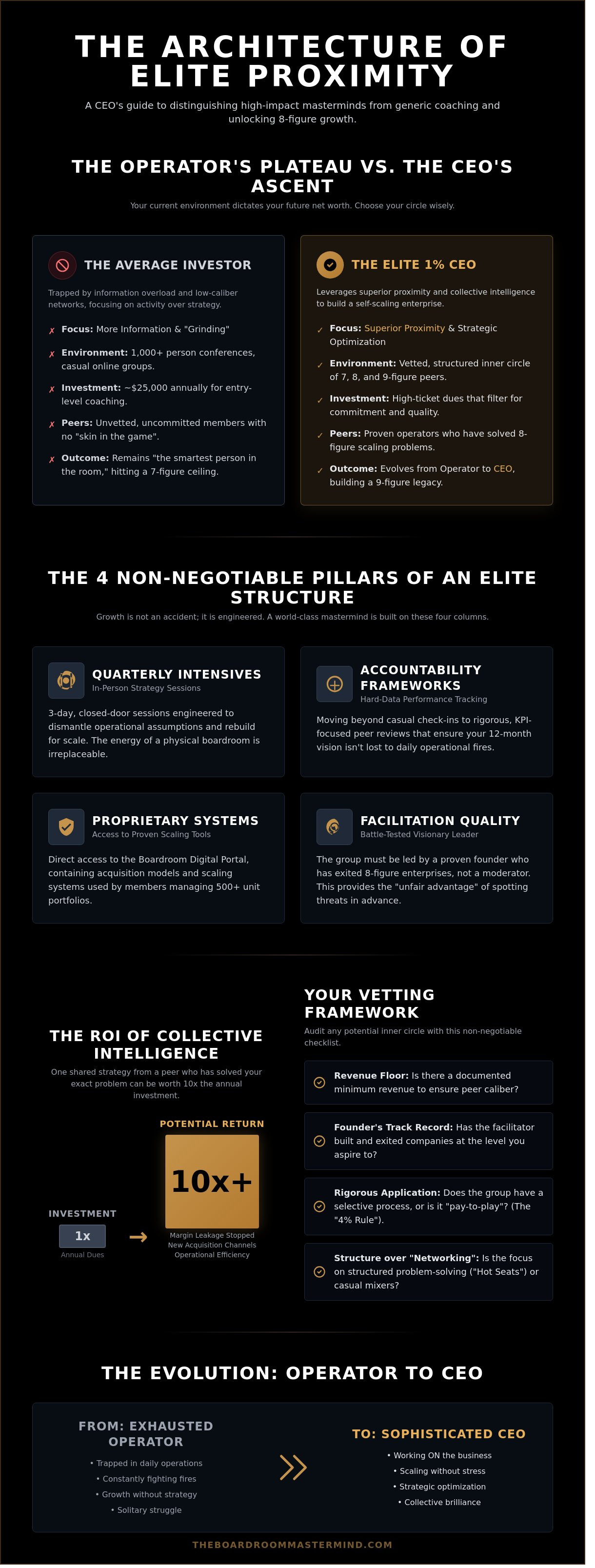
Elite proximity isn't an accident. It's engineered. When evaluating what makes a great real estate mastermind, you must look past the guest list and into the structural engine. High-level CEOs don't need another networking happy hour; they need a rigorous framework that audits their business model every 90 days. A world-class structure relies on four non-negotiable pillars to ensure your trajectory remains vertical.
- Quarterly Intensives: These are three-day, in-person strategy sessions designed to tear down and rebuild your operational assumptions. Virtual calls can't replicate the breakthrough energy of a closed-door boardroom.
- Accountability Frameworks: We move beyond casual "check-ins" to hard-data performance tracking. Peer reviews focus on your KPIs, ensuring that your 12-month vision isn't hijacked by daily fires.
- Proprietary Systems: Members gain direct access to the Boardroom Digital Portal. This includes the exact scaling tools and acquisition models used by investors currently managing portfolios of 500+ units.
- Facilitation Quality: The group leader must be a battle-tested visionary who has exited eight-figure enterprises, not a moderator reading from a script. They provide the "unfair advantage" by spotting threats you haven't considered.
Understanding what makes a great real estate mastermind requires recognizing that growth is a byproduct of the systems you inhabit. If the structure is weak, even the best advice will fail to scale.
The Hot Seat: A Laboratory for High-Stakes Decision Making
High-stakes decision-making requires a laboratory. The Hot Seat identifies the pattern blindness that costs seven-figure owners an average of 15% in annual margin leakage. Within this inner circle, radical transparency is the only currency. You can see the Boardroom Experience in action to understand how this environment fosters the psychological safety needed for raw, strategic honesty among high-achievers.
Between the Meetings: Maintaining Momentum in 2026
Momentum often dies in the silence between events. In 2026, staying ahead of rapid market shifts requires digital collaboration that functions as a 24/7 extension of your executive team. Quarterly audits serve as a firebreak against "stagnation creep," ensuring solo enterprise habits don't infect your scaling operations. If you're ready to transition from operator to owner, choosing a group with this level of architectural depth is the only logical move to scale without the stress.
Calculating the ROI of Strategic Proximity
The math of elite proximity is cold and undeniable. What makes a great real estate mastermind is its ability to deliver a 10x return on investment through a single shared acquisition strategy or a refined tax mitigation play. If your annual dues are $30,000, a single $300,000 commercial deal or a 15% reduction in overhead through shared offshore talent strategies pays for the seat ten times over. This is the direct ROI of high-level access.
Indirect ROI is measured in the mistakes you don't make. When you sit with those who have already scaled to 9-figures, you bypass the catastrophic errors that stall most mid-market firms. You gain an "unfair advantage" by accessing private capital, elite talent pools, and off-market deal flow that never hits the public sector. This environment facilitates the transition from a profitable business to a generational wealth engine. It's about moving from active income to institutional-grade legacy building.
The Hidden Cost of Being the Smartest Person in the Room
If you're the highest earner in your current circle, you've reached your ceiling. Your network is likely reinforcing a "hustler" mentality that keeps you trapped in daily operations. Proximity to higher-level thinkers is the fastest way to expand your vision and break through that 7-figure plateau. This shift is essential for scaling beyond your local market and dominating larger territories.
Case Studies in Scale: From Operator to Owner
The transition from operator to owner is where true freedom resides. We've documented members who compressed a decade of growth into 24 months by implementing institutional systems shared within the inner circle. These aren't theories; they're battle-tested frameworks for 9-figure success. You can explore our member case studies to see the tangible results of collective intelligence. Understanding what makes a great real estate mastermind starts with seeing the success of those who have already paved the way.
Stop operating in a vacuum and start leveraging the collective power of the elite. Apply for the Boardroom experience today.
The Selection Framework: How to Vet Your Next Inner Circle
Selecting a peer group is a strategic acquisition of collective intelligence. If you choose poorly, you're paying to be the smartest person in the room. To determine what makes a great real estate mastermind, you must move beyond the marketing deck and audit the actual infrastructure of the group. Start by requesting the hard data. An elite circle should provide the average annual revenue and years of experience of its active members. If the median revenue falls below $2M, you aren't in a boardroom; you're in a classroom.
Verify the founder's credentials with surgical precision. A true mentor has built exactly what they teach, backed by a documented track record of 8-figure exits or portfolio scaling. Look for these specific indicators:
- Systems over Vanity: Does the group prioritize "hustle" or "optimization"? You need a community that focuses on wealth architecture and exit strategies.
- Hard Accountability: Ask for specific examples of how the group handles members who underperform. High-level groups maintain their standard by removing those who don't contribute to the collective momentum.
- Operational Depth: Ensure the curriculum focuses on compounding returns and legacy building rather than the latest social media trend.
Red Flags: When a Mastermind is Actually a Marketing Funnel
Many programs prioritize volume over member quality. These "guru-led" funnels treat you as a lead, not a peer. A commodity group sells information; a community sells access and high-stakes problem solving. If the program has 500 people in a single Zoom call, it's a course, not a circle. True proximity requires a capped roster where every member adds 10x value to the room.The Boardroom Litmus Test
If your current growth has plateaued because you've outpaced your local network, then it's time to upgrade your proximity. If you're ready to transition from operator to owner, then you need a framework designed for 9-figure legacies. Your next move defines your trajectory for the next decade. Apply for The Boardroom Mastermind to secure your seat at the table.Own the Room Where 9-Figure Legacies Are Built
Success at the highest level isn't a solo endeavor. It's the result of calculated proximity to those who've already solved the problems you're currently facing. You now understand the architecture of impact and how a rigorous selection framework protects the integrity of your inner circle. What makes a great real estate mastermind is the deliberate curation of peers who demand excellence and provide the collective intelligence needed to transition from operator to owner. It's about moving beyond the noise to find strategic clarity and sustainable leverage.
The Boardroom Mastermind is designed for the elite few who value time and execution over frantic hustle. With a strict 4.4% acceptance rate, we maintain an unrivaled standard of excellence that keeps the conversation at a high-stakes level. Members here are actively scaling to 9-figures through high-level systems and quarterly intensives with Kent Clothier. This is your opportunity to secure the unfair advantage required to dominate your market while building a business that operates without your constant presence.
The path to your next breakthrough is through the right door. Apply to Join the Boardroom Mastermind Inner Circle and start building your legacy today. Your ascent to the next level is the logical conclusion of choosing the right room.
Frequently Asked Questions
What is the difference between a real estate mastermind and a coaching program?
Coaching focuses on one-way instruction from a mentor, while a mastermind centers on the collective intelligence of a peer group. In a coaching program, you follow a single person's playbook. In an elite boardroom, you leverage the diverse experiences of multiple high-level operators to solve complex scaling problems. Understanding that peer-to-peer accountability is what makes a great real estate mastermind will help you transition from a student to a sophisticated owner.
How much does a high-ticket real estate mastermind cost in 2026?
High-ticket real estate masterminds in 2026 typically require an annual investment between $25,000 and $100,000 according to industry benchmark reports. This fee grants you exclusive access to proprietary systems and elite proximity that can't be found in the general marketplace. You're not buying information; you're investing in the strategic assets and deal flow that generate a 10x return on your capital through optimized exit strategies.
Is a mastermind group worth it for an investor already doing 7 figures?
A mastermind is the most critical investment for a 7-figure investor because it provides the framework to scale toward a 9-figure legacy. Data shows that 92% of entrepreneurs plateau at the seven-figure mark because they lack the systems to remove themselves from daily operations. Joining an inner circle allows you to borrow the proven architecture of those who've already cleared the hurdles you currently face; ensuring your growth is both predictable and sustainable.
What are the minimum requirements to join an elite real estate mastermind?
Most elite groups require members to have a minimum of $1 million in annual revenue or a portfolio exceeding 50 units to ensure everyone in the room provides high-level value. These strict benchmarks protect the integrity of the boardroom and guarantee that conversations remain focused on enterprise-level scaling. Beyond the financials, a 100% commitment to radical transparency and ethical expansion is mandatory for anyone seeking entry into these exclusive circles.
How often do great real estate masterminds meet in person?
Elite masterminds typically meet in person 3 to 4 times per year to facilitate deep strategic planning and relationship building. These quarterly summits are designed to be high-impact briefings that don't distract from your primary business operations. Between these physical meetings, members use secure digital channels for real-time problem solving. This rhythm ensures you maintain the momentum needed for aggressive growth while respecting the value of your time as a CEO.


