
The CEO Blueprint for Building Strategic Alliances that Drive 8-Figure Scale
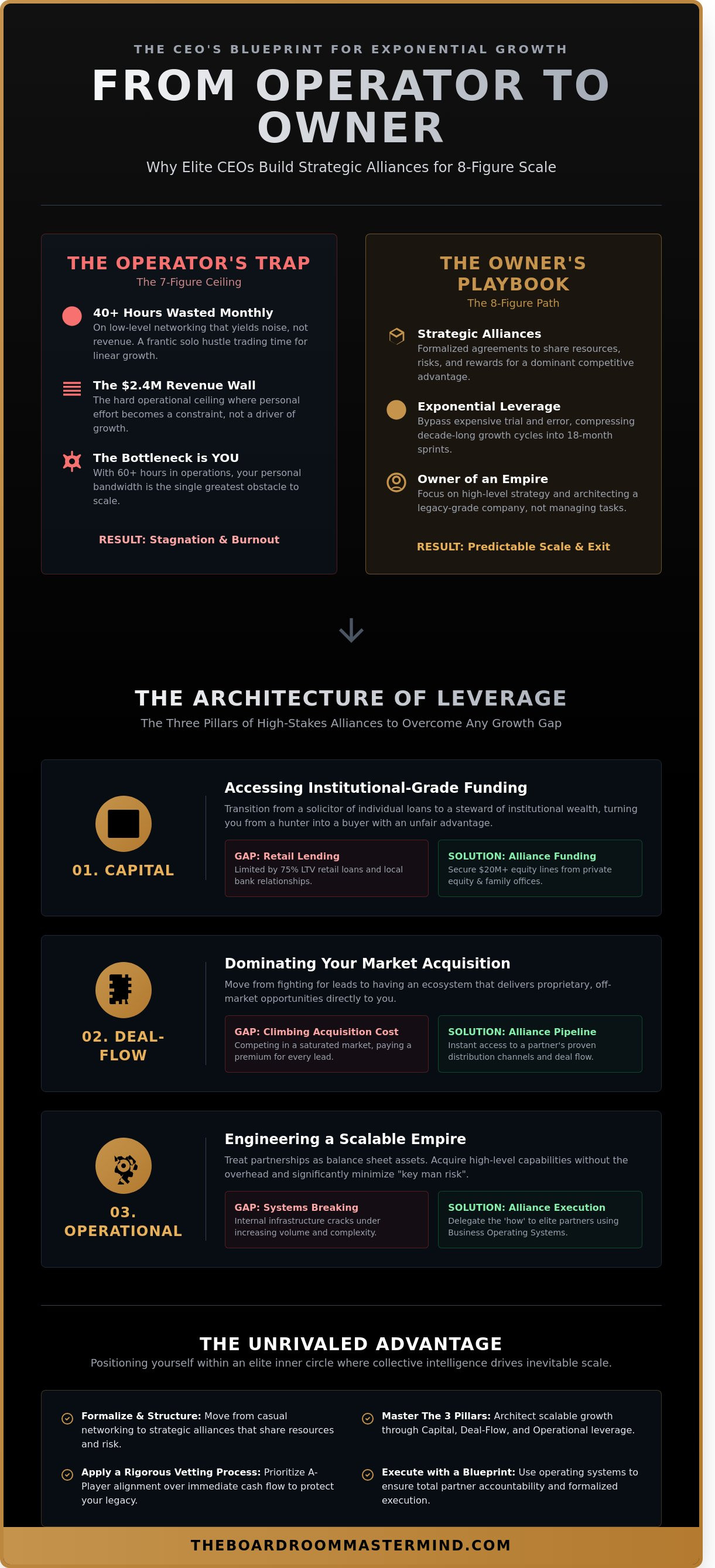
Your personal bandwidth is no longer an asset; it is the single greatest bottleneck preventing your transition from operator to owner. While 94% of mid-market CEOs rely on incremental internal growth, the elite few understand that building strategic alliances is the only predictable path to an 8-figure exit. You’ve likely felt the exhaustion of the solo hustle, spending 40 hours a month on low-level networking that yields nothing but noise and wasted potential. It's time to stop trading your life for linear growth.
We agree that the frantic energy of entry-level coaching has no place in your boardroom. You deserve access to institutional-grade capital and a high-level deal flow that operates independently of your daily involvement. This blueprint reveals how to engineer high-stakes partnerships that provide unrivaled leverage, allowing you to scale operations while actually reducing your personal stress. We will examine the three-tier framework for identifying elite partners, securing your unfair advantage, and architecting a legacy-grade company that's perpetually ready for a premium acquisition.
Key Takeaways
- Shift your focus from casual networking to building strategic alliances that formalize the sharing of resources and risk for a dominant competitive advantage.
- Architect a scalable empire by mastering the three pillars of high-stakes leverage: Capital, Deal-Flow, and Operational Excellence.
- Apply a rigorous vetting process that prioritizes A-Player alignment over immediate cash flow to protect your long-term legacy and exit potential.
- Transition from high-level dialogue to formalized execution using a step-by-step blueprint and Business Operating Systems that ensure total partner accountability.
- Secure an unrivaled "unfair advantage" by positioning yourself within an elite inner circle of 8 and 9-figure entrepreneurs where collective intelligence drives inevitable scale.
Beyond Networking: Why Elite CEOs Build Strategic Alliances for 8-Figure Scale
Networking is for those looking for work; building strategic alliances is for those looking to dominate markets. Elite CEOs understand that casual connections rarely move the needle on a balance sheet. To reach an 8-figure valuation, you must move beyond the "coffee chat" culture. You need a formalized structure. A foundational understanding of what is a strategic alliance reveals it as a sophisticated agreement where two or more parties share resources, risks, and rewards for a specific competitive advantage. This isn't about social capital. It's about operational leverage and calculated market positioning.
The fastest path to outgrowing the "hustler" phase is through the acquisition of collective intelligence. Why spend $500,000 and three years testing a new distribution channel when an alliance gives you instant access to a proven one? By building strategic alliances, you bypass the expensive trial and error that stalls most growth-phase companies. You stop playing the game of incremental gains and start playing the game of exponential leaps. This is the hallmark of the true CEO mindset. It's the difference between owning a job and owning an empire.
The Death of the Solo Founder
The 7-figure ceiling is a psychological and operational reality. Data shows most founders hit a hard wall at $2.4 million in annual recurring revenue. At this stage, your personal effort is no longer a driver; it's a constraint. If your calendar is consistently booked with 60 hours of operational tasks, you're the bottleneck. You must choose between the organic grind and leveraged growth. Alliances allow you to scale without adding more weight to your own shoulders. If you don't delegate the "how" to strategic partners, you'll never have the time to focus on the high-level strategy required for 8-figure scale.
Alliances as a Strategic Business Asset
Treat your partnerships as balance sheet assets, not just relationships. This approach allows you to acquire high-level capabilities without the 40% tax and benefits overhead associated with a full-time executive team. These alliances also serve to diversify your risk profile. Investors value a company with a robust ecosystem of partners higher than an isolated entity because the "key man risk" is significantly minimized. In the environment of The Boardroom, these assets are managed with the same rigor as your cash flow. They are the primary keys to a 9-figure legacy and an unrivaled market position.
The Architecture of Leverage: Three Pillars of High-Stakes Alliances
Building strategic alliances isn't a networking exercise; it's a structural requirement for 8-figure growth. If your firm is plateauing at the $3M or $5M mark, your bottleneck is likely a deficit in one of three critical areas: Capital, Deal-Flow, or Operational Excellence. These pillars act as force multipliers. They allow you to compress decade-long growth cycles into 18-month sprints. The objective is always scaling without the stress, which is only possible when you move from a solo operator to a designer of high-level ecosystems where responsibility is shared among elite partners.
- Capital Gap: You have the deals and the team, but you're limited by 75% LTV retail loans.
- Deal-Flow Gap: You have the funding and the infrastructure, but your cost per acquisition is climbing.
- Operational Gap: You have the money and the leads, but your internal systems are breaking under the volume.
Capital Alliances: Accessing Institutional-Grade Funding
Retail lending is for beginners. To sustain an 8-figure real estate empire, you must move beyond local banks and into the world of private equity and family offices. Credibility is your primary currency in these rooms. High-ticket capital partners don't just look at the asset; they audit your track record and your reporting systems. Transitioning to a fund management model is the ultimate strategic alliance play. It shifts your role from a solicitor of individual loans to a steward of institutional wealth. Securing a $20M committed equity line changes your entire acquisition strategy; it turns you from a hunter into a buyer with an unfair advantage.
Deal-Flow Alliances: Dominating Your Market
Elite CEOs don't compete for scraps; they collaborate to control the feast. When you partner with supposed competitors, you can aggregate inventory and dominate local lead generation through shared costs. Building these alliances often involves proprietary data sharing that creates a barrier to entry for smaller players. Structure your referral and co-investment models to incentivize A-players with a "win-win" 20% equity split on off-market opportunities. This turns every high-level operator in your market into a potential scout rather than a rival. If you want to see how the world's most successful CEOs structure these agreements, joining an inner circle of high-achievers is the fastest way to gain that perspective.
Operational Excellence: Scaling Through Shared Infrastructure
You don't need to own every department to control the outcome. Operational alliances allow you to plug into existing, world-class infrastructures. Whether it's a third-party property management firm that handles 5,000 units or a specialized legal team that closes 50 deals a month, these partnerships allow you to remain lean. By leveraging the collective intelligence of specialists, you ensure your business remains agile. You focus on the 5% of activities that drive 95% of your wealth, while your partners handle the tactical execution with surgical precision.
The CEO Litmus Test: Evaluating Potential Partners for Long-Term ROI
Building an enterprise that scales past $10M requires more than a handshake and a shared interest. You need a vetting process that ignores immediate cash flow in favor of long-term vision. Data from the 2023 Harvard Business Review indicates that 60% of strategic alliances fail within the first 36 months due to poor cultural integration and misaligned goals. If you're aiming for a 9-figure legacy, you cannot compromise on the quality of your inner circle. C-level partners will anchor your growth; only A-players provide the propulsion required for elite scale. Success is binary in this environment. You're either accelerating or you're decaying.
Before signing a Letter of Intent, you must audit their internal systems and leadership team. Look at their employee retention rates and their documented standard operating procedures. If their back-end is a chaotic mess of "hustle culture," your alliance will eventually collapse under the weight of its own inefficiency. It's vital to understand the distinction between an accountability partner vs. mastermind when looking for growth. One keeps you on track for minor goals, while the other provides the collective intelligence to dominate an entire industry.
Values Alignment vs. Asset Alignment
Shared assets look impressive on a balance sheet, but shared core values are the only insurance against alliance failure. Identify red flags early by observing how they treat their lowest-paid vendors or how they react to a 15% dip in quarterly revenue. If a potential partner prioritizes short-term extraction over long-term reinvestment, walk away immediately. You must also agree on a shared exit strategy from day one. Whether the goal is an IPO in 2029 or a private equity buyout at a 10x multiple, the destination must be identical for both parties to remain incentivized.
The Capability Gap Analysis
Successful building strategic alliances depends on filling holes, not doubling down on what you already do well. Perform a rigorous SWOT analysis on your own operations to find the missing piece. If you're a visionary with a 90% focus on high-level sales, don't partner with another rainmaker. You need an operator with a 100% focus on systems and fulfillment. The goal is a "1 + 1 = 3" outcome where the combined entity possesses an unfair advantage neither could achieve alone. This synergy is what transforms a standard business into a market-dominating force.
- Audit the C-Suite: Does their leadership team have the capacity to manage a 200% increase in volume?
- Analyze the Tech Stack: Are their systems compatible with your scaling requirements?
- Review the Financials: Look for sustainable margins, not just top-line revenue growth.
When building strategic alliances at the 8-figure level, your time is your most valuable asset. Don't waste it on partners who haven't done the internal work to match your trajectory. Demand excellence, verify their claims with hard data, and only move forward when the alignment is absolute.
The Execution Blueprint: Structuring Alliances for Exit and Legacy
You don't build an 8-figure empire on handshakes and good intentions. High-level execution requires a clinical approach to formalization. The transition from an initial conversation to a formalized powerhouse begins with a rigorous 30-day "Alignment Phase." During this window, you must audit the cultural and operational compatibility of both entities. Building strategic alliances is not about finding a friend; it's about finding a force multiplier. If your partner's internal data doesn't mirror their outward claims, the deal dies before legal gets involved.
Every successful joint venture relies on a robust Business Operating System (BOS). Whether you utilize EOS, Scaling Up, or a proprietary Boardroom framework, accountability must be automated. You're moving from operator to owner. This means your presence shouldn't be the glue holding the alliance together. By the 90-day mark, the alliance should function as a self-governing entity with its own Profit and Loss statement. This separation is vital. It allows you to protect your primary company's equity while leveraging the new entity for rapid valuation growth.
Defining the Rules of Engagement
Precision is your greatest asset. Set three "North Star" KPIs that dictate the health of the alliance. If these metrics dip for two consecutive months, an immediate "Correction Intensive" is triggered. Quarterly reviews aren't social hours. They are cold, data-driven audits of the alliance's progress against your 3-year exit targets. Implement a pre-negotiated conflict resolution framework. Use a "Shotgun Clause" or a structured mediation process to handle growth pains. This ensures that a 15% disagreement doesn't derail 100% of your progress.
Structuring for the Exit
Strategic alliances make your business an irresistible target for institutional buyers. According to the 2023 Mid-Market M&A Report, companies with diversified, alliance-driven revenue streams command multiples 1.8x higher than those relying on solo performance. You're building for the exit from day one. This requires a "Legacy Play" mindset. Ensure all Intellectual Property created within the alliance is clearly owned or licensed to outlast the individual founders. This isn't just about cash flow. It's about wealth architecture that compounds over decades.
Stop playing small and start engineering your 9-figure legacy. If you're ready to move from the middle of the pack to the head of the table, it's time to apply for your seat in the inner circle.
Engineering Your Inner Circle: The Boardroom Mastermind Advantage
Real scale isn't a solo sport. It's a game of proximity. If you're the smartest person in the room, you're in the wrong room. The Boardroom Mastermind provides the precise environment required for building strategic alliances that move the needle by millions, not thousands. We curate a space where 8 and 9-figure entrepreneurs collaborate on high-stakes architecture. This is your unfair advantage. While the masses compete for crumbs, our members leverage quarterly in-person intensives to solidify high-trust partnerships. Trust is the currency of the elite. You can't build it over a generic Zoom call. It's forged during deep-dive sessions where every participant has skin in the game and a track record of execution.
Access to the Collective Intelligence
The "Boardroom" isn't a metaphor; it's a standard of operation. This is where the top 5% of founders gather to solve complex bottlenecks that stop others in their tracks. We reject 95% of applicants to ensure the room remains pure. If you aren't operating at a high level, you won't get in. Our dedicated digital portal and in-person events serve as a sophisticated matchmaking engine for building strategic alliances. We facilitate the specific introductions that lead to multi-million dollar joint ventures, acquisitions, and shared distribution channels. You gain immediate access to a vault of collective intelligence from CEOs managing $10M to $500M portfolios.
- Elite Vetting: Every member is screened for both financial success and character alignment.
- Quarterly Intensives: Four days of high-level strategy and partnership building every 90 days.
- Direct Access: Skip the gatekeepers and speak directly to the decision-makers.
Your Ascent to 9 Figures
Success becomes inevitable when your network is engineered for scale. You've reached the point where more effort no longer equals more growth. You need better partners, not more hours. Scaling without the stress is only possible when you stop being the operator and start being the architect of your destiny. If you're still feeling the friction of the 7-Figure Ceiling, it's a clear signal that your current circle is too small for your vision.
Join the Inner Circle. Move away from the noise of the general marketplace and step into a space where your legacy is the priority. Your 9-figure ascent starts with a single high-level connection. We provide the room; you provide the vision. It's time to stop guessing and start leveraging the proven frameworks of those who have already crossed the finish line.
The Final Bridge to Unrivaled Scale
The transition from a high-performing operator to a legacy-driven owner requires more than just incremental growth. It demands a fundamental shift in how you view your ecosystem. Building strategic alliances is the specific mechanism that separates those stuck at the 7-figure ceiling from those engineering 8 and 9-figure exits. By applying the three pillars of leverage and the partner litmus test, you transform your business into a compounding asset rather than a job you own. You've seen the blueprint for structuring these high-stakes partnerships; now you need the environment to execute them.
Access is the ultimate unfair advantage in the pursuit of peak performance. The Boardroom Mastermind provides the infrastructure for this ascent. Our members gain immediate entry into a vetted 8 and 9-figure peer network where collective intelligence replaces guesswork. You'll participate in quarterly in-person business audits designed to identify bottlenecks and utilize our exclusive digital collaboration portal to maintain momentum between sessions. Don't leave your legacy to chance when the path to predictable growth is already paved by those who've walked it before you.
Apply to Join The Boardroom Mastermind and Engineer Your Elite Alliances Today
Your seat at the table is waiting, and the next level of your empire starts with the right room.
Frequently Asked Questions
What is the difference between a strategic alliance and a joint venture?
A strategic alliance is a collaborative agreement between two separate entities to pursue shared objectives while remaining independent; a joint venture creates a totally new legal entity with shared equity. In an alliance, you maintain 100% control of your firm's existing assets. In a joint venture, you typically split 50/50 or 60/40 ownership of the new venture. This distinction is critical for CEOs protecting their primary cap table.
How do I know if my business is ready for a strategic alliance?
You're ready when your internal operations maintain a 25% or higher net profit margin and your core systems can handle a 3x surge in lead flow without breaking. Scaling before your infrastructure is "alliance-ready" leads to immediate churn. If your current team manages 50 transactions monthly with 98% accuracy, you have the operational maturity to handle the influx of a high-level partnership.
What are the biggest risks when building strategic alliances in real estate?
The biggest risks are brand dilution and the contamination of your proprietary deal flow. If a partner fails to close on a $10 million acquisition, your reputation suffers by association. Data from the 2023 Real Estate Leadership Survey shows that 42% of failed alliances result from misaligned exit timelines. Protect your assets with ironclad non-compete clauses and clear performance hurdles from day one.
How do I find high-level partners if I am currently the most successful person in my network?
You must move beyond your local geography and enter elite environments where $50 million plus exits are the baseline. When you're the most successful person in the room, you're in the wrong room. Seek out masterminds where the average member generates $15 million in annual revenue. This shift provides the collective intelligence necessary for building strategic alliances that actually move the needle.
Should I give up equity in my company to form a strategic alliance?
No, you should rarely trade equity for a partnership when a revenue-share or performance-based fee structure achieves the same result. Equity is your most expensive currency. Instead of surrendering a 10% stake in your parent company, structure a special purpose vehicle or a tiered commission model. This keeps your cap table clean for a future 8-figure exit while still incentivizing your partner effectively.
How do strategic alliances impact my business valuation for a future exit?
Strategic alliances increase your valuation multiple by proving your business can generate predictable, non-owner-dependent revenue. Private equity firms often apply a 1.5x premium to the EBITDA of companies with diversified, contractual lead sources. By building strategic alliances, you transform your business from a hustle into a scalable asset. This makes your company significantly more attractive to institutional buyers looking for stability and growth.
What is the first step in approaching a potential 8-figure partner?
The first step is identifying a specific value gap in their current operation that your infrastructure can solve immediately. Don't ask for a meeting; present a 2-page brief outlining how your systems will add $2.5 million to their bottom line within 12 months. High-level CEOs ignore coffee chats but respond to data-backed proposals. Lead with the ROI, not the relationship, to command immediate respect.
How do I ensure my strategic alliance doesn’t create more work for me as the CEO?
You ensure the alliance doesn't create more work by appointing a dedicated manager and automating the data exchange between your CRMs. As CEO, your role is to architect the deal, not manage the daily integration. If the partnership requires more than 2 hours of your personal time weekly after the initial 30-day setup, the deal structure is flawed. Use API-driven reporting to monitor performance remotely.


