The Boardroom vs. YPO: Which Elite Network Drives 8-Figure Real Estate Scale?
The most expensive peer group you'll ever join isn't the one with the highest membership fee. It's the one that costs you two years of stalled growth because its advice was built for someone else's business. When serious real estate founders compare The Boardroom to YPO, they're really asking a sharper question: does a global network of generalist CEOs actually move the needle on a high-volume acquisitions model, or does it just look impressive on a LinkedIn bio?
If you've sat in a room full of accomplished people and still walked away feeling strategically alone, you already know the answer isn't simply "more networking." The problem isn't access to people. It's access to the right people, operating at a level above yours, in the same industry, with the same operational constraints you're trying to break through.
This article delivers a definitive structural and strategic breakdown of both organizations. You'll understand exactly how each group is built, who it's built for, and which one is architected to take a real estate founder from 7-figure operator to 8-figure CEO. The difference is more consequential than most people expect.
Key Takeaways
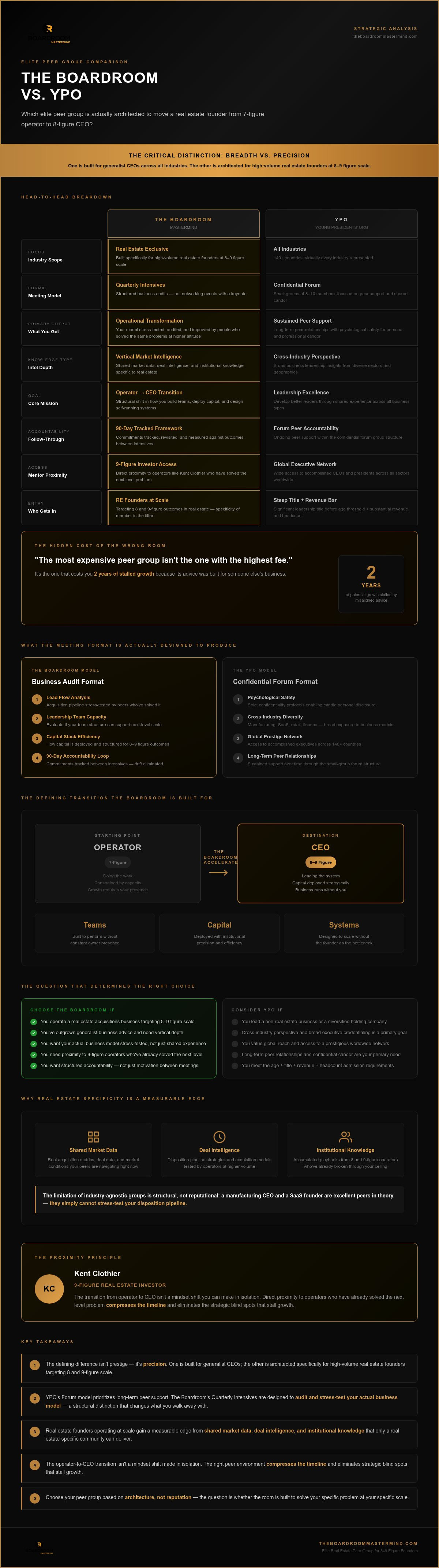
- When you compare The Boardroom to YPO, the defining difference isn't prestige — it's precision: one is built for generalist CEOs across all industries, while the other is architected specifically for high-volume real estate founders targeting 8- and 9-figure scale.
- YPO's confidential Forum model prioritizes long-term peer support and shared leadership experiences, whereas The Boardroom's Quarterly Intensives are designed to audit and stress-test your actual business model — a structural distinction that changes what you walk away with.
- Industry-agnostic peer groups offer broad perspective, but real estate founders operating at scale gain a measurable edge from shared market data, deal intelligence, and institutional knowledge that only a real estate-specific community can deliver.
- The transition from operator to CEO isn't a mindset shift you can make in isolation — the right peer environment, with proximity to 9-figure investors like Kent Clothier, compresses the timeline and eliminates the strategic blind spots that stall growth.
- This article breaks down exactly which organizational structure is built for your stage, your industry, and your next level — so you can make a decision based on architecture, not reputation.
Beyond the Network: Understanding the Elite Peer Group Landscape
Networking is a commodity. At a certain altitude of business, everyone you need to know is already accessible. The question that separates stalled operators from scaling CEOs isn't who's in the room. It's whether the room is architected to solve your specific problem.
This is the core tension when serious founders compare The Boardroom to YPO. Both organizations operate at the top of the peer group hierarchy. Both demand significant professional credentials to enter. But their structural DNA is fundamentally different, and that difference determines whether you leave each meeting with a sharper strategy or simply a more impressive contact list.
The YPO Value Proposition: Prestige and Global Proximity
YPO (Young Presidents' Organization) is the closest thing the executive world has to a universal credential. With members across 140+ countries spanning virtually every industry, it delivers something genuinely rare: a confidential peer forum with global reach. The Forum model, a small group of typically eight to ten members, operates under strict confidentiality protocols designed to create psychological safety for personal and professional candor. Admission requirements are deliberately steep, generally requiring that members have achieved a significant leadership title before a defined age threshold, alongside substantial company revenue and employee headcount. That barrier is the point. It signals that everyone in the room has cleared a meaningful threshold of achievement.
The limitation is structural, not reputational. When your most pressing challenge is scaling a high-volume real estate acquisitions model, a forum built for cross-industry breadth simply can't deliver the vertical depth you need. A manufacturing CEO and a SaaS founder are excellent peers in theory. In practice, they can't stress-test your disposition pipeline.
The Boardroom Value Proposition: Strategic Real Estate Architecture
The Boardroom Mastermind operates on an entirely different premise. It's built specifically for real estate founders targeting 8- and 9-figure scale, and its entire architecture reflects that singular focus. The curriculum centers on one defining transition: moving from operator to CEO. That's not a mindset reframe dressed up as strategy. It's a structural shift in how you build teams, deploy capital, and design systems that perform without your constant presence.
For founders who've outgrown generalist business advice, that specificity is the asset. The Boardroom Mastermind delivers Quarterly Intensives, an exclusive community of high-level real estate entrepreneurs, and strategic business auditing resources, all calibrated to the operational realities of real estate at scale. The choice between global breadth and vertical depth isn't about prestige. It's about precision.
Curriculum vs. Connection: Comparing Structural Philosophies
Structure determines outcome. When you compare The Boardroom to YPO at the architectural level, the distinction isn't about which organization has more accomplished members. It's about what the meeting format is actually designed to produce. One model is built for sustained peer support. The other is built for operational transformation. Those aren't the same thing, and confusing them is expensive.
The Business Audit: How The Boardroom Optimizes Growth
The Boardroom's Quarterly Intensives aren't networking events with a keynote attached. They're structured audits. Each session is designed to stress-test the actual mechanics of your business: lead flow, acquisition pipeline, leadership team capacity, and capital stack efficiency. The objective is surgical. You walk in with your current model, and it gets examined by people who've solved the same problems at a higher altitude. Inside a Boardroom Intensive, the format compresses months of strategic drift into days of accountable execution.
The 90-day accountability framework is where the real leverage lives. Commitments made inside the room don't evaporate when you return to your market. They're tracked, revisited, and measured against outcomes. That accountability loop is what separates a productive intensive from a well-catered conference. Building a leadership team capable of executing without your constant oversight is a recurring focus, because the transition from operator to CEO isn't a declaration. It's a structural redesign of how your business functions.
YPO Education: The Generalist Executive's Toolkit
YPO delivers genuine value at the leadership breadth level. Its global events and executive education programs expose members to world-class speakers and cross-industry thinking that sharpens general management capabilities. For a CEO navigating workforce dynamics across multiple geographies or managing macroeconomic uncertainty, that exposure is legitimate currency.
The structural limitation surfaces when your most urgent problems are specific: deal flow velocity, capital allocation across a growing acquisitions portfolio, or disposition pipeline optimization. YPO's curriculum isn't designed to answer those questions, because it's not designed for any single industry. It's designed for the generalist executive, which is a different professional with different constraints.
Founders who've outgrown general leadership advice and need precision-calibrated strategy around real estate capital management will find the gap between broad education and tactical execution increasingly difficult to bridge inside a cross-industry forum. The Boardroom Mastermind is built specifically to close that gap.
Industry-Agnostic vs. Real Estate Specificity: Where Do You Fit?
Cross-industry perspective has genuine value. Hearing how a manufacturing CEO restructured her leadership team or how a retail founder automated his supply chain can surface transferable frameworks you'd never encounter inside a single-industry silo. That's not a trivial benefit. For executives navigating broad organizational challenges, YPO's deliberate industry diversity is a feature, not a limitation.
But there's a ceiling on how far borrowed frameworks travel. When you're trying to break through the 7-figure plateau in real estate, the bottlenecks aren't generic leadership problems. They're specific, technical, and deeply vertical. The 7-Figure Ceiling isn't a mindset issue you can solve with cross-industry inspiration. It's an architectural problem that demands real estate-specific systems, capital structures, and operational intelligence to dismantle. That's where industry-agnostic peer groups hit their structural limit.
When you compare The Boardroom to YPO on this axis, the distinction becomes sharp. The Boardroom's membership shares market data, deal intelligence, and institutional knowledge that only accumulates inside a community operating in the same vertical. That's an unfair advantage in the most literal sense: information that your competitors outside the room simply don't have access to.
The Real Estate CEO Litmus Test
Ask yourself which of these challenges is currently stalling your growth:
- Deal sourcing velocity: Scaling a consistent acquisition pipeline beyond what your direct team can generate
- Capital stack complexity: Structuring real estate private equity relationships and institutional-grade financing for a growing portfolio
- Asset management at scale: Building systems that manage performance across multiple markets without your constant oversight
- Disposition pipeline optimization: Designing exit strategies that maximize return velocity without creating operational drag
A tech founder or retail CEO can engage with these problems intellectually. They can't solve them. The Boardroom's community is built around founders who've navigated exactly these inflection points, which means the room itself functions as a living database of high-stakes real estate decision-making.
When YPO Is the Correct Choice
Intellectual honesty matters here. YPO is the right environment for a real estate founder who's deliberately seeking perspective outside the industry, whether that's to explore portfolio diversification into adjacent sectors, build relationships that support a broader holding company structure, or simply benefit from the psychological reset that comes from discussing leadership challenges with people who have no stake in your market. If you're at a stage where general executive development and global connectivity are the primary objectives, YPO delivers those with unmatched reach.
The calculus shifts the moment your most urgent constraint is vertical. If the problem is specifically real estate, the solution needs to be specifically real estate. Explore The Boardroom Mastermind to understand what a precision-built peer environment looks like for founders targeting 8- and 9-figure scale.
The Boardroom Mastermind: A Strategic Asset for the Real Estate CEO
There's a category of founder who's done the hard work. They've built a real business, survived market cycles, and proven the model. What they can't solve alone is the architectural problem sitting between where they are and where they're going. That's precisely who The Boardroom was built for: the battle-tested visionary who's outgrown tactical execution and needs a peer environment calibrated to 9-figure thinking.
When you compare The Boardroom to YPO at this level, the distinction isn't about prestige or global reach. It's about what the community is actually engineered to produce. The unfair advantage of peer advisory at The Boardroom isn't inspiration. It's institutional intelligence: shared deal data, capital stack frameworks, and market-specific decision-making that compounds in value every quarter you're inside the room.
Think of The Boardroom less as a membership and more as a Business Operating System for scaling to 9 figures. The community functions as a living infrastructure layer beneath your business, one that surfaces blind spots before they become costly, pressure-tests strategic decisions before capital is deployed, and holds you accountable to the commitments that actually move the needle. View Member Spotlights to see what that trajectory looks like in practice.
The Transition from Operator to Professional CEO
The hardest shift in real estate isn't finding deals. It's building a business that doesn't require you to find every deal. The Boardroom's entire framework is oriented around this transition: from tactical manager to strategic CEO. That means designing leadership teams with genuine autonomy, building systems that generate consistent output without your daily presence, and making high-stakes capital decisions from a position of clarity rather than reactivity. Proximity to Kent Clothier and other 9-figure operators inside the community compresses that learning curve in ways no generalist peer group can replicate.
Next Steps: Applying for The Boardroom
The Boardroom rejects approximately 95% of applicants. That number isn't a marketing claim; it's a structural filter. The community's value depends entirely on the quality of the people inside it, and diluting that standard would compromise the one thing members are paying for: peers who operate at or above their level.
If you're a real estate founder targeting 8- or 9-figure scale, the first step is an honest assessment of your business maturity. Are your systems generating consistent deal flow without your direct involvement? Is your leadership team executing at a level that gives you strategic bandwidth? Those are the questions that determine readiness, not ambition.
When you compare The Boardroom to YPO, the final answer comes down to this: one organization is built for the generalist executive, and the other is built for you. Apply to Join The Boardroom Mastermind and find out whether you qualify for the room that changes the trajectory.
Make the Decision That Matches Your Ambition
When you compare The Boardroom to YPO, the architecture tells the story. YPO delivers global reach and cross-industry breadth for generalist executives. The Boardroom delivers quarterly business audits, battle-tested frameworks for institutional growth, and an exclusive network of high-volume real estate CEOs who are solving the exact problems you're facing right now.
The question isn't which organization has more prestige. It's which one is built for your next level. If your constraints are vertical, your solution needs to be vertical. A peer group that can't stress-test your acquisition pipeline or pressure-test your capital stack isn't a strategic asset; it's a social one.
The founders who reach 8- and 9-figure scale don't get there by collecting credentials. They get there by surrounding themselves with people who've already solved the problems standing between them and the next threshold.
If that's the room you're ready for, apply to join The Boardroom Mastermind and find out whether you qualify. The right environment changes everything.
Frequently Asked Questions
What are the revenue requirements for The Boardroom Mastermind vs. YPO?
YPO's admission requirements typically include substantial company revenue and a minimum employee headcount, with thresholds that vary by chapter and region. The Boardroom Mastermind doesn't publish a fixed revenue floor, but its application process is calibrated to founders actively targeting 8- and 9-figure scale in real estate. The 95% applicant rejection rate reflects a qualitative filter: business maturity, operational readiness, and strategic clarity matter more than a single revenue number.
Can I be a member of both YPO and The Boardroom?
There's no structural rule preventing dual membership, and some founders do hold both. The practical question is whether the investment of time and resources in a generalist executive forum complements or competes with the vertical depth you're building inside The Boardroom. If your growth constraints are specifically real estate, your highest-leverage hours belong in the room designed to solve that problem. Dual membership makes more sense when your objectives span both broad leadership development and industry-specific scaling.
How does The Boardroom's quarterly intensive differ from a YPO forum?
When you compare The Boardroom to YPO on format, the structural difference is significant. YPO's forum model prioritizes confidential peer support across a small, cross-industry group, meeting regularly to share personal and professional challenges. The Boardroom's Quarterly Intensives are structured business audits: your acquisition pipeline, leadership team capacity, and capital stack get pressure-tested by peers who've solved identical problems at a higher altitude. One format builds connection; the other builds operational clarity with a 90-day accountability framework attached.
Is The Boardroom specifically for real estate investors?
Yes. The Boardroom Mastermind is built exclusively for real estate founders targeting 7, 8, and 9-figure scale, with its entire curriculum oriented around the transition from operator to CEO inside that industry. It's not a generalist business mastermind that includes real estate as one of many verticals. The community's shared market intelligence, deal frameworks, and proximity to operators like Kent Clothier are only possible because every person in the room is navigating the same industry, the same capital structures, and the same scaling constraints.
What is the ROI of an elite mastermind group for an 8-figure business?
ROI at this level isn't calculated in referrals or contacts. It compounds through strategic decisions made faster, with better information, and with fewer expensive mistakes. A single blind spot eliminated before capital is deployed, or one capital stack structure surfaced by a peer who's already executed it, can generate returns that dwarf any membership cost. For real estate founders, the institutional knowledge inside a precision-built peer community, the kind that can stress-test a disposition pipeline or validate an acquisitions model, is the asset that's genuinely difficult to price.

Disclaimer
Mr. Clothier is an expert in real estate investing. As such his experiences are not necessarily typical to the standard real estate investor and whose results may vary. The successes shared on this site are not considered typical. Most individuals who order the educational materials and systems probably do not follow any of the techniques or strategies and consequently make little to no money due to their inaction. The company is in the process of determining the typical success of its clients. Stories shared herein are for example purpose only and should not be construed as "guarantees" of success. Results will vary based on background, education, and experience and actions taken.
This site is not a part of the Google/Facebook website or Google/Facebook Inc. Additionally, this site is NOT endorsed by or affiliated with Google/Facebook in any way. GOOGLE/FACEBOOK is a trademark of GOOGLE/FACEBOOK, Inc.
INCOME DISCLAIMER: This website and the items it distributes contain business strategies, marketing methods and other business advice that, regardless of referenced results and experience, may not produce the same results (or any results) for you. The Boardroom Mastermind makes absolutely no guarantee, expressed or implied, that by following the advice or content available from this web site you will make any money or improve current profits, as there are several factors and variables that come into play regarding any given business. Primarily, results will depend on the nature of the product or business model, the conditions of the marketplace, the experience of the individual, and situations and elements that are beyond your control. As with any business endeavor, you assume all risk related to investment and money based on your own discretion and at your own potential expense.
LIABILITY DISCLAIMER: By reading this website or the documents it offers, you assume all risks associated with using the advice given, with a full understanding that you, solely, are responsible for anything that may occur as a result of putting this information into action in any way, and regardless of your interpretation of the advice. You further agree that The Boardroom Mastermind, its affiliates, subsidiaries, officers and agents, cannot be held responsible in any way for the success or failure of your business as a result of the information provided. It is your responsibility to conduct your own due diligence regarding the safe and successful operation of your business. In summary, you understand that we make absolutely no guarantees regarding income as a result of applying this information, as well as the fact that you are solely responsible for the results of any action taken on your part as a result of any given information. In addition, you agree that our content is to be considered "for entertainment purposes only". Always seek the advice of a professional when making legal, financial, tax, or business decisions.
BUSINESS OPPORTUNITY: All products and services offered by The Boardroom Mastermind are intended to provide prospective purchasers with general business strategies, marketing methods and other general advice for business development and training. At no point is The Boardroom Mastermind soliciting anyone to enter into a new business nor is it representing, either expressly or by implication, that it will provide locations for a business, provide outlets, accounts, or customers, or purchase any of the goods or services made by the purchaser.
The products being offered through this promotion are packages of informational tools to help you learn about business and deal making strategies.


