
The 8-Figure Audit: Overcoming the Business Scaling Challenges That Stall Real Estate Empires in 2026
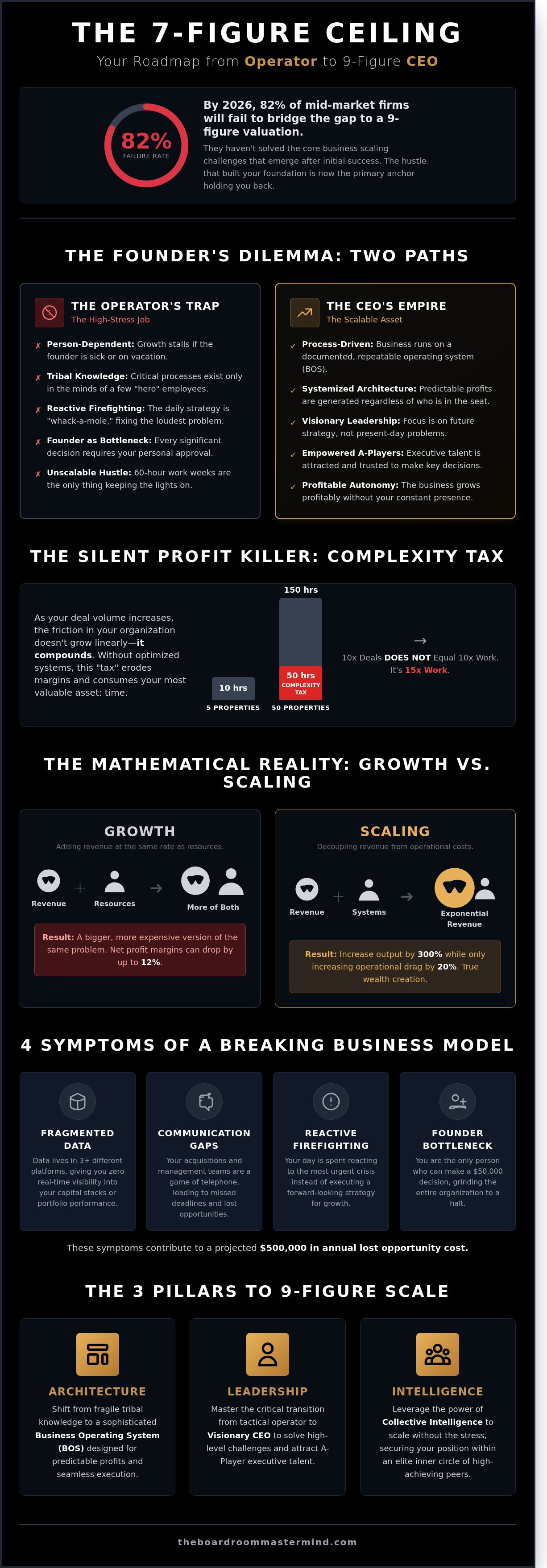
The 8-figure mark is a graveyard for real estate founders who refuse to stop being the smartest person in every room. By 2026, the complexity of the market will ensure that 82% of mid-market firms fail to bridge the gap to a 9-figure valuation because they haven't solved their core business scaling challenges. You've likely felt the friction already. As your deal volume increases, the quality of execution drops; your 60-hour work weeks have become the only thing keeping the lights on. It's a precarious position that threatens the very legacy you've worked to build.
It's exhausting to own a business that feels more like a high-paying job than a scalable asset. You know that true wealth isn't found in the daily grind; it's found in the architecture of a self-sustaining empire. This audit identifies the specific structural bottlenecks and leadership gaps that prevent you from attracting A-player executive talent. We'll show you how to transition from the daily operator to the visionary CEO. This is your roadmap to predictable 9-figure growth that runs profitably without your constant presence.
Key Takeaways
- Break the 7-figure ceiling by identifying why the high-energy hustle that built your foundation is the primary anchor dragging on your exponential growth.
- Shift from fragile tribal knowledge to a sophisticated Business Operating System (BOS) designed for predictable profits and seamless disposition.
- Master the transition from tactical operator to visionary CEO to solve the most critical business scaling challenges that stall elite real estate empires.
- Utilize a rigorous 15-point CEO checklist to audit your leadership, operations, and capital pillars during your next high-level quarterly intensive.
- Leverage the power of collective intelligence to scale without the stress, securing your position within an elite inner circle of high-achieving peers.
The 7-Figure Ceiling: Why Traditional Growth Strategies Fail at Scale
You didn't build a seven-figure real estate portfolio by playing it safe. You ground out the deals, handled the late-night calls, and personally oversaw every closing. That raw hustle was your greatest asset; now, it's your most dangerous liability. As you eye the $10M or $50M mark in 2026, the tactics that fueled your initial rise will become the very chains that bind your progress. Overcoming the specific business scaling challenges that emerge at this level requires a fundamental shift from being a high-performing operator to becoming a strategic owner.
The "Complexity Tax" is a silent profit killer. For every deal you add beyond your current capacity, the friction within your organization doesn't grow linearly; it compounds. If your team spent 10 hours managing five properties, they won't simply spend 100 hours managing fifty. Without optimized systems, the communication loops and logistical hurdles will consume 150 hours, eroding your margins and stealing your time. This is the "Operator Trap." If you're still the primary problem-solver in your business, you haven't built a legacy; you've just created a high-stress job for yourself. True elite performance demands a departure from the "do-it-all" mentality.
Growth vs. Scaling: The Mathematical Reality
Growth and scaling are often used interchangeably, but in the Boardroom, we know they're worlds apart. Growth means adding revenue at the same rate you add resources. If you double your deal flow but have to double your headcount and overhead to handle it, you've simply built a bigger, more expensive version of your existing problem. Scaling is the art of decoupling revenue from costs. It's the ability to increase your output by 300% while only increasing your operational drag by 20%. As an organization matures, the challenges of a scaleup company shift from finding deals to building the infrastructure that can digest them without breaking. Investors who ignore this distinction often face margin compression, seeing their net profit percentages drop by as much as 12% during periods of unoptimized expansion.
The Symptoms of a Breaking Business Model
A business that's outgrown its systems leaves clues. You might notice fragmented data across three different platforms, leaving you with zero real-time visibility into your capital stacks. Communication between your acquisitions team and property management becomes a game of telephone, leading to missed deadlines and a projected $500,000 in annual lost opportunity cost. You find yourself playing a daily game of "Whack-a-Mole," where your only strategy is reacting to the loudest fire. This reactive stance prevents you from solving the business scaling challenges of tomorrow. When the founder is the only person capable of making a $50,000 decision, the business hasn't just hit a ceiling; it's reached a breaking point. Scaling without the stress requires moving from a person-dependent model to a process-driven architecture.
The Infrastructure Gap: Architecting Your Business Operating System
Most real estate firms hit a glass ceiling because they rely on tribal knowledge. If your growth depends on the founder's intuition or a handful of "hero" employees, you don't own a business; you own a high-paying, high-stress job. Transitioning to documented, repeatable processes is the only way to survive the 2026 market shift. A Business Operating System is the central nervous system of a 9-figure empire. It replaces individual heroics with a repeatable architecture that ensures predictable profits regardless of who is sitting in the seat.
Scaling requires moving beyond basic spreadsheets and fragmented communication. Many firms fail because they ignore overlooked scalability aspects like real-time data integration and automated reporting. By 2026, the elite 2% will leverage integrated 8-figure platforms that provide a single source of truth for every asset in the portfolio. Most firms fail the 8-figure transition because they treat business scaling challenges as temporary fires to be extinguished rather than structural flaws to be re-engineered. An annual business audit serves as your structural stress test, identifying where your foundation will fracture before you add another $20 million in assets under management.
Systemizing Deal Flow and Capital Management
You can't scale an empire on a diet of "who you know." A true deal machine functions independently of the founder's personal network. It relies on a rigorous process where leading indicators, such as outbound call volume or specific direct-to-seller touchpoints, predict revenue 6 months into the future. If you cannot forecast your 2026 Q4 acquisitions today, your deal flow is a liability. By identifying these business scaling challenges during a mandatory annual audit, you prevent the structural collapse that often follows rapid growth. This level of predictability allows for aggressive capital deployment without the standard anxiety of the "feast or famine" cycle.
Standardizing Excellence Across the Portfolio
Excellence must be a default setting, not a lucky outcome. You must create playbooks for every core function, from due diligence to investor relations. This allows you to maintain quality control without personally inspecting every asset. Automation handles the low-value administrative friction that consumes 40% of an operator's time. This shift from operator to owner is the core focus of those within our elite inner circle. By standardizing these functions, you ensure that every asset performs to the same high-stakes standard regardless of your physical location. It's about building a legacy that thrives on your vision, not your presence.
The Leadership Bottleneck: Transitioning from Founder to CEO
You didn't build a real estate empire to become its most expensive employee. Yet, the primary obstacle in the 2026 market isn't capital or lead flow; it's the founder's grip on the steering wheel. When you're involved in every tactical pivot, you create a ceiling that no amount of marketing can shatter. This is one of the most persistent business scaling challenges facing firms today. Elite A-Players don't join companies to take orders from a "Hustler" who can't trust their expertise. They follow Visionary CEOs who provide the objective and get out of the way. To scale past the $10M mark, you must move from the center of the wheel to the top of the pyramid.
Audit your calendar over the last 30 days. If 70% of your time is spent on "how" instead of "who," you're the bottleneck. A 2024 analysis of 500 high-growth firms showed that founders who transitioned to a pure CEO role within 18 months of hitting $5M saw a 42% higher valuation than those who remained in the weeds. You aren't being paid to solve problems; you're being paid to build a machine that solves problems without you. If you can't walk away for 90 days without the revenue dipping, you don't own a business. You own a high-stress job with a lot of overhead.
Hiring for the Future, Not the Present
Most real estate owners hire "helpers" to offload tasks they hate. This is a fatal error in 2026. You need leaders who own outcomes, not assistants who follow checklists. Your current team might've been perfect for the $1M grind, but they often lack the mental architecture for a $100M legacy. Data from top-tier recruiters suggests that 68% of early-stage hires are replaced by the time a company hits $50M. Structure your executive compensation to align with 8-figure goals by using performance-based equity or long-term incentive plans. This ensures your leadership team is focused on the exit, not just the next paycheck.
Mastering the Art of Strategic Delegation
Stop asking "how do I do this?" and start asking "who is the best person to lead this?" True delegation isn't abdication; it's the transfer of authority. You're building a high-performance culture where accountability is the baseline. This requires a profound The Operator to CEO Mindset Shift in Real Estate. When you stop being the smartest person in the room, your business finally has room to grow. This shift is essential to solving the business scaling challenges that keep most founders stuck in the mid-seven figures. High-level execution requires a team that thrives on ownership, not a staff that waits for permission.
- Identify the Bottleneck: Pinpoint the three decisions that always require your approval.
- Empower the Lead: Assign a specific executive to own those three decisions entirely.
- Measure the Result: Use a scorecard with 3-5 key metrics to track their performance weekly.
The CEO Scaling Checklist: 15 Challenges to Audit in 2026
Scaling to an 8-figure legacy requires a shift from tactical execution to strategic auditing. You cannot solve 2026 business scaling challenges with a 2020 mindset. This checklist serves as your quarterly intensive tool to identify the hidden friction points that drain your momentum; it forces you to stop working in the business and start architecting the machine that runs it.
Operational & Systems Audit
Efficiency is the only way to protect your margins as you grow. If your operations rely on tribal knowledge rather than documented protocols, you don't own a business; you own a high-paying job. Audit these three areas immediately:
- Documented BOS: Do you have a Business Operating System so robust that an outside CEO could step in today and maintain 100% operational continuity?
- Channel Diversification: Are your lead generation channels diversified? Relying on a single platform for more than 30% of your revenue creates a catastrophic point of failure.
- Data Centralization: Is your data fragmented across five different platforms, or is it centralized in a single source of truth for real-time decision-making?
Leadership & Talent Audit
Your growth is capped by the caliber of your leadership team. To move toward a 9-figure exit, you must transition from a "genius with a thousand helpers" to a true visionary. Use these benchmarks to measure your progress:
- The 30-Day Litmus Test: Can the business run for 30 consecutive days without a single phone call or Slack message to the founder? If not, you have a bottleneck, not a business.
- KPI Authority: Does every department head have clear, measurable KPIs and the absolute authority to execute without seeking your permission?
- A-Player Culture: Are you settling for "B-players" because they are comfortable, or are you building an unbreakable A-player leadership team that challenges your perspective?
Capital & Strategy Audit
Wealth is built through compounding, not just high-volume transactions. Sophisticated business scaling challenges often stem from a lack of financial foresight. Audit your capital stack to ensure it supports 20% year-over-year growth:
- Capital Structure: Is your capital stack structured for 9-figure scale, or are you still relying on 7-figure survival tactics like high-interest short-term debt?
- Wealth Architecture: Are you focused on "hustle" income that stops when you do, or are you building long-term compounding wealth through equity and assets?
- Strategic Alignment: Do you have a clear 3-year vision that 100% of your team can recite and execute against?
The elite 1% of real estate entrepreneurs don't guess; they audit. If your current trajectory doesn't lead to a legacy, it's time to change the plan. Secure your seat in the Boardroom and master the architecture of 8-figure scale.
Scaling Without the Stress: The Power of Collective Intelligence
Isolation is the primary inhibitor of the 8-figure founder. While entry-level operators focus on raw hustle, elite CEOs understand that solving business scaling challenges in a vacuum is a recipe for burnout. The complexity of the 2026 real estate market requires a shift from individual effort to collective intelligence. You've reached a ceiling where your own perspective is no longer enough to identify the invisible bottlenecks stalling your empire's growth. Overcoming business scaling challenges at this level becomes a matter of logic and proximity, not just luck.
The transition from business owner to legacy architect isn't about working more hours; it's about strategic leverage. When you surround yourself with peers who have already bypassed your current revenue plateau, your learning curve collapses. You don't just gain information; you gain the "Unfair Advantage" of foresight. This isn't theory. It's the difference between guessing your next move and executing a proven playbook with surgical precision. Efficiency is the currency of the elite, and isolation is an expense you can no longer afford.
The ROI of Peer Proximity
A single strategic insight from a 9-figure peer can save you 12 months of expensive trial and error. In the high-stakes environment of elite real estate, one optimized system can eliminate $500,000 in annual operational waste. This is the power of the Inner Circle. Radical accountability ensures you stay on a 9-figure trajectory, forcing you to confront the inefficiencies you've grown accustomed to tolerating. The "quiet professionals" who dominate their markets don't do it by shouting; they do it by sharing intelligence with a curated group of high-performers.
- Compressed Timeframes: Solve in one hour what usually takes a fiscal quarter of internal meetings.
- Shared Intelligence: Access the proprietary data and systems of founders who are 2-3 steps ahead of your current position.
- Risk Mitigation: Identify the 20% of structural risks that could cause 80% of your future scaling friction before they manifest in your P&L.
Your Invitation to the Boardroom
The Boardroom Mastermind isn't a coaching program for the masses. It's a strategic asset designed for the 2% who have already built 7 and 8-figure operations. Every quarter, we conduct a radical audit of your business model to strip away the fluff and focus on the levers that drive compounding wealth. Our members operate at the 7, 8, and 9-figure levels, creating a density of talent that is unrivaled in the industry. If you're ready to stop being the smartest person in the room, it's time to change the room.
The path to your next milestone is already paved. You just need the right access to see it. Apply for the Boardroom Mastermind and Scale Your Empire today and secure your seat at the table where legacies are built.
Architect Your Nine-Figure Legacy
The real estate landscape of 2026 has no patience for fragmented systems or founder bottlenecks. To move beyond the seven-figure ceiling, you must implement a rigorous Business Operating System and transition into a true CEO role. These business scaling challenges represent the final filter between a high-income job and a self-sustaining empire. Success at this level isn't about working more hours; it's about leveraging the right architecture and elite proximity. You can't solve eight-figure problems with a six-figure network.
The Boardroom Mastermind provides the precise leverage you need to scale without the stress. Members gain direct access to a collective managing over $1B in assets and participate in quarterly in-person business audits led by Kent Clothier. You'll deploy exclusive BOS frameworks designed specifically for 8 and 9-figure growth. If you want to own an empire rather than a job, then you must audit your infrastructure today. Stop guessing at your next move and start executing with the confidence of the world's top investors.
Secure Your Seat in the Inner Circle: Apply for The Boardroom Mastermind
The path to your legacy is clear for those with the right access.
Frequently Asked Questions
What are the most common business scaling challenges in real estate for 2026?
The primary business scaling challenges for 2026 involve a 22% increase in cost-per-acquisition and the persistence of interest rates above 5.5%. You can't rely on the cheap capital of 2021 anymore. Success requires a 40% improvement in operational efficiency to maintain margins as market volatility increases. Scaling in this environment demands a shift from aggressive acquisition to disciplined, systems-based expansion.
How do I know if I am the bottleneck in my real estate company?
You're the bottleneck if your team waits more than 4 hours for a decision or if 90% of your daily tasks involve transaction-level approvals. When your physical presence is the only way a deal closes, you've built a job instead of a legacy. If your revenue plateaus for 3 consecutive quarters despite increased marketing spend, your personal involvement is the ceiling.
What is the difference between growing a business and scaling a business?
Growing means your expenses increase at the same rate as your revenue, while scaling means your revenue grows exponentially while your costs remain flat. A healthy 8-figure scale-up aims for a 300% revenue increase with less than a 20% increase in headcount. It's about building a machine that produces more output with significantly less human intervention and manual effort.
How many A-players do I need to reach an 8-figure revenue mark?
Reaching a $10 million annual revenue mark typically requires 5 core A-players who own their respective departments. You need a Chief Operating Officer, a Head of Sales, a Marketing Director, and a Lead Underwriter who all operate with 100% autonomy. Hiring 20 B-players will only increase your stress; focus on these 5 elite leaders to drive your expansion and maintain high-level execution.
Can a real estate business really scale without the founder being involved in every deal?
Scaling an empire requires the founder to remove themselves from 100% of the daily deal flow to focus on high-level vision and capital relationships. If you're still signing off on every $50,000 flip, you'll never manage a $100 million portfolio. Transitioning to a true owner means your systems handle the execution while you manage the strategy and the board.
What is a Business Operating System (BOS) and why do I need one?
A Business Operating System is a documented framework that synchronizes your team, strategy, and execution into one repeatable process. Companies using a structured BOS see a 45% increase in profit margins within 12 months because they eliminate tribal knowledge. It's the instruction manual for your company that ensures the business runs whether you're in the office or on a month-long sabbatical.
How does a mastermind group help solve scaling challenges faster than coaching?
A mastermind group provides access to the collective intelligence of 30 peers who have already solved the business scaling challenges you're currently facing. While coaching is a linear relationship, the Inner Circle offers a multi-dimensional perspective that can shorten your growth curve by 2 to 3 years. You don't just get advice; you get the exact blueprints and vendor lists used by 9-figure operators.
What is the "7-figure ceiling" and why do so many investors hit it?
The 7-figure ceiling occurs when the brute force of the founder's personality can no longer manage the complexity of the business. Statistics show that 96% of real estate investors never cross the $1 million revenue mark because they refuse to invest in systems. To break through, you must trade your daily hustle for a scalable architecture that functions independently of your individual effort.


