
The $1,000,000 Mistake: Calculating the True Cost of a Bad Hire in Real Estate
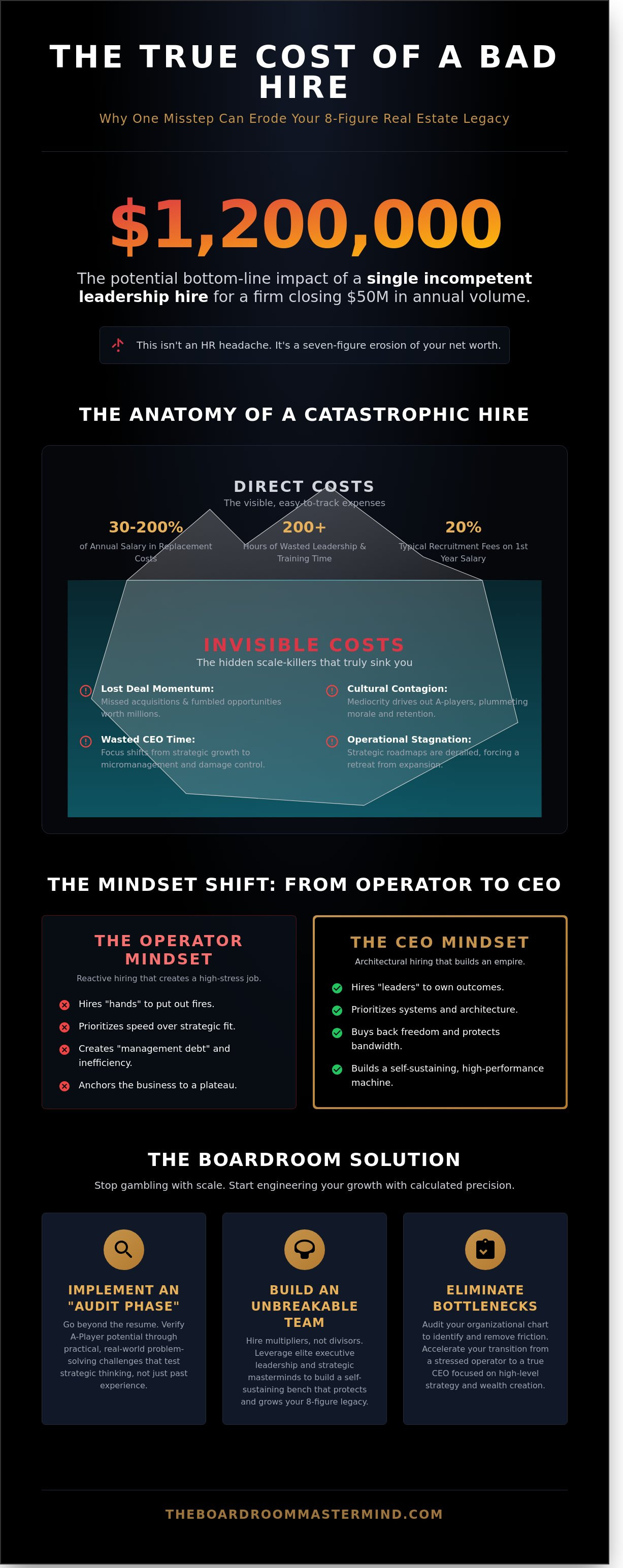
A single executive misstep in your real estate firm isn't just an HR headache; it's a seven-figure erosion of your net worth. While most operators look at salary alone, the true cost of a bad hire includes lost deal momentum, diluted culture, and the 200 hours of wasted training time that you'll never get back. For a firm closing $50 million in annual volume, a single incompetent hire in a leadership role can result in a $1.2 million hit to the bottom line when you factor in missed acquisitions and operational friction.
You know that your time is the most valuable asset in the Boardroom, yet you're likely still stuck correcting mistakes made by people who simply don't get it. This article provides the high-level framework you need to quantify these hidden risks and implement a rigorous selection process for A-players. We'll examine the strategies required to protect your 8-figure legacy and complete your transition from a stressed operator to a true CEO. It's time to stop gambling with your scale and start engineering your growth with calculated precision.
Key Takeaways
- Identify why recruitment errors are strategic scale-killers that drain your most finite resource—the CEO’s time.
- Quantify the true cost of a bad hire by exposing the invisible tolls of lost deal flow and organizational stagnation.
- Implement a high-level "Audit Phase" to verify A-player potential through practical problem-solving rather than surface-level resumes.
- Audit your current organizational chart to eliminate operational bottlenecks and accelerate your transition from operator to owner.
- Leverage elite executive leadership training to build a self-sustaining bench that protects your 8-figure legacy.
The Scale-Killer: Why a Bad Hire is More Than a Sunk Salary
Real estate growth is a game of momentum. A bad hire isn't just a line item on your P&L; it's a strategic misalignment that acts as a catastrophic brake on your entire operation. For the elite entrepreneur, the cost of a bad hire at the seven or eight-figure level is rarely about the lost salary. It's about the friction introduced into a high-performance machine. When you install a tactical operator instead of a strategic leader, you aren't just losing money. You're anchoring your business to a plateau that prevents nine-figure scalability.
Your time is the most expensive currency in your business. It's the fuel for your legacy. A 2023 survey by CareerBuilder found that 74% of companies have made a poor hiring decision, but for real estate CEOs, the fallout is far more lethal than a simple HR statistic. Every hour you spend correcting errors or mediating personality conflicts is an hour stolen from high-level deal flow and wealth architecture. The true opportunity cost of a bad hire is the $2,000,000 in acquisition volume you failed to capture because you were too busy micromanaging a "C-player."
This creates the 7-figure ceiling. It's a structural barrier built by entrepreneurs who hire "hands" to execute tasks rather than "leaders" to own outcomes. At the boardroom level, hiring is never about adding headcount. It's about buying back your freedom and protecting your bandwidth.
The Distinction Between Hiring Help and Building a Team
The hustler mindset prioritizes speed, often hiring anyone with a pulse to put out immediate fires. This reactive approach is the fastest way to stall. In contrast, the CEO mindset prioritizes architecture and systems. A bad hire creates management debt, which is a compounding interest of inefficiency that drains your culture and your bank account. If your team requires constant oversight to function, you haven't built a business; you've just bought yourself a high-stress job.
True scale requires an inner circle that operates with an unfair advantage. Every member of your team should be a multiplier, not a divisor. When you stop hiring for help and start building a team of leaders, you move from the frantic energy of the operator to the calm, calculated confidence of the owner. This transition is the only way to achieve peak performance without sacrificing personal freedom.
Quantifying the Damage: Direct Expenses vs. The Opportunity Cost of Stagnation
A bad hire is never just a payroll error; it's a massive drain on your working capital. Direct costs start with recruitment fees that typically hit 20% of the first year's salary, followed by the heavy lift of onboarding and training. Industry data suggests that calculating the true cost of replacement reveals a price tag between 30% and 200% of an annual salary. For a $150,000 Director of Operations, you're looking at a $300,000 loss before they've even cleared their desk. Elite operators understand that elite teams are built through proximity to other high-achievers in a strategic mastermind environment.
The "Invisible Costs" often outweigh the line items on your P&L. You lose deal flow when an acquisitions manager fumbles a 48-hour response window on a distressed asset. You lose institutional trust when a property manager alienates your most reliable vendors. One bad executive can derail a 12-month strategic roadmap, forcing you to spend the next two quarters in retreat rather than expansion. Opportunity cost is the revenue lost because your focus was diverted to fixing mistakes instead of hunting new deals.
The Cultural Contagion: How One Bad Hire Devalues Your A-Players
Top performers don't tolerate mediocrity for long. When an elite team must pick up the slack for a weak link, you pay a "morale tax" that often leads to your best talent exiting for greener pastures. Maintaining a high-performance culture requires ruthless protection of your standards. If your A-players feel their excellence is subsidizing someone else's incompetence, your retention rates for top talent will plummet by 25% or more within six months.
Real Estate Specific Risks: Errors in Underwriting and Acquisition
In real estate, the cost of a bad hire is amplified by the scale of the assets under management. A single underwriting error in a multi-family acquisition can overvalue a property by millions, wiping out five years of projected profit in one signature. If your finance lead lacks the discipline for rigorous stress-testing, you aren't just hiring a person; you're inviting a systemic risk into your portfolio. Precision is the only currency that matters at this level, and a lack of it can be catastrophic.
The CEO’s Litmus Test: Identifying A-Player Potential Before the Contract is Signed
Stop scanning resumes for years of experience. Resumes are lagging indicators of past performance, often polished to hide mediocrity. To scale toward a nine-figure legacy, your recruitment must shift from "resume-checking" to "value-alignment" and "problem-solving" assessments. If you hire to fix today's mess, you remain an operator. If you hire for the $50 million company you intend to build by 2026, you become a true owner.
The most effective vetting tool is the 72-hour Audit Phase. Do not take their word for it. Hand them a real-world data set or a broken operational process and demand a strategic solution within three days. A-players don't ask for a handbook; they provide the roadmap. This aggressive vetting is the only way to mitigate the cost of a bad hire before they ever touch your cap table or your culture.
Red Flags That Elite Real Estate CEOs Often Miss
The "Culture Fit" trap is a silent killer of high-growth firms. Most CEOs hire people they enjoy getting a drink with, rather than people who challenge their assumptions. You don't need a mirror; you need a multiplier. Watch for a lack of ownership. If a candidate speaks in terms of "tasks completed" rather than "results delivered," they are an operator, not a visionary. An A-player obsesses over ROI from day one. If they don't ask about your exit strategy or your 10-year scaling plan, they aren't built for the Boardroom.
Leveraging Your Inner Circle for Better Talent
Your hiring pool is a direct reflection of your proximity. Elite talent doesn't scroll through generic job boards. They circulate within exclusive mastermind groups where performance is the only currency. When you sit at a table with 8-figure earners, you gain access to a pre-vetted pipeline of talent that has already been battle-tested in high-stakes environments. This collective intelligence acts as a natural filter, ensuring you only encounter candidates who understand the weight of a legacy-level business. Proximity eliminates the cost of a bad hire by replacing guesswork with proven referrals.
Ready to upgrade your inner circle and stop settling for mediocre talent? Apply for The Boardroom Mastermind experience today.
Building an Unbreakable Leadership Team: How to Graduate from Operator to CEO
Scaling a real estate empire requires more than just capital; it demands a fundamental shift in your identity. You can't reach the nine-figure mark while still acting as the primary problem solver. To graduate from operator to CEO, you must first audit your current organizational chart to identify bottleneck roles where growth has stalled. If every decision requires your approval, you aren't leading; you're micromanaging. This friction point is where the cost of a bad hire becomes most visible, as an incompetent manager can freeze your entire operation for months.
Your evolution continues by following these four strategic pillars:
- Audit the Org Chart: Map out every function. If your name appears in more than two boxes, you're a single point of failure.
- Develop the Bench: Invest in executive leadership training to transform high-potential employees into autonomous decision-makers.
- Systematize Everything: Implement a Business Operating System that ensures the company functions at 100% capacity even if you're offline for 30 days.
- Leverage Elite Peers: Surround yourself with visionaries who've already scaled to 9-figures. Their past mistakes are your future shortcuts.
Scaling Without the Stress: The Boardroom Methodology
High-stakes growth shouldn't come at the expense of your sanity. The Boardroom Mastermind serves as a strategic asset that provides the collective intelligence necessary to navigate complex hiring cycles. Data shows that 92% of elite entrepreneurs struggle with delegation before joining a high-level inner circle. By tapping into this network, you gain an unfair advantage that prevents the cost of a bad hire from eroding your profit margins. It's about moving from frantic energy to calculated, strategic execution.
Your Next Level Requires a Different Version of Your Team
The team that got you to $1 million is rarely the team that will get you to $100 million. It's a hard truth, but legacy requires evolution. You must audit your roster today to ensure it's built for the 2030 vision you've set. Don't wait for a crisis to realize your bench is weak. View these case studies to see how elite CEOs have successfully restructured their leadership to achieve total freedom and unrivaled scale.
Stop Paying the Seven-Figure Tax on Mediocrity
You've seen the math. The true cost of a bad hire isn't a simple line item on a P&L; it's a structural failure that can cost a real estate firm up to 15 times the individual's annual salary according to Topgrading research. If you're managing a 7 or 8-figure portfolio, one wrong move in the C-suite doesn't just burn cash. It stalls your exit strategy and anchors you to the daily grind. Transitioning from a high-level operator to a true CEO requires more than better interviewing. It demands a systematic audit of your leadership team and a shift toward a culture of A-players who treat your capital like their own.
The path to a 9-figure legacy is paved with collective intelligence, not isolated effort. You don't have to navigate these high-stakes decisions in a vacuum. At The Boardroom Mastermind, we provide the frameworks to optimize your leadership team and the peer network to validate your strategy. You'll gain direct access to an elite circle of 7, 8, and 9-figure investors who have already solved the bottlenecks you're facing today. Stop gambling on potential and start engineering your scale. Quarterly intensives and proven frameworks ensure you finally move from the center of the business to the head of the table.
Apply to Join the Boardroom Inner Circle
Your next level of freedom and impact is well within reach when you surround yourself with the right architects.
Frequently Asked Questions
What is the most accurate formula to calculate the cost of a bad hire?
The most accurate formula calculates the cost of a bad hire as 15 times the individual’s annual salary for executive roles. This calculation accounts for recruitment fees, onboarding time, and the opportunity cost of lost revenue. If you hire a $150,000 COO who fails, your firm faces a $2.25 million deficit. You must factor in the 25 percent decrease in team output that typically follows a leadership vacuum.
How does a bad hire impact the productivity of an existing real estate team?
A bad hire reduces the productivity of a high-performing real estate team by 40 percent according to research from Northwestern University. High achievers spend 20 percent of their week correcting the errors of a sub-par peer. This friction stalls your scaling efforts and creates a bottleneck in your lead conversion pipeline. When your elite performers are busy managing mediocrity, they aren't generating the 10x returns your legacy requires.
Can a bad hire be rehabilitated or is immediate termination always the answer?
Immediate termination is the strategic choice because 80 percent of bad hires fail to meet performance standards even after intensive retraining. If a hire doesn't align with your core values within the first 90 days, rehabilitation is a sunk cost fallacy. You're running a high-stakes business, not a social experiment. Every day a low performer remains on your payroll, they consume the capital you need for market domination.
What are the specific red flags for a bad executive-level hire in real estate?
The primary red flag for an executive hire is an inability to articulate a specific 90 day execution plan backed by historical data. If a candidate cannot cite three distinct instances where they increased EBITDA by at least 15 percent, they lack the strategic depth for your boardroom. Watch for leaders who prioritize personal ego over organizational leverage. Elite operators focus on systems; amateurs focus on activity.
How can joining a mastermind group help me avoid hiring mistakes?
Joining a mastermind group provides access to a collective intelligence that vets candidates through the lens of proven 8 figure experience. You leverage the Inner Circle to identify high level talent before they hit the open market. This strategic advantage helps you avoid the cost of a bad hire by using peer tested hiring frameworks. When you operate within a group of elite peers, you stop guessing and start executing with precision.


