
Scaling a Real Estate Portfolio: From High-Volume Investor to Institutional CEO
What if the very skills that got you to seven figures are the exact same ones preventing you from reaching nine? You've mastered the hustle, but you're still the primary engine of your business, acting as a high-paid operator rather than a true institutional CEO. Scaling a real estate portfolio in April 2026 isn't just about finding deals in a market with 6.46% average interest rates. It's about architecting a systems-driven machine that functions without your constant intervention. If your presence is required for every closing, you don't own a business; you own a demanding job.
We know the exhaustion of being the smartest person in the room while your growth plateaus. This article provides the strategic frameworks and leadership shifts required to break the 7-figure ceiling and build a 9-figure empire. You'll learn how to leverage the restored 100% bonus depreciation and the $15 million estate tax exemption to secure your family's future. We're moving past the frantic energy of the entry-level investor and into the calculated confidence of the Inner Circle. It's time to transition from operator to owner, access institutional-grade capital, and build a self-sustaining legacy that thrives for generations.
Key Takeaways
- Identify the structural bottlenecks of the 7-figure ceiling and replace individual hustle with a robust Business Operating System.
- Transition from basic financing to institutional-grade capital stacks to remove the funding friction that stalls high-volume growth.
- Build a self-sustaining machine by installing a C-suite leadership team, shifting your role from the primary operator to a visionary CEO.
- Gain an unrivaled strategic edge by utilizing elite peer proximity to audit your roadmap for scaling a real estate portfolio toward a nine-figure legacy.
The 7-Figure Ceiling: Why Systems, Not Deals, Limit Your Scale
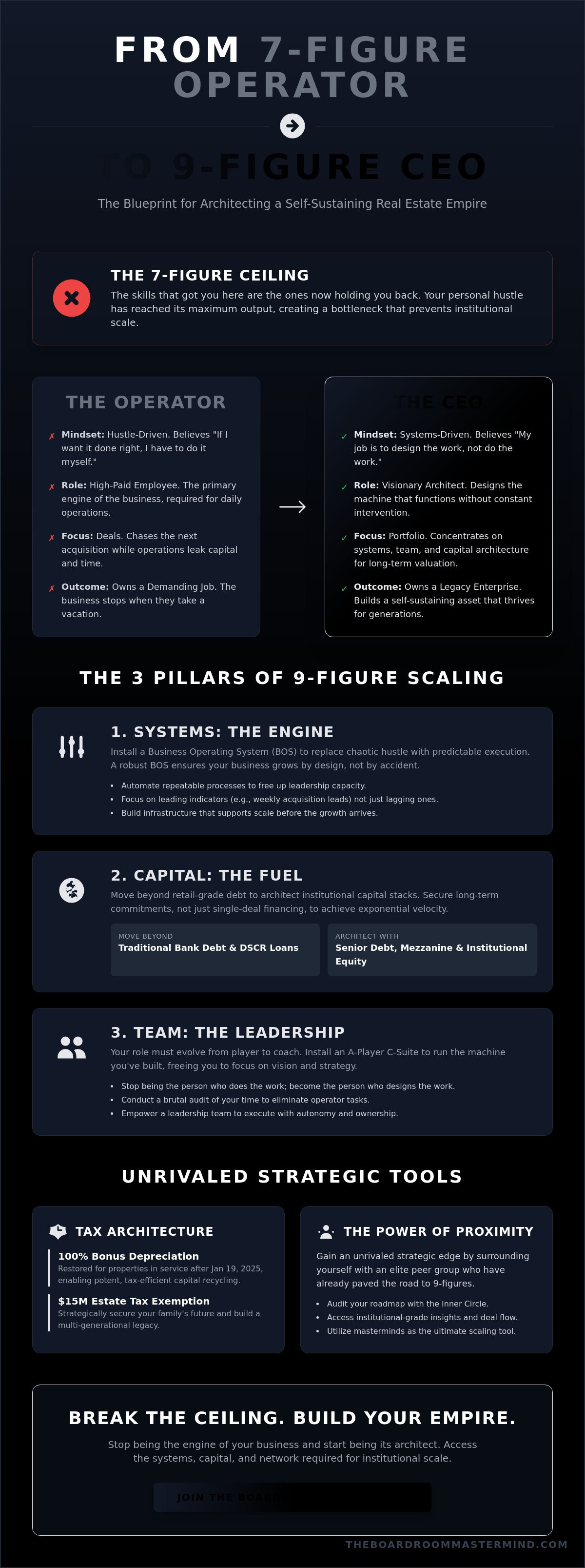
You've reached the limit of what manual effort can sustain. This is the 7-figure ceiling. It's the point where your personal output, your 14-hour days, and your direct involvement in every negotiation can no longer move the needle. Scaling a real estate portfolio beyond this point isn't a matter of finding better deals; it's a matter of building a better machine. Most investors are trapped in deal-focused thinking, chasing the next acquisition while their current operations leak capital and time. If you don't have a system to manage the growth, the growth will eventually manage you.
If you're still the one answering every crisis call, your systems are actually designed to keep you small. They rely on your individual genius rather than a repeatable process. The "Quiet Professional" understands that true dominance comes from infrastructure. While the amateur hustler brags about their busyness, the elite CEO focuses on the real estate investing fundamentals that drive long-term valuation: systems, team, and capital architecture. This shift toward a portfolio-focused strategy is the only way to ensure scaling a real estate portfolio doesn't lead to personal burnout.
The Operator to CEO Mindset Shift
If your business stops when you take a vacation, you're an operator, not a CEO. You are the primary bottleneck. Transitioning to a Founder vs CEO Mindset requires a brutal audit of your time. You must stop being the person who does the work and start being the person who designs the work. This evolution from "hustler" to strategic Architect of wealth is the difference between owning a high-paid job and owning a legacy-level enterprise.
Implementing a Business Operating System (BOS)
A Business Operating System is the engine that executes your vision predictably. It transforms daily chaos into a self-sustaining machine. By focusing on leading indicators, like weekly acquisition leads, rather than just lagging indicators like quarterly profit, you gain a dashboard for 8-figure execution. Implementing the Architecture of 8-Figure Scaling ensures that your business grows by design, not by accident. This is the only path to scaling a real estate portfolio without increasing your personal workload.
Advanced Capital Stacks: Moving Beyond Basic Financing
Are you financing properties, or are you architecting a capital machine? If you rely solely on traditional bank debt or DSCR loans, you've already capped your velocity. As of April 2026, investment property rates hover near 7.491%, and while these tools work for the high-volume investor, they're insufficient for the institutional CEO. Relying on retail-grade debt creates a linear growth curve. If you want exponential results, you must move toward a structured capital stack that includes senior debt, mezzanine financing, and institutional equity. Real Estate Private Equity is the vehicle for institutional-grade portfolio expansion.
The transition to 9 figures requires a shift in how you view "other people's money." It's no longer about finding a partner for a single deal; it's about securing a commitment for a decade. This is the institutional mindset. It values certainty of execution and cost of capital over the simplicity of a local bank loan. If your capital is stagnant, your legacy is at risk. You can explore how elite investors audit their financial structures by reviewing our portfolio case studies to see this architecture in action.
Transitioning to Fund Management
Moving from individual syndications to a discretionary fund model is the ultimate power move. It eliminates the "deal-by-deal" anxiety and gives you the "unfair advantage" of closing with cash-like speed. To attract family offices and institutional-grade partners, you must present more than just a deal; you must present a sophisticated investment thesis. By following The Architect’s Guide to Institutional Scale, you position yourself as a peer to the world's most sophisticated capital allocators.
Leveraging Equity and Appreciation for Velocity
Velocity is the heartbeat of scaling a real estate portfolio. With the restoration of 100% bonus depreciation for properties placed in service after January 19, 2025, the tax-efficient recycling of capital has never been more potent. You aren't just waiting for appreciation; you're manufacturing equity through optimization and then compounding that intelligence across national markets. This is how you achieve unrivaled growth without the friction of traditional tax liabilities. If you're ready to audit your current capital stack, consider joining an elite boardroom environment to refine your strategy.
Building an A-Player Leadership Team for 8-Figure Execution
Your scale is directly proportional to the talent density of your leadership team. If you're still managing the day-to-day, you've reached your maximum capacity. Scaling a real estate portfolio requires moving beyond a team of assistants and into a structure of high-level executives. You need a COO to refine the machine, a CFO to optimize the capital stack, and a Head of Acquisitions to navigate a market currently defined by a tight 3.9-month supply of inventory. These aren't just employees; they're the architects of your legacy.
The true cost of a bad executive hire is catastrophic. It's not just the lost salary; it's the 18 months of stalled growth and the erosion of your culture. A-Player Talent consists of individuals who solve problems before they reach the CEO. If you're still the primary problem-solver, you haven't hired A-players yet. You must audit your team with the same rigor you use to audit a $50 million multifamily deal. Precision in hiring is the only way to maintain a self-sustaining business machine.
The CEO Blueprint for Executive Delegation
Delegation isn't abdication. It's the strategic offloading of high-value tasks while maintaining absolute control of the vision. By implementing the CEO’s Blueprint for 8-Figure Scale, you ensure that your leadership team is empowered to execute without your constant oversight. This framework allows you to focus on high-level capital relationships and long-term strategy while the machine runs predictably in the background.
Engineering a High-Performance Culture
Culture is the invisible infrastructure that holds your empire together. You must align executive compensation models with long-term portfolio growth goals to ensure your interests and theirs are perfectly synchronized. This creates a sense of collective intelligence where every leader is incentivized to find the "unfair advantage" in every deal. When your team operates with this level of accountability, scaling a real estate portfolio becomes a logical certainty rather than a constant struggle. If you’re ready to build this caliber of team, you should apply for a seat in the Boardroom to audit your leadership strategy with peers who have already scaled to nine figures.
The Power of Proximity: Why Elite Masterminds Are the Ultimate Scaling Tool
If you are the smartest person in your local real estate group, you have already hit your ceiling. True dominance in this industry isn't achieved in isolation; it's forged in the Boardroom. This is an elite space where high-level decisions are audited by peers who operate at your level or higher. While others seek casual advice on forums, the institutional CEO utilizes collective intelligence to prevent expensive mistakes in capital structuring and market pivots. In a 2026 market defined by a tight 3.9-month housing supply, having an inner circle to stress-test your acquisition strategy is a critical strategic asset, not an educational expense.
Surrounding yourself with CEOs who have already achieved 9-figure legacies provides an unrivaled unfair advantage. You gain access to the mental models and systems architecture that took them decades to refine. Scaling a real estate portfolio becomes a predictable process when your roadmap is vetted by those who have already navigated the terrain. This environment moves you away from the frantic energy of the operator and into the grounded, calculated confidence of the owner.
Calculating the ROI of Elite Peer Networks
Stop thinking about networking and start thinking about strategic alliances. These connections provide the "unfair advantage" of access to off-market deals and private capital that never hits the retail market. By leveraging the Benefits of a Peer Advisory Group, you gain a collective intelligence that acts as a force multiplier for your growth. It's the difference between guessing your next move and executing with the weight of a seasoned board of directors behind you.
The Boardroom Mastermind: Engineering Your Ascent
The Boardroom Mastermind is designed for the quiet professional who values high-level execution over mere hustle. Through our Quarterly In-Person Intensives, we conduct a brutal audit of your business machine to ensure you are transitioning from "Scaling with Stress" to "Scaling with Systems." We don't just talk about growth; we engineer the ascent to a nine-figure legacy. If you're ready to leave the masses behind and join the elite, it's time to apply for the Boardroom Mastermind and secure your seat at the table.
Architecting Your Nine-Figure Legacy
The transition from a high-volume investor to an institutional CEO is a complete architectural overhaul of your business and your mindset. By replacing personal hustle with a Business Operating System and adopting sophisticated capital stacks, you remove the friction that keeps most investors stuck at seven figures. You've seen how A-player leadership and elite proximity serve as the ultimate force multipliers for your wealth. Scaling a real estate portfolio into a nine-figure empire is a logical certainty for those with the right access.
You don't have to navigate this complexity alone. The Boardroom Mastermind provides the proven frameworks for scaling without the stress. Through our quarterly in-person business intensives, you'll gain direct access to a network of 8 and 9-figure real estate CEOs who have already mastered the ascent. If you're ready to secure your legacy and join the elite inner circle, the next step is yours to take.
Apply to join the elite inner circle at The Boardroom Mastermind and start engineering your transition from operator to owner today. Your ascent is inevitable with the right board behind you.
Strategic Insights for Institutional Growth
What is the most common bottleneck when scaling a real estate portfolio?
The primary bottleneck is almost always the founder’s personal bandwidth and their insistence on being the "genius with a thousand helpers." Scaling a real estate portfolio requires a shift from manual oversight to a Business Operating System that functions without your daily input. If you're still the one negotiating every purchase agreement in a market with a 3.9-month supply of inventory, you're the friction preventing your own growth.
How much capital do I need to transition to institutional-grade real estate investing?
Institutional-grade investing begins when you move past conforming loan limits, which are set at $832,750 for 2026. Transitioning to this level requires enough liquidity to attract senior debt and mezzanine financing for assets valued at $10 million or more. You don't need to provide all the cash yourself. You need a track record that secures institutional equity commitments and family office partnerships to leverage your acquisitions effectively.
Is a mastermind group necessary for reaching 8 or 9 figures?
It's not a matter of necessity; it's a matter of the speed of your ascent and the reduction of risk. An elite peer advisory group provides the "collective intelligence" required to audit your capital stack and market pivots before they become multi-million dollar mistakes. Surrounding yourself with CEOs who manage nine-figure legacies gives you the "unfair advantage" of seeing around corners that solo operators simply cannot.
What is the difference between a real estate operator and a real estate CEO?
A real estate operator is a high-paid hustler who manages deals, while a real estate CEO is an architect who manages the machine that finds and funds those deals. The operator is the engine; the CEO is the designer of the factory. If your business stops when you take a thirty-day sabbatical, you're an operator. True CEOs focus on talent density and capital architecture rather than the minutiae of property management.
How do I structure a real estate fund for rapid portfolio expansion?
Transition from deal-by-deal syndications to a discretionary fund model to gain unrivaled speed of execution. This structure allows you to deploy capital immediately when a deal fits your investment thesis, rather than waiting for individual investors to commit. You'll need a sophisticated legal framework that includes a GP/LP structure, clear waterfall distributions, and a C-suite team capable of institutional-grade reporting and asset optimization.


