
Real Estate Syndication: The CEO’s Blueprint for Scaling to 8 Figures
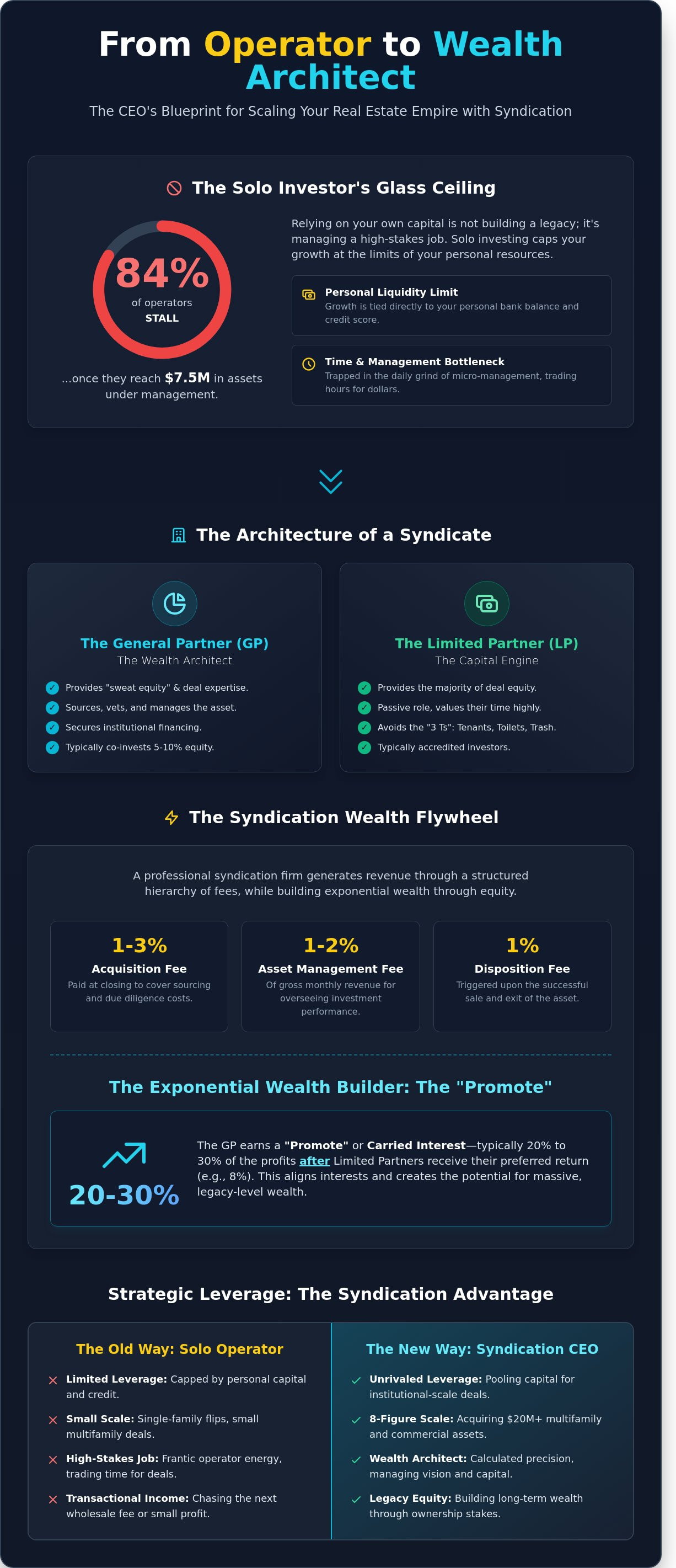
The ceiling of your net worth is directly tied to the limits of your personal liquidity. If you are still relying on your own capital to close deals, you aren't building a legacy; you are simply managing a high-stakes job. Data shows that 84% of independent operators stall once they reach $7.5 million in assets under management because they lack the structural leverage to go further. This is where real estate syndication becomes the definitive tool for the elite CEO. It's the mechanism that separates the frantic operator from the sophisticated wealth architect who commands the market.
You already know that sourcing $20 million multifamily assets alone is a mathematical impossibility for the isolated investor, yet you still find yourself trapped in the daily grind of micro-management. It's time to stop playing small. This blueprint reveals how to transition into a true CEO role, allowing you to achieve 8-figure scale while building a legacy-level investment firm. We will examine the specific frameworks for capital raising, deal flow optimization, and the institutional systems required to enter the inner circle of high-level wealth.
Key Takeaways
- Stop trading time for deals and begin architecting a legacy by shifting from a high-volume operator to a sophisticated wealth architect.
- Decode the structural relationship between General Partners and Limited Partners to master the legal and financial frameworks of real estate syndication.
- Identify why traditional joint ventures create bottlenecks and how to utilize syndication for unrivaled leverage and operational economies of scale.
- Implement the high-level systems required to build a predictable capital-raising engine and a consistent pipeline of institutional-grade deals.
- Leverage the power of collective intelligence to find strategic partners and Key Principals that accelerate your ascent to an eight-figure exit.
Beyond the Hustle: Why Syndication is the Ultimate Vehicle for Real Estate Scale
Real estate syndication is the strategic alignment of sophisticated capital with specialized operational expertise. It's the difference between owning a job and owning an empire. While the average investor spends their career chasing the next single-family flip, the elite focus on institutional-grade assets that offer true scalability. To understand the foundation of this model, one must grasp what is real estate syndication at its core: a partnership where the General Partner (GP) provides the vision and the Limited Partners (LP) provide the equity.
This model solves the two primary bottlenecks that stifle growth: limited capital and restricted time. Most solo operators hit a hard ceiling at 10 properties or $2,500,000 in personal debt. By transitioning to an owner mindset, you stop trading hours for dollars. You move from the frantic energy of the operator to the calculated precision of the wealth architect. This is the bridge to an 8-figure business valuation and a legacy that outlives your daily involvement.
The Death of the Solo Investor
Solo investing caps your growth at the limits of your personal credit score and bank balance. You can't reach a $100 million portfolio alone. Managing other people's money requires a psychological shift from "my money" to a fiduciary responsibility. It's the move from transactional income to long-term equity. Instead of a $20,000 wholesale fee, you're looking at a 20% equity stake in a 200-unit complex. The scale is incomparable. Solo efforts are a sprint; real estate syndication is the marathon that builds generational wealth.
Syndication as a Scalable Business Model
A professional syndication firm functions as a high-performance machine. It generates revenue through a structured hierarchy of fees:
- Acquisition Fees: Typically 1% to 3% of the purchase price, paid at closing to cover the costs of sourcing the deal.
- Asset Management Fees: Usually 1% to 2% of gross monthly revenue for overseeing the investment's performance.
- Disposition Fees: A 1% fee often triggered upon the successful exit and sale of the asset.
The "Promote" or carried interest is where exponential wealth is built. This structure often awards the sponsor 20% to 30% of the upside after investors receive their 8% preferred return. As the CEO, your primary objective is to manage the capital stack and drive the strategic vision, not to handle daily property grievances. You're building a firm, not just buying a building.
The Architecture of a Syndicate: Decoding the GP and LP Relationship
Real estate syndication is a calculated partnership designed to separate the labor of execution from the weight of capital. It functions as a high-performance machine where roles are clearly defined to maximize efficiency and mitigate risk. Most sophisticated deals utilize a Limited Liability Company (LLC) or a Limited Partnership (LP) structure. These legal frameworks protect individual assets while providing a transparent vehicle for tax benefits and cash flow distribution. Success in this arena isn't about luck; it's about the precision of the waterfall structure.
The General Partner (GP): The Wealth Architect
The GP acts as the pilot of the investment vehicle. Their responsibilities include sourcing off-market assets, conducting 90-day due diligence periods, and securing institutional-grade financing. A robust GP team usually consists of a Visionary who identifies the 15% IRR potential and an Integrator who handles the granular asset management. While the GP provides the "sweat equity," elite sponsors typically co-invest 5% to 10% of the total equity. They implement professional systems for raising capital and managing the acquisition cycle to ensure the project remains on schedule and under budget.
The Limited Partner (LP): The Capital Engine
LPs provide the fuel that drives the deal. These are often CEOs and entrepreneurs who value their time at $1,000 per hour and refuse to deal with the "three Ts": tenants, toilets, and trash. Under SEC Regulation D, Rule 506(c), participation is limited to Accredited Investors, defined as individuals with a $1M net worth or a consistent annual income of $200,000. For LPs, the real estate syndication model offers a passive path to equity without the operational headaches. Profit distribution follows a strict hierarchy:
- Preferred Return: LPs typically receive the first 7% to 9% of cash flow.
- The Split: Remaining profits are shared, often 70/30 or 80/20 in favor of the LPs.
- The Catch-up: A mechanism that allows the GP to reach a specific profit percentage after LPs hit their hurdles.
The sponsor's track record is the most critical variable. A GP who has successfully navigated the 2008 financial crisis or the 2022 interest rate hikes brings a level of battle-tested security that a novice cannot replicate. If you're looking to transition from an active operator to a high-level owner, joining an exclusive inner circle can provide the strategic access required to vet these sponsors effectively. This is how you scale your legacy without increasing your stress level.
Strategic Leverage: How Syndication Outperforms Traditional Joint Ventures
Real estate syndication isn't just a different way to buy property; it's a structural evolution for the elite operator. Standard joint ventures (JVs) often trap you in a cycle of consensus where every partner has a say in every minor repair. This rigidity kills speed. Syndication provides the flexibility of a centralized command structure. You lead as the General Partner; your investors provide the fuel as Limited Partners. This clear separation of roles protects your time and your sanity. While JVs often rely on informal agreements, following SEC regulations on real estate syndication creates a professional, institutional-grade environment that attracts high-net-worth capital. It limits your personal liability to your specific actions as a Sponsor, shielding your personal balance sheet from the risks inherent in solo ownership or general partnerships.
Scalability vs. Simplicity
A Joint Venture is a viable tool for a $1.2 million four-plex in North Park. It's simple, but it doesn't scale. When you aim for a $45 million, 200-unit complex in Mission Valley, the JV model collapses under its own weight. You can't manage 50 equal partners; you can manage 50 Limited Partners. Real estate syndication carries a higher administrative load in the setup phase, but it offers explosive growth potential that JVs cannot match. Choose a JV when you want a hobby. Choose a syndicate when you're ready to build a legacy. The economies of scale in a 200-unit asset mean your management costs per door typically drop by 15% to 22% compared to smaller, scattered portfolios.
Tax Optimization for the CEO
The tax code is written for owners, not employees. Syndication allows you to pass through significant benefits via K-1 distributions to both the GP and LP levels. You're not just earning cash flow; you're shielding it. Within this structure, the 1031 exchange remains a potent tool for deferring capital gains at scale, allowing you to roll equity from one massive asset into the next without the IRS taking a 20% cut. Cost segregation is a strategic tool that reclassifies building components to accelerate depreciation, providing the massive tax shields necessary for sustained 8-figure growth. This isn't just about saving money; it's about weaponizing the tax code to compound your wealth faster than any traditional investment vehicle allows.
Engineering the Machine: Systems for Raising Capital and Sourcing Deals
Amateurs wait for the perfect deal to find investors. Elites build the pool first. A successful real estate syndication isn't a series of one-off transactions; it's a high-performance machine fueled by predictable systems. You must transition from a deal-chaser to a system-operator. This requires a dual-engine approach: a capital-raising flywheel and an institutional-grade sourcing pipeline. Without these structures, you're not building a business; you're merely working a high-stress job.
The Capital Raising System
You must adopt an "always be raising" posture. Waiting until you have a signed Letter of Intent (LOI) to talk to investors is a recipe for failure. Instead, use your personal brand to project authority and attract capital passively. A sophisticated Investor CRM is your most valuable asset here. It allows you to segment your Limited Partners (LPs) by liquidity and risk profile, ensuring that when a $15 million acquisition arises, your equity is committed within 72 hours.
Legal precision is your defensive moat. Most operators utilize SEC Rule 506(b), which prohibits general solicitation and requires a substantive, pre-existing relationship. If you choose to market openly, Rule 506(c) is mandatory, requiring rigorous accredited investor verification. Your "Deal Room" must reflect this professionalism. A high-tier offering memorandum with 30 plus pages of data, sub-market analytics, and sensitivity tables isn't optional. It's the standard for those playing at the eight-figure level.
Sourcing Institutional-Grade Assets
Moving into the big leagues means leaving the residential MLS behind. Your sourcing engine relies on off-market commercial relationships and "speed to certainty." In a competitive landscape like San Diego, sellers prioritize the buyer who can deliver a firm LOI and a proof of funds within 48 hours. You win by being the most prepared, not necessarily the highest bidder.
Your machine must filter opportunities through three uncompromising KPIs:
- Yield Spread: A stabilized Cap Rate at least 150 basis points above current debt costs.
- Target IRR: A minimum 15% Internal Rate of Return over a five-year hold.
- DSCR: A Debt Service Coverage Ratio of 1.25 or higher to withstand market volatility.
By automating the due diligence process with a standardized 60-point checklist, you eliminate emotional bias. This systematic approach ensures that only high-alpha assets enter your portfolio, protecting your legacy and your investors' capital.
Stop playing small and start operating at scale. Secure your seat in the Boardroom and master the architecture of wealth.
The Boardroom Advantage: Scaling Your Syndication Business Through Collective Intelligence
Real estate syndication isn't a solo sport. You can't reach the $100 million mark by grinding in isolation. Elite operators understand that their net worth is capped by their network's depth. When you operate in a vacuum, you're prone to blind spots that cost millions in missed acquisitions or failed capital raises. You need a room where 9-figure exits are the standard, not the exception. Moving from a deal maker to a firm owner requires a fundamental shift in how you leverage human capital.
The Power of the Peer Network
The Boardroom Mastermind serves as a high-velocity engine for multi-million dollar partnerships. Within this inner circle, finding a Key Principal (KP) with a $50 million balance sheet or a co-GP with specialized institutional experience becomes a matter of a single conversation. You gain access to "Unfair Advantages" like proprietary debt structures and off-market deal flow that never hits the public exchange. This environment facilitates a transition into a true CEO role. You stop managing the minutiae and start directing the vision, effectively eliminating the operational burnout that stalls 92% of mid-level syndicators.
- Access to KPs: Secure the balance sheet strength required for massive agency debt.
- Strategic Audits: Review your 2024 pro-forma with peers who have managed 5,000+ units.
- Operational Freedom: Implement systems that allow the business to scale without your 24/7 involvement.
Your Ascent to 9-Figure Legacy
There's a massive gulf between a real estate job and a real estate enterprise. A job requires your presence; an enterprise generates wealth through systems and compounding. High-level networking short-circuits the learning curve of complex real estate syndication structures, such as 506(c) offerings or 300-unit value-add plays. By auditing your model against peers who have already scaled to $500 million in assets under management, you identify the specific bottlenecks holding you back. Accountability in this room isn't about motivation. It's about the clinical execution of a growth strategy that ensures your legacy. Secure your seat at the table. Apply for The Boardroom Mastermind to scale your syndication firm.
Architect Your 8-Figure Legacy
Mastering real estate syndication is the definitive pivot from operator to owner. You've seen how the GP and LP relationship creates the structural leverage necessary to move beyond the constraints of traditional joint ventures. Scaling to 8 figures requires more than just sourcing deals; it demands a sophisticated architecture of systems and the collective intelligence of those who've already crossed the finish line. It's time to stop grinding and start optimizing for true wealth.
The elite don't build in isolation. They leverage the experience of an inner circle to collapse time frames and avoid costly errors. Through The Boardroom Mastermind, you'll engage in four quarterly in-person intensives alongside 8-figure CEOs who operate at your level. You'll benefit from a strategic business audit from the mastermind's top advisors, ensuring your systems are primed for 9-figure expansion. This is the exclusive network of elite real estate professionals designed to provide the clarity you need to dominate your market.
Scale your real estate business to 8 and 9 figures with The Boardroom Mastermind and join the ranks of the world's most successful wealth architects. Your ascent to the next level of impact is waiting.
Frequently Asked Questions
What is the minimum amount of capital needed to start a real estate syndication?
Individual investors typically need a minimum of $50,000 to $100,000 to participate in a San Diego offering. This capital entry point allows you to leverage institutional-grade assets that would otherwise be out of reach. In 85% of professional real estate syndication structures, these minimums ensure the pool consists of serious, high-net-worth partners. It is a strategic move for those scaling their portfolio while maintaining focus on their primary business operations.
Do I need to be an accredited investor to be a General Partner (GP)?
No, you don't need to be an accredited investor to serve as a General Partner or sponsor. SEC Rule 501 defines accreditation status for the investors providing capital, not the operators managing the deal. However, 92% of successful GPs are accredited because it signals financial stability to their inner circle. Your value as a GP comes from your ability to source 7-figure deals and execute a sophisticated exit strategy.
How do real estate syndicators get paid for their work?
Syndicators earn through acquisition fees, asset management fees, and the equity promote. Most operators charge a 1% to 3% acquisition fee at closing to cover the costs of sourcing the asset. They also receive a 2% annual fee for optimizing the property’s performance. The real wealth is built through the "promote," where the GP earns 20% to 30% of profits after hitting a specific hurdle rate.
What is the difference between a 506(b) and a 506(c) syndication?
A 506(b) offering allows 35 non-accredited investors but prohibits any public advertising of the deal. In contrast, the 506(c) framework permits general solicitation but requires every investor to be a verified accredited individual. Since the 2012 JOBS Act, 506(c) filings have increased by 44% among elite operators who use digital marketing to scale. Choosing the right structure depends on whether you have an existing network or need to build one.
How long is the typical hold period for a syndicated real estate investment?
The standard hold period for a value-add project ranges from 3 to 7 years. Most San Diego operators target a 5 year exit strategy to maximize the compounding effect of forced appreciation and market growth. This timeline provides enough room to execute a strategic renovation plan and stabilize the asset. It ensures the transition from operator to owner happens at the peak of the property's valuation cycle.
Can I use my self-directed IRA to invest in a real estate syndication?
Yes, you can use a self-directed IRA (SDIRA) to deploy capital into a syndication through a qualified custodian. Currently, about 2% of total US retirement assets are held in alternative investments like these. This strategy allows your returns to grow tax-deferred or tax-free if using a Roth SDIRA. It's a powerful tool for wealth architecture that moves your retirement funds away from volatile public markets into tangible, cash-flowing assets.
What happens if a syndicated deal doesn't perform as expected?
If a deal misses its pro forma targets, the GP typically suspends distributions to preserve capital and protect the asset. Most legal structures require that 100% of the preferred return is paid to limited partners before the GP receives any profit split. In extreme cases, a capital call may be issued where partners contribute additional funds to stabilize the investment. This ensures the collective intelligence of the group protects the legacy play.
How do I find high-net-worth investors for my first syndication deal?
You find elite investors by positioning yourself within exclusive masterminds and private professional networks. Data shows that 72% of high-net-worth capital is raised through existing relationships rather than cold outreach. Focus on solving bottlenecks for CEOs who have liquidity but lack the time to find deals. When you provide an unfair advantage through a vetted 8-figure opportunity, the capital naturally follows your lead into the boardroom.


