
Real Estate Private Equity: The Architect’s Guide to Institutional Scale
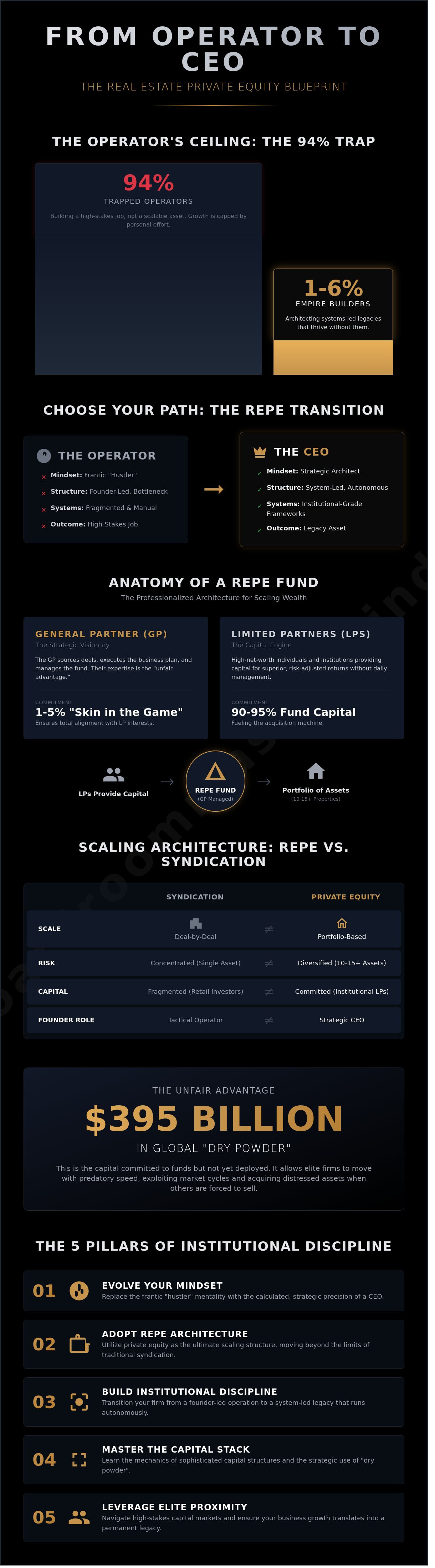
Why do 94% of real estate entrepreneurs remain trapped in the "operator" cycle while the top 1% build empires that thrive without them? You've likely reached a level of success that others envy, yet you're still the primary bottleneck in your own firm. You've mastered the deal, but your capital raising remains fragmented and your systems lack the institutional-grade rigor required for true scale. It's a common ceiling. If your business requires your daily presence to survive, you haven't built an asset; you've built a high-stakes job.
We agree that the "hustle" that got you here won't be the same engine that takes you to a nine-figure legacy. To break through, you must master the mechanics of real estate private equity. This isn't just about chasing bigger deals; it's about a fundamental shift in how you architect your wealth and your time. This guide provides the blueprint to transition from a high-speed operator to a legacy-driven CEO by implementing sophisticated capital stacks and autonomous operational frameworks. We will examine the exact structures and strategies used by elite firms to secure institutional scale and total personal freedom.
Key Takeaways
- Evolve your operational philosophy by replacing the frantic "hustler" mindset with the calculated, strategic precision of a professionalized investment class.
- Understand why real estate private equity serves as the ultimate scaling architecture for CEOs ready to move beyond the limitations of traditional syndication.
- Identify the five critical pillars of institutional discipline required to transition your firm from a founder-led operation to a system-led legacy.
- Master the mechanics of the capital stack and the strategic use of "dry powder" to exploit market cycles with institutional-grade timing.
- Learn how to navigate high-stakes capital markets by leveraging elite proximity, ensuring your business growth translates into a permanent nine-figure legacy.
Demystifying Real Estate Private Equity: Beyond the Passive Investment
You've reached the ceiling of individual effort. The "hustler mindset" serves you well during the climb to your first $1 million in net worth; it relies on grit, localized hunting, and direct oversight. However, that same energy becomes a liability when you're eyeing $100 million. At the seven and eight-figure levels, the game changes from finding deals to building a machine. Real estate private equity is that machine. It represents the professionalized evolution of property investment, moving away from the frantic energy of the solo operator and toward the calculated precision of the architect.
Transitioning into Private equity real estate isn't just a change in asset size; it's a total shift in identity. You're no longer just buying buildings. You're designing a sophisticated investment vehicle that aggregates capital to dominate entire markets. This is where elite entrepreneurs separate themselves from the crowd. They stop chasing the next flip and start constructing a legacy. It's the difference between being a laborer and being the person who owns the firm that employs the laborer. If you want to scale without the stress of constant micromanagement, this structural evolution is your only path forward.
The Core Participants: GPs, LPs, and the Value Chain
The architecture of a real estate private equity firm relies on a clear division of power and capital. The General Partner (GP) is the strategic visionary. They're the ones with the "unfair advantage" in deal sourcing and operational execution. They don't just find assets; they optimize them. On the other side, Limited Partners (LPs) provide the capital. These are high-net-worth individuals or institutional entities seeking superior risk-adjusted returns without the burden of daily management. Alignment is the glue here. GPs typically commit 1% to 5% of their own capital as "skin in the game," ensuring their interests mirror those of the LPs. Success is rewarded through a waterfall structure, where the GP earns a performance fee only after LPs receive a preferred return, often set at 8%.
Why Institutional Scale Requires a Structural Shift
Doubling down on "more of the same" is a recipe for burnout. If your current model requires you to touch every document, you aren't scaling; you're just accelerating toward a crash. Institutional scale requires you to mitigate individual risk through diversification and systems. In 2023, firms that successfully navigated market volatility were those that spread capital across 10 to 15 distinct assets rather than betting on single-entry points. This structural shift allows you to absorb shocks that would bankrupt a smaller operator. It provides the freedom to focus on high-level strategy while the system handles the tactical execution. Real estate private equity is the vehicle that turns localized knowledge into institutional wealth.
The Anatomy of a REPE Fund: Structures, Strategies, and the Capital Stack
Real estate private equity is the ultimate vehicle for operators who've outgrown the limitations of individual syndications. It's a precision-engineered machine where the General Partner (GP) provides the expertise and the Limited Partners (LPs) provide the fuel. This legal architecture typically takes the form of a Limited Partnership. The GP manages the assets and assumes liability, while the LPs contribute approximately 90% to 95% of the capital. This separation of roles allows you to scale without the friction of managing thousands of individual retail investors.
Timing is everything in high-stakes acquisitions. Currently, global dry powder—capital committed but not yet deployed—sits at approximately $395 billion. This liquidity allows funds to move with predatory speed when market distress creates a vacuum. Your investment thesis is the blueprint that justifies this speed. It must be a data-backed directive, such as a focus on Class B multi-family in the Sunbelt or cold-storage logistics in the Midwest. Without a rigorous thesis, you won't attract the sovereign wealth funds or pension funds that move the needle. These institutions prioritize transparency in real estate private equity to ensure their risk models remain intact throughout the fund's 7-year to 10-year lifecycle.
REPE Investment Strategies: From Core to Opportunistic
Success requires choosing a lane and dominating it. Core and Core-Plus strategies focus on stabilized, high-quality assets with IRRs typically ranging from 7% to 10%. These are the defensive plays. Value-Add is the sweet spot for the elite operator. By executing a renovation or repositioning plan, you can drive IRRs into the 12% to 16% range. Opportunistic plays are the most aggressive. These involve ground-up development or distressed debt restructuring where returns can exceed 20%. If you want to build a legacy, you must understand which strategy fits your current infrastructure. You can explore how to refine your own strategy by joining a sophisticated inner circle of high-achievers.
Decoding the Capital Stack and the Waterfall
The capital stack defines the hierarchy of payment and risk. Senior debt sits at the base, holding the first lien position. Above that, mezzanine debt and preferred equity provide leverage. Common equity, where the GP and LPs sit, is at the top. It's the most at risk, but it captures the most upside. This upside is distributed through a "Waterfall" structure.
- Hurdle Rate: Often set at an 8% internal rate of return (IRR). LPs receive all distributions until this benchmark is met.
- Catch-up: A mechanism that allows the GP to receive a disproportionate share of profits until their total take matches a specific percentage.
- Carried Interest: The performance fee, typically 20%, that motivates the GP to exceed expectations.
This structure ensures that elite performance is rewarded. If you don't hit the hurdle, you don't get the carry. It's a binary environment where results are the only currency that matters. The transition from operator to owner happens when you master these mechanics to build predictable, compounding wealth.
REPE vs. REITs vs. Syndication: Choosing Your Scaling Architecture
Most operators treat capital raising as a series of sprints. They view real estate private equity as merely a larger version of the syndication model they already know. This is a fundamental strategic error. Syndication is a tactical hunt; it's a deal-by-deal struggle that keeps the founder chained to the treadmill of constant pitching. Real estate private equity is an institutional machine. It represents the transition from being a deal-finder to becoming a fund manager who commands discretionary capital. While syndication relies on the "hope" of a successful raise, REPE operates on the "certainty" of committed funds.
The distinction between Public REITs and Private Equity is equally stark. Public REITs offer liquidity, but they come with a high price: the loss of privacy and the burden of extreme regulatory oversight. SEC compliance and quarterly reporting can easily cost a firm over $250,000 annually in administrative overhead. Private Equity, by contrast, thrives on exclusivity. It allows you to maintain a lean, high-performance team while executing complex strategies away from the prying eyes of the public markets. Success in this arena requires a sophisticated understanding of how Leverage in Private Equity Real Estate functions as a tool for architectural growth rather than just a way to cover a purchase price.
Syndication: The Tactical Hunt
Syndication is often the entry point for 85% of investors, yet it becomes a prison for the ambitious. Because capital is raised on a deal-by-deal basis, the founder is perpetually stuck in the "operator" role. If you don't find a deal, you don't raise money; if you don't raise money, you don't get paid. This cycle creates a fragmented business model that lacks predictability. It's a significant factor in why many talented CEOs hit The 7-Figure Ceiling: A CEO Guide to Exclusive Mastermind Groups. You aren't building a legacy; you're building a job that requires your constant presence to survive.
REPE: The Strategic Machine
Transitioning to real estate private equity changes the physics of your firm. By securing committed capital through a discretionary fund, you gain the ability to move with institutional speed. You no longer sell a single property; you sell a vision, a track record, and a repeatable system. This structure allows for:
- Instant Execution: Closing deals in 30 days or less because the capital is already in the bank.
- Institutional Weight: Attracting family offices and pension funds that ignore small-scale syndicators.
- Operational Freedom: Shifting the founder's focus from "Where is the next check?" to "How do we optimize the portfolio?"
The Institutional Shift: Operating Your Business with Private Equity Discipline
Transitioning into the world of real estate private equity requires more than just a larger balance sheet. It demands a total structural overhaul. You are moving from a founder-led hustle to a system-led enterprise. This evolution rests on five non-negotiable pillars: a rigid investment thesis, automated deal sourcing, data-centric underwriting, institutional-grade reporting, and a culture of radical accountability. If your business still relies on your personal intuition to greenlight a project, you aren't building a firm. You're managing a job. Institutional scale happens when the system makes the decision, not the person.
A common objection among independent operators is that institutionalization kills the entrepreneurial speed that built the company. This is a myth born of poor management. In reality, discipline accelerates execution. When your team operates within a defined framework, they stop second-guessing and start producing. You don't lose speed; you lose the friction of indecision. A-Player leaders don't want to guess what "good" looks like. They want a clear scoreboard. By implementing real estate private equity discipline, you empower your leadership to move faster because the guardrails are already in place.
Step 1: Standardizing the Deal Flow and Underwriting
Standardizing your process means removing subjectivity from the acquisition engine. Every deal must pass through a rigorous, multi-stage filter before it ever reaches your desk. This requires a "Business Operating System" that produces predictable outcomes regardless of market volatility. By the time a property is underwritten, the numbers should speak for themselves. You aren't just buying assets; you're executing a repeatable strategy. This level of precision is exactly how you begin scaling beyond the San Diego market or any localized territory into a national powerhouse. A 2023 analysis of high-growth firms showed that those with standardized underwriting protocols saw a 22% increase in deal closing efficiency.
Step 2: Sophisticated Reporting and Asset Management
Moving beyond basic accounting is the hallmark of the elite. High-level portfolio KPIs must be tracked with the same intensity as your cash flow. Your Asset Manager isn't a bookkeeper; they're a protector of LP value. Their job is to optimize every square foot and every line item to ensure the exit strategy remains on track. The Business Audit is a non-negotiable ritual for 8-figure growth, serving as a quarterly deep-dive that exposes operational leaks before they become catastrophic failures. When you treat your reporting as a strategic weapon rather than a clerical chore, you signal to the market that you're ready for institutional capital.
Ready to stop operating like a solo practitioner and start leading like a CEO? Apply to join the Inner Circle and master the architecture of scale.
Inside the Boardroom: Navigating High-Stakes Capital and Legacy Growth
Institutional scale isn't a solo pursuit. It's a strategic evolution that requires a seat at the table where the highest stakes are decided. The Boardroom Mastermind serves as the definitive Inner Circle for CEOs ready to dominate the world of real estate private equity. Transitioning from a high-volume operator to an institutional-grade owner requires more than just capital; it requires the proximity to power that only an elite peer group provides.
When you're navigating institutional capital markets, proximity is your greatest strategic asset. You don't need more generic advice. You need the collective intelligence of peers who have already secured $100 million commitments and structured complex waterfall distributions. This environment provides the clarity needed to move past the frantic energy of the hustle and into the calculated precision of a legacy builder.
The Collective Intelligence Advantage
Sharing battle-tested strategies within a closed-door environment accelerates your institutional shift by years. Peer auditing is the primary mechanism that prevents the Founder Bottleneck. Data shows that 85% of mid-market firms stall because the founder remains the primary decision-maker for every operational detail. In the Boardroom, we dismantle these bottlenecks by stress-testing your systems against 9-figure benchmarks.
- Quarterly Intensives: These sessions audit your business model for 9-figure readiness, ensuring your infrastructure can handle rapid capital inflows.
- Institutional Deal Flow: Elite networking acts as the ultimate shortcut, providing access to off-market opportunities and high-level joint venture partners.
- Risk Mitigation: Learn from the expensive mistakes of others to protect your AUM and your reputation.
Scaling Without the Stress: The CEO’s Final Evolution
True success in real estate private equity is defined by freedom of time and the depth of your impact, not just the size of your portfolio. The psychological shift required to lead a legacy-driven investment firm is profound. You must move from being the smartest person in the room to being the architect of a self-sustaining machine. This evolution allows you to focus on high-level vision while your systems compound wealth in the background.
The path to the next level is clear for those with the right access. If you're ready to stop trading time for deals and start building a permanent institution, the next step is inevitable. It's time to leave the noise behind and join the ranks of the world's most sophisticated investors. Apply for The Boardroom Mastermind and scale your empire today.
Architect Your Institutional Future
The shift from individual syndicator to institutional powerhouse requires more than just capital. It demands a fundamental transformation in how you architect your legacy. You've now seen how real estate private equity provides the framework to move beyond passive participation and into the realm of true market dominance. By optimizing your capital stack and adopting the discipline of a 9-figure operator, you transition from chasing deals to commanding an enterprise. High-stakes growth is a calculated science, not a game of chance.
If you're operating at the 7 or 8-figure level, you've already proven you can win. Now it's time to ensure your structure can handle the weight of 10x expansion. The Boardroom Mastermind, led by industry visionary Kent Clothier, provides the elite environment necessary for this evolution. Our members gain access to an exclusive network of 7, 8, and 9-figure investors who prioritize collective intelligence over generic advice. Through our quarterly in-person business audits, we dissect your operations to eliminate bottlenecks and solidify your exit strategy.
Join the Inner Circle: Apply for The Boardroom Mastermind
Your ascent to the next level of institutional scale is the only logical conclusion for a visionary who refuses to settle. We're ready to help you build what's next.
Frequently Asked Questions
What is the difference between real estate private equity and a REIT?
Real estate private equity offers direct ownership and higher control, while REITs are liquid securities traded on public exchanges like the NYSE. REPE investors typically commit $250,000 or more into illiquid assets for five to ten years. REITs allow entry for the price of a single share. You trade liquidity for the superior tax advantages and 15% to 20% targeted returns found in the private sector.
How much capital do I need to start a real estate private equity fund?
You need approximately $500,000 in liquid capital to cover the legal, regulatory, and operational overhead of launching a professional fund. Legal fees for a Regulation D 506(c) offering often range from $40,000 to $150,000 depending on complexity. Beyond administrative costs, institutional LPs expect the General Partner to commit 1% to 5% of the total fund equity as skin in the game.
Is real estate private equity considered a high-risk investment?
Risk in real estate private equity depends on the strategy, with opportunistic funds carrying higher execution risk than core assets. Core investments target stable 7% returns with low leverage. Conversely, opportunistic plays seek 20% plus IRRs through heavy development or repositioning. Risk isn't a deterrent for the elite; it's a variable you manage through rigorous underwriting and a 25% margin of safety on exit cap rates.
What is a typical waterfall structure in a REPE deal?
A typical waterfall follows a four-tier structure that prioritizes investor returns before the sponsor participates in the profits. First, 100% of cash flow goes to LPs until they reach an 8% preferred return. Next, the sponsor receives a catch-up. Finally, remaining profits are split, often 80% to LPs and 20% to the GP, until a second 15% IRR hurdle triggers a 30% performance fee for the sponsor.
Can I transition my syndication business into a private equity model?
You can transition by moving from deal-by-deal syndications to a discretionary fund model where capital is committed upfront. This shift requires a track record of at least three to five successful full-cycle exits. By securing $20 million or more in committed capital, you eliminate the funding contingency from your offers. It transforms you from a deal-chaser into a sophisticated fund manager with immediate closing power.
What are the main strategies used by real estate private equity firms?
Real estate private equity firms primarily utilize Core, Core-Plus, Value-Add, and Opportunistic strategies to generate alpha. Value-Add is the most common for mid-market firms, targeting 13% to 18% total returns through physical renovations or operational efficiencies. These firms often seek a 20% increase in Net Operating Income within the first 24 months. Each strategy represents a different point on the risk-reward spectrum.
How do REPE firms find and underwrite their deals?
Firms find deals through deep-rooted broker networks where 70% of transactions occur off-market. Underwriting involves a 30-day due diligence period where analysts scrutinize every lease, utility bill, and tax assessment. They use sophisticated sensitivity analyses to stress test the investment against a 2% rise in interest rates. This disciplined approach ensures that only the top 5% of reviewed deals move to a final investment committee.
What is the "Hurdle Rate" and why does it matter to investors?
The hurdle rate is the 8% minimum annual return that investors must receive before you, the sponsor, earn your performance promote. It's the ultimate benchmark of accountability in the boardroom. If the fund returns 7.9%, the GP earns nothing but their management fee. This mechanism protects the Inner Circle of investors and ensures the sponsor is incentivized to exceed institutional-grade benchmarks through superior asset management.


