
Real Estate Mastermind vs. Coaching: The CEO’s Guide to Strategic Scaling
The very coach who helped you hit your first million might be the exact person preventing you from hitting a hundred million. It's a common paradox for the high-achieving founder. You've built a formidable machine, yet you've become the ultimate operational bottleneck. When evaluating a real estate mastermind vs coaching, you must realize that trading time for tactical advice eventually hits a ceiling. You likely feel the weight of being the smartest person in every room you enter, which means your growth is capped by your own limited perspective.
You know that what got you here won't get you to an institutional scale. This guide reveals why elite founders eventually outgrow traditional mentorship and how to identify a high-stakes mastermind that functions as your external board of advisors. You will learn how to transition from tactical management to strategic oversight. We will analyze the architectural shifts required to ensure your business generates 9-figure deal flow while you reclaim your personal autonomy and secure your position among industry titans.
Key Takeaways
- Identify the specific operational ceiling where traditional coaching ends and strategic peer-level auditing becomes mandatory for 8-figure expansion.
- Navigate the real estate mastermind vs coaching decision by prioritizing environments with strict revenue minimums that ensure you are no longer the smartest person in the room.
- Master the "Operator-to-CEO" shift by implementing structural pivots that move you away from tactical execution and toward institutional-scale deal flow.
- Evaluate potential peer groups using a boardroom litmus test that prioritizes battle-tested business deconstruction over generic motivational advice.
The Ceiling of Instruction: Why Coaching Fails the Elite Founder
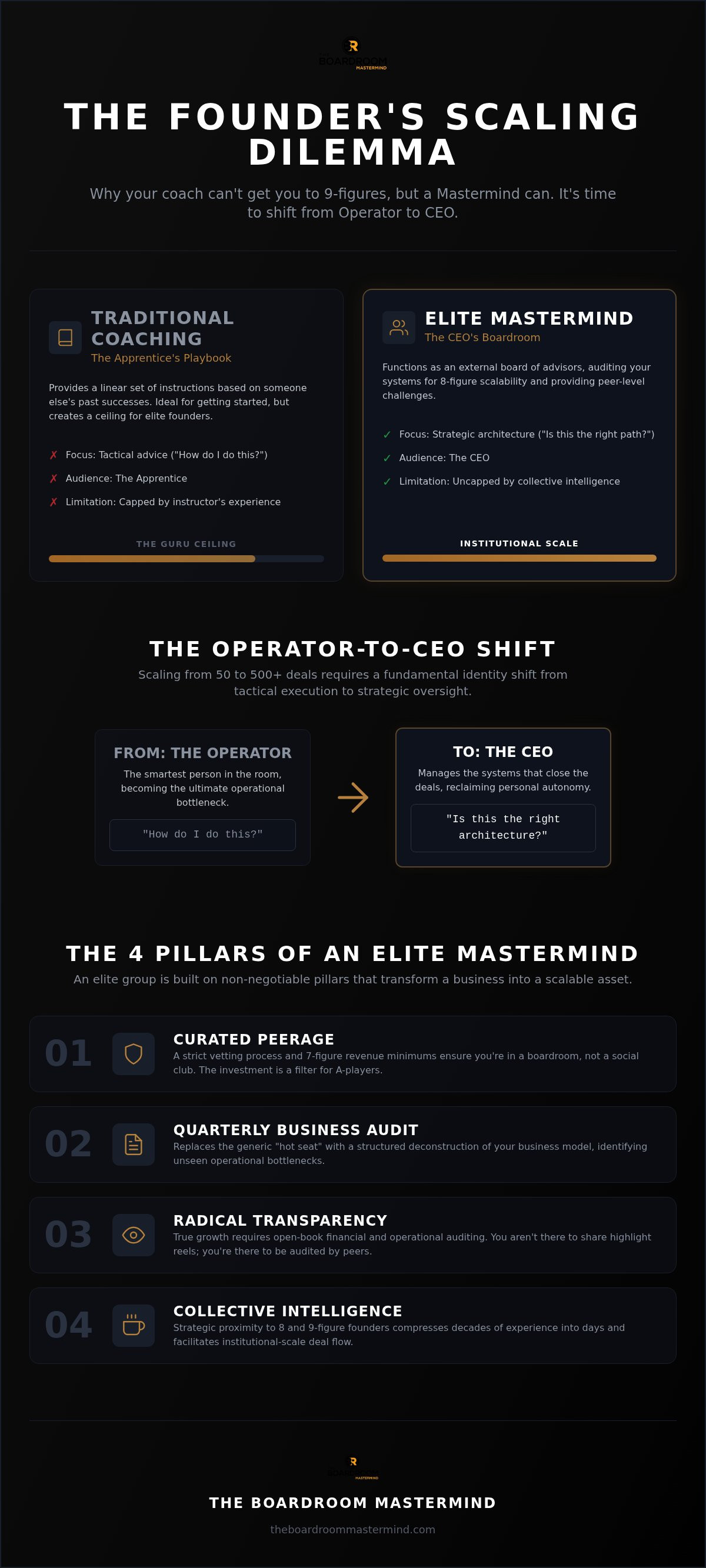
Coaching is designed for the apprentice. It provides a linear playbook, a set of instructions tailored to someone else’s past successes. For the established founder, this creates the "Guru Ceiling." You are essentially following a system that's limited by the individual instructor's personal capacity and outdated market experience. When you reach a certain level of success, the debate of real estate mastermind vs coaching becomes a question of survival. You cannot scale an institutional-grade business on a foundation of entry-level tactics.
A real estate mastermind is a high-stakes boardroom that audits your existing systems for 8-figure scalability. Scaling from 50 to 500 houses annually requires a fundamental shift in identity. You must move from tactical execution to strategic oversight, where your primary job is no longer closing deals, but managing the systems that close them. This transition is where most founders fail because they lack the high-level accountability to step away from the daily grind. The concept of a Mastermind group has historically been about the coordination of knowledge and effort; for you, it means ending the strategic isolation that comes with being the smartest person in your local market.
When to Fire Your Coach
You'll know you've outgrown traditional coaching when the advice you receive feels repetitive or purely tactical. If your mentor is still talking about lead generation while you're worried about capital stack optimization, the relationship has expired. You need a peer-level challenge, not a lecture.
- Shift the Question: You stop asking "How do I do this?" and start asking "Is this the right architecture for my exit?"
- Audit the Room: If you aren't feeling the healthy pressure of competing with 9-figure founders, your growth will stagnate.
- Strategic Proximity: Seek a strategic asset that functions as an external board of advisors rather than a single point of failure.
The 4 Pillars of an Elite Real Estate Mastermind
While many struggle when differentiating coaching and masterminds, the distinction lies in the architecture of the room. An elite group isn't built on social networking; it's built on four non-negotiable pillars that transform a business from a job into a scalable asset. Understanding the nuances of real estate mastermind vs coaching is about recognizing when you need a strategist rather than a teacher.
First, curated peerage is mandatory. If the group doesn't enforce a strict vetting process and 7-figure revenue minimums, you're paying for a social club, not a boardroom. This exclusivity filters for founders who have already solved the basic problems of survival. Second, the quarterly business audit replaces the standard "hot seat." Instead of random advice, you receive a structured deconstruction of your model. This process identifies operational bottlenecks that your internal team might be too close to see. Third, radical transparency requires moving beyond highlight reels. True growth happens when members engage in open-book financial and operational auditing. You aren't there to brag; you're there to be audited. Finally, collective intelligence facilitates institutional-scale deal flow that is impossible to achieve in isolation.
Engineering Strategic Proximity
Proximity is the ultimate shortcut. When you sit in a room with 8 and 9-figure founders, years of trial and error are compressed into a single afternoon. This environment forces elite decision-making that is simply unavailable in traditional mentorship. The Boardroom Experience is specifically designed to facilitate these high-stakes interactions, ensuring every member operates with the clarity of a battle-tested CEO.
If you are ready to audit your architecture alongside the industry's top 5%, joining an elite peer network is the logical conclusion. This strategic proximity ensures that your attainment of significant professional milestones is not just a goal, but a predictable result of the company you keep. The path to the next level is clear for those with the right access.
Calculating the Strategic ROI: Systems Over Secrets
High-level executives don't look for bargains; they look for asymmetric returns. In the real estate mastermind vs coaching debate, the ROI of a mastermind is found in the caliber of the room. A high-ticket investment isn't just a cost. It's a filter. It ensures you're surrounded by A-players with significant skin in the game. When every member has invested heavily to be there, the level of commitment and execution rises. You aren't just buying access; you're buying a room where everyone is actually doing the work.
Consider the Time ROI. A single strategic pivot suggested by a peer who has already scaled to 9 figures can save you 500+ hours of operational hustle. You're essentially buying back your time by avoiding the trial-and-error phase of expansion. This is the core of Calculating the ROI of a High-Ticket Mastermind Group. You stop guessing and start executing with the clarity of someone who has already reached the finish line.
Managing institutional capital requires precision. Amateur mistakes at this level aren't just embarrassing; they're expensive. Instead of chasing "secrets," elite founders invest in a proven Business Operating System that standardizes success. Standardized systems lead to predictable growth, while "secrets" lead to inconsistent results and operational fragility.
Wealth Architecture vs. Tactical Hustle
Most mentorship programs focus on the "next big marketing secret." Elite groups pivot toward wealth architecture and business permanence. The goal is a leadership team that functions without your daily intervention. This is how you achieve true founder autonomy. You aren't building a bigger job; you're building an enterprise. If you're ready to stop hustling and start architecting, apply for The Boardroom Mastermind today.
The Boardroom Litmus Test: Selecting Your Final Peer Group
Choosing a peer group is a high-stakes decision that dictates your business trajectory. When weighing a real estate mastermind vs coaching, you must look beyond the marketing and focus on the architecture of the community. Start by auditing the audit. Does the organization possess a battle-tested process for deconstructing your specific business model? If they cannot stress-test your infrastructure and identify the cracks in your scaling strategy, they cannot help you reach the next tier of financial success.
Analyze the leadership with clinical precision. Is the founder a practicing visionary who is actively navigating today's market, or a full-time guru who hasn't seen a contract in years? You need a peer who understands the nuances of current institutional-scale deal flow. Next, review the Member Spotlight. If the room isn't populated by 8 and 9-figure founders, your growth will be limited by the collective average. Finally, demand a high rejection rate. A group that accepts everyone provides value to no one. We maintain a 95% rejection rate to ensure the room remains an exclusive strategic asset for high-achievers.
The Boardroom Mastermind Difference
We curate a high-stakes environment where 7, 8, and 9-figure founders collaborate to solve complex operational challenges. Our four quarterly in-person intensives are designed to facilitate the transition from tactical management to strategic oversight. This process isn't about learning a new marketing trick; it's about engineering a business that runs without your daily intervention. If you are ready to stop being the smartest person in the room and start operating at a global level, the choice is clear. Apply for Membership in The Boardroom Mastermind and secure your seat at the table.
Securing Your Seat at the 9-Figure Table
The transition from tactical hustler to institutional CEO isn't a matter of effort; it's a matter of architecture. You've seen why the real estate mastermind vs coaching debate is won by those who value strategic proximity over repetitive instruction. High-stakes growth requires a move away from generic playbooks and toward the rigorous deconstruction provided by Quarterly Business Audits. By surrounding yourself with a vetted 7, 8, and 9-figure peer network, you ensure that your business systems are built for permanence rather than just the next deal.
The evidence is clear in our Member Spotlights, where founders have successfully scaled from 50 to 500 houses a year by auditing their core infrastructure. You don't need another mentor to tell you how to work harder. You need an external board of advisors to help you work smarter. If you're ready to stop being the smartest person in your network and start architecting a legacy, it's time to elevate your environment.
Apply for Membership in The Boardroom Mastermind and join the elite top 5% of investors nationwide. Your next level of scale starts here.
Frequently Asked Questions
What is the primary difference between real estate coaching and a mastermind?
The primary difference lies in the architecture of the environment. Coaching follows a top-down model where a mentor provides a specific playbook for tactical execution. A mastermind functions as an external board of advisors where high-level peers audit your business architecture. When analyzing real estate mastermind vs coaching, the former focuses on strategic oversight and institutional scale rather than just skill acquisition.
Is a high-ticket real estate mastermind worth the investment for established owners?
A high-ticket mastermind is a strategic asset that offers asymmetric returns for established owners. The investment filters for A-players with significant skin in the game, ensuring you aren't the smartest person in the room. By gaining access to 8 and 9-figure founders, you avoid the costly trial-and-error phase of expansion. This strategic proximity compresses years of learning into quarters, making it essential for scaling.
How do I know if I have outgrown my current real estate coaching program?
You've outgrown your coaching program when the advice feels repetitive or purely tactical. If you are solving high-level operational bottlenecks while your coach is still discussing basic lead generation, the relationship has hit its ceiling. Another indicator is feeling like the smartest person in your current network. Elite founders require peer-level challenges that force a transition from operator to a true CEO mindset.
What happens during a quarterly business intensive meeting?
During a quarterly business intensive, members participate in a rigorous, structured deconstruction of their existing business models. These multi-day sessions involve open-book auditing of financial and operational systems to identify growth-limiting bottlenecks. Instead of random advice, you receive strategic collaboration from a peer network of 7, 8, and 9-figure founders. The goal is to optimize your architecture for predictable, institutional-scale deal flow nationwide.
How much does an elite real estate mastermind typically cost in 2026?
Elite mastermind costs reflect the exclusivity and strategic value of the peer network. While industry prices in 2026 span a wide range, high-stakes groups utilize a significant investment as a filter for A-players. This ensures that every individual at the table is a committed, high-achieving founder. When evaluating real estate mastermind vs coaching, established CEOs prioritize the potential ROI from strategic proximity and institutional-scale impact.

Disclaimer
Mr. Clothier is an expert in real estate investing. As such his experiences are not necessarily typical to the standard real estate investor and whose results may vary. The successes shared on this site are not considered typical. Most individuals who order the educational materials and systems probably do not follow any of the techniques or strategies and consequently make little to no money due to their inaction. The company is in the process of determining the typical success of its clients. Stories shared herein are for example purpose only and should not be construed as "guarantees" of success. Results will vary based on background, education, and experience and actions taken.
This site is not a part of the Google/Facebook website or Google/Facebook Inc. Additionally, this site is NOT endorsed by or affiliated with Google/Facebook in any way. GOOGLE/FACEBOOK is a trademark of GOOGLE/FACEBOOK, Inc.
INCOME DISCLAIMER: This website and the items it distributes contain business strategies, marketing methods and other business advice that, regardless of referenced results and experience, may not produce the same results (or any results) for you. The Boardroom Mastermind makes absolutely no guarantee, expressed or implied, that by following the advice or content available from this web site you will make any money or improve current profits, as there are several factors and variables that come into play regarding any given business. Primarily, results will depend on the nature of the product or business model, the conditions of the marketplace, the experience of the individual, and situations and elements that are beyond your control. As with any business endeavor, you assume all risk related to investment and money based on your own discretion and at your own potential expense.
LIABILITY DISCLAIMER: By reading this website or the documents it offers, you assume all risks associated with using the advice given, with a full understanding that you, solely, are responsible for anything that may occur as a result of putting this information into action in any way, and regardless of your interpretation of the advice. You further agree that The Boardroom Mastermind, its affiliates, subsidiaries, officers and agents, cannot be held responsible in any way for the success or failure of your business as a result of the information provided. It is your responsibility to conduct your own due diligence regarding the safe and successful operation of your business. In summary, you understand that we make absolutely no guarantees regarding income as a result of applying this information, as well as the fact that you are solely responsible for the results of any action taken on your part as a result of any given information. In addition, you agree that our content is to be considered "for entertainment purposes only". Always seek the advice of a professional when making legal, financial, tax, or business decisions.
BUSINESS OPPORTUNITY: All products and services offered by The Boardroom Mastermind are intended to provide prospective purchasers with general business strategies, marketing methods and other general advice for business development and training. At no point is The Boardroom Mastermind soliciting anyone to enter into a new business nor is it representing, either expressly or by implication, that it will provide locations for a business, provide outlets, accounts, or customers, or purchase any of the goods or services made by the purchaser.
The products being offered through this promotion are packages of informational tools to help you learn about business and deal making strategies.


