
Real Estate Market Expansion Strategy: The CEO’s Blueprint for 8-Figure Scale
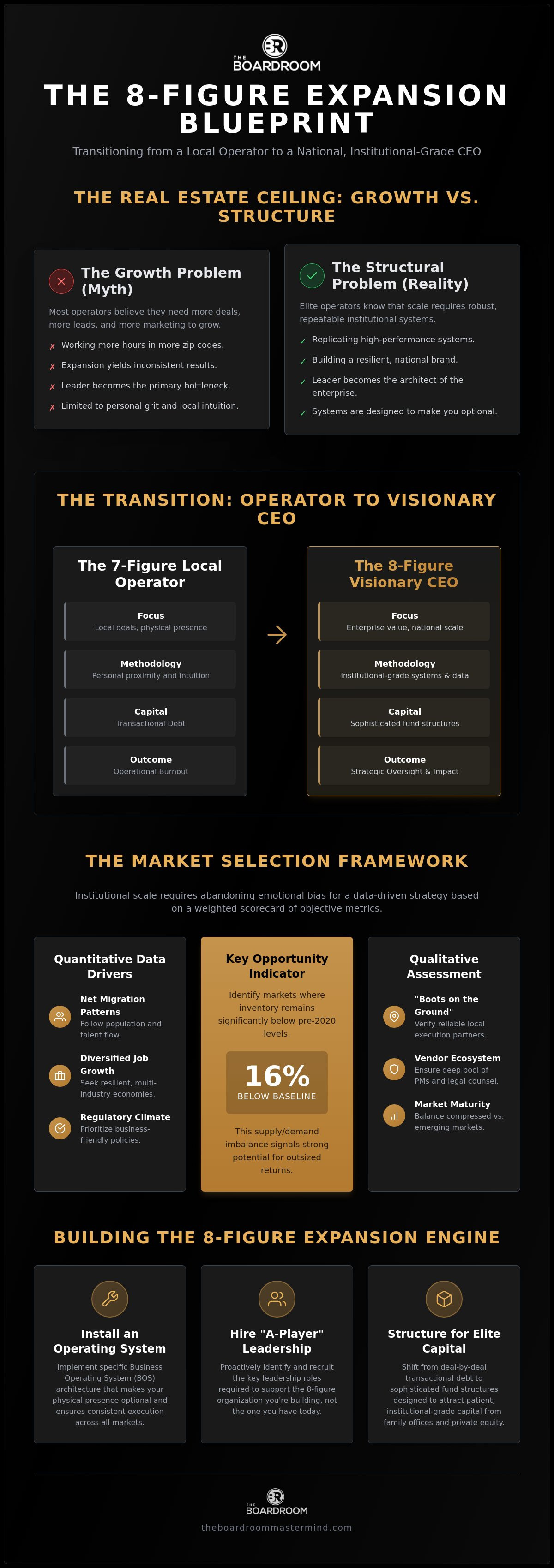
Most real estate operators believe they have a growth problem when they actually have a structural one. Are you truly scaling a business, or are you simply working more hours in more zip codes? If you feel trapped by the day-to-day grind of local deals while your expansion efforts yield inconsistent results, you aren't alone. It's a common ceiling for those who rely on personal grit rather than institutional systems. With $875 billion in commercial and multifamily loan maturities scheduled for 2026, the window for sophisticated acquisition is wide, but only for those with a refined real estate market expansion strategy. You want to stop being the bottleneck and start being the architect of a national enterprise.
I understand the desire to move beyond the "hustler" phase and enter the ranks of elite, 8-figure visionaries who command respect in any market. This blueprint promises to deliver the strategic frameworks necessary to transition from a local operator to an institutional-grade CEO. We will break down the repeatable systems for market evaluation, the methodology for building a high-performance leadership team, and the path to securing private capital from elite peers. It is time to trade operational burnout for strategic oversight and permanent impact.
Key Takeaways
- Distinguish between geographic and asset class expansion to ensure your growth increases enterprise value rather than just overhead.
- Master a data-driven real estate market expansion strategy that prioritizes net migration and regulatory climates over simple proximity.
- Install the specific Business Operating System architecture required to make your presence optional as you scale nationally.
- Identify the "A-Player" leadership roles you must hire now to support the 8-figure organization you're building.
- Shift from transactional debt to sophisticated fund structures that attract family offices and institutional-grade capital.
Beyond Local Limits: Defining Real Estate Market Expansion for the Elite Investor
Expansion isn't a marketing experiment. It's the calculated replication of high-performance systems across diverse geographies to maximize enterprise value and secure long-term dominance. For the sophisticated principal, a real estate market expansion strategy represents the bridge between local proficiency and national scale. You must distinguish between geographic expansion, which involves entering new territories, and asset class expansion, which involves pivoting into new sectors like industrial or build-to-rent. Both require a fundamental shift in how you view your role as a leader. If you're still treating expansion as a series of individual deals, you aren't scaling; you're just working harder in more places.
To better understand the mechanics of exponential growth, watch this helpful video:
Real estate market expansion is a systematic de-risking of your investment portfolio through geographic diversification. Most operators hit a 7-figure ceiling because their current systems are built around their personal proximity and local intuition. These local-centric frameworks inevitably shatter when you attempt to scale toward the 8-figure mark. You can't be in two places at once. Therefore, your systems must be. This transition requires moving away from foundational real estate investment strategies that rely on your physical presence and toward those that rely on institutional-grade architecture.
The Strategic Objectives of Multi-Market Scaling
Scaling across multiple markets serves two primary functions: achieving institutional scale and mitigating idiosyncratic risk. Family offices and private equity firms rarely look at local operators who lack a repeatable model. They seek visionaries with a broad geographic footprint that proves their systems are resilient. By diversifying your holdings, you ensure that a regulatory shift in one city doesn't cripple your entire enterprise. You aren't just buying buildings; you're building a resilient, national brand that commands respect from elite peers and capital partners alike.
The Market Selection Framework: Data-Driven Metrics for Institutional Scale
Institutional scale requires an abandonment of emotional bias. You can't enter a market because you "like the vibe" of the city. You enter because the data dictates a high probability of outsized returns. A sophisticated real estate market expansion strategy utilizes a weighted scorecard to prioritize opportunities based on objective quantitative metrics. We look at net migration patterns, diversified job growth, and the regulatory climate. For instance, knowing that the median existing home price sat at $398,000 in early 2026 provides a baseline, but the real value lies in identifying where inventory remains 16% below pre-2020 levels.
Quantitative data only tells half the story. You must also perform a qualitative assessment of the local vendor ecosystem. Do you have reliable "boots on the ground" capable of executing your vision? Is there a deep pool of property managers and legal counsel familiar with institutional requirements? Assessing market maturity is critical. Entering a saturated market leads to compressed cap rates. Emerging markets offer greater upside but higher operational friction. To refine your selection process, consult the Emerging Trends in Real Estate report for a forward-looking analysis of capital flows. If you're ready to stress-test your current model against elite peers, exploring The Boardroom experience can provide the clarity needed for your next move.
Primary vs. Secondary Market Dynamics
While primary markets offer liquidity, 8-figure investors often find higher alpha in secondary markets. These regions typically feature less institutional competition and lower entry costs. However, you must weigh the cost of entry against the velocity of exit. A market might look attractive on paper, but if the buyer pool is shallow, your capital remains trapped. Your goal is to identify markets where inventory is rebounding yet remains tight. This creates a supply-demand imbalance you can exploit with precision.
Operationalizing the Expansion: Transitioning from Operator to Visionary CEO
Transitioning from local proficiency to national scale is less about acquiring more assets and more about building the architecture that manages them. A truly effective real estate market expansion strategy requires a Business Operating System (BOS) that allows your presence to be optional. If a deal cannot close without your direct signature or a problem cannot be solved without your personal intervention, you haven't built a business. You've built a high-paying job. The CEO role is the architect of systems rather than the manager of tasks. Your primary objective is to design a framework where high-level execution happens by default, regardless of your physical location.
Building this architecture starts with an "A-Player" leadership team. You must hire for the business you want, not the business you have. This often means recruiting talent that feels "too expensive" for your current revenue but is essential for your future 8-figure scale. These leaders must navigate the delicate balance between centralized corporate oversight and decentralized local autonomy. While brand standards and financial reporting should be centralized for efficiency, local teams need the autonomy to react to market-specific nuances. This balance ensures your expansion remains agile without sacrificing the institutional quality that attracts major capital partners.
Success at this level is a result of calculated delegation. You are no longer the one finding the deals; you are the one ensuring the deal-finding system is optimized. If you find yourself still bogged down in tactical management, it's time to audit your leadership structure. To secure your position at the top of the industry, apply to join The Boardroom Mastermind Membership and align yourself with visionaries who have already mastered this transition.
The Role of the Elite Mastermind in Operational Growth
Scaling in isolation is a recipe for expensive mistakes. High-level peer auditing allows you to identify operational bottlenecks that are invisible from inside your own organization. When you sit with elite peers, you gain access to battle-tested expansion models that have already survived market shifts. This collective intelligence helps you avoid the common pitfalls that keep most operators stuck. For many, the biggest hurdle is recognizing when they've reached The 7-Figure Ceiling: A CEO Guide to Exclusive Mastermind Groups. Breaking through that limit requires a fundamental shift in how you allocate your most valuable asset: your time.
Capitalizing Growth: Structuring the 8-Figure Expansion Engine
Scaling to eight figures requires a radical departure from transactional debt. Local operators often find themselves trapped in a cycle of deal-by-deal financing, which creates a glass ceiling on growth. To execute a national real estate market expansion strategy, you must build a capital engine that functions independently of individual property closings. This means transitioning into structured real estate funds and private equity models. With approximately $875 billion in commercial and multifamily real estate loans scheduled to mature in 2026, the market is primed for principals who possess the liquidity and structure to move decisively. You aren't just buying assets. You're building a vehicle that can absorb opportunities at scale.
Attracting institutional-grade capital, specifically from family offices, requires more than just a high internal rate of return. These sophisticated partners look for a scaling operator who treats their business as the ultimate asset. They want to see institutional-grade reporting, a battle-tested leadership team, and a clear path to multi-market dominance. Adopting a private equity mindset means you focus on the enterprise value of your firm rather than the equity in a single building. For a deeper dive into this structural evolution, consult Real Estate Private Equity: The Architect’s Guide to Institutional Scale. This shift in perspective is what separates the high-level visionary from the frantic operator.
The Power of Proximity in Capital Raising
Capital doesn't just flow toward good deals. It flows toward trusted relationships. In the world of 8-figure expansion, your proximity to elite peers is your most significant "unfair advantage." Secure capital partners are often found in restricted environments where high-level execution is the baseline expectation. When you surround yourself with individuals who have already achieved national scale, you gain access to the vernacular and the networks required to close institutional-level funding. Your real estate market expansion strategy is only as strong as the capital stack supporting it. If you're ready to stress-test your model and secure the partnerships necessary for national dominance, apply for The Boardroom Mastermind to audit your expansion strategy and join the ranks of the industry’s most ambitious leaders.
The Path to 8-Figure Dominance
Transitioning from a local operator to a multi-market visionary isn't a matter of raw effort; it's a matter of strategic architecture. You've learned how to leverage data-driven scorecards to remove emotion from market entry and why an "A-Player" leadership team is the backbone of any successful real estate market expansion strategy. You now understand that institutional scale requires a fundamental shift from transactional debt to sophisticated fund structures that attract family offices. These frameworks are the difference between a business that owns you and a business that creates permanent wealth.
The path to national dominance is clear for those with the right proximity. It's time to stop managing tasks and start architecting systems. Apply to join The Boardroom Mastermind and scale your empire to 8 figures. You'll gain access to quarterly in-person intensive strategy sessions and an elite network of 7, 8, and 9-figure real estate entrepreneurs. By utilizing our exclusive business auditing resources, your attainment of the next financial milestone becomes a logical conclusion. The ceiling you're hitting today is simply the floor for your next level of impact.
Frequently Asked Questions
What is the most common mistake real estate investors make during market expansion?
The most frequent failure is attempting to scale a local business model without first installing a robust Business Operating System. Many operators rely on their personal proximity and intuition to close deals, which creates an immediate bottleneck as soon as they cross state lines. If your presence is required for a transaction to finalize, you aren't expanding a business; you're just expanding your workload. You must build systems that function independently of your physical location.
How do I know if my real estate business is ready for multi-market scaling?
You're ready for expansion when your current local operation runs profitably without your daily intervention. Look for indicators such as predictable deal flow and a leadership team capable of managing multi-state operations. If your local processes are documented and your systems can be replicated with precision, you have the foundation for a national real estate market expansion strategy. Scaling before your local systems are bulletproof only amplifies existing operational cracks.
What role does a leadership team play in a real estate market expansion strategy?
Your leadership team acts as the architect of your growth, moving you from a tactical operator to a visionary CEO. They manage the decentralized local teams while maintaining centralized corporate oversight and institutional-grade reporting standards. Without a team of A-players who can execute your vision independently, your expansion efforts will inevitably lead to operational burnout. A sophisticated real estate market expansion strategy depends on leaders who can manage the business you want, not just the business you have today.
Is it better to expand geographically or into new real estate asset classes first?
Geographic expansion is typically the lower-risk path because it allows you to replicate proven systems in new territories. Entering a new asset class requires learning a different vernacular and vendor ecosystem, which often disrupts your momentum. Focus on dominating multiple markets with your core asset class before diversifying into new sectors. This approach ensures you leverage your existing expertise to achieve 8-figure scale with fewer operational surprises.
How can joining an elite mastermind group accelerate my market expansion?
Elite masterminds provide an "unfair advantage" by giving you direct access to capital partners and peers who have already achieved national scale. Instead of learning through expensive trial and error, you benefit from collective intelligence and high-level peer auditing. This proximity helps you identify operational bottlenecks and refine your strategy before committing significant capital. Aligning with visionaries who have already mastered multi-market growth is the most efficient shortcut to achieving permanent impact.


