
Real Estate Investment Exit Strategy: A Practical Guide
A profitable portfolio isn’t the same thing as a transferable company. A sound exit strategy for real estate investment company owners starts with a sharper question: are you selling properties, transferring an operating platform, or changing your role while retaining part of the business?
It’s reasonable to find the choice complex. A full sale, partial transition, and recapitalization can serve very different personal and business goals, especially when key relationships and decisions still depend on the founder. Start by describing the future you want, then work backward to what a buyer or successor would need to take over with confidence.
This guide compares common exit routes and outlines a practical readiness review. You’ll identify records to organize, assess how founder dependence affects transferability, and map a sequence of next steps, including when to involve professional advisers. The aim is a decision grounded in your goals, not a transaction pursued by default.
Key Takeaways
- Choose an exit strategy for real estate investment company ownership by working backward from your personal objectives and desired role after transition.
- Compare a full company sale, asset sale, partial sale, recapitalization, and internal succession by the control you retain and the continuity each route requires.
- Use a sequenced readiness review to identify gaps in entity records, financial reporting, contracts, team capacity, and repeatable operations.
- Turn your preferred route into milestones, decision gates, and accountable owners, then coordinate with qualified legal, tax, accounting, valuation, and transaction professionals as relevant.
Exit Strategy for a Real Estate Investment Company: Define the Destination First
An exit strategy for real estate investment company owners is a planned transition of assets, ownership, or operations, shaped by what the owner wants next. The term can describe several different outcomes, so define the destination before choosing a transaction. Do you want liquidity now, continued income, a legacy for a successor, less day-to-day involvement, or control over selected assets after a transition?
An exit plan is not just a sale event. It’s the sequence of decisions that moves ownership and responsibility toward your intended future. Selling a property portfolio doesn’t automatically transfer the operating company, its team, or its systems. A foundational exit strategy can involve different business transitions, but the right structure depends on what you’re actually transferring.
What exactly are you exiting: properties, operations, or ownership?
A portfolio sale transfers specified real estate assets. A company sale or ownership transfer may also involve the entity that holds assets and runs the business. These are not interchangeable decisions. Entity structure, contracts, liabilities, and transaction consequences can differ, so consult qualified legal, tax, and accounting professionals before settling on a structure. Begin by listing what you intend to transfer, what you expect to retain, and which responsibilities must continue after the transaction.
Set the owner’s destination before choosing a transaction
Write down your preferred involvement after the transition, who you expect to lead or own the business, your timing, and any non-negotiable terms. Be specific: might you remain as an adviser for a defined period, retain an interest, or step away from operations? Record what matters most if priorities conflict, such as immediate liquidity versus continuity for employees. If portfolio composition and capital structure shape your options, explore this real estate private equity guide.
Compare Real Estate Investment Company Exit Routes Before You Commit
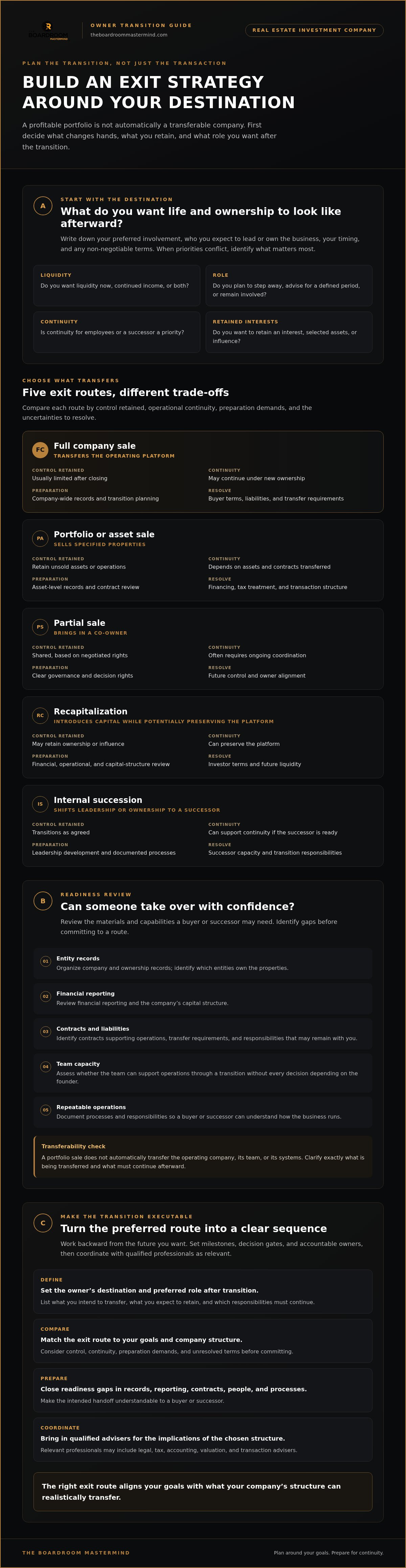
Once your destination is clear, compare routes by what changes hands, what remains yours, and who must keep the business running. A full company sale may transfer an operating platform; an asset sale may dispose of selected properties while leaving the company intact. A partial sale or recapitalization can bring in capital while preserving some ownership, while internal succession shifts leadership or ownership to a successor. Compare each route against your objectives, the company’s structure, and the work required to maintain operations through the transition.
The right exit route is the one that aligns your goals with what your company’s structure can realistically transfer.
| Route | Control retained | Operational continuity | Preparation demands | Key uncertainties |
|---|---|---|---|---|
| Full company sale | Usually limited after closing | May continue under new ownership | Company-wide records and transition planning | Buyer terms, liabilities, and transfer requirements |
| Portfolio or asset sale | Retain unsold assets or operations | Depends on assets and contracts transferred | Asset-level records and contract review | Financing, tax treatment, and transaction structure |
| Partial sale | Shared, based on negotiated rights | Often requires ongoing coordination | Clear governance and decision rights | Future control and owner alignment |
| Recapitalization | May retain ownership or influence | Can preserve the platform | Financial, operational, and capital-structure review | Investor terms and future liquidity |
| Internal succession | Transitions as agreed | Can support continuity if the successor is ready | Leadership development and documented processes | Successor capacity and transition responsibilities |
Company sale or property sale?
Transferring an operating platform is different from disposing of selected properties. A company transaction may involve employees, contracts, systems, and ownership interests; an asset transaction focuses on specified real estate. Before comparing offers or structures, identify which entities own the properties, which contracts support operations, and what responsibilities would remain with you. Entity structure, contracts, tax consequences, financing, and regulatory considerations can affect the available choices. Ask qualified legal, tax, accounting, and transaction professionals to assess the implications before committing.
Partial exit or succession?
Assess your desired continuing role, successor readiness, decision rights, and who owns each transition responsibility. A practical test is to list recurring decisions and tasks, then identify who can handle each without your involvement. Any items with no clear owner point to a continuity gap to address. Operational transferability matters: explore this business operating system guide for context. Experienced owners may also use a strategic peer environment to challenge assumptions as they weigh options.
Prepare Your Real Estate Company for an Exit with a Readiness Review
Readiness is more than assembling a data room. It’s testing whether the company’s records, leadership, and operating rhythm support the transition you want. For an exit strategy for real estate investment company owners, work through this review in sequence:
- Goals: Confirm the intended timing, owner involvement, and priorities for the transition. Note where priorities could conflict.
- Entity and asset records: Organize entity documents, ownership details, property schedules, and operating agreements. Check that the schedules match your current records and flag discrepancies.
- Financial reporting: Assemble current financial statements and supporting records. List inconsistencies, missing documentation, or unexplained items for professional review.
- Contracts: Inventory leases, financing documents, vendor agreements, and other material commitments. Note renewal dates, termination terms, and any transfer questions for advisers.
- Team and operations: Map key responsibilities, recurring processes, management coverage, and relationships dependent on the founder. Identify work that would stop or slow if you stepped away.
Potential buyers or successors may examine the reliability of records, concentration in tenants, customers, properties, or key relationships, and whether essential work follows repeatable processes. Use the review to surface gaps early, not to assume every issue has the same effect on every transaction. Valuation, tax treatment, securities questions, and transaction documents belong with qualified professionals. The precise diligence list depends on the structure and adviser guidance.
Which operating dependencies could complicate a transition?
Identify decisions only you can make, important relationships held solely by you, and functions with no clear accountable owner. For each recurring task, record the steps, the person responsible, and where relevant information is kept. Then test whether someone else can complete the work without relying on your memory or intervention. Transferability is the company’s ability to continue operating effectively beyond its founder. Clarifying roles and leadership coverage can reveal continuity gaps; this leadership team blueprint offers related context.
What should you organize before adviser conversations?
Start with entity records, property schedules, operating agreements, contracts, and financial statements. Create a simple index showing what you have, what is missing, and which questions need professional input. Keep unresolved issues visible rather than trying to settle every legal, tax, or accounting question yourself before seeking advice. A structured review with experienced peers can also challenge assumptions about founder dependence and leadership readiness. Explore The Boardroom Mastermind Membership as a peer environment for experienced operators strengthening business leadership.
Move from Exit Readiness to an Executable Transition Plan
Readiness creates options. Execution requires a sequence. Turn your preferred route into milestones, decision gates, and named owners so the transition advances without relying on assumptions or one person’s memory. A practical plan can move from confirming owner objectives, to resolving information gaps, to professional review, and then to a decision on whether to proceed. For each step, specify the evidence required to mark it complete.
- Set milestones: Define what must be completed before each phase can begin, such as reconciling records or documenting a key operating process.
- Assign accountability: Name who owns each task, from assembling records to coordinating adviser input. Make ownership explicit rather than assuming someone will handle it.
- Create decision gates: Record what needs to be confirmed before committing to a transaction or transition, including open questions and who has authority to decide.
- Coordinate advisers: Engage legal, tax, accounting, valuation, and transaction professionals as relevant, with clear roles and shared context.
An exit strategy for real estate investment company owners should protect the decision process as well as the intended outcome. Document open questions, dependencies, and who has authority to decide. Separate reversible preparation, such as organizing records or clarifying responsibilities, from transaction decisions that require specialist advice. This lets you make progress while keeping the route open until you have the information needed to commit.
How can an owner reduce execution risk without rushing a sale?
Use a written issue log to track unresolved questions, key-person dependencies, and decisions awaiting review. For each material commitment, note what evidence is needed, who must weigh in, and who makes the final call. Review the log regularly and update it when assumptions change. This keeps preparation moving while leaving room to adjust if professional advice or new information changes your understanding of the options.
When can strategic peer input strengthen exit planning?
Experienced peers can challenge whether your stated goals match your operating model, whether leadership is ready, and whether the proposed transition depends too heavily on you. That perspective is not transaction, legal, or tax advice, and it can’t guarantee an outcome. The Boardroom Mastermind Membership is an elite peer group and educational platform for experienced real estate investors and entrepreneurs. Its quarterly in-person intensive meetings provide an opportunity to audit business models and focus on growth. Consider whether that peer environment is relevant as you test your assumptions.
For strategic collaboration as you assess your business and leadership, explore The Boardroom Mastermind as a peer community for experienced operators.
Build a Transition That Supports Your Next Chapter
A strong exit strategy for real estate investment company owners starts with the destination, not a default transaction. Compare routes based on your objectives and company structure, then assess whether records, leadership, and operations can support the transition. From there, translate your preferred path into clear milestones, decision points, and professional guidance.
The plan should serve more than the business. It should reflect the level of liquidity, involvement, continuity, and control you want after the transition. Pressure-test those priorities with people who understand the demands of operating and scaling a real estate business.
The Boardroom Mastermind Membership brings experienced operators together through peer collaboration, accountability, leadership development, and business-model audits, including quarterly in-person intensive meetings in cities across the United States. It’s a strategic peer environment, not a transaction adviser. Explore The Boardroom Mastermind Membership to learn about the peer community and consider whether it fits your long-range planning. With a clear destination and disciplined preparation, you can move toward your next chapter with a more deliberate plan.
Frequently Asked Questions
What is an exit strategy for a real estate investment company?
An exit strategy for real estate investment company owners is a deliberate plan for transitioning ownership, selected assets, or operating responsibilities in line with personal and business objectives. It defines what the owner wants next, such as liquidity, a continuing role, or a successor-led business, then identifies a suitable route and preparation steps. It isn’t simply the decision to list properties or accept an offer.
Should I sell my real estate company or sell its properties?
That depends on what you want to transfer and retain. Selling properties can dispose of selected assets while leaving the operating company in place. Selling or transferring the company may involve its ownership, operations, contracts, and team. Compare the effects on control and business continuity, then ask qualified legal, tax, and accounting professionals to review entity structure and potential transaction consequences before deciding.
Can I exit a real estate investment company without selling everything?
Yes. Depending on your goals and company structure, you could explore selling selected assets, transferring a partial ownership interest, recapitalizing, or transitioning leadership and ownership internally. These routes may allow you to retain some assets, involvement, or control, but terms and responsibilities vary. Clarify what you want to keep, who will make decisions, and what the transition requires, then seek relevant professional advice.
How do I prepare a real estate investment company for sale?
Start by confirming your objectives and assembling entity records, property schedules, operating agreements, contracts, and reliable financial statements. Review how the business handles recurring work, key relationships, and management responsibilities, especially where operations depend on the founder. Track gaps and questions for advisers. The diligence materials and preparation required will depend on the proposed transaction structure, so coordinate with qualified legal, tax, accounting, valuation, and transaction professionals as relevant.
When should I start planning an exit from my real estate investment company?
Start when you begin weighing a future ownership or leadership transition, not only when you’re ready to pursue a transaction. Early planning gives you time to clarify personal priorities, improve recordkeeping, document recurring processes, and strengthen management continuity. You don’t need to choose a final route immediately. Set a review point to revisit your goals and readiness as business conditions and personal objectives change.

Disclaimer
Mr. Clothier is an expert in real estate investing. As such his experiences are not necessarily typical to the standard real estate investor and whose results may vary. The successes shared on this site are not considered typical. Most individuals who order the educational materials and systems probably do not follow any of the techniques or strategies and consequently make little to no money due to their inaction. The company is in the process of determining the typical success of its clients. Stories shared herein are for example purpose only and should not be construed as "guarantees" of success. Results will vary based on background, education, and experience and actions taken.
This site is not a part of the Google/Facebook website or Google/Facebook Inc. Additionally, this site is NOT endorsed by or affiliated with Google/Facebook in any way. GOOGLE/FACEBOOK is a trademark of GOOGLE/FACEBOOK, Inc.
INCOME DISCLAIMER: This website and the items it distributes contain business strategies, marketing methods and other business advice that, regardless of referenced results and experience, may not produce the same results (or any results) for you. The Boardroom Mastermind makes absolutely no guarantee, expressed or implied, that by following the advice or content available from this web site you will make any money or improve current profits, as there are several factors and variables that come into play regarding any given business. Primarily, results will depend on the nature of the product or business model, the conditions of the marketplace, the experience of the individual, and situations and elements that are beyond your control. As with any business endeavor, you assume all risk related to investment and money based on your own discretion and at your own potential expense.
LIABILITY DISCLAIMER: By reading this website or the documents it offers, you assume all risks associated with using the advice given, with a full understanding that you, solely, are responsible for anything that may occur as a result of putting this information into action in any way, and regardless of your interpretation of the advice. You further agree that The Boardroom Mastermind, its affiliates, subsidiaries, officers and agents, cannot be held responsible in any way for the success or failure of your business as a result of the information provided. It is your responsibility to conduct your own due diligence regarding the safe and successful operation of your business. In summary, you understand that we make absolutely no guarantees regarding income as a result of applying this information, as well as the fact that you are solely responsible for the results of any action taken on your part as a result of any given information. In addition, you agree that our content is to be considered "for entertainment purposes only". Always seek the advice of a professional when making legal, financial, tax, or business decisions.
BUSINESS OPPORTUNITY: All products and services offered by The Boardroom Mastermind are intended to provide prospective purchasers with general business strategies, marketing methods and other general advice for business development and training. At no point is The Boardroom Mastermind soliciting anyone to enter into a new business nor is it representing, either expressly or by implication, that it will provide locations for a business, provide outlets, accounts, or customers, or purchase any of the goods or services made by the purchaser.
The products being offered through this promotion are packages of informational tools to help you learn about business and deal making strategies.


