
Real Estate Crisis Management: CEO Resilience Playbook
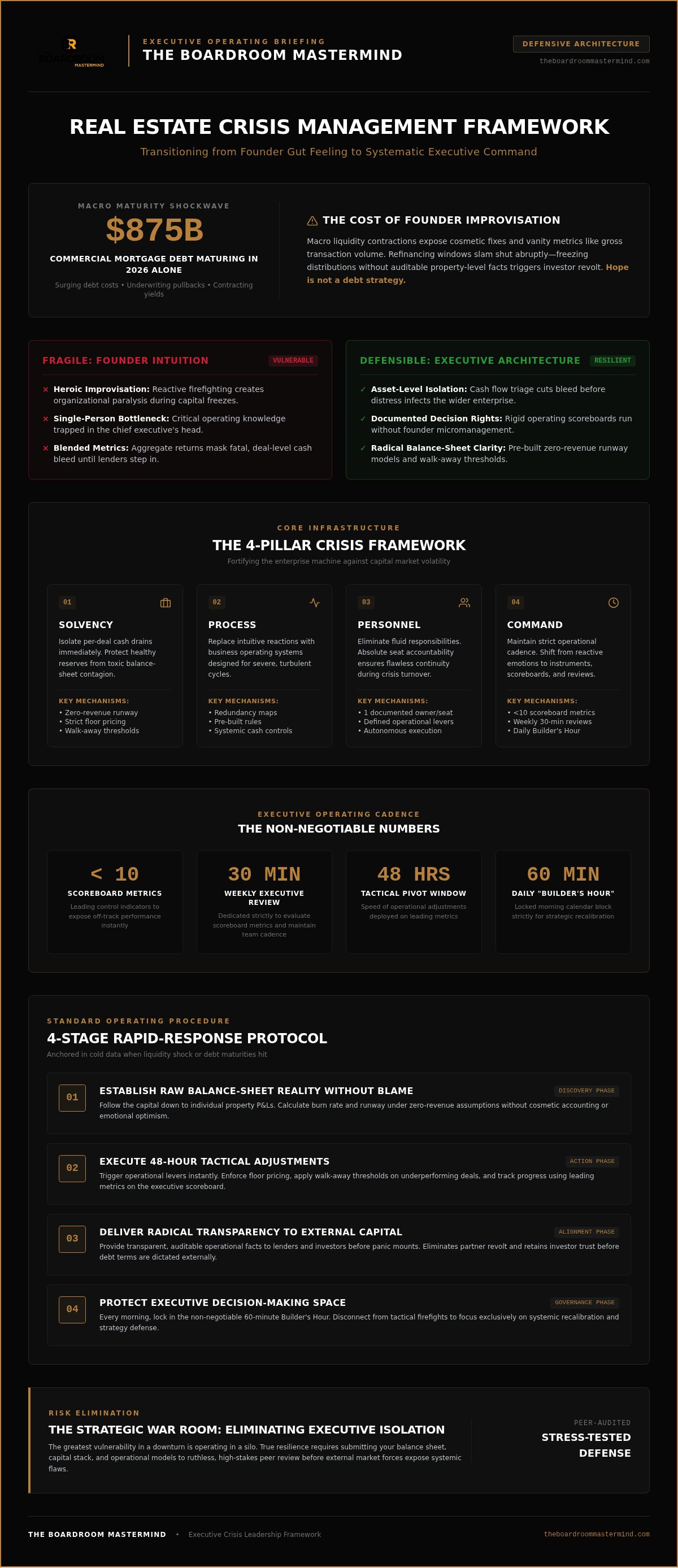
When a sudden liquidity shock strikes, heroic founder improvisation is the fastest path to insolvency. You already know that shifting market cycles don't care about past performance. With $875 billion in commercial mortgage debt maturing in 2026 alone and lender underwriting growing increasingly stringent, relying on founder gut feeling leaves your enterprise completely exposed to capital freezes, partnership friction, and operational chaos. True crisis management for real estate companies isn't an exercise in frantic, emotional fire-fighting. It demands rigorous, pre-built operational architecture and total balance-sheet clarity long before market turbulence arrives.
In this executive briefing, you'll discover how elite real estate operators build defensible systems, isolate core cash flows, safeguard investor capital, and maintain composure through catastrophic market disruptions. We examine the exact rapid-response operational frameworks, capital fortification standards, and disciplined weekly scoreboard cadences you need to transition permanently from reactive panic to systematic, decisive executive command.
Key Takeaways
- Effective crisis management for real estate companies replaces founder intuition with systemic balance-sheet defense and property-level cash flow isolation.
- Fortify your business architecture around four non-negotiable pillars: Solvency, Process, Personnel, and Strategic Command to contain capital shocks before they spread.
- Deploy a rapid-response protocol anchored in cold data, implementing 48-hour tactical adjustments tracked on a disciplined scoreboard of fewer than ten total metrics.
- Eliminate the risks of executive isolation by submitting your balance sheet and operational models to high-stakes peer review in a dedicated strategic war room.
The Real Anatomy of Real Estate Crises: Where Portfolios Actually Break
Real estate crises rarely stem from isolated physical accidents or bad luck. They expose structural fragility. In reality, established crisis management principles prove that enterprise survival isn't about purchasing liability insurance or relying on optimistic investor updates. True resilience requires disciplined balance-sheet defense. When macroeconomic liquidity contracts, organizations anchored to founder intuition freeze instantly. Defensible crisis management for real estate companies must isolate financial shocks at the individual asset level before distress infects the broader machine. Cosmetic fixes won't save a broken capital stack.
Capital and Debt Maturity Shocks
Surging debt costs and abrupt lender pullbacks expose cosmetic safety measures immediately. Real estate operators who prioritize vanity metrics like gross transaction volume over ruthless per-deal unit economics get caught without cover. When debt yields contract and refinancing windows slam shut, freezing investor distributions without transparent, auditable facts triggers rapid revolt. You cannot out-raise negative cash margins. You must follow the money down to the specific property P&L, cutting bleed before lenders dictate your restructuring terms. Hope isn't a debt strategy.
Operational Single-Points-of-Failure
Vulnerability compounds exponentially when operational execution resides entirely in one founder's head. The second capital freezes or market volatility accelerates, that key-person dependency creates organizational paralysis. Unclear seat accountability guarantees chaos during rapid team turnover, compounding debt stress with operational failure. Systematic crisis management for real estate companies mandates documented decision rights, rigid scoreboards, and operational redundancies that function flawlessly without the chief executive's continuous intervention. When the machine runs on process rather than personality, the portfolio endures.
The 4-Pillar Crisis Framework: Fortifying the Real Estate Machine
SaaS notification tools and passive alerts cannot protect enterprise equity when markets seize. Practical business continuity and preparedness guidelines demonstrate that survivability hinges on disciplined infrastructure, not ad-hoc software fixes. Robust crisis management for real estate companies rests upon four non-negotiable pillars: Solvency, Process, Personnel, and Strategic Command. By building a business operating system designed for turbulent cycles, operators establish clear decision rules that isolate systemic volatility before distress spreads across the broader organization.
Cash Flow Triage and Solvency Safeguards
Portfolio survival requires radical visibility into per-deal liquidity. Calculating aggregate returns hides dangerous asset-level cash drains. Operators must establish immutable walk-away thresholds and strict floor pricing long before lenders apply pressure. Know your exact daily burn rate and cash runway under zero-revenue assumptions. When you isolate underperforming assets early, you protect healthy capital reserves from toxic balance-sheet contagion.
Command Cadence and Role Accountability
Crisis creates paralysis when team responsibilities remain fluid. Every critical seat must have exactly one documented owner with absolute authority over defined operational levers. To maintain operational rhythm, institute a mandatory weekly thirty-minute executive review. This session exists solely to evaluate leading control indicators on an operating scoreboard of fewer than ten total metrics, exposing off-track performance instantly. Comprehensive crisis management for real estate companies replaces founder bottlenecking with systematic, autonomous command.
Step-by-Step Response Protocol: Leading Real Estate Teams Through Disruption
Panic is an operational failure. When sudden debt maturities or capital freezes hit your desk, emotion must yield to instruments. Sound executive governance, supported by research in the Stanford GSB crisis leadership playbook, dictates an unyielding four-stage protocol: establish raw balance-sheet reality without blame, execute 48-hour tactical adjustments on leading metrics, deliver radical transparency to external capital, and protect your executive decision-making space. Every morning, lock in the Builder's Hour, a non-negotiable 60-minute calendar block dedicated strictly to strategic recalibration and balance-sheet fortification before the operational noise begins.
Stakeholder Alignment and Capital Preservation
Silence destroys trust faster than operational headwinds. When capital markets shift, initiate contact with senior lenders and banking partners using precise debt-yield calculations, current rent collections, and stress-tested liquidity forecasts. If syndication distributions must pause, deliver hard numbers immediately rather than sugarcoating performance. Align your communications directly with the institutional disciplines outlined in our briefing on real estate private equity governance. Lenders and limited partners respect operators who lead with cold reality.
Maintaining the 30-Minute Weekly Scoreboard Meeting
True crisis management for real estate companies forbids conversational status theater. Structure your weekly tactical meeting around three rigid mandates:
- Read pure data: Review your operating scoreboard tracking no more than ten total metrics, mixing three to five leading indicators with hard lagging financial facts.
- Eliminate excuses: Forbid defensive narratives or lengthy historical storytelling around off-track numbers.
- Isolate one action: Assign the team exactly one priority operational fix to implement over the following seven days.
To audit your leadership command and upgrade your firm's crisis systems, apply to join The Boardroom Mastermind and review your operating architecture alongside proven industry leaders.
The Strategic War Room: Building an Unshakeable Peer-Audited Defense
Founder isolation is lethal during market contractions. When liquidity dries up or debt structures wobble, solitary leaders default to emotion, denial, and cognitive fatigue. Passive market commentary will never pressure-test your specific balance sheet. True crisis management for real estate companies requires subjecting your underwriting models, capital exposure, and operational cash burn to rigorous external scrutiny. Defensible resilience is built in war rooms, never inside an executive vacuum.
Eliminating Blind Spots with Peer Audits
Navigating complex downturns without battle-tested counsel invites disaster. High-performing operators actively leverage peer advisory group strategies to audit their business models long before lenders force the issue. Structured quarterly intensives dismantle creeping operational bloat and uncover hidden balance-sheet vulnerabilities through unsparing cross-examination. Objective counsel from peers running eight- and nine-figure enterprises cuts through internal rationalizations, holding your leadership accountable to cold metrics rather than founder instinct.
Transitioning to Unbreakable CEO Leadership
Market volatility demands an uncompromising evolution from frantic fire-fighting to composed architectural command. Safeguarding family assets and enterprise value requires battle-tested operational playbooks, institutional governance, and total leadership team accountability under fire. When your organization executes systematically, macro disruption shifts from an existential crisis into an unprecedented competitive advantage. Decisive crisis management for real estate companies replaces anxiety with structural command.
To pressure-test your balance sheet alongside an elite network of proven 7-, 8-, and 9-figure real estate operators, apply for membership in The Boardroom Mastermind.
Institutionalize Your Defense: Command the Next Market Cycle
Market cycles don't negotiate, and they certainly don't reward panic. True resilience isn't an accident of luck; it's an intentional engineering choice. Defensible crisis management for real estate companies demands uncompromising balance-sheet governance, property-level cash visibility, and disciplined scoreboard cadences that run without executive bottlenecking. When macroeconomic shocks strike, pre-built operational systems preserve enterprise equity while emotional firefighting burns it.
You don't have to navigate high-stakes industry volatility in isolation. Facilitated by veteran founder Kent Clothier, bringing over two decades of experience scaling national enterprises, our quarterly business model audits pressure-test the operational architecture of established 7-, 8-, and 9-figure founders. We curate a strictly vetted peer network that rejects 95% of applicants to protect the caliber and discretion of the room. Fortify your business alongside elite 8-figure operators in The Boardroom Mastermind. Step into decisive executive command and secure your enterprise advantage today.
Frequently Asked Questions
What are the first steps a real estate CEO must take during a sudden market freeze?
A real estate CEO must immediately freeze uncommitted capital outlays and establish total balance-sheet transparency. Dedicate your 60-minute Builder's Hour to auditing per-deal cash burn rather than relying on aggregate portfolio averages. Contact senior lenders with audited property data, review debt covenants, and eliminate discretionary overhead. Systematic crisis management for real estate companies requires replacing emotional reactivity with verifiable instruments, isolating asset-level vulnerabilities before external creditors dictate your terms.
How do real estate companies separate true operational crises from temporary market downturns?
You separate operational crises from broader cyclical downturns by measuring asset-level unit economics rather than macro sentiment. If your debt yields compress, conversion speeds drop, or key personnel seats fail while competitors maintain pace, you face an internal systemic operational crisis. Downturns compress cap rates and soften transaction velocity, but operational failures destroy margins from within. Tracking fewer than ten total metrics on a weekly scoreboard reveals whether failure stems from execution or macroeconomic climate.
What leading indicators warn real estate operators of an impending liquidity crunch?
Leading indicators surface weeks before a balance-sheet crisis manifests on your P&L. Watch for extended loan-closing cycles beyond 14 days, dropping debt-yield margins on active refinancings, and decelerating daily cash collection velocities. When accounts receivable stretch past 30 days or tenant lease concessions spike across individual assets, your cash buffer is actively evaporating. Monitoring three to five leading indicators weekly alerts executive leadership to liquidity shortfalls long before balloon maturities arrive.
How should real estate leaders communicate catastrophic project delays to private investors?
Communicate catastrophic delays with unsparing mathematical transparency rather than optimistic narrative spinning. State the exact schedule variance, the capital impact per equity tranche, the root cause, and the single concrete action underway to resolve it. Never sugarcoat distress or delay communication until distributions pause. Private investors forgive market headwinds and execution delays when leaders provide predictable, auditable updates. They revolt only when silence masks compounding balance-sheet decay.
Why do standard corporate crisis templates fail when applied to real estate investment firms?
Generic corporate playbooks assume crises center on public relations, product recalls, or server outages. They fail because crisis management for real estate companies is inherently tied to asset-level capital structures, illiquid balance sheets, and strict debt covenants. Real estate disruption requires urgent cash flow triage, debt workouts, and seat-specific operational accountability. Drafting a press release won't cure a defaulting loan; enforcing strict pricing floors, maintaining lender relationships, and executing structural capital preservation will.

Disclaimer
Mr. Clothier is an expert in real estate investing. As such his experiences are not necessarily typical to the standard real estate investor and whose results may vary. The successes shared on this site are not considered typical. Most individuals who order the educational materials and systems probably do not follow any of the techniques or strategies and consequently make little to no money due to their inaction. The company is in the process of determining the typical success of its clients. Stories shared herein are for example purpose only and should not be construed as "guarantees" of success. Results will vary based on background, education, and experience and actions taken.
This site is not a part of the Google/Facebook website or Google/Facebook Inc. Additionally, this site is NOT endorsed by or affiliated with Google/Facebook in any way. GOOGLE/FACEBOOK is a trademark of GOOGLE/FACEBOOK, Inc.
INCOME DISCLAIMER: This website and the items it distributes contain business strategies, marketing methods and other business advice that, regardless of referenced results and experience, may not produce the same results (or any results) for you. The Boardroom Mastermind makes absolutely no guarantee, expressed or implied, that by following the advice or content available from this web site you will make any money or improve current profits, as there are several factors and variables that come into play regarding any given business. Primarily, results will depend on the nature of the product or business model, the conditions of the marketplace, the experience of the individual, and situations and elements that are beyond your control. As with any business endeavor, you assume all risk related to investment and money based on your own discretion and at your own potential expense.
LIABILITY DISCLAIMER: By reading this website or the documents it offers, you assume all risks associated with using the advice given, with a full understanding that you, solely, are responsible for anything that may occur as a result of putting this information into action in any way, and regardless of your interpretation of the advice. You further agree that The Boardroom Mastermind, its affiliates, subsidiaries, officers and agents, cannot be held responsible in any way for the success or failure of your business as a result of the information provided. It is your responsibility to conduct your own due diligence regarding the safe and successful operation of your business. In summary, you understand that we make absolutely no guarantees regarding income as a result of applying this information, as well as the fact that you are solely responsible for the results of any action taken on your part as a result of any given information. In addition, you agree that our content is to be considered "for entertainment purposes only". Always seek the advice of a professional when making legal, financial, tax, or business decisions.
BUSINESS OPPORTUNITY: All products and services offered by The Boardroom Mastermind are intended to provide prospective purchasers with general business strategies, marketing methods and other general advice for business development and training. At no point is The Boardroom Mastermind soliciting anyone to enter into a new business nor is it representing, either expressly or by implication, that it will provide locations for a business, provide outlets, accounts, or customers, or purchase any of the goods or services made by the purchaser.
The products being offered through this promotion are packages of informational tools to help you learn about business and deal making strategies.


