
Real Estate Capital Raising Strategies: Scaling to 8-Figure Institutional Architecture
Scaling your portfolio to an eight-figure institutional level isn't a matter of finding more deals; it's a matter of re-engineering your business architecture. Most operators hit a ceiling because they rely on an exhausted pool of friends and family, treating capital as a series of one-off transactions rather than a continuous, systematic flow. You've likely felt the frustration of a capital bottleneck stalling a prime acquisition while you struggle to prove your credibility to family offices. Your real estate capital raising strategies are built for an operator, not a CEO.
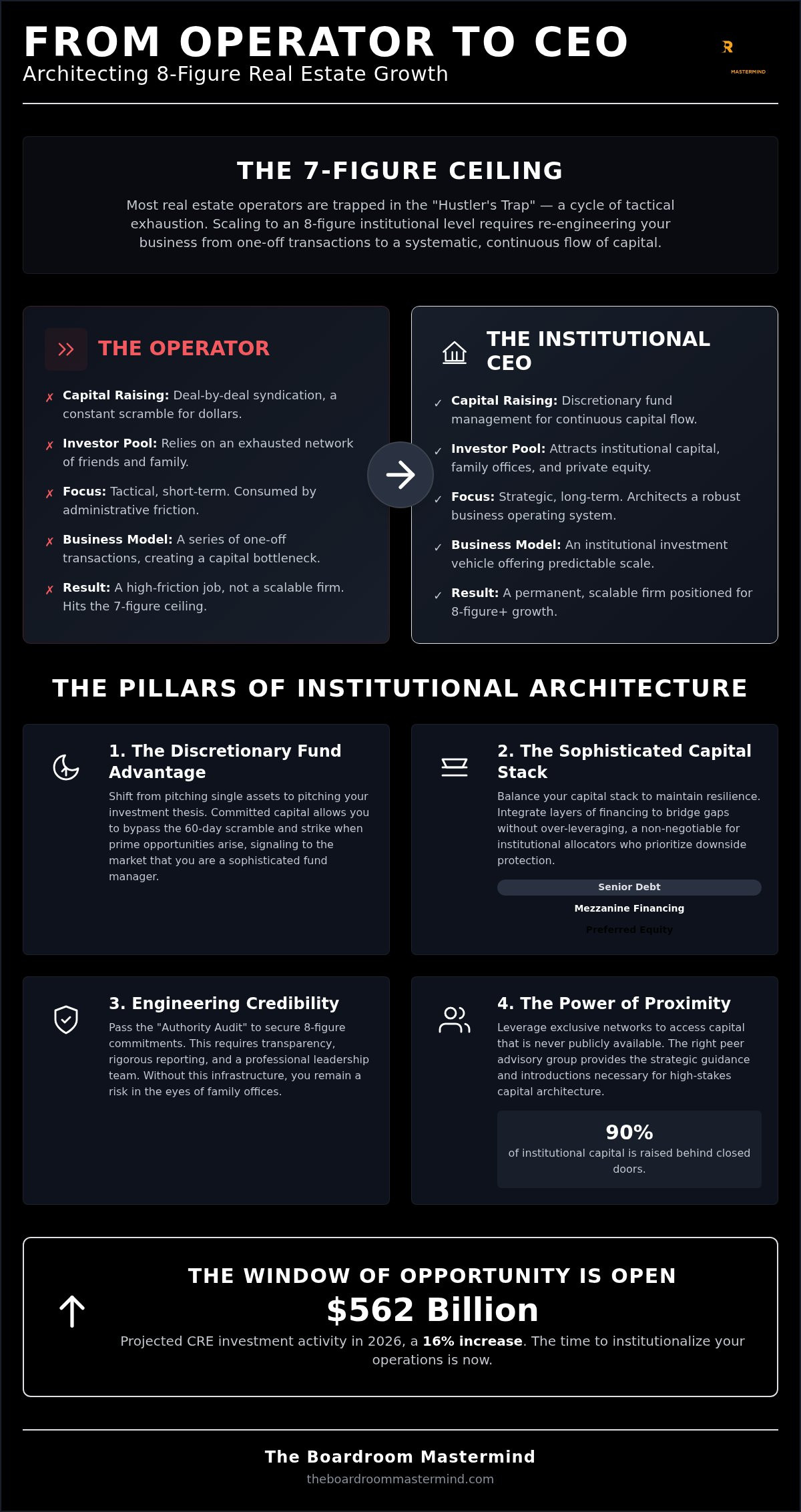
This briefing, rooted in Kent Clothier's leadership and high-level business auditing, will show you how to master the sophisticated structures required to transition from deal-by-deal syndication to institutional-grade fund management. We'll examine the shift to predictable systems for continuous capital flow. With CRE investment activity projected to rise by 16% in 2026, reaching $562 billion, the window to institutionalize your operations is open. Through The Boardroom Mastermind, you'll learn to secure your seat at the table with global high achievers.
Key Takeaways
- Escape the "hustler's trap" by transitioning from deal-by-deal syndication to discretionary fund management, allowing for true institutional scaling.
- Architect a sophisticated 2026 capital stack that balances senior debt, mezzanine financing, and preferred equity to maintain resilience in a shifting market.
- Implement elite real estate capital raising strategies by passing the "Authority Audit" required to secure 8-figure commitments from family offices and private equity.
- Leverage the "Power of Proximity" within exclusive networks to access the 90% of institutional capital that is raised behind closed doors.
The 7-Figure Ceiling: Why Tactical Capital Raising Fails at Scale
Most real estate operators are trapped in a cycle of tactical exhaustion. You find a deal, then you scramble to find the dollars. This "Hustler's Trap" of deal-by-deal syndication is the primary barrier to reaching an 8-figure portfolio. When you rely on a fragmented pool of retail investors, your bandwidth as a CEO is consumed by administrative friction rather than strategic growth. Managing 100 individual investors isn't scaling; it's a full-time job in customer service that drains the energy needed for high-level acquisition.
To break through, you must redefine your target. Transitioning to institutional real estate investment standards means shifting your focus toward family offices and private equity. These entities don't just provide capital; they provide the fuel for a predictable, scalable business model. If your current real estate capital raising strategies feel like a series of frantic tasks, your business architecture is likely the bottleneck. True scale requires a robust business operating system that positions you as a peer to institutional allocators.
Operator vs. CEO: The Capital Mindset Shift
Stop asking for money. Start offering an institutional investment vehicle. An operator focuses on the next check; a CEO focuses on architecting a capital stack that ensures long-term permanence. This shift requires you to step away from the daily pitch and move toward strategic oversight. Your role is to build the framework that makes capital an inevitability, not a variable.
Identifying the Scaling Bottlenecks
Audit your investor relations today. If your process relies on your personal involvement for every update, you've built a job, not a firm. Sophisticated capital demands transparency, rigorous reporting, and a professional leadership team to manage compliance. Without these systems, you remain a risk in the eyes of family offices. Transitioning to 8-figure real estate capital raising strategies is impossible without the infrastructure to support it.
Institutional Capital Architecture: Structuring for 8-Figure Growth
Scaling beyond $10 million requires a fundamental shift from chasing deals to architecting a permanent capital vehicle. Individual syndications are tactical; discretionary funds are strategic. When you move toward fund management, you stop pitching a single asset and start pitching your investment thesis. Family offices and 9-figure wealth managers don't want to vet every property. They want to vet your process, your team, and your ability to execute within a real estate private equity framework.
Success in 2026 hinges on your ability to balance the capital stack. With 30-year fixed mortgage rates hovering around 6.75%, the cost of debt has fundamentally changed. Sophisticated real estate capital raising strategies now integrate mezzanine financing and preferred equity to bridge gaps without over-leveraging. This level of complexity is non-negotiable for building investor trust among institutional allocators who prioritize downside protection and operational discipline.
The Discretionary Fund Advantage
Speed is your greatest asset in a competitive market. Committed capital allows you to strike when prime opportunities arise, bypassing the 60-day scramble of a traditional raise. Evergreen structures further reduce investor fatigue, creating a long-term partnership rather than a series of transactional requests. This architecture signals to the market that you are no longer an operator, but a sophisticated fund manager.
Sophisticated Debt Management
Managing CRE debt risks in 2026 requires a defensive posture. Institutional lenders are increasingly selective, prioritizing CEOs who demonstrate a track record of stability. Often, the difference between a rejected term sheet and a closed deal is the strategic guidance found within a peer advisory group. Surrounding yourself with visionaries who have navigated high-stakes debt architecture is the ultimate shortcut to credibility. If you're ready to audit your current structure, joining an elite mastermind community is the next logical step.
Engineering Credibility: The CEO’s Blueprint for High-Net-Worth Trust
Institutional investors perform an "Authority Audit" that extends far beyond your balance sheet. They evaluate your leadership, your team, and your operational maturity before committing a single dollar. As CRE investment activity is projected to rise by 16% in 2026, reaching $562 billion, the competition for high-net-worth trust will intensify. Successful real estate capital raising strategies rely on a 2026 business plan that projects growth with surgical precision. This requires a "Transparency Engine" comprised of reporting systems that mirror institutional standards.
Reporting as a Strategic Asset
Move your investor relations beyond fragmented email threads. High-level allocators demand unified platforms for communication and onboarding. By automating the "Trust Loop" through data-rich investor portals, you eliminate the manual friction that suggests amateurism. Top-tier founders utilize quarterly business audits to identify operational drift before it causes stagnation. Consistency in reporting isn't just administrative; it is a strategic asset that secures permanence.
The Social Proof of Elite Associations
Your network remains the ultimate validator for institutional partners. Proximity to 8 and 9-figure visionaries provides a level of social proof that no pitch deck can replicate. Institutional wealth managers often look at your associations as a proxy for your risk profile. Within The Boardroom Mastermind, members have leveraged this strategic proximity to close 8-figure deals that were previously out of reach. Access to elite circles transforms your credibility from a claim into a fact. If you are ready to audit your leadership and scale your impact, apply to join our next quarterly intensive.
The Proximity Advantage: Leveraging Elite Networks for Capital Flow
Institutional capital doesn't reside on public forums or at local networking mixers. It moves through restricted channels where trust is the primary currency. Approximately 90% of institutional-grade capital is raised behind closed doors; it is the result of strategic proximity rather than public solicitation. To access these 8-figure stacks, you must position yourself within the circles where these decisions are made. The Boardroom Mastermind provides this exact environment, engineering direct access to 8 and 9-figure real estate visionaries who have already mastered the architecture of scale.
Under the leadership of Kent Clothier, our quarterly intensives serve as a high-stakes catalyst for your growth. These are not passive seminars. They are rigorous business audits where your current real estate capital raising strategies are stress-tested by peers who operate at the highest tiers of financial success. By auditing your model among those who have already scaled, you graduate from the friction of daily "hustling" to the clarity of CEO oversight. This transition is essential for anyone looking to manage capital at an institutional level.
Accessing Restricted Capital Circles
High-ticket exclusive mastermind groups are the ultimate shortcut for bypassing traditional gatekeepers. When you operate in isolation, you are limited by your own perspective and an exhausted pool of local investors. Transitioning into a national institutional architect requires a shift in environment. In these restricted spaces, a single strategic conversation can replace months of cold outreach and failed pitches.
Next Steps: Auditing Your Scaling Potential
Is your business truly ready for 8-figure commitments? The Boardroom Litmus Test determines if your systems can withstand the scrutiny of a family office. We select only the elite 5% of real estate leaders who are committed to strategic permanence and long-term impact. It's time to stop chasing checks and start building an institution. Audit your business model and scale your capital raising at the next Boardroom Intensive.
Architecting Your Institutional Future
Scaling to an eight-figure portfolio is no longer about the next deal; it's about business architecture permanence. To leave the "hustler's trap" behind, you must transition from a tactical operator to a strategic CEO. This requires more than capital. It demands a sophisticated capital stack, institutional reporting, and elite credibility. Your real estate capital raising strategies must meet the standards of family offices and allocators who value operational discipline over mere activity.
True growth happens through strategic proximity. Led by Kent Clothier and the REWW leadership team, our quarterly intensives provide the auditing necessary to refine your model for 8-figure growth. You gain access to a peer network of 7, 8, and 9-figure investors who understand the weight of global wealth architecture. It's time to stop chasing and start leading. Apply to join the elite network of 8-figure real estate CEOs at The Boardroom Mastermind and secure your place among the industry's visionaries.
Frequently Asked Questions
What is the difference between real estate syndication and a private equity fund?
Real estate syndication is a transactional, deal-by-deal model where you must raise capital for every individual asset. A private equity fund is a discretionary pool of capital that allows for rapid, strategic execution. In a syndication, you're selling the property. In a fund, you're selling your investment thesis and leadership team. Funds provide the permanence required to attract institutional allocators and move beyond the retail investor pool.
How do I attract family office investment for my real estate deals?
Attracting family office investment requires passing a rigorous "Authority Audit" of your leadership and systems. These wealth managers value capital preservation and operational discipline over aggressive projections. To win their trust, you must implement institutional-grade reporting and a professional leadership team. Sophisticated real estate capital raising strategies for family offices focus on long-term partnership and the ability to deploy 8-figure capital stacks into resilient assets.
What are the most effective capital raising strategies for 2026?
Success in 2026 relies on leveraging discretionary capital and "Transparency Engines." With a projected 16% increase in CRE investment volume, the most effective real estate capital raising strategies focus on speed and certainty of close. You must move away from high-friction retail models. By utilizing committed funds and sophisticated debt stacks, you can capitalize on market shifts while maintaining the operational transparency that institutional investors demand.
Do I need a specific business operating system to raise institutional capital?
Raising institutional capital is impossible without a business operating system that supports autonomous growth. High-net-worth investors and family offices don't invest in "hustlers"; they invest in CEOs who lead scalable organizations. Your infrastructure must provide real-time data, rigorous compliance, and a leadership team that functions without your daily intervention. This systematic approach transforms your firm from a tactical operator into a credible, institutional-grade investment vehicle.
How does joining a mastermind group help with real estate capital raising?
Joining an elite mastermind group provides the strategic proximity necessary to bypass traditional gatekeepers. Most 8-figure capital is raised in restricted circles rather than public platforms. Through quarterly intensives led by Kent Clothier, you audit your business model alongside 7, 8, and 9-figure real estate visionaries. This peer network serves as a validator for your credibility, offering the social proof and high-level connections required to scale your impact.

Disclaimer
Mr. Clothier is an expert in real estate investing. As such his experiences are not necessarily typical to the standard real estate investor and whose results may vary. The successes shared on this site are not considered typical. Most individuals who order the educational materials and systems probably do not follow any of the techniques or strategies and consequently make little to no money due to their inaction. The company is in the process of determining the typical success of its clients. Stories shared herein are for example purpose only and should not be construed as "guarantees" of success. Results will vary based on background, education, and experience and actions taken.
This site is not a part of the Google/Facebook website or Google/Facebook Inc. Additionally, this site is NOT endorsed by or affiliated with Google/Facebook in any way. GOOGLE/FACEBOOK is a trademark of GOOGLE/FACEBOOK, Inc.
INCOME DISCLAIMER: This website and the items it distributes contain business strategies, marketing methods and other business advice that, regardless of referenced results and experience, may not produce the same results (or any results) for you. The Boardroom Mastermind makes absolutely no guarantee, expressed or implied, that by following the advice or content available from this web site you will make any money or improve current profits, as there are several factors and variables that come into play regarding any given business. Primarily, results will depend on the nature of the product or business model, the conditions of the marketplace, the experience of the individual, and situations and elements that are beyond your control. As with any business endeavor, you assume all risk related to investment and money based on your own discretion and at your own potential expense.
LIABILITY DISCLAIMER: By reading this website or the documents it offers, you assume all risks associated with using the advice given, with a full understanding that you, solely, are responsible for anything that may occur as a result of putting this information into action in any way, and regardless of your interpretation of the advice. You further agree that The Boardroom Mastermind, its affiliates, subsidiaries, officers and agents, cannot be held responsible in any way for the success or failure of your business as a result of the information provided. It is your responsibility to conduct your own due diligence regarding the safe and successful operation of your business. In summary, you understand that we make absolutely no guarantees regarding income as a result of applying this information, as well as the fact that you are solely responsible for the results of any action taken on your part as a result of any given information. In addition, you agree that our content is to be considered "for entertainment purposes only". Always seek the advice of a professional when making legal, financial, tax, or business decisions.
BUSINESS OPPORTUNITY: All products and services offered by The Boardroom Mastermind are intended to provide prospective purchasers with general business strategies, marketing methods and other general advice for business development and training. At no point is The Boardroom Mastermind soliciting anyone to enter into a new business nor is it representing, either expressly or by implication, that it will provide locations for a business, provide outlets, accounts, or customers, or purchase any of the goods or services made by the purchaser.
The products being offered through this promotion are packages of informational tools to help you learn about business and deal making strategies.


