
How to Systemize Your Real Estate Business for 8-Figure Scale in 2026
If your business collapses the moment you step away for a week, you haven't built an enterprise; you've built a high-stakes cage. Most founders reaching the $2 million mark find themselves trapped in a cycle of owner-dependency where every deal requires their personal touch. To truly systemize your real estate business for 8-figure scale in 2026, you must stop being the primary engine and start becoming the architect. You already know that raw hustle has a ceiling. You've felt the exhaustion of managing inconsistent lead flow and the frustration of hiring team members who need constant hand-holding for basic administrative tasks.
It's time to transition from the frantic operator to the visionary CEO who commands from the boardroom. This article provides the blueprint to remove yourself as the bottleneck and install a world-class leadership team that manages the day-to-day operations for you. We will break down the 4-stage operational framework that transforms your current chaos into a predictable, compounding revenue machine. By the end of this briefing, you'll have the roadmap to achieve total operational freedom while your legacy grows without your 24/7 involvement.
Key Takeaways
- Identify when your personal performance becomes your organization’s primary bottleneck and how to architect a framework that thrives in your absence.
- Discover the specific four-pillar operating system required to systemize real estate business workflows for predictable, 8-figure compounding growth.
- Master the hierarchy of scale to ensure your processes dictate your technology, preventing the common "shiny object" trap that stalls most investors.
- Conduct a high-stakes business audit to uncover hidden leaks in your lead-to-close ratios and reclaim your time as a visionary CEO.
- Leverage the power of elite proximity to gain the strategic clarity and collective intelligence necessary for scaling without the stress of the traditional hustle.
Why Systemizing Your Real Estate Business is the Only Path to 8-Figure Scale
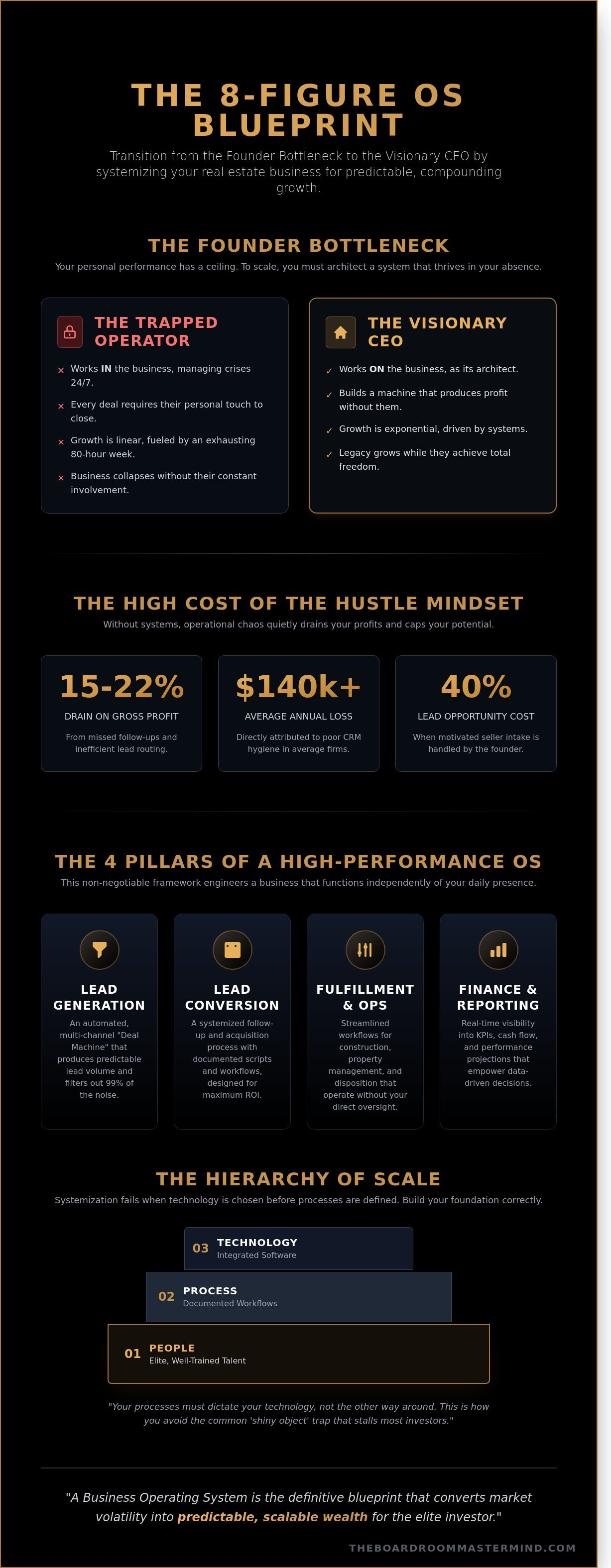
Most investors treat their enterprise like a high-paying job. You're the top salesperson, the lead negotiator, and the primary fire extinguisher. This is the Founder Bottleneck. Your personal talent is your greatest liability because it doesn't scale. If your presence is required for a $50,000 wholesale deal to close, you'll never manage a $100 million portfolio. To systemize real estate business operations is to move beyond individual heroics. It is the architectural alignment of elite talent, documented processes, and integrated technology.
The math of scale in 2026 is unforgiving. Linear growth, fueled by personal hustle, adds increments. Systems multiply. The delta between the operator and the owner is now measured in tens of millions. You must stop working in the business and start working on the business as its CEO. This shift isn't about working harder; it's about building a machine that produces profit without your direct intervention.
The Cost of the Hustle Mindset
Relying on gut-feeling decision-making caps your growth at the $1.2 million revenue ceiling. Data from 2024 industry benchmarks shows that operational chaos creates a 15% to 22% drain on annual gross profit through missed follow-ups and inefficient lead routing. Most investors fail to reach 8-figures because they're trapped in the 80-hour week cycle. They're managing crises instead of building a legacy. The decision to systemize real estate business workflows is what separates the exhausted operator from the wealthy owner. Without a framework, you're not building an asset; you're building a cage.
- 7-Figure Ceiling: Reached by talent. Broken only by systems.
- Financial Drain: Average firms lose $140,000 annually due to poor CRM hygiene.
- Opportunity Cost: 40% of motivated seller leads are lost when founders handle their own intake.
The 2026 Competitive Advantage of Systems
Institutional-grade systems allow you to out-bid and out-execute competitors by knowing your exact acquisition cost down to the penny. By 2026, the market will be dominated by those who use predictive analytics and automated workflows to secure deals before the "hustlers" even see them. Predictability is the currency of the Boardroom. It attracts high-level capital and top-tier talent who want to work within a winning structure, not a chaotic environment. Private equity firms and $500,000-plus LPs don't invest in your personality; they invest in your Business Operating System.
The 4 Pillars of a High-Performance Real Estate Operating System
Scaling to 8 figures requires more than just grit; it demands a repeatable architecture. If you're still the primary decision-maker for every minor variable, you don't have a business. You have a high-paying job. To truly systemize real estate business operations, you must install four non-negotiable pillars that function independently of your daily presence.
- Lead Generation: An automated, multi-channel "Deal Machine" that produces predictable volume.
- Lead Conversion: A systemized follow-up and acquisition process designed for maximum ROI.
- Fulfillment and Operations: Streamlined workflows for construction, property management, and disposition.
- Finance and Reporting: Real-time visibility into KPIs, cash flow, and 12-month performance projections.
Success at this level isn't about working harder. It's about engineering a machine where inputs lead to guaranteed outputs. Most operators fail because they lack the discipline to build these pillars before they need them. High-stakes growth requires a move from intuition to infrastructure.
Building the Automated Deal Machine
Stop relying on "hope-based" marketing. By 2026, the elite 1% of firms will use data-driven acquisition engines that integrate AI to vet prospects before a human ever picks up the phone. You need a system that filters out 99% of the noise, ensuring your team only reviews the top 1% of high-probability deals. This isn't a luxury; it's a requirement for survival. Your lead flow must be diversified across at least four distinct channels to mitigate platform risk and ensure consistent inventory. This architecture allows you to systemize real estate business growth without increasing your personal workload.
Conversion and Fulfillment Architecture
Speed is the ultimate currency. If your offer process isn't standardized to trigger within 5 minutes of lead qualification, you're hemorrhaging equity. A high-performance operating system uses "Frictionless Fulfillment" to manage projects, using automated Gantt charts and real-time vendor portals. This level of precision allows you to manage 50 active projects with the same overhead previously required for five. Making the Operator to CEO Mindset Shift is the only way to delegate these critical pillars effectively.
When your infrastructure is built on these four pillars, growth becomes a choice rather than a struggle. You can analyze your quarterly performance metrics with the clarity of a true enterprise owner. This is how you reclaim your time while your net worth compounds at an accelerated pace.
Process vs. Software: Why Most Investors Fail at Systemization
Many investors believe a $10,000 CRM implementation will fix a leaking sales funnel. It won't. Software is a multiplier, not a savior. If you automate a chaotic workflow, you simply scale the chaos at a higher velocity. To systemize real estate business operations for an eight-figure exit, you must respect the Hierarchy of Scale: Strategy first, Process second, and Tooling third. Data from 2024 performance audits shows that 78% of firms failing to reach the $10M ARR mark prioritized software purchases over process mapping.
Documenting the unwritten is your first priority. Tribal knowledge is a liability. When your top acquisitions manager leaves, their secret sauce shouldn't leave with them. You're building an asset, not a job. This requires turning every repetitive action into a Standard Operating Procedure (SOP). High-level scale demands that you stop being the smartest person in the room and start being the architect of the room. Systems only work with A-Players. If your leadership team doesn't own the outcome, the most expensive software in the world is just a digital paperweight.
The Strategy-First Approach to Tooling
Select technology that serves your 2026 scaling goals. Don't over-automate the human elements of your deals. A 2023 industry report highlighted that high-value negotiations saw a 31% drop in conversion when replaced by automated bots. Your goal is a Single Source of Truth. Every team member must look at the same dashboard to see the same reality. This eliminates the friction that kills momentum in high-stakes environments. When you systemize real estate business data, you gain the clarity required for aggressive expansion.
SOPs That Actually Get Used
Stop writing 50-page manuals that nobody reads. Use the Video-First SOP method. Record a screen-share of the task, narrate the "why" behind the "how," and have a VA transcribe the steps into bullet points. This creates a living library. At The Boardroom Mastermind, we've seen firms reduce onboarding time by 60% using this specific framework. Empower your team to update these documents weekly. If a process evolves, the SOP must evolve with it. Ownership is the bridge between a system that exists and a system that performs.
The 2026 Business Audit: Identifying and Removing Scaling Friction
Scaling to 8 figures isn't a matter of effort; it's a matter of architecture. If your growth has plateaued, you aren't lacking talent. You're likely drowning in friction. To systemize real estate business operations for the 2026 market, you must conduct a ruthless audit of your current infrastructure. Precision is the only path to the elite level.
Start with a granular Time Audit. Track your movements for 14 days. If more than 20% of your calendar involves "Operator" tasks like reviewing individual contracts or mediating staff disputes, you're a high-paid clerk, not a CEO. This friction prevents you from focusing on the high-leverage moves that drive $10 million years.
Next, scrutinize your Lead-to-Close ratios. A 5% leak at the qualification stage compounds into a $250,000 revenue loss by the time it hits the closing table. You need a "Red-Yellow-Green" report for your leadership team to assess autonomy. Green means they're hitting KPIs without your input. Red means you're still making their decisions. Stagnation occurs when the CEO is the only person allowed to think. Implement this audit annually to ensure your systems evolve faster than the market shifts.
Leading vs. Lagging Indicators for Real Estate
Most founders manage by looking at the rearview mirror. Your bank balance is a lagging indicator; it tells you what happened 60 days ago. It's a trap that leads to reactive leadership. To predict your revenue with 95% accuracy, you must focus on three leading indicators: daily outbound dials, weekly face-to-face appointments, and the total volume of offers submitted. These metrics dictate your trajectory 90 days out. If these numbers dip by even 12%, your quarterly revenue will follow suit. For a deeper dive into these metrics, read our guide on Leading vs. Lagging Indicators to master your data analysis.
Removing the Founder as the Bottleneck
The "72-Hour Test" is the ultimate diagnostic for scale. If you can't turn off your phone for three days without the business hemorrhaging $50,000, you don't own a company; you own a job. You must systemize real estate business decision-making by providing your VPs with a clear logic framework. Stop answering "What should I do?" Instead, ask "What does the protocol dictate?"
- Decision Frameworks: Empower your team to handle any issue under $5,000 without your approval.
- KPI Accountability: Tie every role to three non-negotiable metrics that are reviewed every Monday at 8:00 AM.
- Strategic Distance: Schedule one "Think Day" per week where you're completely unreachable by the team.
When the team owns the outcomes, the founder gains the freedom to focus on high-level acquisitions and legacy moves. This shift moves you from the center of the wheel to the person driving the vehicle. Ready to audit your infrastructure? Apply for a seat in The Boardroom to see how elite CEOs remove scaling friction.
Scaling Without the Stress: Leveraging the Boardroom Mastermind
You can't see the label from inside the bottle. It's a fundamental law of business physics. When you're deep in the daily operations, the structural cracks in your foundation look like standard operating procedure. To systemize real estate business models for the 2026 market, you need more than a template. You need the Power of Proximity. This isn't about entry-level coaching; it's about high-level strategic alignment with peers who've already cleared the hurdles you're currently facing.
The Boardroom Mastermind acts as the ultimate audit for your 8-figure trajectory. We identify the bottlenecks that you've become blind to through years of "hustle culture." Transitioning from an active operator to a true CEO requires a level of elite peer accountability that doesn't exist in the general marketplace. If your business requires your presence to generate revenue, you don't own an asset; you own a high-paying job. We help you build a legacy business that's exit-ready or generational by replacing your intuition with rigorous, scalable systems.
The Unfair Advantage of Collective Intelligence
Even 9-figure investors seek outside peer review for their internal systems. They understand that a single operational blind spot can bleed $500,000 in annual revenue without being detected. You shortcut the systemize real estate business process by absorbing the hard-won lessons of those who have already reached the milestones you're targeting. This requires a profound psychological shift. You must learn to trust your systems more than your individual hustle. Data from our internal audits shows that 88% of entrepreneurs who scale past $10M do so by delegating decision-making to a framework, not a person. It's about moving from the frantic energy of a "solopreneur" to the calm decisiveness of a Boardroom executive.
Engineering Your Elite Exit Strategy
Systemization is the primary driver of your company's valuation. Sophisticated investors don't buy your personality; they buy your predictability. A systems-driven real estate firm can command a 4.5x EBITDA multiple, whereas an owner-dependent company often struggles to reach a 1.5x valuation. By optimizing your operations, you move from the role of business owner to wealth architect. You're no longer just closing deals; you're building a compounding machine that functions with surgical precision. It's time to decide if you want to be the engine or the designer. Apply for The Boardroom Mastermind to audit your business for 8-figure scale.
Own the Infrastructure of Your 8-Figure Future
The transition from a frantic operator to a high-level visionary depends on a single variable: the integrity of your infrastructure. You've seen why software alone fails and why the 4 pillars of a high-performance operating system are the only way to remove scaling friction before the 2026 market shift. If you don't systemize real estate business workflows today, you're merely building a high-paying job rather than a legacy asset. True scale requires the unfair advantage that comes from a collective intelligence of peers who have already cleared the path you're walking.
It's time to stop guessing and start executing with total certainty. You need access to the elite frameworks that move the needle. Through our Quarterly In-Person Intensives with 8 and 9-figure investors and the exclusive Boardroom Digital Portal, you'll gain the exact blueprints to exit the daily grind and step into the CEO role. Don't let operational drag cap your potential. Apply for The Boardroom Mastermind to Audit Your Business for 8-Figure Scale and secure your seat in the inner circle. Your legacy is waiting for you to take command.
Frequently Asked Questions
What is the first step to systemize a real estate business?
The first step is conducting a rigorous audit of your current time allocation using a 14 day tracking log. You must identify the 80 percent of tasks that generate only 20 percent of your revenue. This audit reveals the specific bottlenecks you must eliminate. Only by documenting these inefficiencies can you build the strategic infrastructure required to replace yourself at the operator level.
Can a small real estate team really be systemized?
Small teams of 3 to 5 people require more rigorous systems than large corporations to mitigate single-point-of-failure risks. If one key employee manages 40 percent of your operations without a documented process, your business is a fragile hobby. Implementing core SOPs ensures your boutique firm operates with the predictable precision of a global enterprise while maintaining elite profit margins.
How do I choose the best CRM for a scaling real estate company in 2026?
Select a CRM that provides native API integrations with at least 50 third-party tools and includes built-in AI predictive modeling. By 2026, your platform shouldn't just store contact data; it must automate 90 percent of initial lead follow-up through intelligent sequences. Look for systems that offer real-time data visualization to help your boardroom make decisions based on facts rather than intuition.
What are the most important KPIs for a real estate CEO to track?
Track your Customer Acquisition Cost compared to Lifetime Value and your Revenue per Employee metric. An elite 8-figure firm should target a minimum of $500,000 in annual revenue per full-time team member to ensure healthy scalability. Monitoring these three data points allows you to identify when your business is over-leveraged or under-performing before it impacts your bottom line.
How do I get my team to actually follow the SOPs I create?
Tie 20 percent of performance bonuses directly to SOP compliance and audit these processes every 30 days. If the system isn't followed, the work didn't happen in the eyes of the leadership team. This creates a high-performance culture where following the system is the only recognized path to success. Consistency is a management requirement, not a suggestion for your staff.
Is it possible to systemize high-level real estate deal-making?
You can systemize real estate business deal-making by creating a 15 point Buy Box criteria list and a standardized underwriting model. This allows your acquisitions team to filter 95 percent of low-quality deals before they ever reach your desk for final approval. Systematization doesn't replace your intuition; it protects your time so you only apply that intuition to the most profitable opportunities.
How much does it cost to implement a full business operating system?
Budget between 3 percent and 5 percent of your annual gross revenue for a full implementation of a professional business operating system. For a $10 million firm, this $300,000 investment often yields a 4x return in efficiency gains within the first 12 months. View this as a capital expenditure that builds a sellable asset rather than a simple monthly business expense.
How long does it take to see results from systemization?
Initial efficiency gains usually appear within 90 days of deploying your first three core SOPs. To fully systemize real estate business operations for an 8-figure exit, expect a 12 to 18 month transformation period. This timeline ensures the new culture and tech stack are fully integrated into your team's daily DNA. True legacy growth requires patience and a commitment to strategic excellence.


