
How to Structure a Business Partner Buyout: The CEO’s Strategic Blueprint for 8-Figure Scale
Is your partner the catalyst for your next ten million, or are they the operational bottleneck preventing your evolution into a true CEO? Most founders eventually realize that the frantic energy required to start a company is fundamentally incompatible with the calculated precision needed for eight-figure scale. You likely feel the friction every day, watching potential growth stall because of misaligned visions or an understandable fear of over-leveraging the balance sheet. Understanding how to structure a business partner buyout is not just a legal necessity; it's a strategic re-architecting of your leadership stack to unlock institutional-level growth.
You've worked too hard to let a messy exit or an inflated valuation compromise your company's future. It's time to master the financial engineering that allows for a clean break without suffocating your cash flow. In this blueprint, we'll analyze the 2026 tax landscape, including Section 199A deductions and the current 9% to 11.5% SBA 7(a) interest rates, to ensure your buyout is a launchpad rather than a burden. You'll learn the exact frameworks to value your high-growth entity and the specific steps to secure your autonomy while positioning your brand for permanent industry dominance.
Key Takeaways
- Master how to structure a business partner buyout as a strategic re-architecting of your leadership stack, ensuring your 10-year vision isn't held back by a legacy mindset.
- Move beyond book value by deploying sophisticated valuation metrics like EBITDA multiples for service arms or Net Asset Value for portfolio-heavy entities.
- Safeguard operational liquidity through the "Stay-Lend" model of seller financing and performance-based earn-outs to bridge valuation gaps without over-leveraging.
- Conduct a post-buyout CEO audit to identify leadership gaps and finalize your transition from tactical management to high-level strategic oversight.
The Strategic Logic: Why Buyouts Are Essential for 8-Figure Scaling
A business partner buyout is rarely about conflict; it's about alignment. When you're scaling toward an 8-figure valuation, the "hustler" energy that served you at $1M often becomes a liability at $10M. You need a unified vision, not a divided leadership stack. Consolidating control allows you to re-architect the company for institutional scale, transforming the entity from a high-yield job into a true asset. Understanding what a buyout is at this level means viewing it as a strategic acquisition of your own future autonomy.
Determining how to structure a business partner buyout early in the scaling process prevents the messy, public disputes that devalue high-growth entities. This process serves as the ultimate catalyst for building a leadership team that answers to a single CEO vision rather than navigating the friction of co-founder compromise. If you aren't in total control of the ship, you can't steer it toward a 10-year horizon.
To better understand this concept, watch this helpful video:
The Founder vs. CEO Dilemma
Scaling to the highest tiers of success requires a shift from tactical management to strategic oversight. If your partner is still focused on the "grind" while you're focused on the "systems," the friction will eventually stall your growth velocity. This misalignment is the primary reason established firms restructure in 2026. You cannot build a legacy on a foundation of operational discord. If one partner is content with current cash flow while the other demands aggressive reinvestment, the path forward requires a clean break.
Buyout Triggers: Foreseeable vs. Sudden Transitions
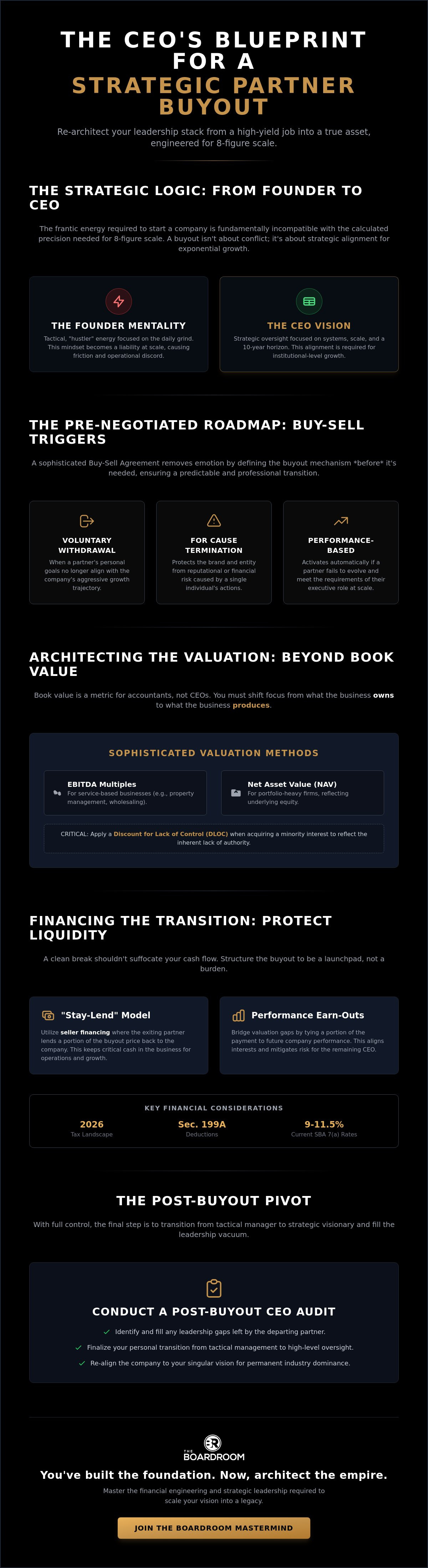
A sophisticated Buy-Sell Agreement acts as your pre-negotiated roadmap. It removes the emotion from high-stakes decisions by defining exactly how to structure a business partner buyout before the need arises. These triggers typically fall into three categories:
- Voluntary Withdrawal: When a partner's personal goals no longer align with the company's aggressive trajectory.
- For Cause Termination: Protecting the brand from reputational or financial risk caused by a single individual.
- Performance-Based Triggers: Ensuring that if a partner fails to evolve into their required executive role, the buyout mechanism activates automatically.
By defining these parameters today, you ensure that the transition to an 8-figure organization remains predictable and professional.
Architecting the Valuation: Moving Beyond Simple Book Value
Book value is a metric for accountants, not for 8-figure CEOs. If you rely on the balance sheet alone, you're fundamentally mispricing the future potential of your entity. High-growth real estate firms possess significant intangible assets, including proprietary deal flow, brand equity, and battle-tested systems, that book value fails to capture. When determining how to structure a business partner buyout, you must shift the focus from what the business owns to what the business produces.
Sophisticated valuations require a bifurcated approach. For real estate service businesses, such as property management or high-volume wholesaling, EBITDA multiples are the standard. However, for portfolio-heavy firms, Net Asset Value (NAV) provides a more accurate reflection of the underlying equity. A critical component is the Discount for Lack of Control (DLOC). If you're acquiring a minority interest, the price should reflect the inherent lack of authority that equity holds. Engaging a third-party forensic accountant ensures a Boardroom-grade valuation that is indisputable, protecting you from emotional negotiations. Understanding the nuances of Financing the Transition requires this level of mathematical precision before any capital moves.
Valuation Methods for Sophisticated Entities
Earning multiples are only effective if you normalize the data. You must strip out one-time expenses and owner-specific add-backs to find the true operational baseline. In the stabilized interest rate environment of 2026, Discounted Cash Flow (DCF) models have become essential for predicting growth over a five to ten-year horizon. This forward-looking approach ensures you don't overpay for past performance that may not be repeatable. Mastering how to structure a business partner buyout involves recognizing that you aren't just buying shares; you're buying a proven engine of wealth.
The Role of Goodwill and Proprietary Systems
Your business operating system is a tangible asset that commands a premium. A company that runs on predictable, documented systems is inherently more valuable than one that relies on the frantic energy of a single partner. Quantifying this goodwill allows you to justify a higher enterprise value while proving that the business can thrive after the partner exits. For leaders looking to master these complex financial architectures, the Boardroom Mastermind provides the peer-level clarity needed to execute at the highest level of professional excellence.
Financing the Transition: Protecting Liquidity and Cash Flow
The most common mistake in 8-figure buyouts is draining the corporate war chest to fund a lump-sum exit. You must protect your operational liquidity to ensure the business can withstand the leadership transition. Mastering how to structure a business partner buyout requires a sophisticated "Stay-Lend" model. By using an amortized note, you pay the departing partner out of future cash flow, effectively turning them into a subordinate lender. This preserves your capital for aggressive growth while keeping the partner’s financial interests aligned with the company’s short-term stability.
When a valuation gap exists, deploy an earn-out provision. This mechanism ties a portion of the purchase price to post-buyout performance metrics. It’s a decisive way to bridge the distance between a partner’s perceived value and the company’s actualized results. For deals exceeding the typical $5 million SBA cap, look toward real estate private equity. Institutional capital allows you to consolidate control without the high variable rates of SBA 7(a) loans, which currently hover between 9% and 11.5% as of June 2026. Reviewing expert perspectives on structuring and financing a partnership buyout will help you determine the optimal split between cash at closing and deferred payments.
The Capital Stack for High-Ticket Buyouts
You must decide between institutional debt and silent equity. While debt preserves your ownership percentage, it adds a fixed monthly burden to your balance sheet. Conversely, a silent equity partner provides non-recourse capital but requires a share of the long-term upside. Many CEOs choose to refinance existing real estate assets to pull out equity, utilizing the stable 6.11% rates available for 25-year 504 loans to fund the buyout. This strategy requires a surgical understanding of your current debt-to-equity ratios to avoid over-leveraging the entity.
Tax Efficiency in Buyout Structures
Tax architecture is where the real profit is made or lost. Exiting partners face significant liabilities, with "hot" assets like accounts receivable taxed at rates up to 37% in 2026. Structuring the deal as an asset purchase may allow you to step up the basis of the company’s assets, providing substantial depreciation benefits. If you are ready to architect a buyout that maximizes your personal wealth and business autonomy, apply for The Boardroom Mastermind Membership to consult with peers who have executed these exact maneuvers.
The Post-Buyout Pivot: Filling the Leadership Vacuum
The ink on your buyout agreement represents a beginning, not an end. While you have mastered how to structure a business partner buyout to secure total control, the operational reality of solo leadership requires an immediate, calculated pivot. You must audit your business model to identify where the departed partner’s influence created structural dependencies or tactical bottlenecks. This is your opportunity to strip away legacy inefficiencies and re-architect the organization for institutional scale.
The transition requires a rigorous CEO Audit. You can no longer afford to operate in the tactical lane to compensate for a partner’s absence; you must ascend to pure strategic oversight. Elite founders recognize that losing a co-founder also means losing a primary sounding board. To replace this intellectual capital, sophisticated leaders utilize exclusive mastermind groups. These environments provide the high-level accountability and diverse perspectives necessary to pressure-test your 8-figure growth strategy without the friction of internal politics. Establishing a formal Board of Advisors further solidifies this framework, ensuring your decisions are vetted by peers who operate at your level of financial success.
Scaling Without the Hustle
Use this transition as a reset button for your company culture. If your previous structure relied on the "hustler" energy of a co-founder, you must now implement a professional leadership team to manage day-to-day operations. This shift from person-dependent growth to system-dependent growth is the hallmark of an 8-figure CEO. By hiring specialized executives to handle the tactical execution, you reclaim your time for high-impact deal-making and long-term wealth architecture.
Engineering Your Elite Network
The Power of Proximity is the fastest way to replace the strategic input of a departed partner. When you exit a partnership, you risk operational isolation. Engaging with a peer advisory group allows you to leverage shared expertise and collective intelligence. Understanding how to structure a business partner buyout is merely the first step. The true challenge lies in surrounding yourself with a network that demands excellence, ensuring your solo tenure is defined by unprecedented expansion and personal autonomy.
Architecting Your Autonomy for Institutional Scale
You have moved past the tactical friction of co-founder misalignment and analyzed the financial engineering required to protect your company’s liquidity. By moving beyond book value and deploying sophisticated capital stacks, you've positioned your entity for permanent industry dominance. Mastering how to structure a business partner buyout is the final hurdle in your evolution from a tactical operator to a battle-tested visionary. The control you've reclaimed is the foundation upon which your eight-figure legacy will be built.
The transition to solo leadership doesn't mean you should scale in isolation. The most successful founders replace the internal sounding board of a partner with an elite network of peers who have already conquered the eight-figure ceiling. You need a space where your strategy is pressure-tested by those operating at the highest tiers of financial success. Apply for The Boardroom Mastermind Membership to audit your business architecture through our quarterly in-person intensives and join an exclusive network of 7, 8, and 9-figure real estate founders. Our proven frameworks for the Operator to CEO transition ensure your next chapter is defined by autonomy, impact, and unprecedented growth. Your seat at the table is waiting.
Frequently Asked Questions
What is the most common valuation method for a real estate partner buyout?
The most effective valuation method for high-growth real estate firms is a bifurcated approach that combines Net Asset Value (NAV) for the property portfolio with an EBITDA multiple for the operational service arm. You must normalize the earnings by stripping out owner-specific add-backs and one-time expenses to establish a true operational baseline. This dual-layered strategy ensures you aren't overpaying for the brand’s goodwill while accurately reflecting the market value of the underlying real estate assets.
Can I use an SBA loan to buy out a business partner in 2026?
You can utilize SBA 7(a) or 504 loans for a partner buyout in 2026, provided the transaction results in you holding 100% ownership of the entity. As of June 2026, variable rates for SBA 7(a) loans are approximately 9% to 11.5%, while the 25-year SBA 504 loan offers a more stable fixed rate of 6.11%. While these programs are viable for mid-market transitions, remember that SBA Express loans are capped at $500,000, which is often insufficient for 8-figure leadership restructures.
How do I handle a hostile partner who refuses to be bought out?
Handling a hostile partner requires a strict adherence to the triggers defined in your pre-negotiated Buy-Sell Agreement. If your agreement lacks a mandatory "shotgun clause" or specific exit provisions, you must engage a specialized M&A attorney to initiate a formal valuation and legal mediation. Don't allow personal friction to compromise your company's growth velocity; in many cases, a calculated premium payment is the most efficient way to reclaim your operational autonomy and focus on the 10-year vision.
What is an earn-out provision, and how does it protect the company?
An earn-out provision is a contractual mechanism where a portion of the purchase price is contingent on the business achieving specific financial milestones after the partner departs. This protects the company’s cash flow by ensuring you only pay the full valuation if the entity maintains its performance during the leadership transition. When determining how to structure a business partner buyout, the earn-out serves as a vital tool to bridge the gap between a partner’s inflated expectations and the company’s actualized results.
Should I hire a business broker or a specialized attorney for the buyout?
For an 8-figure buyout, you must prioritize a specialized M&A attorney and a forensic accountant over a general business broker. Brokers typically focus on the transaction fee, whereas an attorney ensures the legal architecture protects your long-term control and minimizes personal liability. You need advisors who understand the technical nuances of how to structure a business partner buyout to survive institutional-level scrutiny and protect your personal wealth during the transition.


