
How to Measure Company Culture: A Guide for Leaders
What if your company’s stated values describe the culture you want, but not what employees experience every day? Learning how to measure company culture starts with identifying that gap. Culture can seem intangible, and a survey score alone may miss the decisions, team habits, and quieter voices that show how work gets done.
You need more than an abstract values statement. You need observable signals and evidence you can revisit. This guide shows you how to define behaviors that put values into practice, combine employee perspectives with operating evidence, and turn what you learn into specific leadership actions.
A practical measurement system has three parts: identify the behaviors that matter, gather evidence from more than one source, and review the findings consistently. The aim isn’t to produce a flattering score. It’s to understand where your culture supports the work, where it breaks down, and what leaders should change next.
Key Takeaways
- Translate stated values into actions and decisions you can observe during everyday work.
- Compare employee experience, workplace behaviors, and workforce outcomes, while recognizing what each indicator can and can’t establish.
- Learn how to measure company culture by combining surveys, focus groups, and interviews to see broad patterns and specific experiences.
- Turn the strongest evidence-backed gap into a visible leadership action, then explain what will change and what needs more time.
Measure Company Culture: Start with What People Do
Culture becomes measurable when you translate stated values into observable actions and decisions. A company may say it values accountability, candor, or collaboration. Look for evidence in what people do when priorities compete, deadlines tighten, or a mistake surfaces. Written values describe an intention; everyday behavior shows whether that intention shapes how the organization operates.
Organizational culture encompasses shared assumptions, practices, and ways of working, as outlined in What is Organizational Culture? For leaders, the task is to make those patterns specific enough to examine. Measurable culture is the pattern of shared behaviors, decisions, and employee experiences that reveals how an organization’s values operate in practice.
A sentiment score can flag a concern, but it can’t represent the whole culture or explain the cause. A low score on trust, for example, doesn’t tell you whether the issue is inconsistent decisions, poor communication, or fear of speaking up. Treat scores as signals to investigate, not verdicts.
Turn each stated value into an observable behavior
Start with one value and ask what employees and managers would see or hear if it were practiced. For accountability, you might look for project owners raising a missed commitment early, explaining the obstacle, and agreeing on a recovery plan. Compare that with a pattern of shifting blame or waiting for someone else to notice. Define actions that can be recognized across teams, not just admired in a values statement.
Set a baseline before judging progress
Before launching a culture initiative, record the evidence you already have and the period it represents. Note the survey questions and response patterns, examples of relevant workplace behavior, and operating measures you plan to compare later. This creates a reference point for assessing change. A baseline describes the current state; a target describes the state you intend to reach. Avoid choosing an arbitrary score. Define the target in relation to the behavior or experience you want to improve.
Which Company Culture Indicators Should You Measure?
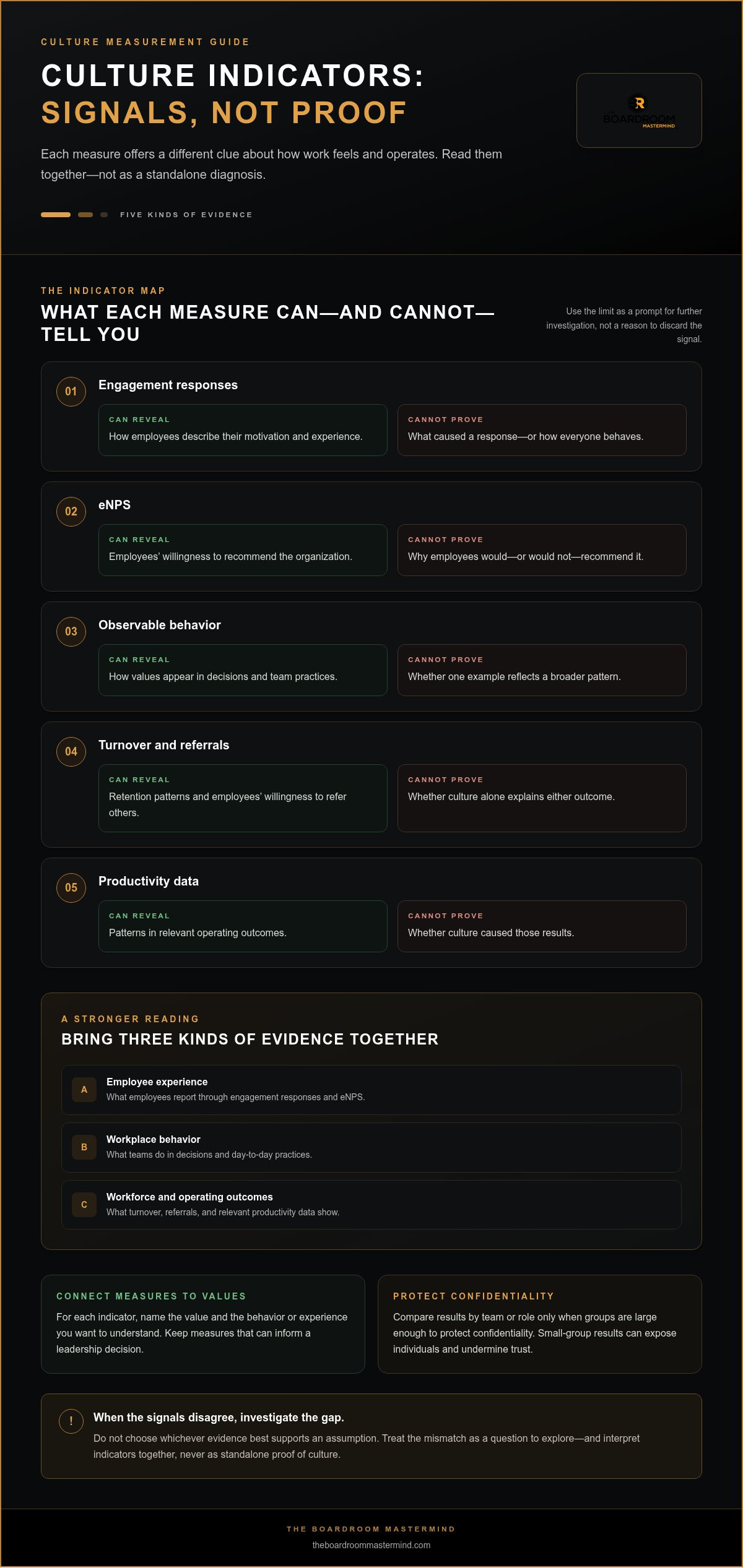
To decide how to measure company culture, pair what employees report with what teams do and what workforce outcomes show. Each measure has blind spots. Gallup's Perspective on Measuring Company Culture offers context for connecting culture with workplace experience.
| Indicator | What it can reveal | What it can’t prove |
|---|---|---|
| Engagement responses | How employees describe motivation and experience | What caused a response or how everyone behaves |
| eNPS | Willingness to recommend the organization | Why employees would or wouldn’t recommend it |
| Observable behavior | How values show up in decisions and team practices | Whether a single example reflects a broader pattern |
| Turnover and referrals | Retention and employees’ willingness to refer others | Whether culture alone explains either outcome |
| Productivity data | Patterns in relevant operating outcomes | Whether culture caused those results |
Indicators are signals to investigate, not standalone proof of culture. Interpret them together rather than treating any one score as a complete diagnosis.
Choose indicators that connect to your values
For each measure, name the value and the behavior or experience you want to understand. If collaboration matters, examine whether teams share information across functions and ask employees whether they can get the input they need. Skip metrics that won’t inform a leadership decision. A useful indicator helps you decide what to investigate or adjust.
Balance perception with observable evidence
Pair employee-reported experience with patterns in decisions, team practices, referrals, turnover, or relevant productivity data. Compare results by team or role only when groups are large enough to protect confidentiality. Small-group results can expose individuals and undermine trust in the measurement process. When a score and observed behavior tell different stories, treat the gap as a question to investigate rather than choosing the evidence that best supports your assumption.
Candid peer discussion can help leaders challenge assumptions about their operating practices. The Boardroom Mastermind offers a peer network, weekly Zoom calls, bi-weekly progress check-ins, and quarterly hot-seat breakdowns of members’ businesses. Membership is for experienced business owners with significant revenue, not people just getting started. You MUST be THE REAL DEAL and doing significant business revenue. The Boardroom Mastermind is not for new business owners that are just getting started. EXPERIENCE MATTERS here. We have a strict ‘NO DOUCHE BAG’ rule. No scarcity is allowed. You MUST be willing to connect any and every ‘dot’ possible for your fellow members. You MUST be willing to be vulnerable and break down your business needs in front of your fellow members. You MUST be looking to grow and improve your business DRAMATICALLY and QUICKLY.
How to Measure Company Culture Step by Step
A reliable process turns a broad culture question into evidence leaders can examine and act on. Keep the scope focused: one value or experience, a few relevant indicators, and a clear plan for reviewing what you learn.
- Define the question. Name the value, behavior, or employee experience you want to understand. For example, ask whether people raise concerns early enough for the team to respond.
- Select indicators. Choose measures that can answer that question, not simply metrics that are easy to collect. Pair a direct employee question with a behavior or operating signal when possible.
- Collect evidence. Surveys provide breadth but may miss context or quieter voices. Focus groups can explain shared experiences, though group dynamics may shape what people say. Interviews reveal specific experiences, but a few accounts don’t establish an organization-wide pattern. Add observations of everyday practices and relevant workforce data.
- Compare patterns. Look for alignment or gaps across employee feedback, observed behavior, and operating evidence. Note where the sources agree and where they don’t.
- Document findings. Record the evidence, the period it covers, its limitations, and the questions that remain open. Separate what you observed from your interpretation.
Triangulation builds confidence when different evidence sources point to the same pattern. It doesn’t remove the need to consider context or check whether a change in conditions could explain what you’re seeing.
Design employee feedback that supports candid answers
Ask clear, neutral questions tied to specific experiences, such as whether people can raise concerns without negative consequences. Avoid wording that signals the answer you expect. Explain who can access responses, how confidentiality is protected, and when employees will hear what leaders learned and plan to do. If people can’t speak freely in a group setting, offer a suitable way to share feedback privately.
Look for patterns across teams and time
Compare relevant teams or periods, but treat small samples cautiously. Separate recurring themes from isolated comments, and document gaps in participation or evidence before drawing conclusions. Keep questions consistent when comparing results, and note changes in team structure or workload that could affect the comparison.
For leaders who want candid peer accountability as they examine operating practices, The Boardroom Mastermind includes regular peer discussions and quarterly hot-seat breakdowns. Members share business challenges and get real-time problem-solving input from the group.
Turn Company Culture Findings into Leadership Action
Measurement creates value only when leaders act on what the evidence shows. Prioritize one well-supported gap, name the leader accountable for addressing it, and define a visible action employees can recognize. If the evidence points to hesitation about raising concerns, for example, managers could invite concerns during team discussions and report how they’re addressed. The action should be observable, not just a new statement of intent.
Set a review date before the work begins. At that review, compare new evidence with the original baseline, assess whether the action happened, and decide whether to continue, adapt, or investigate further. Keep culture actions within the organization’s business operating system and an existing leadership review, rather than leaving them as an unowned side initiative.
Close the feedback loop without overpromising
Tell employees what leaders heard, what will change, who owns the next step, and when they’ll receive an update. If a requested change can’t happen immediately, explain why and what leaders will do instead, if anything. A clear decision and follow-up date build more credibility than silence or a promise without an owner.
Build leadership accountability into the review
Add the action to a standing leadership agenda. Review the owner’s progress, evidence of implementation, and any new employee feedback. Then document the decision and the next review date. This cadence keeps attention on follow-through, not just the original findings, and helps leaders distinguish a completed task from a meaningful shift in workplace experience.
Peer accountability can also help leaders test their assumptions and stay focused on follow-through. The Boardroom Mastermind brings experienced real estate professionals together through weekly Zoom calls, bi-weekly progress check-ins, and quarterly hot-seat breakdowns.
Make the Next Culture Decision Count
How to measure company culture matters only if the evidence shapes how leaders operate. Carry one clear question into your next leadership review: what practice will make your values visible in the decisions employees experience? Keep the commitment focused, assign an owner, and set a date to revisit it. Consistent follow-through makes measurement part of leadership rather than a one-time exercise.
The Boardroom Mastermind annual membership includes weekly Zoom calls, bi-weekly progress check-ins, and quarterly hot-seat breakdowns for real-time business problem solving. If you’re an experienced real estate professional ready for candid peer accountability, explore The Boardroom Mastermind.
Frequently Asked Questions
How often should a company measure its culture?
Set the cadence according to the decision leaders need to make. If you’re checking whether a new meeting practice is helping employees speak up, a focused pulse check may provide timely feedback. Broader questions about trust may need more time to show a pattern. Keep core questions consistent for comparison, explain the schedule, and tell employees what leaders changed after reviewing the results.
Can you measure company culture without an employee survey?
Yes. Surveys are one source of evidence, not a requirement. You can learn from structured conversations, exit feedback, and observations of how decisions are made, such as whether teams share concerns before a project goes off track. Each source has blind spots, so note who contributed and what may be missing. Protect confidentiality, document your approach, and look for corroborating signals before treating a pattern as widespread.
Are anonymous culture surveys more accurate?
Not automatically. Anonymity may help employees feel safer sharing sensitive views, but it doesn’t ensure every group responds or that answers explain the underlying causes. Be precise about what “anonymous” means, who can see raw responses, and whether small teams could be identifiable. If you can’t protect anonymity, don’t promise it. Explain how leaders will use the feedback so employees can see its purpose.
What is the difference between company culture and employee engagement?
Company culture is the shared norms and behaviors that shape how work gets done. Employee engagement describes employees’ connection to and involvement in their work. They can influence one another, but they aren’t interchangeable. A team may report strong commitment while avoiding disagreement in meetings. Treat engagement as a clue, then examine workplace conditions and everyday conduct before deciding what it says about culture.
How can a small company measure culture with limited data?
Start with one question, such as whether employees know who owns a decision, and observe the same behavior over time. Keep brief, consistent notes from regular one-to-one conversations and document examples of decisions or handoffs. A short pulse survey may help, but small teams can make responses identifiable. Be transparent about that limitation, avoid overinterpreting individual comments, and compare like with like at each review.

Disclaimer
Mr. Clothier is an expert in real estate investing. As such his experiences are not necessarily typical to the standard real estate investor and whose results may vary. The successes shared on this site are not considered typical. Most individuals who order the educational materials and systems probably do not follow any of the techniques or strategies and consequently make little to no money due to their inaction. The company is in the process of determining the typical success of its clients. Stories shared herein are for example purpose only and should not be construed as "guarantees" of success. Results will vary based on background, education, and experience and actions taken.
This site is not a part of the Google/Facebook website or Google/Facebook Inc. Additionally, this site is NOT endorsed by or affiliated with Google/Facebook in any way. GOOGLE/FACEBOOK is a trademark of GOOGLE/FACEBOOK, Inc.
INCOME DISCLAIMER: This website and the items it distributes contain business strategies, marketing methods and other business advice that, regardless of referenced results and experience, may not produce the same results (or any results) for you. The Boardroom Mastermind makes absolutely no guarantee, expressed or implied, that by following the advice or content available from this web site you will make any money or improve current profits, as there are several factors and variables that come into play regarding any given business. Primarily, results will depend on the nature of the product or business model, the conditions of the marketplace, the experience of the individual, and situations and elements that are beyond your control. As with any business endeavor, you assume all risk related to investment and money based on your own discretion and at your own potential expense.
LIABILITY DISCLAIMER: By reading this website or the documents it offers, you assume all risks associated with using the advice given, with a full understanding that you, solely, are responsible for anything that may occur as a result of putting this information into action in any way, and regardless of your interpretation of the advice. You further agree that The Boardroom Mastermind, its affiliates, subsidiaries, officers and agents, cannot be held responsible in any way for the success or failure of your business as a result of the information provided. It is your responsibility to conduct your own due diligence regarding the safe and successful operation of your business. In summary, you understand that we make absolutely no guarantees regarding income as a result of applying this information, as well as the fact that you are solely responsible for the results of any action taken on your part as a result of any given information. In addition, you agree that our content is to be considered "for entertainment purposes only". Always seek the advice of a professional when making legal, financial, tax, or business decisions.
BUSINESS OPPORTUNITY: All products and services offered by The Boardroom Mastermind are intended to provide prospective purchasers with general business strategies, marketing methods and other general advice for business development and training. At no point is The Boardroom Mastermind soliciting anyone to enter into a new business nor is it representing, either expressly or by implication, that it will provide locations for a business, provide outlets, accounts, or customers, or purchase any of the goods or services made by the purchaser.
The products being offered through this promotion are packages of informational tools to help you learn about business and deal making strategies.


