
How to Improve Decision-Making Skills as a Leader
What if the fastest way to make a high-stakes decision isn’t to gather more information, but to get clear on what matters? If you’re asking how to improve decision making skills as a leader, start by replacing instinct alone with a repeatable process. Urgent choices rarely arrive with complete facts. When every call escalates to you, momentum stalls. Untested assumptions and second-guessing can make even a sound decision difficult to act on.
You don’t need endless analysis or consensus on every issue. You need explicit criteria, a clear decision owner, and the judgment to know when more input will improve the call. This article offers a practical approach to framing decisions, testing assumptions, involving the right people, and choosing when to act. You’ll also learn how to review results without turning an imperfect outcome into blame. The aim is disciplined speed: decisions your team can execute, learn from, and use to strengthen the next call.
Key Takeaways
- A sound decision can lead to an unexpected outcome. Assess the quality of your reasoning separately from the result.
- Define the objective and non-negotiable constraints before weighing options so preferences don’t distort the choice.
- To learn how to improve decision making skills as a leader, clarify who owns the call and invite focused input that tests key assumptions.
- Review decisions without hindsight bias or blame. Experienced peers can surface blind spots while you preserve clear accountability.
Why Leadership Decision-Making Gets Harder as Your Business Grows
As your business grows, decisions affect more people, systems, and capital. Instinct can help you spot an opportunity, but it becomes less reliable as your only decision tool when one choice has consequences across the organization. Improving your decision-making starts with recognizing that growing complexity, rather than personal hesitation, may be the real challenge.
A decision’s quality and its outcome aren’t the same thing. A well-reasoned choice can still produce an unfavorable result because conditions change or an assumption proves wrong. A good leadership decision connects explicit objectives with available evidence and clearly understood trade-offs. Evaluate the reasoning, not just whether the result went your way. Decision-making involves a cognitive process of decision-making, and that process can be affected by both rational analysis and bias.
Recognize the signs of a decision bottleneck
Repeated escalations, choices that sit unresolved, and decisions that are regularly reversed can point to unclear decision rights. Ask who owns the call, what authority they have, and what input they need. If those answers are vague, the issue may be structural rather than a lack of information. A genuine information gap has a specific answer that could change the choice. Discomfort with uncertainty may remain even after the relevant facts are available.
Separate urgency from importance
A deadline should determine how quickly you gather input and decide, not which option wins. For example, adjusting an internal reporting format is usually reversible. Set a short trial and review how it works. Committing to a new market or business model has broader, harder-to-reverse consequences, so scrutinize the assumptions and risks more closely. Under pressure, resist unclear objectives and untested assumptions. Then name an accountable owner for follow-through. Speed without ownership leaves a decision unfinished.
A Leader’s Decision Framework: Define the Choice Before Debating Solutions
Before ideas dominate the discussion, define the decision. A repeatable framework helps you improve your decision-making without turning every choice into a drawn-out review. Move through these steps in order:
- State the decision: Write the choice that must be made in one sentence.
- Define the objective: Name the outcome the decision should advance.
- Set constraints: Separate non-negotiables, such as available capacity or strategic commitments, from preferences, such as a favored approach.
- Compare options: Assess viable alternatives against the same criteria.
- Assign an owner: Name who makes the final call and leads execution.
- Review: Decide what evidence will show whether the choice is working.
Gather evidence that could change the decision, not information simply because it’s available. Identify the key unknowns, then set a stopping condition. Proceed when decision-changing questions have credible answers, or when the remaining uncertainty is understood and acceptable. If new evidence can’t alter the options or risks, more analysis may be delay in disguise.
Set decision criteria before choosing an option
Specify the intended outcome, the risks you’re willing to accept, and the conditions that rule out an alternative. Criteria should fit the business context of this decision, not a benchmark borrowed from a different company or market. Setting criteria before comparing options gives the team a consistent basis for evaluating the choice and helps reduce hindsight-driven justification.
Match the process to reversibility and stakes
A reversible choice can often move ahead with a lighter review and a clear check-in. A commitment that’s difficult to unwind calls for deeper scrutiny, including a challenge to the assumptions behind it. The Cynefin framework for leaders offers a way to consider context and complexity when choosing an approach. For experienced investors and entrepreneurs, strategic peer collaboration can help surface blind spots. The designated decision owner still remains accountable for the call.
How to Improve Decision-Making Skills as a Leader in Real Situations
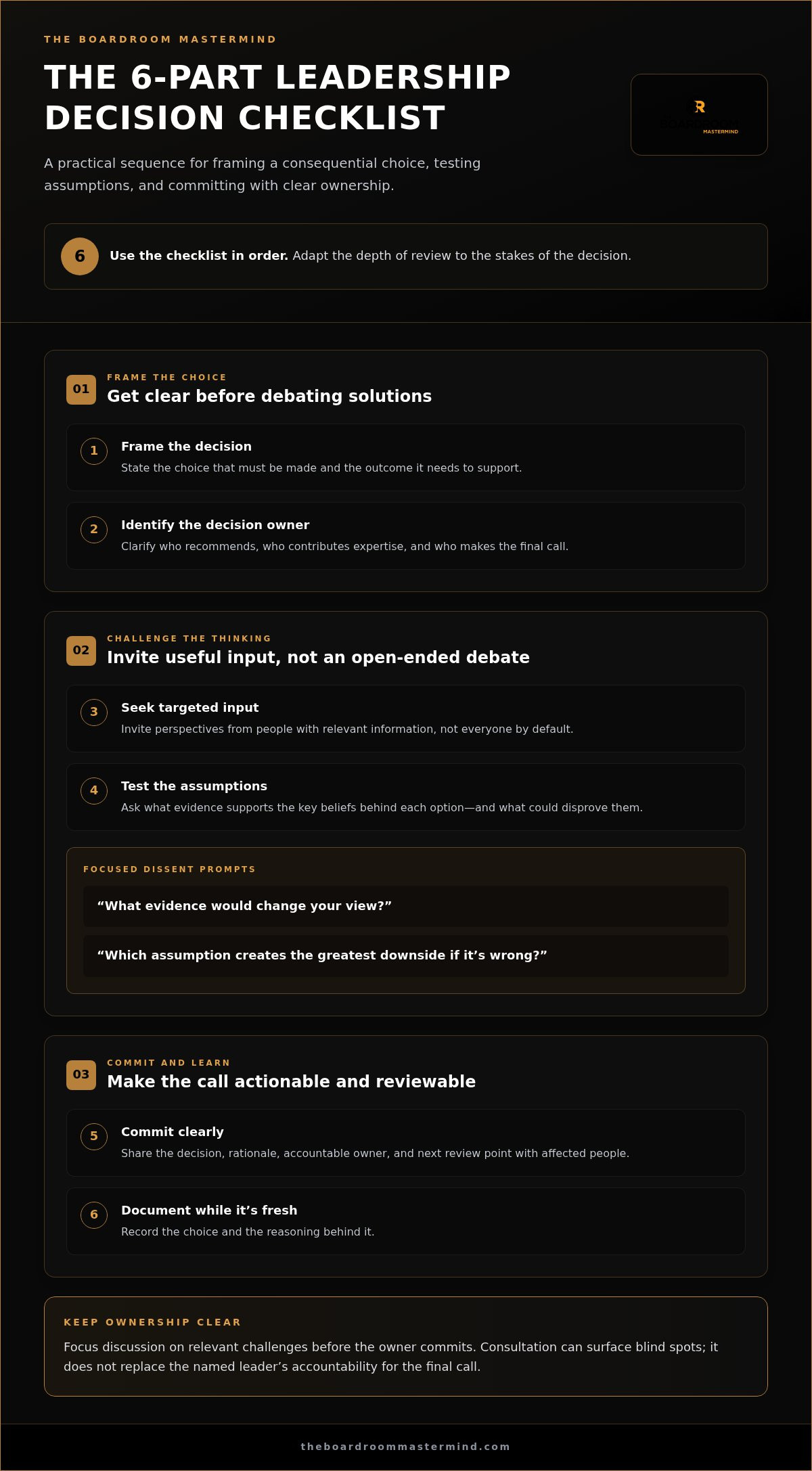
A framework creates value only when it shapes the actual conversation. Use this checklist for a consequential choice, adapting the depth of review to the stakes:
- Frame the decision: State the choice and the outcome it needs to support.
- Identify the owner: Clarify who recommends, who contributes expertise, and who makes the final call.
- Seek targeted input: Invite perspectives from people with relevant information, not everyone by default.
- Test assumptions: Ask what evidence supports the key beliefs behind each option and what could disprove them.
- Commit: Share the decision, rationale, accountable owner, and next review point with affected people.
- Document: Record the choice and reasoning while they’re fresh.
To invite dissent without opening an unstructured debate, ask, “What evidence would change your view?” or “Which assumption creates the greatest downside if it’s wrong?” These questions focus discussion on decision quality. The goal isn’t to eliminate disagreement. It’s to surface relevant challenges before the owner commits.
Use input without surrendering decision ownership
Set roles before discussion begins. One person may develop the recommendation, others may contribute operational or financial expertise, and a named leader owns the final call. This prevents consultation from quietly becoming a search for consensus. Experienced peers can pressure-test assumptions and reveal blind spots, but the accountable owner must decide and lead execution.
Create a decision record that supports follow-through
Keep a concise record of the choice, criteria, key assumptions, owner, and conditions that would trigger a revisit. Document assumptions when the decision is made so later reviews can distinguish evidence from memory. Clear decision rights also depend on capable roles and responsibilities across the business.
Communicate the outcome plainly: what was decided, why, who is responsible, and when progress will be reviewed. This gives the team direction without requiring everyone to agree with every trade-off. To build stronger judgment through strategic collaboration and accountability, Explore The Boardroom Mastermind.
Review Leadership Decisions, Learn, and Build Better Judgment
A result is not a verdict on the quality of the decision. Review the reasoning, execution, and outcome separately. Were the objectives and criteria appropriate? Did the team follow through as intended? What happened, including what no one could reasonably know at the time? This distinction helps you improve decision-making without turning every setback into blame.
Turn outcomes into better future decisions
Compare the assumptions recorded before the decision with what actually unfolded. Note which proved accurate, which didn’t, and what evidence wasn’t available when the call was made. Keep the original criteria visible. Otherwise, hindsight bias can make the outcome seem predictable, while changing the criteria after the fact disguises what the decision was meant to achieve. Choose one adjustment to the process, such as gathering a missing perspective or setting a clearer review condition.
Use trusted peers to pressure-test consequential choices
For recurring, high-stakes decisions, candid input from experienced peers can expose assumptions that familiarity has made hard to see. Share the objective, rationale, and uncertainties, then ask where the reasoning is most vulnerable. Structured peer discussion strengthens scrutiny; it doesn’t transfer accountability. The leader who owns the decision remains responsible for weighing the challenge, making the call, and acting on the result.
Close each review by capturing the lesson in the decision record and applying it to the next relevant choice. Judgment improves through disciplined practice: better questions, stronger evidence, and follow-through. The goal isn’t to expect every outcome to go well, but to make the next decision better informed.
For experienced investors and entrepreneurs, quarterly in-person intensives offer time to examine business models, challenge assumptions, and learn alongside peers. The quarterly peer learning experience brings that reflection into a setting focused on business audits and growth.
Make Your Next Decision a Leadership Advantage
Make disciplined decision-making part of how your business operates, not a process reserved for exceptional moments. As your leadership team takes ownership of more choices, your attention can shift from approving every move to setting direction and strengthening the people who execute it. That’s the lasting value of improving your decision-making as a leader: building a business that can move forward with clarity even when you’re not in every conversation.
For experienced real estate investors and entrepreneurs, the right peer environment can support that shift. The Boardroom Mastermind Membership brings members together for strategic collaboration and accountability. Quarterly in-person intensive meetings give members time to audit their business models and optimize growth.
Explore The Boardroom Mastermind Membership to learn how strategic collaboration and accountability can help you challenge assumptions and lead with greater confidence.
Frequently Asked Questions
How can a leader make decisions more confidently?
A leader makes decisions more confidently by making the logic visible, not by waiting for certainty. To improve decision-making, write down the outcome you’re pursuing, the main trade-off, and the condition that would prompt a rethink. For example, if a pilot misses its agreed adoption signal, you’ll know when to adjust. A documented rationale gives you a basis for action even when the result remains uncertain.
What is the first step in making a difficult leadership decision?
Begin by phrasing the choice as a question that can be answered, such as, “Should we extend this pilot or end it?” Then define what success would look like in practical terms, such as whether the pilot resolves the operational problem it was designed to address. This keeps the conversation focused on the decision at hand rather than drifting into a broad discussion of every possible improvement.
How do leaders avoid overthinking decisions?
Decide in advance what new information would genuinely change your choice, and stop searching once you’ve addressed those questions. For example, if the decision depends on whether a team can support a new workflow, ask for that capacity assessment rather than collecting unrelated market data. Record what would trigger a review, then return to the choice when that condition occurs, not simply because doubt resurfaces.
Should leaders make decisions alone or involve their team?
Involve people whose expertise or day-to-day experience can reveal consequences you might miss. Ask the team responsible for implementation to identify likely bottlenecks, for example. Keep consultation focused: invite each person to name a risk or explain what evidence could change their view. Before discussion, clarify who is advising and who decides. Afterward, communicate the rationale and next steps so input leads to action, not ambiguity.

Disclaimer
Mr. Clothier is an expert in real estate investing. As such his experiences are not necessarily typical to the standard real estate investor and whose results may vary. The successes shared on this site are not considered typical. Most individuals who order the educational materials and systems probably do not follow any of the techniques or strategies and consequently make little to no money due to their inaction. The company is in the process of determining the typical success of its clients. Stories shared herein are for example purpose only and should not be construed as "guarantees" of success. Results will vary based on background, education, and experience and actions taken.
This site is not a part of the Google/Facebook website or Google/Facebook Inc. Additionally, this site is NOT endorsed by or affiliated with Google/Facebook in any way. GOOGLE/FACEBOOK is a trademark of GOOGLE/FACEBOOK, Inc.
INCOME DISCLAIMER: This website and the items it distributes contain business strategies, marketing methods and other business advice that, regardless of referenced results and experience, may not produce the same results (or any results) for you. The Boardroom Mastermind makes absolutely no guarantee, expressed or implied, that by following the advice or content available from this web site you will make any money or improve current profits, as there are several factors and variables that come into play regarding any given business. Primarily, results will depend on the nature of the product or business model, the conditions of the marketplace, the experience of the individual, and situations and elements that are beyond your control. As with any business endeavor, you assume all risk related to investment and money based on your own discretion and at your own potential expense.
LIABILITY DISCLAIMER: By reading this website or the documents it offers, you assume all risks associated with using the advice given, with a full understanding that you, solely, are responsible for anything that may occur as a result of putting this information into action in any way, and regardless of your interpretation of the advice. You further agree that The Boardroom Mastermind, its affiliates, subsidiaries, officers and agents, cannot be held responsible in any way for the success or failure of your business as a result of the information provided. It is your responsibility to conduct your own due diligence regarding the safe and successful operation of your business. In summary, you understand that we make absolutely no guarantees regarding income as a result of applying this information, as well as the fact that you are solely responsible for the results of any action taken on your part as a result of any given information. In addition, you agree that our content is to be considered "for entertainment purposes only". Always seek the advice of a professional when making legal, financial, tax, or business decisions.
BUSINESS OPPORTUNITY: All products and services offered by The Boardroom Mastermind are intended to provide prospective purchasers with general business strategies, marketing methods and other general advice for business development and training. At no point is The Boardroom Mastermind soliciting anyone to enter into a new business nor is it representing, either expressly or by implication, that it will provide locations for a business, provide outlets, accounts, or customers, or purchase any of the goods or services made by the purchaser.
The products being offered through this promotion are packages of informational tools to help you learn about business and deal making strategies.


