
How to Find Off-Market Real Estate Deals at Scale: Build a Repeatable System
What if the path to more off-market deals isn’t a larger list, but a better operating system? If deal flow depends on sporadic referrals, fragmented property data, or one person’s hustle, growth can quickly become unpredictable. Learning how to find off-market real estate deals at scale means building a sourcing pipeline that produces qualified opportunities consistently, not simply adding more leads to an already crowded workflow.
This guide shows you how to create that repeatable system. You’ll learn to define clear ownership, organize sourcing channels, and qualify opportunities against consistent investment criteria before they consume your team’s time. Then you can compare channels using meaningful evidence, refine what works, and expand based on the quality of qualified opportunities, not activity alone. The objective is disciplined growth: a more dependable flow of potential deals, with the operational clarity to decide what deserves further investment.
Key Takeaways
- Learn how to find off-market real estate deals at scale by building a sourcing process around your target assets, not scattered tactics.
- Compare referrals, owner outreach, public records, and property marketplaces using consistent criteria for control, repeatability, and follow-up.
- Structure your pipeline so each opportunity has a clear stage, qualification standard, and owner responsible for the next action.
- Use evidence from qualified opportunities and regular reviews to decide which channels to refine or expand as your operation grows.
What Counts as an Off-Market Real Estate Deal, and What It Does Not Guarantee
An off-market real estate deal is a potential property transaction where the property isn’t actively listed or publicly advertised for sale. The opportunity may come through a direct owner conversation, a professional relationship, or another private channel rather than a public listing.
Private does not automatically mean distressed. An owner may prefer discretion, consider a sale without committing to one, or respond to a relevant buyer’s approach. Investors may pursue these opportunities to build relationships, access properties before broad exposure, and negotiate directly. Those advantages depend on the people and circumstances involved; they aren’t guaranteed features of every transaction.
Why investors pursue off-market properties
A trusted introduction can create a conversation that wouldn’t happen through a public listing. But access is only the sourcing step. The investor still needs to assess the property’s condition, likely operating costs, seller expectations, and fit with their acquisition criteria. For context, off-plan property describes a purchase before a property is built or completed; that status is distinct from whether a property is publicly advertised. Categories can overlap, but they aren’t interchangeable.
The misconception that off-market means underpriced
Less public exposure may mean fewer competing offers, but it doesn’t establish fair value or create a discount. A seller may expect a price above what the property supports. Deferred maintenance, uncertain expenses, or a mismatch with your investment strategy can also make a privately sourced opportunity unattractive.
Off-market describes how a property is sourced, not whether it’s a good investment. Compare the proposed terms with your own underwriting, confirm the property’s condition, and test whether the opportunity meets your return and risk thresholds. A deal that fails those tests isn’t improved by being private.
That distinction is central to how to find off-market real estate deals at scale. The objective isn’t to collect private leads for their own sake. It’s to create access to opportunities, then apply the same disciplined evaluation before deciding which ones deserve further attention.
How to Compare Off-Market Sourcing Channels for Repeatable Deal Flow
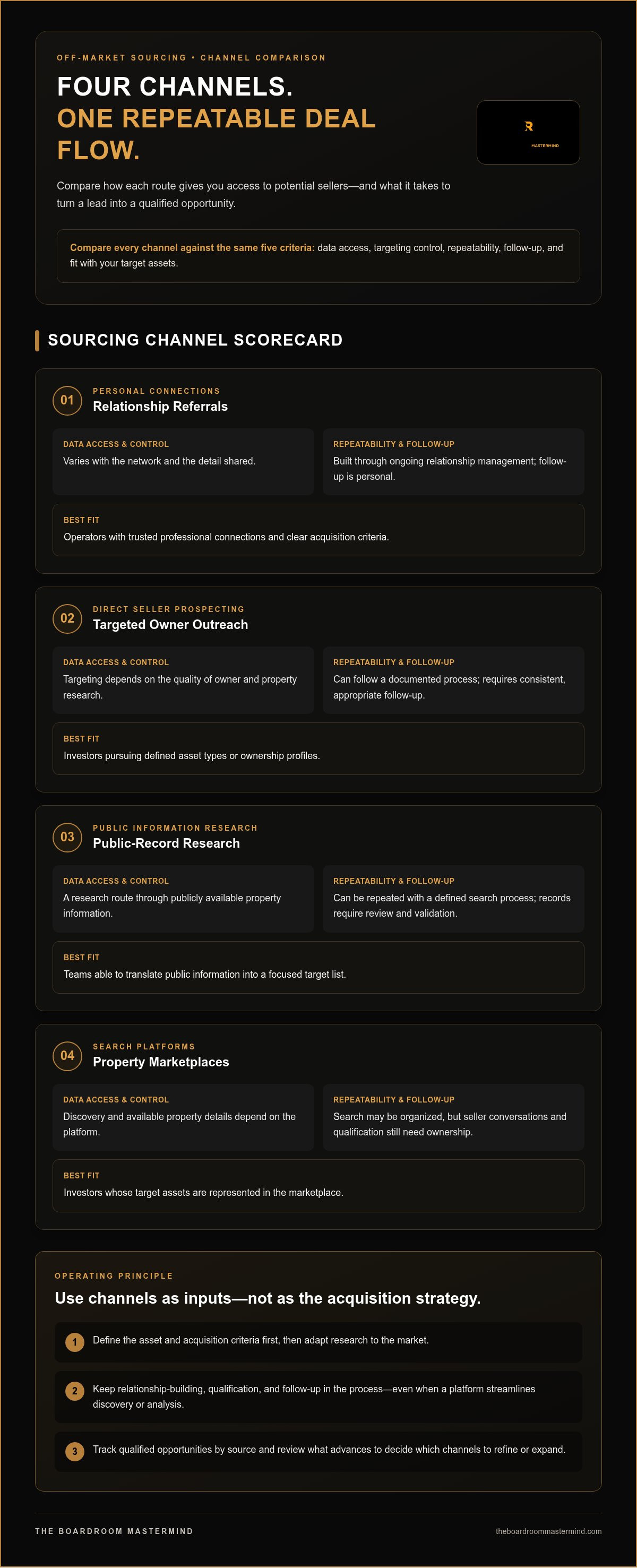
Each channel creates a different route to potential sellers. Compare them against the same operating criteria before deciding where to focus: what property data is accessible, how much control you have over targeting, whether the process can be repeated, what follow-up it requires, and whether it fits your target assets.
| Channel | Data access and control | Repeatability and follow-up | Best fit |
|---|---|---|---|
| Relationship referrals | Varies with the network and the detail shared | Built through ongoing relationship management; follow-up is personal | Operators with trusted professional connections and clear acquisition criteria |
| Targeted owner outreach | Targeting depends on the quality of owner and property research | Can follow a documented process; requires consistent, appropriate follow-up | Investors pursuing defined asset types or ownership profiles |
| Public-record research | Offers a research route through publicly available property information | Can be repeated with a defined search process; records require review and validation | Teams able to translate public information into a focused target list |
| Property marketplaces | Discovery and available property details depend on the platform | Search may be organized, but seller conversations and qualification still need ownership | Investors whose target assets are represented in the marketplace |
A marketplace or property-data platform can streamline discovery and organize analysis. Mashvisor, for example, is a third-party marketplace that presents property search and investment analysis tools. Treat any platform as one input, not a complete acquisition strategy: it doesn’t replace direct relationship-building, qualification, or follow-up. Your objective is a channel mix you can manage, not dependence on one interface.
Relationships and direct research can add context that broad searches miss. Local knowledge may help identify relevant ownership patterns or property characteristics, but the framework should remain portable: define the asset and acquisition criteria first, then adapt research to the market. Direct property acquisition also differs from investing through Real Estate Investment Trusts (REITs), which SEC Investor.gov describes as a way to invest in real estate through a company.
Channels produce leads; consistent criteria determine which deserve attention. To refine how to find off-market real estate deals at scale, track qualified opportunities by source and review what advances. Experienced operators seeking structured peer discussion around growth systems can explore The Boardroom Mastermind.
How to Build an Off-Market Deal Pipeline You Can Measure and Scale
Build the process before increasing lead volume. A documented pipeline makes it possible to see where opportunities stall, who owns the next action, and whether a sourcing channel merits more investment.
Define the acquisition filter before sourcing
Write a buy box that specifies target asset type, relevant market characteristics, acceptable condition, and investment assumptions. Set clear limits for price, required work, and expected performance according to your strategy. A written buy box keeps unqualified volume from setting the agenda.
Use this workflow to move each lead from discovery to a decision:
- Set criteria: Document the buy box and the details needed to screen a property.
- Build target lists: Record each property, owner information, source, and the reason it fits your search.
- Assign outreach: Name the person responsible for the initial contact and subsequent follow-up.
- Qualify consistently: Compare the seller’s expectations and available property information with your investment criteria.
- Review outcomes: Decide whether to advance, nurture, or reject the opportunity, and record why.
Keep stages clear, such as identified, outreach started, response received, under review, qualified, and closed or rejected. Assign one owner to maintain each record, including outreach status, the owner’s response, next action, and due date. Record rejection reasons too. If similar opportunities repeatedly miss the same criterion, adjust targeting rather than asking the team to process more of them.
Measure a short list: qualified opportunities by source, movement between stages, and completion of scheduled follow-ups. These indicators show whether the pipeline is progressing, not just growing. A documented operating workflow also supports broader strategic real estate portfolio management, where decisions depend on organized information and deliberate review.
Before adding channels, expanding into new markets, or increasing team capacity, review actual pipeline performance. How to find off-market real estate deals at scale comes down to evidence-led iteration: improve the process where qualified opportunities advance, then test expansion against your criteria. Explore The Boardroom Mastermind for peer accountability and business discussions with experienced real estate operators.
How Experienced Operators Turn Deal Sourcing Into a Scalable Business System
A sourcing process stops being founder-dependent when the criteria, handoffs, and review rhythm are documented. Team members can then see what qualifies, who owns the next action, and when an opportunity needs a decision. That structure makes execution more consistent, but it has limits: a process can improve visibility and accountability, not guarantee a seller response, a viable acquisition, or investment returns. Underwriting and operational capacity still matter.
What peer accountability can contribute to a sourcing strategy
Once the workflow is clear, peer discussion can help you pressure-test choices such as whether to refine your buy box, improve follow-up ownership, or expand a channel. It’s a forum for examining decisions, not a promised source of deals. The Boardroom Mastermind’s membership includes four quarterly events, weekly Zoom calls, bi-weekly progress check-ins, workshops, and quarterly hot-seat business breakdowns. Explore the peer experience and accountability to understand the membership environment.
Eligibility is specific:
- You MUST be THE REAL DEAL and doing significant business revenue.
- The Boardroom Mastermind is not for new business owners that are just getting started. EXPERIENCE MATTERS here.
- We have a strict ‘NO DOUCHE BAG’ rule.
- No scarcity is allowed.
- You MUST be willing to connect any and every ‘dot’ possible for your fellow members.
- You MUST be willing to be vulnerable and break down your business needs in front of your fellow members.
- You MUST be looking to grow and improve your business DRAMATICALLY and QUICKLY.
If you’ve assessed your sourcing system and are ready to refine how to find off-market real estate deals at scale alongside experienced operators, consider whether this peer environment fits your next stage of business growth. Explore The Boardroom Mastermind.
Make Your Next Growth Move Deliberate
The next step in how to find off-market real estate deals at scale isn’t necessarily more outreach. It may be giving your team greater ownership, tightening a decision handoff, or building a review rhythm that frees you to focus on strategy. Choose one operational improvement, put it into practice, and assess whether it strengthens your sourcing system before expanding further.
For experienced operators refining that next stage, The Boardroom Mastermind has operated since 2012. Its membership combines peer access and accountability through quarterly events, weekly Zoom calls, bi-weekly check-ins, workshops, hot-seat business breakdowns, and the FABL app. These are opportunities to examine business decisions with peers, not promises of deal flow or financial outcomes.
Ready to consider the right environment for your next phase of growth? Explore The Boardroom Mastermind and decide whether its peer community aligns with your ambitions. Build with intention, and scale on a foundation your business can sustain.
Frequently Asked Questions
What is an off-market real estate deal?
An off-market real estate deal is a property opportunity that isn’t actively marketed through public sale listings. For example, an owner might discuss a possible sale directly with an investor before deciding whether to advertise the property. That status describes how the opportunity surfaced, not its value. Verify that the property and seller fit your acquisition criteria, then assess the numbers and risks independently.
Are off-market real estate deals always cheaper?
No. A private sale can involve a price that reflects the owner’s expectations rather than a discount. For instance, an owner may approach an investor with a firm price that leaves little room for renovation costs or other expenses. Compare the proposed terms with your own valuation and underwriting. If the investment only works under assumptions you can’t support, limited exposure doesn’t make it worthwhile.
Can you find off-market properties without a paid data platform?
Yes. Investors can develop opportunities through professional relationships, referrals, and research using public property records. These approaches may require more manual organization: you’ll need to identify relevant properties, record what you learn, and manage follow-up yourself. A paid platform may consolidate some discovery or analysis tasks, but it isn’t essential to every sourcing approach. Choose based on your target assets and available capacity.
How many off-market leads should a real estate investor pursue?
There’s no universal lead quota. Set a volume your team can research, qualify, and follow up on without letting promising opportunities go stale. To decide how to find off-market real estate deals at scale, review how many leads become qualified opportunities and how long each stage takes. If follow-up is falling behind, fix capacity or workflow before increasing intake.
Do you need a real estate license to find off-market deals?
It depends on what you do and the rules in the relevant jurisdiction. Researching properties or pursuing an acquisition for your own account may be treated differently from representing another party or negotiating a transaction for compensation. Don’t rely on a general online answer to decide where the line falls. Consult a qualified real estate attorney or the appropriate licensing authority about your specific activities.

Disclaimer
Mr. Clothier is an expert in real estate investing. As such his experiences are not necessarily typical to the standard real estate investor and whose results may vary. The successes shared on this site are not considered typical. Most individuals who order the educational materials and systems probably do not follow any of the techniques or strategies and consequently make little to no money due to their inaction. The company is in the process of determining the typical success of its clients. Stories shared herein are for example purpose only and should not be construed as "guarantees" of success. Results will vary based on background, education, and experience and actions taken.
This site is not a part of the Google/Facebook website or Google/Facebook Inc. Additionally, this site is NOT endorsed by or affiliated with Google/Facebook in any way. GOOGLE/FACEBOOK is a trademark of GOOGLE/FACEBOOK, Inc.
INCOME DISCLAIMER: This website and the items it distributes contain business strategies, marketing methods and other business advice that, regardless of referenced results and experience, may not produce the same results (or any results) for you. The Boardroom Mastermind makes absolutely no guarantee, expressed or implied, that by following the advice or content available from this web site you will make any money or improve current profits, as there are several factors and variables that come into play regarding any given business. Primarily, results will depend on the nature of the product or business model, the conditions of the marketplace, the experience of the individual, and situations and elements that are beyond your control. As with any business endeavor, you assume all risk related to investment and money based on your own discretion and at your own potential expense.
LIABILITY DISCLAIMER: By reading this website or the documents it offers, you assume all risks associated with using the advice given, with a full understanding that you, solely, are responsible for anything that may occur as a result of putting this information into action in any way, and regardless of your interpretation of the advice. You further agree that The Boardroom Mastermind, its affiliates, subsidiaries, officers and agents, cannot be held responsible in any way for the success or failure of your business as a result of the information provided. It is your responsibility to conduct your own due diligence regarding the safe and successful operation of your business. In summary, you understand that we make absolutely no guarantees regarding income as a result of applying this information, as well as the fact that you are solely responsible for the results of any action taken on your part as a result of any given information. In addition, you agree that our content is to be considered "for entertainment purposes only". Always seek the advice of a professional when making legal, financial, tax, or business decisions.
BUSINESS OPPORTUNITY: All products and services offered by The Boardroom Mastermind are intended to provide prospective purchasers with general business strategies, marketing methods and other general advice for business development and training. At no point is The Boardroom Mastermind soliciting anyone to enter into a new business nor is it representing, either expressly or by implication, that it will provide locations for a business, provide outlets, accounts, or customers, or purchase any of the goods or services made by the purchaser.
The products being offered through this promotion are packages of informational tools to help you learn about business and deal making strategies.


