
How to Effectively Run Quarterly Planning Meetings: A CEO’s Guide
A quarterly planning meeting that ends with a polished presentation but no clear decisions is expensive theater. If leaders leave with competing priorities, unclear ownership, or goals that fade by the next month, the meeting hasn’t done its job. Learning how to effectively run quarterly planning meetings means shifting the focus from reporting what happened to deciding what happens next.
You already know the quarter deserves a serious review. The challenge is keeping that review focused, strategic, and tied to execution. A disciplined process helps your leadership team assess performance, agree on measurable priorities, assign accountable owners, and set a follow-through rhythm that keeps decisions active between meetings.
This guide covers how to prepare a focused agenda, turn evidence into decisions, and translate those decisions into action. For experienced real estate operators, peer discussion can add another perspective. The Boardroom Mastermind’s quarterly events include intensive workshops and hot-seat breakdowns where members examine business challenges and work through them with peers.
Key Takeaways
- Make the quarterly meeting a decision forum, not an extended status update. Keep routine reporting and unrelated problem-solving from displacing strategic choices.
- Ask leaders to arrive with concise updates and proposed priorities, supported by evidence about previous commitments and current constraints.
- Use a time-boxed, decision-first agenda that moves from outcomes and evidence to priorities and ownership.
- Give every decision a next action, success measure, due point, and review date. Share the plan and establish a clear way to raise risks.
What Makes a Quarterly Planning Meeting Worth the Time?
A quarterly planning meeting is a decision forum, not a longer version of the weekly operations call. Its purpose is to examine evidence from the quarter, decide what matters next, and make explicit trade-offs about where leadership attention and company resources will go. That distinction is central to how to effectively run quarterly planning meetings: routine updates inform decisions, but they shouldn’t consume the time reserved to make them.
A useful meeting ends with decisions, accountable owners, and review points. If the group produces only discussion, a list of unresolved issues, or a recap leaders could have read beforehand, it hasn’t earned the time invested. Quarterly choices should connect to the company’s longer-term direction. A priority is strategic when it advances the company’s mission and goals, not merely because it feels urgent this week. The foundations of Strategic Planning help clarify the link between direction, goals, and implementation.
Which decisions belong in the quarterly planning room?
Bring decisions with material consequences for the next quarter: priorities, constraints, trade-offs, and dependencies across teams. A real estate leadership team might assess whether acquisition capacity supports the portfolio plan, whether project timelines require shifting resources, or which assets deserve attention first. Ask of each agenda item: “What decision must this group make, and what changes based on the answer?” If there’s no clear decision, move it to an operational meeting or handle it outside the room.
Who should attend, and who should not?
Invite leaders who have authority to make the decisions or direct responsibility for carrying them out. Their participation lets the group test assumptions, surface dependencies, and commit to ownership while the relevant people are present. Keep the room focused. Observers without a decision-making or execution role can receive the written outcome afterward, while routine metrics and team updates can be shared in advance. A smaller group of accountable voices can challenge a proposal and reach a clear decision more efficiently.
How to Prepare for a Quarterly Planning Meeting
Preparation determines whether leaders arrive ready to decide or spend the session reconstructing what happened. Use a simple principle: send the evidence and decision questions before asking leaders to debate priorities. That gives participants time to examine the facts, test assumptions, and prepare to make trade-offs.
Use a consistent preparation sequence:
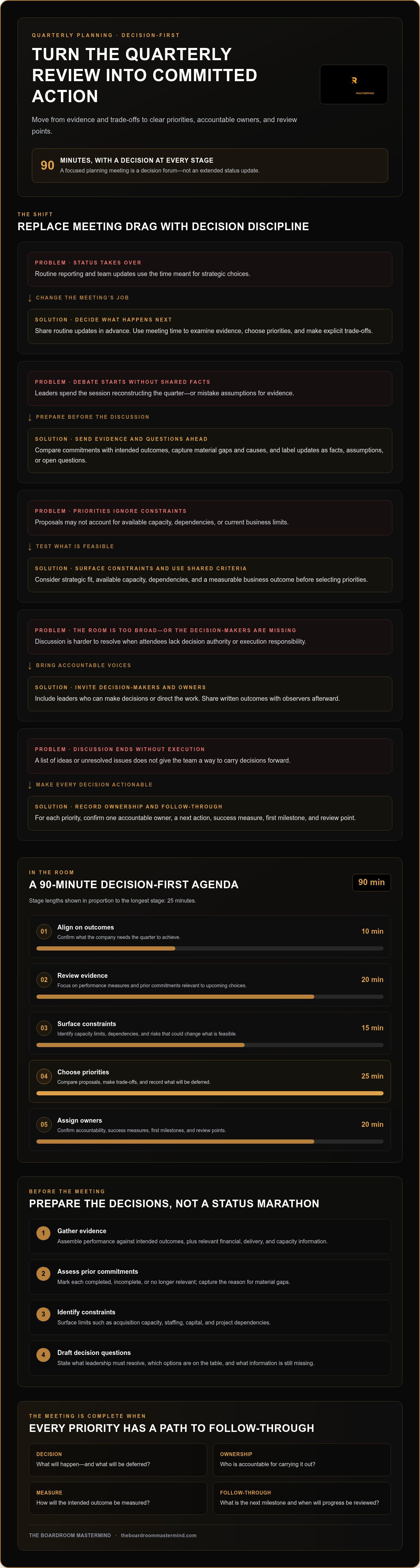
- Gather evidence. Assemble measures that show performance against the quarter’s intended outcomes, along with relevant financial, delivery, and capacity information.
- Assess prior commitments. Mark each as completed, incomplete, or no longer relevant. Capture the reason behind any material gap.
- Identify constraints. Surface limits such as acquisition capacity, staffing, capital, or project dependencies that could affect proposed priorities.
- Draft decision questions. State what leadership must resolve, what options are on the table, and what information is still missing.
Ask each leader to submit a concise update and proposed priorities in advance. Label each item as a fact, an assumption, or an open question. For example, a delivery date supported by a project schedule is a fact; an expected contractor start date may be an assumption; whether to shift resources is a decision question. This keeps confidence from being mistaken for evidence, a core discipline in how to effectively run quarterly planning meetings.
Review the last quarter without turning it into a status marathon
Compare commitments with intended outcomes, not just activity completed. Record material gaps and their causes, then identify what changed in the market, business, or operating capacity. Decide which priorities still support the company’s direction and which assumptions need fresh scrutiny. Routine progress details belong in the pre-read, not a spoken tour of every team’s work.
Set the meeting’s decision criteria in advance
Agree on how proposals will be judged: strategic fit, available capacity, dependencies, and a measurable business outcome. A strategic planning framework can structure the discussion, but the criteria should reflect the company’s direction and current constraints. Experienced real estate operators who value structured peer discussion can also examine business challenges with other members of the Boardroom Mastermind.
How to Run the Quarterly Planning Meeting: A Decision-First Agenda
Move from shared context to committed action. This practical 90-minute structure gives each decision stage a place while limiting status updates and side debates:
- Align on outcomes, 10 minutes: Confirm what the company needs the quarter to achieve.
- Review evidence, 20 minutes: Focus on performance measures and prior commitments that matter to upcoming choices.
- Surface constraints, 15 minutes: Identify capacity limits, dependencies, and risks that could change what’s feasible.
- Choose priorities, 25 minutes: Compare proposals, make trade-offs, and record what will be deferred.
- Assign owners, 20 minutes: Confirm accountability, success measures, first milestones, and review points.
Time-box each stage. If a discussion doesn’t affect a quarterly decision, add it to a parking list with a follow-up owner instead of letting it take over the agenda. Every selected priority needs one accountable owner, a measurable outcome, and a first milestone. Shared effort is welcome; shared accountability without a clear lead is not.
How do you choose priorities when everything seems urgent?
Test each proposal against four factors: strategic relevance, available capacity, dependencies, and the consequence of delay. A project may be valuable but infeasible if it competes for the same team or capital as a higher-impact commitment. Make the trade-off explicit: name what the team will defer, why, and what condition could bring it back for review. Don’t disguise a longer wish list as a plan.
How should the meeting handle disagreement?
Ask each leader to separate the evidence from the assumption behind their position. Then identify what information would change the decision and whether waiting for it is worth the delay. Document the decision, any unresolved risk, and the person responsible for the next action. Disagreement has served its purpose once the decision and its rationale are clear.
Peer discussion can add another perspective to consequential decisions. Explore the quarterly event information to see how these sessions are structured, or explore the Boardroom Mastermind.
Turn Quarterly Decisions into Execution and Choose the Right Support
A decision creates value only when it changes what happens next. Record every priority in a concise execution plan with five elements: one accountable owner, the next action, a due point, a measurable success outcome, and a review date. Share the written plan with affected teams. Make clear how they should flag blockers or changing assumptions, and who will respond.
What should happen after the meeting?
Send the decision log and priority summary promptly, while the reasoning is still clear. Schedule progress checks between quarterly meetings, using the agreed measures to spot slippage early. If a new constraint threatens delivery, the owner should raise it before it becomes a missed outcome. A course correction changes the route or next action; abandoning a priority means reconsidering the commitment itself. Don’t confuse the two.
Follow-through is essential to how to effectively run quarterly planning meetings. Give each check-in a clear purpose: confirm progress, surface risks, and agree on the next action. Keep the original decision visible so short-term pressure doesn’t quietly replace the quarter’s priorities with a fresh list of urgent tasks.
When can peer accountability add value?
Internal ownership remains essential, but experienced operators can also benefit from examining a challenge with peers who understand the demands of running a business. The Boardroom Mastermind’s annual membership includes four quarterly events, two-day intensive workshops, and quarterly hot-seat breakdowns where members examine business needs and work through challenges. The membership is for experienced real estate professionals doing significant business revenue, not new owners just getting started. Members must be willing to be vulnerable and contribute meaningfully to fellow members.
- You MUST be THE REAL DEAL and doing significant business revenue.
- The Boardroom Mastermind is not for new business owners that are just getting started. EXPERIENCE MATTERS here.
- We have a strict ‘NO DOUCHE BAG’ rule.
- No scarcity is allowed.
- You MUST be willing to connect any and every ‘dot’ possible for your fellow members.
- You MUST be willing to be vulnerable and break down your business needs in front of your fellow members.
- You MUST be looking to grow and improve your business DRAMATICALLY and QUICKLY.
To see whether this peer environment fits your stage of business, explore the quarterly event experience and learn about the Boardroom Mastermind.
Make the Next Quarter a Deliberate Step Forward
The standard you set in your planning room shapes what the business makes room for next. Keep the process disciplined, but leave space to challenge assumptions as conditions change. Strong execution isn’t rigid adherence to a document; it’s maintaining strategic intent while responding deliberately to new information. That’s the real test of how to effectively run quarterly planning meetings.
For leaders who want structured peer discussion alongside their company’s planning rhythm, the Boardroom Mastermind brings experienced real estate professionals together through its quarterly events and hot-seat business breakdowns. Members are expected to examine their business needs openly and contribute meaningfully to fellow operators.
If that kind of peer environment fits your stage of business, explore the Boardroom Mastermind experience. Then take your next quarterly decision from intention to execution, with clarity, ownership, and room to lead well.
Frequently Asked Questions
How long should a quarterly planning meeting last?
Set the duration according to the decisions and preparation required, not a fixed template. A quarter with a few connected choices may need less discussion than one involving competing investments or dependencies across teams. Protect time for leaders to examine evidence and make deliberate trade-offs. If sessions repeatedly run over, move information-sharing out of the meeting or reduce the number of decisions on the agenda.
Who should attend a quarterly planning meeting?
Include leaders with decision authority or direct responsibility for executing the priorities under discussion. Invite additional expertise when it’s needed to assess a material constraint, but don’t ask people to attend simply to listen to routine reports. If a decision affects another function, bring its accountable leader into that discussion and send the outcome to everyone who needs to act on it.
What should be on a quarterly planning meeting agenda?
Include a review of the previous quarter, alignment with strategic direction, constraints and trade-offs, priority selection, and ownership. Before the session, circulate evidence and frame each agenda item as a question leadership needs to resolve. Close by recording what the team decided, what it deferred, and the first actions required. This gives participants a reference they can use once the meeting is over.
How do you keep quarterly goals on track after the meeting?
Assign each priority an accountable owner, a measurable outcome, a next action, and a scheduled review point. Share the decision log with affected teams, then use regular progress checks to surface blockers early. Define how the team will handle changed assumptions: record what shifted, assess its impact, and deliberately adjust the plan or reaffirm the commitment.

Disclaimer
Mr. Clothier is an expert in real estate investing. As such his experiences are not necessarily typical to the standard real estate investor and whose results may vary. The successes shared on this site are not considered typical. Most individuals who order the educational materials and systems probably do not follow any of the techniques or strategies and consequently make little to no money due to their inaction. The company is in the process of determining the typical success of its clients. Stories shared herein are for example purpose only and should not be construed as "guarantees" of success. Results will vary based on background, education, and experience and actions taken.
This site is not a part of the Google/Facebook website or Google/Facebook Inc. Additionally, this site is NOT endorsed by or affiliated with Google/Facebook in any way. GOOGLE/FACEBOOK is a trademark of GOOGLE/FACEBOOK, Inc.
INCOME DISCLAIMER: This website and the items it distributes contain business strategies, marketing methods and other business advice that, regardless of referenced results and experience, may not produce the same results (or any results) for you. The Boardroom Mastermind makes absolutely no guarantee, expressed or implied, that by following the advice or content available from this web site you will make any money or improve current profits, as there are several factors and variables that come into play regarding any given business. Primarily, results will depend on the nature of the product or business model, the conditions of the marketplace, the experience of the individual, and situations and elements that are beyond your control. As with any business endeavor, you assume all risk related to investment and money based on your own discretion and at your own potential expense.
LIABILITY DISCLAIMER: By reading this website or the documents it offers, you assume all risks associated with using the advice given, with a full understanding that you, solely, are responsible for anything that may occur as a result of putting this information into action in any way, and regardless of your interpretation of the advice. You further agree that The Boardroom Mastermind, its affiliates, subsidiaries, officers and agents, cannot be held responsible in any way for the success or failure of your business as a result of the information provided. It is your responsibility to conduct your own due diligence regarding the safe and successful operation of your business. In summary, you understand that we make absolutely no guarantees regarding income as a result of applying this information, as well as the fact that you are solely responsible for the results of any action taken on your part as a result of any given information. In addition, you agree that our content is to be considered "for entertainment purposes only". Always seek the advice of a professional when making legal, financial, tax, or business decisions.
BUSINESS OPPORTUNITY: All products and services offered by The Boardroom Mastermind are intended to provide prospective purchasers with general business strategies, marketing methods and other general advice for business development and training. At no point is The Boardroom Mastermind soliciting anyone to enter into a new business nor is it representing, either expressly or by implication, that it will provide locations for a business, provide outlets, accounts, or customers, or purchase any of the goods or services made by the purchaser.
The products being offered through this promotion are packages of informational tools to help you learn about business and deal making strategies.


