
How to Build a High-Performance Culture: The CEO’s Blueprint for 8-Figure Scale
Your business is currently a reflection of your personal stamina, and that's exactly why you're stuck at the eight-figure ceiling. If your presence is the only thing keeping a 22% profit margin from collapsing, you haven't yet built a high-performance culture; you've built a high-stakes job. You've likely felt the weight of being the primary bottleneck, watching as mediocre staff fail to execute your vision the moment you step out of the boardroom.
You know that true scale requires a leadership team that operates with surgical precision without your daily intervention. This blueprint provides the exact strategic framework to engineer a self-sustaining ecosystem of A-players who own their KPIs as if they were their own. You'll learn how to implement the accountability loops and recruitment protocols that allow for 35% more efficient execution, giving you the freedom to focus on high-level strategy and legacy. We're moving beyond the hustle to build a business that scales predictably by design.
Key Takeaways
- Shift from a founder-dependent "Hustle Culture" to a system-driven "Legacy Culture" that operates autonomously at scale.
- Identify the core traits of A-players and learn how to attract elite talent by offering an environment of collective intelligence rather than just a paycheck.
- Implement the strategic blueprint to engineer a high-performance culture where radical accountability ensures every decision aligns with your 8-figure vision.
- Leverage the Law of Proximity to ensure your internal performance remains elite by aligning your leadership with a high-level peer network.
Redefining High-Performance Culture for the 8-Figure Real Estate CEO
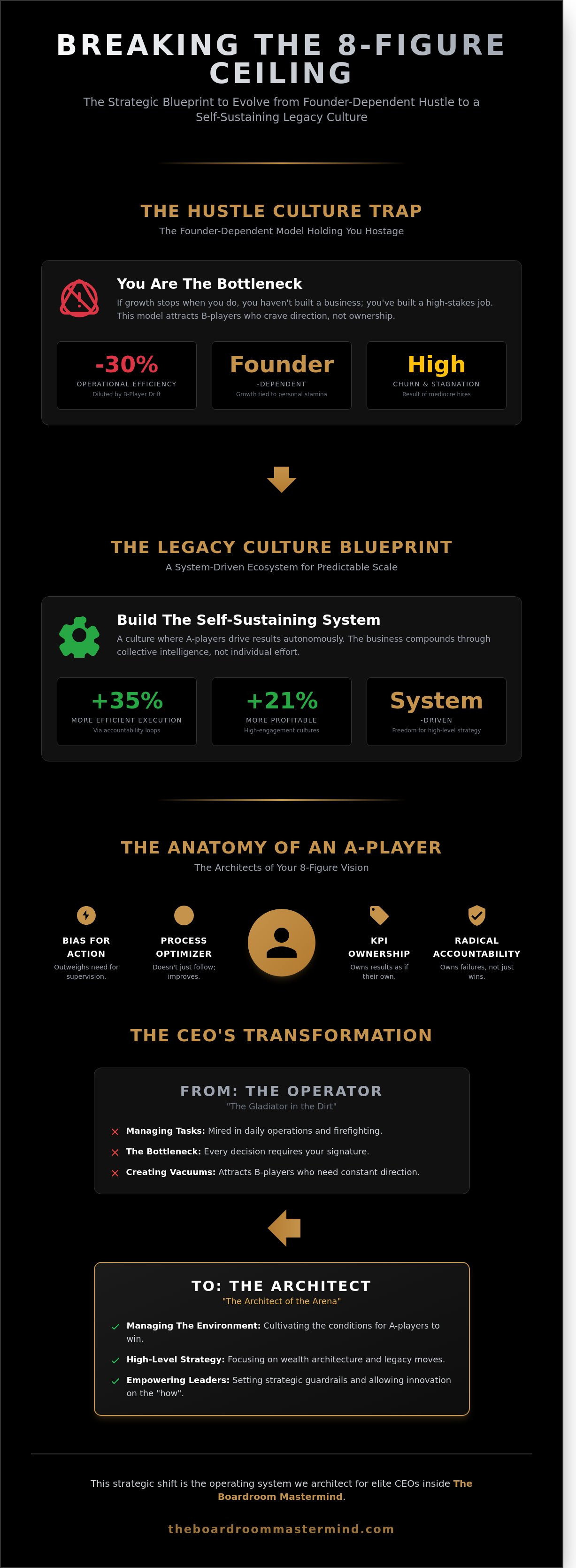
True high-performance culture is not a collection of aspirational values or office perks. It is a self-correcting system where A-players drive results autonomously. Most real estate CEOs remain trapped in Hustle Culture, a founder-dependent model where growth stops the moment the leader stops grinding. To scale to 8 figures and beyond, you must transition to Legacy Culture. This system-dependent framework ensures the business compounds through collective intelligence rather than individual effort. It is the business operating system we architect within The Boardroom Mastermind. In a market where 90% of firms struggle with high churn and stagnant lead conversion, a High Performance Organization becomes your ultimate unfair advantage.
The 7-Figure Ceiling: Why Your Current Culture is Blocking Your Growth
The 7-figure ceiling is the direct result of the Founder Bottleneck. If every marketing spend, hire, or tactical pivot requires your signature, you aren't a CEO; you're a high-paid supervisor. This environment creates a vacuum that attracts B-players who crave direction rather than ownership. Industry data suggests that B-player drift can dilute a firm's operational efficiency by 30% within a single year. These mediocre hires don't just produce less; they actively dilute your vision and slow down your elite talent.
From Operator to Owner: The Cultural Shift
Moving from operator to owner requires you to stop managing tasks and start managing the environment that produces them. You are the architect of the arena, not the gladiator in the dirt. This shift demands a focus on wealth architecture and long-term optimization rather than daily fires. High performance is the alignment of elite talent with a ruthless focus on KPIs.
- Elite Talent: Hiring individuals who are better at their specific roles than you are.
- System Autonomy: Building workflows that identify and correct errors without executive intervention.
- Predictable Scale: Using data-driven benchmarks to remove the guesswork from your growth trajectory.
The Anatomy of an A-Player: Engineering Collective Intelligence
Scaling an organization to 8-figure levels isn't about hiring "good" people. It's about securing architects of your vision. In the high-stakes real estate sector, A-players are defined by radical accountability and a bias for action that outweighs their need for supervision. These individuals don't just follow a process; they optimize it. They're attracted to a high-performance culture because it validates their own standards. While mediocre talent seeks security, elite talent seeks an environment of high-level peers who push them to evolve.
Collective Intelligence is your ultimate unfair advantage. It occurs when a team of specialists out-executes a single genius. This strategic force multiplier allows your business to process complex market shifts faster than your competition. Research by Bain & Company on How to Build a High-Performance Culture indicates that companies with high-engagement cultures are 21% more profitable. This profitability stems from a team that operates with a shared brain, solving problems before they reach the CEO's desk.
Vetting for Cultural Alignment over Technical Skill
Technical proficiency is a baseline, not a differentiator. A "brilliant jerk" with elite skills but a toxic ego will dismantle your 9-figure aspirations from the inside. To protect your culture, utilize an interviewing framework that tests for core values through situational pressure. Ask candidates to describe a time they failed and took 100% responsibility without blaming external market conditions. If they can't own a mistake, they can't lead a department. You're looking for the "quiet professional" who values the legacy of the firm over individual accolades.
Empowerment vs. Abandonment: The CEO’s Balancing Act
Many CEOs confuse delegation with abdication. Abdication is throwing a task over the fence and hoping it gets done. True empowerment requires setting clear strategic guardrails. You provide the "what" and the "why," then allow your A-players to innovate on the "how." This creates a sense of ownership that drives retention. To truly scale, you must invest in high-level leadership development for your top-tier talent. By defining the boundaries of authority, you allow your team to move at speed without needing constant permission. This transition from operator to owner is the only way to achieve sustainable, stress-free growth.
How to Build a High-Performance Culture: A Strategic Implementation Guide
Scaling to 8-figures requires more than a viable product; it demands an elite behavioral framework. You don't stumble into a high-performance culture. You architect it through four relentless steps that prioritize execution over intentions.
- Step 1: Define Non-Negotiables. Identify the 3 to 5 core values that govern every deal. If a value doesn't cost you money or a "talented" employee at some point, it's just marketing fluff.
- Step 2: Establish Radical Accountability. Move the team from "trying" to "owning." In this environment, specific, measurable outcomes are the only currency that matters.
- Step 3: Implement the Rhythm of Execution. Establish a cadence of quarterly audits, weekly pulses, and daily alignment. This prevents strategic drift and maintains momentum.
- Step 4: Reward Cultural Wins. Align compensation and recognition with behaviors, not just revenue. A high-revenue producer who violates your core values is a liability to your long-term legacy.
Research published in The Leader's Guide to Corporate Culture confirms that when you align culture with strategy, you create an unrivaled competitive advantage. This alignment turns your team into a self-correcting organism that thrives on complexity.
Building Your Business Operating System
Your operating system is the documentation of your excellence. It ensures the high-performance culture remains consistent as you scale from 10 to 100 employees. Transparency is the fuel for this system. When your inner circle has access to the logic behind the numbers, trust increases and decision-making speed improves by 40%.
The Annual Business Audit: Cultivating the Garden
High-level growth requires a commitment to pruning. You must periodically remove underperformers to maintain elite standards. Data suggests a single "B-player" can drag down team productivity by 25%. Address cultural debt, the accumulated weight of ignored small infractions, before it bankrupts your 2024 growth trajectory. It's about protecting the collective intelligence of your organization.
Sustaining the Edge: Why Proximity Dictates Performance
The Law of Proximity is absolute. Your performance as a leader is a direct reflection of the elite peer network you maintain. If your external network is stagnant, your internal high-performance culture will eventually decay. You can't lead an eight-figure organization while surrounded by six-figure mindsets. When you're the smartest person in every room, you've reached your ceiling. Breaking through requires a deliberate, strategic shift in your environment.
The Boardroom Mastermind experience provides the external perspective necessary to audit your internal operations. It's about collective intelligence. Accessing a peer group that operates at a higher frequency allows you to identify blind spots that your internal team is too close to see. This is the ultimate shortcut to scaling without the stress. It moves you from the frantic energy of the operator to the calculated precision of the owner.
The CEO’s Private Boardroom
Elite peer groups challenge your cultural assumptions by showing you what's actually possible at scale. Our members often arrive as "hustlers" working 70 hours a week and exit as CEOs working 20. This transformation is driven by proximity to leaders who've already automated their 8-figure operations. By changing their network, they successfully installed a high-performance culture that functions independently of their daily involvement. Data indicates that 85% of entrepreneurs who join an elite inner circle see a measurable increase in operational efficiency within the first six months.
Engineering Your Legacy
It's time to stop building a business and start engineering an empire. True legacy isn't built on hustle; it's built on systems and elite associations. You've reached the level where your growth is no longer about effort, but about access. Explore these case studies to see how 8 and 9-figure founders have leveraged this community to transform their organizations. Secure your seat at the table and claim your unfair advantage.
Secure Your Seat in the Architecture of Scale
Building an 8-figure real estate empire isn't about working harder; it's about the systems you deploy and the people you empower. You've seen how a high-performance culture acts as the ultimate multiplier, turning individual talent into collective intelligence. By prioritizing A-players and maintaining strategic proximity to other elite operators, you move from the role of a frantic operator to a visionary owner. This transition is what separates those who plateau at seven figures from those who achieve a 9-figure legacy.
The blueprint for this evolution requires more than just theory. It demands a proven framework for scaling without the stress. You need direct access to the same 7, 8, and 9-figure entrepreneurs who have already navigated these complexities. Through quarterly in-person strategy intensives, you can refine your operations and solidify your industry authority. Don't settle for incremental growth when exponential scale is within reach.
Apply to Join the Elite Inner Circle of Real Estate CEOs and secure your seat at the table where the world's highest achievers build the future. Your next level of freedom starts here.
Frequently Asked Questions
What is the difference between a high-performance culture and a high-pressure culture?
A high-performance culture relies on sustainable systems and clear accountability, while high-pressure environments depend on fear and unsustainable exertion. High-performance models prioritize long-term leverage and outcome-based results. Conversely, high-pressure setups lead to a 37% increase in employee absenteeism according to Gallup data. True elite performance is about optimization, not burnout. You want a team that wins because the system is designed for victory, not because they’re working 100-hour weeks.
How long does it take to actually change a company's culture?
You should expect a timeline of 12 to 18 months to see a fundamental shift in your organization’s DNA. While you can change a policy in a day, Harvard Business Review research indicates that structural behavioral changes require at least 1.5 years to become permanent. This isn't a quick fix for struggling firms; it's a strategic investment in your company’s 8-figure legacy. Speed is the enemy of stability when you're re-engineering how your elite inner circle operates.
Can a small real estate team have a high-performance culture?
Small teams are the ideal environment to cultivate a high-performance culture because the feedback loops are shorter and more impactful. A 2023 Real Trends report shows that small teams with documented core values and high accountability standards see a 20% increase in net profitability compared to their peers. It’s about the quality of your talent, not the quantity of your headcount. Scaling from five to fifty agents requires this cultural foundation to prevent your operations from collapsing under their own weight.
What is the #1 mistake CEOs make when trying to improve culture?
The biggest failure is treating culture as a marketing exercise rather than an operational framework. McKinsey reports that 70% of organizational transformations fail because leadership behavior doesn't match the stated values. If your actions as CEO don't mirror the standards you set, your team won't follow the blueprint. Building a high-performance culture requires you to be the architect of the system, ensuring every incentive and consequence aligns with your 9-figure exit strategy.
How do I maintain culture while my team is working remotely?
Maintaining culture in a remote environment requires replacing physical proximity with radical transparency and structured communication cadences. A 2022 Stanford study found that remote teams using specific asynchronous frameworks increased their total productivity by 13%. You don't need a shared office to build an elite unit; you need shared outcomes. Use digital dashboards to track KPIs in real time. This ensures every member of your inner circle remains focused on the mission regardless of their geography.


