
Hiring C-Suite Executives: A CEO's Step-by-Step Guide
An executive hire can reset how your company makes decisions, allocates capital, and executes its strategy. The risk isn’t simply choosing the wrong résumé. It’s defining the seat too loosely, then discovering after the decision that the mandate and the leader’s strengths never aligned. A disciplined hiring process for c-suite executives starts by setting the role and evidence standard before candidates enter the picture.
You already know a senior appointment carries consequences well beyond one department. Yet résumés and polished interviews rarely reveal how a candidate will perform against your priorities, authority boundaries, and operating realities. Misalignment discovered after the offer costs momentum, not just time.
This guide lays out a step-by-step approach: define the executive mandate, translate it into observable outcomes, and assess every candidate against consistent, role-specific criteria. You’ll also learn how to make a reasoned selection and establish a clear transition into the role. The objective is disciplined judgment, not intuition dressed up as consensus.
Key Takeaways
- Diagnose whether the business needs an executive capability or a fix to workload, process, or structure before opening a search.
- Build a role scorecard that connects the executive mandate and authority to a focused set of observable outcomes.
- Use a consistent hiring process for c-suite executives: assess candidates against the scorecard, ask role-specific questions, test relevant judgment, and compare evidence.
- Resolve material evidence gaps before deciding, then align decision rights, reporting lines, expectations, and early priorities before the executive starts.
Why a C-Suite Hiring Process Starts With the Business Need
Hiring for a title before defining the business need can create an expensive mismatch: the new executive arrives ready to lead, but the company has no clear agreement on what they own or what success means. Start with the work, not the org chart. In a disciplined hiring process for c-suite executives, role clarity comes before sourcing, interviews, and candidate comparisons because it gives every later decision a consistent standard.
First, diagnose the gap. If a team is overloaded because a major project has a deadline, temporary support or tighter prioritization may solve the problem. If recurring decisions, cross-functional accountability, and durable business outcomes lack an owner, the company may need executive-level capability. A leadership-team blueprint can help frame the broader question: how should leadership responsibilities fit together as the business grows?
Is the company ready to hire a C-suite executive?
Look for repeated work that falls between leaders: capital allocation, operating performance, market expansion, or coordination across functions. Separate ongoing ownership from a time-bound initiative that can be managed as a project. Then surface unresolved strategy, overlapping authority, and unclear reporting lines. If leaders disagree on company priorities, a new executive may inherit conflicting instructions rather than a mandate.
Before deciding to hire, name the recurring decisions that need an owner and identify what currently happens when no one takes responsibility. If the issue is a temporary workload spike, a permanent executive seat may not address it. If the same important decisions keep being delayed or bounced between leaders, define the authority needed to resolve them.
Define the mandate before writing the job description
Write the business problem in plain language: “Improve operating visibility across business units,” for example, is more actionable than “hire a strong COO.” Specify the role’s reporting line, the decisions it can make independently, those requiring CEO approval, and the outcomes it must influence. Keep the scope bounded. Combining finance, operations, technology, and every urgent initiative into one catch-all seat makes accountability harder to assess and the search harder to focus.
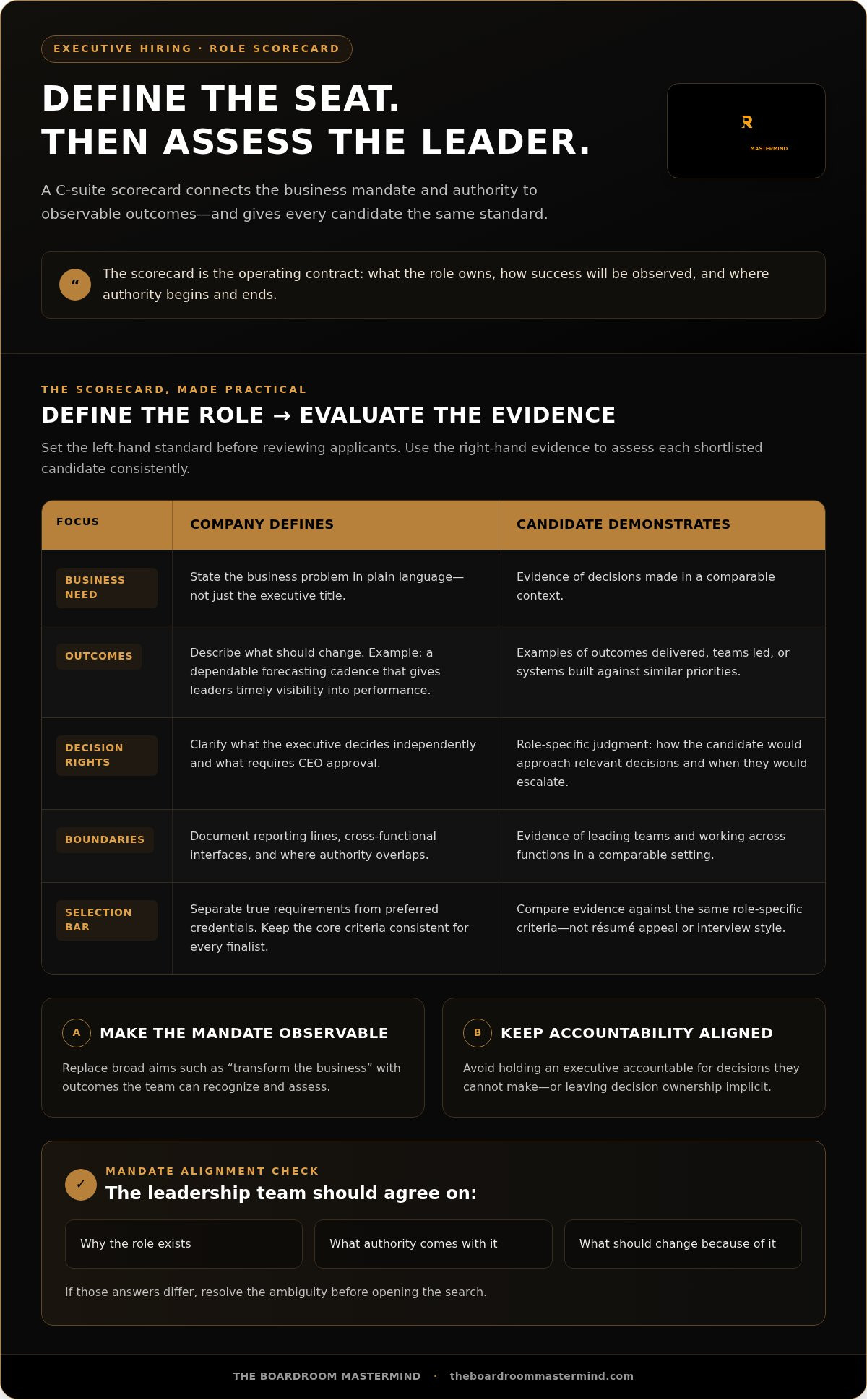
Before opening the search, test the mandate with the leadership team. Can each person describe why the role exists, what authority comes with it, and what should change because of it? If not, resolve the ambiguity first. That discipline protects the company from comparing polished candidates against different, unspoken expectations.
Build a C-Suite Role Scorecard Before You Search
Once the business need is clear, convert it into a standard you can use to evaluate candidates. A role scorecard is not a longer job description. It is the written mandate, decision authority, and measurable outcomes that define what the executive is accountable for.
A scorecard is the operating contract between the company and the executive: what the role owns, how success will be observed, and where authority begins and ends.
Translate strategic priorities into a focused set of outcomes suited to the company’s stage. For example, if the priority is stronger financial control, an outcome might be a dependable forecasting cadence that gives leaders timely visibility into performance. Describe what should be different when the executive is succeeding, and how the team will recognize that change. Avoid vague goals such as “transform the business.” They invite different interpretations and make candidate comparisons subjective.
Set outcomes, decision rights, and reporting lines
For each outcome, define whether the executive owns delivery, influences another leader’s work, or escalates decisions to the CEO or board. Document reporting lines and key cross-functional interfaces, including where authority overlaps. The CEO still sets enterprise direction and resolves decisions reserved for the top office; hiring an executive should strengthen leadership capacity, not leave that boundary implicit. Adjust expectations to the company’s scale and the role’s mandate.
Make the boundary practical. For a recurring decision, state who gathers the information, who recommends a course of action, who decides, and who needs to be informed. This helps prevent two common problems: the executive being held accountable for decisions they cannot make, and other leaders continuing to override decisions the executive is meant to own.
Turn the scorecard into consistent selection criteria
Before reviewing applicants, identify the evidence that would demonstrate each outcome: examples of decisions made, teams led, or systems built in a comparable context. Separate true requirements from preferred credentials. A specific degree or industry title may be useful, but it should not outweigh demonstrated ability to deliver the mandate.
Use the same core criteria for every shortlisted candidate. This keeps a compelling résumé or interview style from quietly changing the standard. If the scorecard exposes gaps in leadership ownership or reporting design, pressure-test that structure with experienced peers; peer discussions about business decisions can help sharpen the questions before the search advances. With the mandate and evidence defined, the hiring process for c-suite executives can move into candidate assessment on firmer ground.
How to Assess and Compare C-Suite Candidates Fairly
Strong interview presence can create confidence without proving capability. In the hiring process for c-suite executives, assess how candidates think, decide, and learn against the role’s defined outcomes. Use the same sequence for each finalist:
- Screen against the scorecard. Look for evidence tied to the role’s required outcomes, not prestige alone.
- Interview consistently. Ask every finalist comparable questions about decisions the executive would own.
- Test relevant judgment. Present a realistic scenario and explore how the candidate weighs trade-offs. Keep the exercise connected to actual responsibilities.
- Compare evidence. Record specific examples and reasoning against each criterion before discussing overall preference.
Keep notes in the same format for each candidate. Record what the person did, the context, their individual contribution, and what changed afterward. When an answer is broad, ask for a specific example rather than filling in the missing details yourself.
Use structured interviews to test executive judgment
Ask how a candidate handled a decision involving competing priorities, such as protecting margin while funding growth. Probe what they personally did, what information shaped their choice, who was affected, and what they learned from the result. Broad claims like “I transformed the organization” need context. What changed, what was the candidate accountable for, and how did they know the approach worked? Capture evidence, not interview chemistry.
Use follow-up questions to distinguish ownership from proximity. A candidate may have been part of a successful initiative without setting its direction or making the key decisions. Ask which choices they made, what alternatives they considered, and how they handled a result that differed from the original plan.
Compare candidates using evidence, not résumé prestige
For each role outcome, summarize the candidate’s supporting examples, unresolved questions, and relevant risks. A reference conversation can add context about the candidate’s contribution, decision-making, and working relationships in the situation they described. Apply the same criteria across finalists, while distinguishing a genuine gap from information you haven’t yet gathered. Document why the chosen candidate best fits this mandate, including the trade-offs behind the decision.
For experienced business owners, candid peer discussion can also help pressure-test how leadership choices affect the wider operation. Explore peer-based business discussions to challenge assumptions and sharpen your decision-making alongside candidate assessment.
Make the Executive Hire and Set Up a Clear First Chapter
A final decision should resolve material evidence gaps, not bury them beneath urgency or enthusiasm. If a candidate’s experience with a critical responsibility is unclear, gather another relevant example or reference before deciding. If the evidence still doesn’t support the mandate, pause. A disciplined hiring process for c-suite executives ends with a reasoned decision, not simply a preferred finalist.
Close the decision and align expectations
Before the start date, review the mandate and success criteria with the selected executive. Confirm reporting lines, key relationships, decision boundaries, and how the CEO and executive will communicate when priorities conflict. Agree on an initial review cadence to surface obstacles, clarify assumptions, and adjust working rhythms. Keep this role-specific transition plan focused on the executive’s first priorities; broader leadership-team development belongs on its own agenda.
Also make sure the people who work closely with the executive understand how decisions will move through the organization. Clear handoffs reduce the risk of duplicate ownership or informal approval requirements that contradict the written mandate. Revisit the scorecard as the role gets underway, and address changes to priorities or authority directly rather than letting expectations drift.
When peer perspective can support an executive decision
Candid peer discussion can help an owner pressure-test the business context around a high-stakes hire. It can challenge assumptions about structure or priorities. The Boardroom Mastermind is designed for experienced entrepreneurs who meet its standards:
- You MUST be THE REAL DEAL and doing significant business revenue.
- The Boardroom Mastermind is not for new business owners that are just getting started. EXPERIENCE MATTERS here.
- We have a strict ‘NO DOUCHE BAG’ rule.
- No scarcity is allowed.
- You MUST be willing to connect any and every ‘dot’ possible for your fellow members.
- You MUST be willing to be vulnerable and break down your business needs in front of your fellow members.
- You MUST be looking to grow and improve your business DRAMATICALLY and QUICKLY.
The annual membership includes four quarterly events, weekly Zoom calls where members highlight their business models with live Q&A, bi-weekly Zoom check-in calls for 90-day progress updates, and quarterly hot-seat breakdowns of members’ businesses. Explore the Boardroom Mastermind Membership to learn about the peer environment and member experience.
Make Your Next Leadership Decision With Greater Clarity
The next executive hire will shape more than a reporting line. It will influence how your business makes decisions, handles pressure, and turns priorities into execution. Treat the hiring process for c-suite executives as one part of a larger leadership discipline: keep testing whether your structure supports the company you’re building.
The decision is stronger when the mandate is clear, every candidate is assessed against the same evidence standard, and remaining risks are discussed before the offer. Keep the scorecard as a working reference after the hire, too. It gives the CEO and executive a shared basis for clarifying priorities and addressing gaps without relying on assumptions.
The Boardroom Mastermind Membership brings experienced real estate entrepreneurs together through quarterly events, weekly Zoom calls, and quarterly business hot-seat breakdowns. If you’re ready to examine your leadership decisions alongside other experienced business owners, explore the Boardroom Mastermind Membership.
Frequently Asked Questions
What is the first step in a C-suite hiring process?
Start by defining the business need, not by publishing a title. Identify decisions or outcomes that repeatedly lack a clear owner, then determine whether an executive hire is the right response. For example, missed forecasts might point to a finance leadership gap, or they might reflect inconsistent reporting. In the hiring process for c-suite executives, clarifying that distinction first helps prevent a search from solving the wrong problem.
How do you evaluate a C-suite executive candidate?
Evaluate each candidate against the role’s written outcomes, using comparable questions and evidence from relevant work. Ask for a specific example, then explore the candidate’s own contribution, the constraints they faced, and what they would change now. For instance, a growth leader should explain how they assessed an opportunity, not only cite growth as a past achievement. Seniority and polish are context, not proof of fit.
How many interview rounds should a C-suite hiring process include?
There’s no universal number of rounds. Set the sequence around the evidence the company still needs: an initial mandate review, substantive discussions with decision-makers, and a final conversation to resolve outstanding questions may be sufficient. Assign a distinct purpose to each meeting. If a round won’t assess a required capability or clarify a key working relationship, it may add calendar time without improving the decision.
Should a company use an executive search firm to hire a C-suite executive?
An executive search firm can broaden candidate access, while the company retains responsibility for the role mandate, assessment, and final choice. Whether to use one depends on the internal team’s capacity and the candidate market for the position. External sourcing doesn’t replace internal judgment: keep the same selection standard whether a candidate comes through a firm, a referral, or the company’s own network.
What should happen after hiring a C-suite executive?
Before the executive starts, prepare the practical conditions for effective work: introductions to essential stakeholders, access to relevant information, and clarity on how decisions move through the organization. Schedule regular check-ins to surface blocked work and adjust expectations early. Use those conversations to assess progress against the agreed mandate, while keeping longer-term leadership development separate from the new executive’s immediate transition.

Disclaimer
Mr. Clothier is an expert in real estate investing. As such his experiences are not necessarily typical to the standard real estate investor and whose results may vary. The successes shared on this site are not considered typical. Most individuals who order the educational materials and systems probably do not follow any of the techniques or strategies and consequently make little to no money due to their inaction. The company is in the process of determining the typical success of its clients. Stories shared herein are for example purpose only and should not be construed as "guarantees" of success. Results will vary based on background, education, and experience and actions taken.
This site is not a part of the Google/Facebook website or Google/Facebook Inc. Additionally, this site is NOT endorsed by or affiliated with Google/Facebook in any way. GOOGLE/FACEBOOK is a trademark of GOOGLE/FACEBOOK, Inc.
INCOME DISCLAIMER: This website and the items it distributes contain business strategies, marketing methods and other business advice that, regardless of referenced results and experience, may not produce the same results (or any results) for you. The Boardroom Mastermind makes absolutely no guarantee, expressed or implied, that by following the advice or content available from this web site you will make any money or improve current profits, as there are several factors and variables that come into play regarding any given business. Primarily, results will depend on the nature of the product or business model, the conditions of the marketplace, the experience of the individual, and situations and elements that are beyond your control. As with any business endeavor, you assume all risk related to investment and money based on your own discretion and at your own potential expense.
LIABILITY DISCLAIMER: By reading this website or the documents it offers, you assume all risks associated with using the advice given, with a full understanding that you, solely, are responsible for anything that may occur as a result of putting this information into action in any way, and regardless of your interpretation of the advice. You further agree that The Boardroom Mastermind, its affiliates, subsidiaries, officers and agents, cannot be held responsible in any way for the success or failure of your business as a result of the information provided. It is your responsibility to conduct your own due diligence regarding the safe and successful operation of your business. In summary, you understand that we make absolutely no guarantees regarding income as a result of applying this information, as well as the fact that you are solely responsible for the results of any action taken on your part as a result of any given information. In addition, you agree that our content is to be considered "for entertainment purposes only". Always seek the advice of a professional when making legal, financial, tax, or business decisions.
BUSINESS OPPORTUNITY: All products and services offered by The Boardroom Mastermind are intended to provide prospective purchasers with general business strategies, marketing methods and other general advice for business development and training. At no point is The Boardroom Mastermind soliciting anyone to enter into a new business nor is it representing, either expressly or by implication, that it will provide locations for a business, provide outlets, accounts, or customers, or purchase any of the goods or services made by the purchaser.
The products being offered through this promotion are packages of informational tools to help you learn about business and deal making strategies.


