
High-Level Real Estate Investment Strategies: A 2026 Framework for Scale
What if your next real estate strategy increases deal volume but weakens the advantage that made you successful? For experienced investors, the question isn’t simply which asset class or structure looks attractive. It’s which high-level real estate investment strategies fit your repeatable edge, capital needs, and capacity to execute.
Strategy lists often blur together asset classes, deal tactics, and investment vehicles, even though each answers a different question. An opportunity may demand more control, capital, or operating capacity than your team can support. Growth can add complexity without improving returns or strengthening your position.
This 2026 framework compares advanced approaches by what they require and how they create value. You’ll learn to distinguish strategy types, test opportunities against your edge and capital fit, and identify the operating capabilities and governance needed before scaling. The objective is disciplined expansion, not activity for its own sake.
Key Takeaways
- Separate asset classes, deal tactics, and investment vehicles to compare how each strategy creates value and distributes control.
- Assess high-level real estate investment strategies against your repeatable sourcing edge, capital needs, and execution capacity.
- Screen opportunities by thesis, sourcing, capital duration, operational demands, and potential to scale without adding needless complexity.
- Turn your chosen approach into clear priorities, accountable ownership, and regular review. Use peer perspectives to challenge assumptions, not replace due diligence.
High-Level Real Estate Investment Strategies Start With Your Repeatable Edge
Owning real estate is an asset position. Building a repeatable investment business is an operating model. The difference is whether you can identify opportunities, create value, deploy capital, and execute through a process that works beyond a single exceptional deal.
A real estate investment strategy connects the opportunities you pursue, the value you create, the capital you use, and the capabilities you need to repeat the work. A property type alone doesn’t establish a durable advantage. Multifamily may be attractive, for example, but the asset class doesn’t explain how you source properties, improve performance, or manage execution. The broad overview of real estate investing covers different approaches and valuation factors. An operator’s strategic question is how those choices fit together into an edge.
Separate investment strategy, deal tactic, and asset class
Keep the categories distinct. Buy-and-hold describes an ownership approach. Renovation is a deal tactic for changing a property’s condition or utility. Multifamily and self-storage are asset classes: they describe what you own, not how you create value. A complete strategy connects these choices, such as a sourcing channel, a renovation capability, and a plan to hold the resulting asset.
Identify the operator’s source of advantage
Test the business behind the thesis. Where do your opportunities come from, and can you access them repeatedly? Can your underwriting withstand changes to assumptions about rents, expenses, vacancy, or project costs? Which execution capabilities can your team reliably bring to a project? Do your capital relationships fit the strategy’s needs and timeline?
A repeatable edge is a capability you can apply across suitable opportunities, not a label borrowed from a popular approach. If your thesis depends on expertise your team lacks or sourcing you can’t consistently access, growth may multiply risk rather than advantage. Name the edge first. Then choose a strategy it can support.
Compare High-Level Real Estate Strategies by How They Create Value
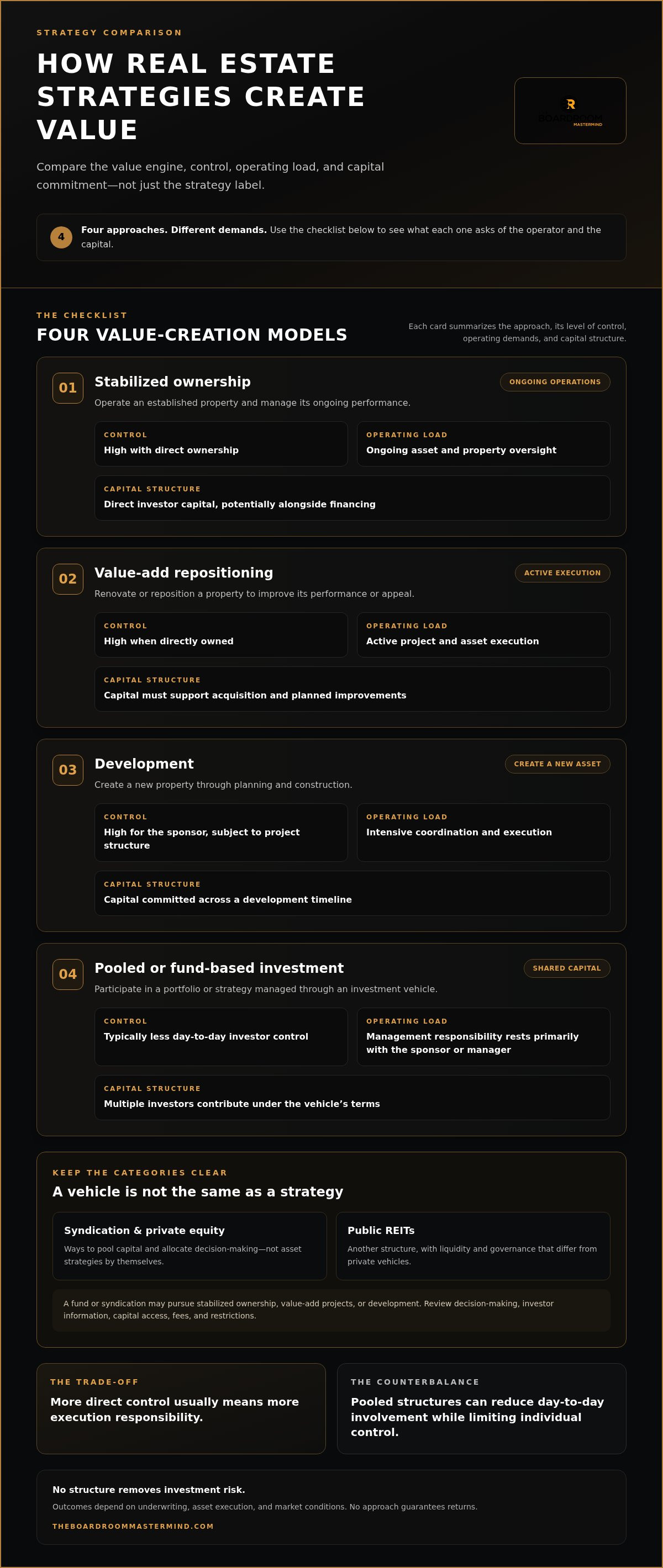
Different approaches can target similar assets while demanding very different levels of control, capital commitment, and operational involvement. Compare the value-creation engine, not just the label.
| Approach | Value-creation mechanism | Control | Operating load | Capital structure |
|---|---|---|---|---|
| Stabilized ownership | Operate an established property and manage ongoing performance | High with direct ownership | Ongoing asset and property oversight | Direct investor capital, potentially alongside financing |
| Value-add repositioning | Renovate or reposition to improve the property’s performance or appeal | High when directly owned | Active project and asset execution | Capital must support acquisition and planned improvements |
| Development | Create a new property through planning and construction | High for the sponsor, subject to project structure | Intensive coordination and execution | Capital committed across a development timeline |
| Pooled or fund-based investment | Participate in a portfolio or strategy managed through a vehicle | Typically less day-to-day investor control | Management responsibility rests primarily with the sponsor or manager | Multiple investors contribute under the vehicle’s terms |
The more directly you control the asset, the more execution responsibility you usually carry. Pooled structures can reduce day-to-day involvement while limiting individual control. Neither structure removes investment risk. Outcomes depend on underwriting, asset execution, and market conditions, so no approach guarantees returns.
Direct ownership and value-add execution
Stabilized ownership centers on recurring operations: maintaining the asset, overseeing management, and monitoring performance. Value-add work adds a distinct execution agenda, such as renovation or repositioning. Development extends that workload into creating an asset. Before committing capital, clarify who will manage leasing, construction, budgets, reporting, and decisions when a project departs from plan. High-level real estate investment strategies account for these demands before the operating burden arrives.
Funds, syndications, and public vehicles
Syndication and private equity describe ways to pool capital and allocate decision-making, not asset strategies in themselves. A fund or syndication may pursue stabilized ownership, value-add projects, or development. Public Real Estate Investment Trusts (REITs) offer another structure, with liquidity and governance that differ from private vehicles. For a deeper look at fund structures, compare these distinctions with the principles in real estate private equity analysis.
Before choosing a structure, read how decisions are made, what information investors receive, how capital can be accessed, and what fees or restrictions apply. Use peer discussion to pressure-test the assumptions, then ground the decision in diligence. The Boardroom Mastermind brings experienced investors together for strategic collaboration and accountability as they evaluate scalable operations.
Choose a Real Estate Strategy That Fits Your Capital and Operating Capacity
A strategy can look compelling on paper and still fail the fit test if capital is tied up longer than planned or execution depends on a stretched team. Use this screen before committing resources. High-level real estate investment strategies should withstand scrutiny across both the investment thesis and the operating model.
- Define the thesis. State what demand supports the opportunity, which acquisition assumptions matter, and how the plan is expected to create value. Identify the assumptions that would change your decision if they proved wrong.
- Verify sourcing. Identify where opportunities come from and whether that channel is repeatable. Track whether the opportunities fit your criteria, not just how many arrive. Consistent access to suitable deals is stronger evidence than enthusiasm for one attractive property.
- Model capital. Map when capital is committed, when it may become available again, and how that duration compares with the project timeline. Consider what happens if the timeline shifts, and account for liquidity needs elsewhere in the portfolio.
- Assess execution. List the people, expertise, systems, and decision rights required at each stage. Review the operating plan, reporting, governance, and dependencies alongside the base case. Identify which tasks rely on one person and what happens if that person is unavailable.
- Test scalability. Ask whether the process can handle added assets without making oversight, reporting, or decision-making fragile. Growth should strengthen the operating model, not overwhelm it.
Pressure-test the thesis before committing resources
Separate repeatable evidence from an appealing but untested opportunity. What supports demand? Can acquisition assumptions be defended with relevant information? Does the plan account for property condition, operating expenses, financing terms, and the work required to execute? Is the planned value-creation mechanism within the team’s capabilities? If the thesis relies on one favorable assumption, examine what happens when that assumption changes.
Test whether the organization can execute at scale
Assign clear leadership ownership, establish reporting that surfaces issues early, and define who can make decisions as conditions change. Document recurring tasks and the decisions that can be made without escalation. If the strategy depends on one operator’s constant intervention, it may not yet be scalable. A documented operating system can clarify responsibilities and keep execution aligned as the portfolio grows.
Pressure-test your assumptions with experienced peers, while keeping investment diligence firmly in your own process. Explore The Boardroom Mastermind Membership for strategic collaboration and accountability with fellow investors and entrepreneurs.
Turn High-Level Real Estate Investment Strategy Into an Executable Growth Plan
A strategy becomes scalable only when it translates into priorities, accountable owners, and disciplined review. The strongest high-level real estate investment strategies don’t depend on constant improvisation. They give leadership a clear basis for deciding what to expand, refine, or pause.
Build a focused strategic review
Set a recurring review around the evidence and operating realities behind your thesis. Bring the relevant records, identify changes since the last review, and keep the questions direct:
- Thesis evidence: What has changed in demand, sourcing, or the assumptions behind your value-creation plan?
- Capital fit: Does the capital timeline still match the strategy, and is concentration creating an unacceptable dependency?
- Execution capacity: Are leadership ownership, reporting, and decision rights clear as activity increases?
- Governance: Are oversight and accountability strong enough to surface problems and guide decisions?
Define in advance what evidence would justify expanding, refining, or pausing the strategy. Record the decision, its owner, and the next review point. That discipline keeps momentum from becoming a substitute for judgment.
Use peer challenge to strengthen execution
Experienced peers can expose blind spots, challenge assumptions, and offer operator perspectives shaped by different business models. That dialogue can sharpen strategic thinking, but it isn’t a replacement for investment diligence and can’t guarantee results. The Boardroom Mastermind is an experienced investor and entrepreneur peer group and educational platform. Members take part in quarterly in-person intensives in various U.S. cities to audit business models and work on growth, alongside a community focused on accountability and leadership development. Its mastermind experience is designed for experienced investors and entrepreneurs who value candid peer dialogue.
Bring a clear decision to the room: what you plan to scale, what could invalidate the thesis, and who owns the next step. Then carry the decision back into your operating rhythm. Explore The Boardroom Mastermind Membership to pursue strategic collaboration and accountability alongside experienced peers.
Make Your Next Strategic Move Deliberate
Scale is a leadership decision before it becomes a portfolio decision. Turn your chosen direction into a clear mandate: what deserves attention now, who owns progress, and what evidence would change the plan. That clarity protects your time and keeps expansion aligned with the business you intend to build.
For experienced investors, candid dialogue with peers can bring an outside perspective to decisions that are difficult to pressure-test internally. The Boardroom Mastermind brings together real estate investors and entrepreneurs for strategic collaboration, accountability, leadership development, and quarterly in-person intensives in cities across the United States, including business-model review. Peer insight can challenge assumptions; it doesn’t replace due diligence or promise investment outcomes.
If you’re ready to examine your next phase of growth alongside experienced operators, explore the strategic peer experience. Make the next move with intention, and build a business that can scale without losing sight of the life it is meant to support.
Frequently Asked Questions
What are high-level real estate investment strategies?
High-level real estate investment strategies are portfolio-level approaches for pursuing opportunities and building an investment operation, rather than labels for a property or single transaction. For example, an investor might focus on acquiring under-managed properties where operational improvements match the team’s expertise. The strategy should guide which deals merit attention and which fall outside the business’s intended direction.
How do I choose a real estate investment strategy?
Choose a strategy your organization can execute consistently, not simply one that looks attractive in a presentation. Compare the skills your team has demonstrated with the work the strategy requires. A team with strong property-management capability but limited experience coordinating construction may be better positioned for an approach centered on operations than one dependent on complex redevelopment. Consider decision-making bandwidth and willingness to manage the associated uncertainty, too.
Can an experienced investor combine multiple real estate strategies?
Yes, provided each approach has a defined role and doesn’t compete for the same people, capital, or leadership attention. An investor might hold stabilized properties while testing a separate value-add thesis with distinct oversight. Set boundaries for resource allocation and decision authority. If the approaches rely on incompatible assumptions or stretch the same team too thin, simplify before adding another strategy.
Are real estate funds and syndications investment strategies?
Funds and syndications are generally investment structures, not value-creation strategies by themselves. They describe how capital and participation are organized; the underlying portfolio might focus on acquisitions, repositioning, development, or another approach. Before investing, understand the vehicle’s decision-making rights, reporting, governance, and restrictions on accessing capital. Those terms shape the investor experience, but they don’t establish the quality of the underlying plan.
How often should a real estate investment strategy be reviewed?
Review it on a consistent schedule and whenever a material change could invalidate its assumptions. A shift in sourcing access, execution leadership, capital availability, or portfolio exposure may call for an earlier reassessment. Keep routine performance monitoring separate from strategic review: operating reports show what is happening, while the strategy review asks whether the current direction still fits the business and its capabilities.

Disclaimer
Mr. Clothier is an expert in real estate investing. As such his experiences are not necessarily typical to the standard real estate investor and whose results may vary. The successes shared on this site are not considered typical. Most individuals who order the educational materials and systems probably do not follow any of the techniques or strategies and consequently make little to no money due to their inaction. The company is in the process of determining the typical success of its clients. Stories shared herein are for example purpose only and should not be construed as "guarantees" of success. Results will vary based on background, education, and experience and actions taken.
This site is not a part of the Google/Facebook website or Google/Facebook Inc. Additionally, this site is NOT endorsed by or affiliated with Google/Facebook in any way. GOOGLE/FACEBOOK is a trademark of GOOGLE/FACEBOOK, Inc.
INCOME DISCLAIMER: This website and the items it distributes contain business strategies, marketing methods and other business advice that, regardless of referenced results and experience, may not produce the same results (or any results) for you. The Boardroom Mastermind makes absolutely no guarantee, expressed or implied, that by following the advice or content available from this web site you will make any money or improve current profits, as there are several factors and variables that come into play regarding any given business. Primarily, results will depend on the nature of the product or business model, the conditions of the marketplace, the experience of the individual, and situations and elements that are beyond your control. As with any business endeavor, you assume all risk related to investment and money based on your own discretion and at your own potential expense.
LIABILITY DISCLAIMER: By reading this website or the documents it offers, you assume all risks associated with using the advice given, with a full understanding that you, solely, are responsible for anything that may occur as a result of putting this information into action in any way, and regardless of your interpretation of the advice. You further agree that The Boardroom Mastermind, its affiliates, subsidiaries, officers and agents, cannot be held responsible in any way for the success or failure of your business as a result of the information provided. It is your responsibility to conduct your own due diligence regarding the safe and successful operation of your business. In summary, you understand that we make absolutely no guarantees regarding income as a result of applying this information, as well as the fact that you are solely responsible for the results of any action taken on your part as a result of any given information. In addition, you agree that our content is to be considered "for entertainment purposes only". Always seek the advice of a professional when making legal, financial, tax, or business decisions.
BUSINESS OPPORTUNITY: All products and services offered by The Boardroom Mastermind are intended to provide prospective purchasers with general business strategies, marketing methods and other general advice for business development and training. At no point is The Boardroom Mastermind soliciting anyone to enter into a new business nor is it representing, either expressly or by implication, that it will provide locations for a business, provide outlets, accounts, or customers, or purchase any of the goods or services made by the purchaser.
The products being offered through this promotion are packages of informational tools to help you learn about business and deal making strategies.


