
Growing Pains in a Real Estate Business: How to Scale Without Becoming the Bottleneck
What if the strain in your growing real estate business isn’t a sign to push harder, but evidence that the company has outgrown the way it operates? Decisions still land on your desk. Handoffs slip. Processes that worked at a smaller scale now produce inconsistent results. Some friction comes with growth, but recurring dependence on the owner points to an operating constraint.
The challenge is knowing which problems need attention first. This article will help you distinguish temporary growing pains from symptoms of a business built around founder-dependent rules, identify the underlying bottleneck, and choose practical changes without treating every snag as a crisis. We’ll look at unclear ownership, inconsistent processes, and weak coordination, then outline how to move from operator-led execution toward CEO-level leadership. The aim isn’t to fix everything at once. It’s to build an operating model that supports growth without making you the decision point for every move.
Key Takeaways
- Growing pains in a real estate business can signal founder-dependent operating rules, not simply a need to work harder.
- Trace recurring friction to its source: decision rights, undocumented workflows, or roles that no longer fit the work.
- Capture the issue, identify its cause, assign ownership, and choose one practical response.
- Trusted peer perspectives and structured accountability can help you challenge assumptions and follow through on strategic changes.
Growing pains in a real estate business: recognize the signals before they compound
More activity should create momentum. Yet as a real estate operation expands, the owner can end up with less clarity, less control, and less capacity to lead. A crowded calendar alone isn’t the tell. Look for recurring friction that interrupts deal flow, delivery, or leadership.
Watch for patterns that show up across transactions or teams:
- Routine questions or exceptions keep escalating to you.
- Similar tasks are handled differently, creating rework or uneven execution.
- Handoffs stall, or decisions wait because no one knows who has authority to make them.
A business growing pain is a repeatable strain that expansion exposes in the way work, decisions, or accountability are structured. One difficult deal or compressed quarter doesn’t prove the business is broken. A pattern that resurfaces across deals, delays follow-up, or repeatedly pulls you into routine execution deserves a closer look.
Which growing pains are symptoms rather than root causes?
A missed handoff may look like an individual mistake, but repeated misses can point to unclear responsibility at the transfer point. Rework may mean the process lacks a shared standard. Delayed decisions may reveal that authority was never defined. Treat these issues as clues, not diagnoses. Record where and when the problem recurs, who is affected, and what work it holds up before deciding what to change.
When does owner involvement become a scaling constraint?
Your involvement becomes restrictive when routine approvals and familiar questions keep interrupting work that only you can do. If progress pauses whenever you’re unavailable, the issue may be unclear decision rights rather than a lack of effort. The CEO mindset shift in real estate starts with moving from personally clearing each obstacle to setting priorities, assigning ownership, and defining expectations. The goal isn’t to disappear from the business. It’s to use your attention where it has the most value.
Why real estate business growing pains persist: people, process, and decision ownership
Recurring friction often survives because the visible problem gets attention while the operating condition behind it stays unchanged. A delayed acquisition handoff, for example, may stem from unclear responsibility between sourcing and underwriting. Repeated approval requests may point to decision rights that were never delegated. And a workflow that lives in the founder’s memory can become inconsistent as more people need to carry it out.
More volume can expose these weaknesses, but growth isn’t automatically the cause. Market conditions also affect deal flow and timing. The National Association of REALTORS® offers guidance to navigate challenging market conditions, but external pressure and internal operating constraints call for different responses.
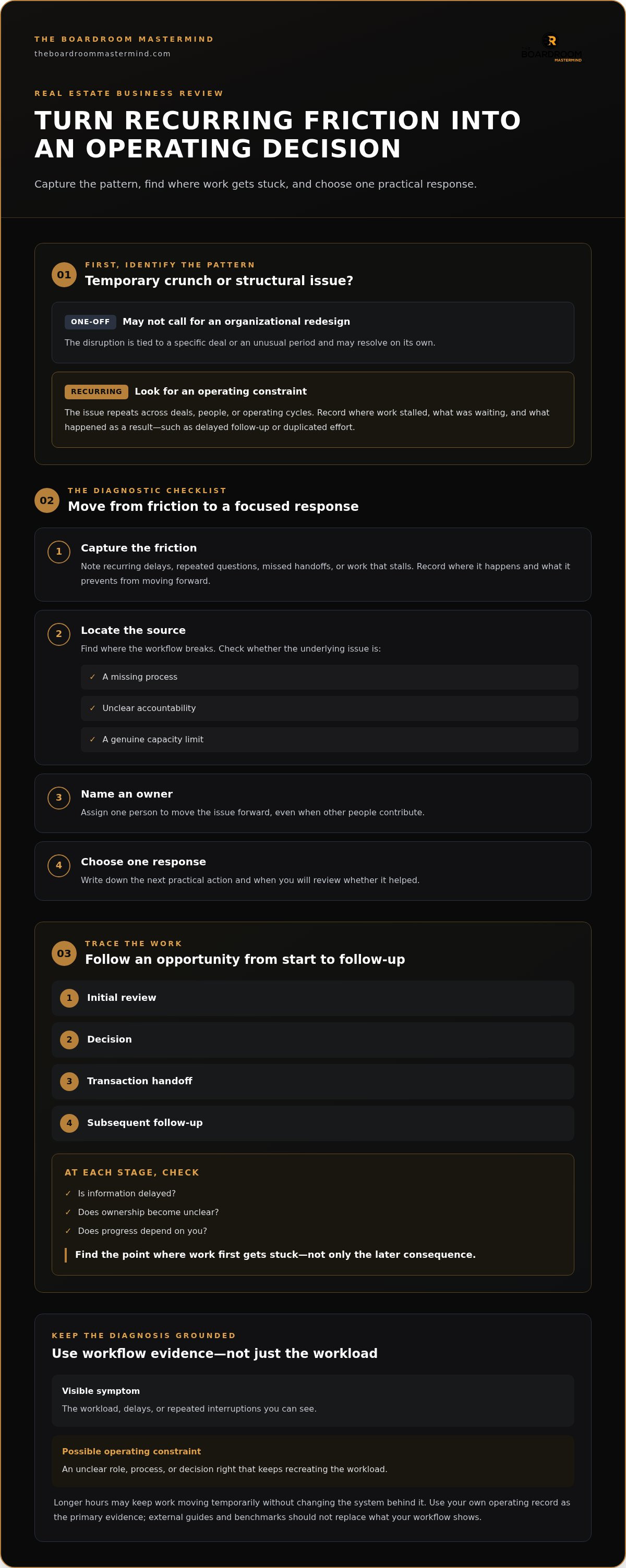
A capacity symptom is the visible workload; the underlying operating constraint is the unclear role, process, or decision right that keeps recreating it. Longer hours may keep work moving temporarily. They don’t necessarily change the system that created the workload.
How can you tell a temporary crunch from a structural problem?
A one-off disruption tied to a specific deal or unusual period may resolve without redesigning the organization. A structural issue repeats across deals, people, or operating cycles. Before making a major change, write down examples: where work stalled, what was waiting, and what happened as a result, such as delayed follow-up or duplicated effort. Compare examples to identify the pattern. A clear record makes the diagnosis more useful than relying on a general impression that the business feels overloaded.
Why can hiring or working harder fail to fix the strain?
Adding a capable person can increase capacity, but without clear ownership and documented workflows, that person may inherit the same ambiguity. The same is true of longer hours: more effort can keep work moving while leaving the constraint intact. Before expanding the team, define the role, decision authority, and handoffs. For experienced operators considering their next strategic move, The Boardroom Mastermind’s peer community offers a setting for collaboration and business-model reflection.
How to diagnose and prioritize growing pains in your real estate business
Once you’ve noticed recurring strain, resist the urge to fix the loudest complaint first. Diagnose the operating constraint, then choose a response that matches its effect on the business. A focused review can turn frustration into a decision you can act on.
- Capture the friction. Record recurring delays, repeated questions, missed handoffs, or work that stalls. Include where the issue appears and what it prevents from moving forward.
- Locate the source. Identify where the workflow breaks. Is a process missing, is accountability unclear, or is there a genuine capacity limit?
- Name an owner. Assign one person to move the issue forward, even if other people contribute.
- Choose one response. Write down the next practical action and when you’ll review whether it helped.
Use acquisition through follow-up as a diagnostic lens. Trace how an opportunity moves from initial review to a decision, transaction handoff, and subsequent follow-up. At each stage, note where information is delayed, ownership becomes unclear, or progress depends on you. Look for the point where work first gets stuck, rather than only the later consequence. Your operating record should be the primary evidence; industry guides and external benchmarks shouldn’t replace evidence from your own workflow.
What should you examine in a real estate operating review?
Look for decisions waiting on approval, handoffs that repeatedly break down, questions people ask more than once, and tasks that can’t proceed without you. For each example, ask: Is the process missing? Is accountability unclear? Is the assigned person genuinely at capacity? These causes require different responses. A missing process calls for a shared way to do the work; unclear accountability calls for a named owner and decision authority; a capacity limit calls for a review of the work assigned.
How do you choose the first constraint to address?
Prioritize by recurrence and operational consequence, not by which complaint is loudest. Choose one repeat issue that affects deal flow, delivery, or leadership. Assign a responsible owner and write down the next action, the expected change, and when you’ll review it. A focused review through The Boardroom Mastermind can also give experienced operators a setting to audit business models and test assumptions through peer collaboration.
Move beyond growing pains with CEO-level perspective and accountability
Once you’ve identified a real constraint, an outside peer perspective can help test the assumptions keeping it in place. Are you holding on to a decision because only you can make it, or because authority was never clearly assigned? Is a workflow genuinely complex, or has no one questioned how it’s been done? The right discussion can sharpen the question. You still own the decision and the execution.
The Boardroom Mastermind brings experienced real estate investors and entrepreneurs together for strategic collaboration, accountability, and quarterly in-person intensives. Members use these sessions to audit business models, examine leadership decisions, and consider the next stage of scale. The Boardroom case studies offer individual examples to explore, not promised or universal outcomes.
When can a peer group help a real estate operator?
A peer group can be useful when a defined constraint raises a strategic question about scale, business-model design, or leadership. Other experienced operators may challenge a familiar assumption or bring a different perspective to the decision. That perspective supports your work; it doesn’t replace your responsibility to assign ownership, make the call, and follow through.
What should your next step look like?
Write down one recurring constraint, the decision needed to address it, and the person responsible for moving it forward. Then decide how you’ll review progress. This turns growing pains in a real estate business into a specific operating issue to address, rather than a general frustration that leads to another round of reactive fixes.
Build a business that can grow beyond your daily oversight
Growing pains in a real estate business don’t automatically mean something is broken. Recurring delays, unclear ownership, and routine decisions that depend on you are signals to examine the operating model, not reasons to react to every difficult deal. Track the pattern, identify the constraint, and assign a clear next step before adding another fix or simply working longer hours.
Scaling deliberately means shifting your attention from clearing every obstacle to setting priorities and building accountable ownership. That transition takes sound execution, but experienced operators don’t have to rely on their perspective alone. The Boardroom Mastermind brings real estate investors and entrepreneurs together through a peer network, accountability, and quarterly in-person intensives for business-model audits and strategic collaboration.
If you’re an experienced operator ready to address a specific constraint with structured peer collaboration and accountability, explore The Boardroom Mastermind.
Frequently Asked Questions
What are growing pains in a real estate business?
Growing pains in a real estate business are repeatable strains that expansion exposes in how work, decisions, or accountability are structured. Common signals include recurring escalations, inconsistent execution, stalled handoffs, and routine decisions waiting on the founder. A challenging deal or busy quarter alone doesn’t mean the business is structurally weak. Look for patterns across transactions or operating cycles before deciding what needs to change.
How do I know if my real estate business has outgrown its current systems?
Your business may have outgrown its systems when the same work breaks down across different deals or team members. Look for repeat delays, duplicated effort, inconsistent follow-up, and tasks that pause until you provide instructions or approval. Track examples and consequences, then identify whether the issue is an undocumented workflow, unclear ownership, or a true capacity limit. Recurrence gives you stronger evidence than one frustrating incident.
Should I hire more people to solve growing pains in a real estate business?
Hire when you’ve identified a genuine capacity gap, not as a substitute for clear processes or decision ownership. If a new team member enters an undefined role, they may inherit the same ambiguity and create additional handoffs. First clarify what work needs to be done, who owns each decision, and where the current team is at capacity. Then assess whether additional capacity is the right response.
How can a real estate business owner stop being the bottleneck?
Start by identifying routine decisions and questions that repeatedly come to you. Document the relevant workflow and decision boundaries, assign a clear owner, and delegate authority for defined situations. Review how the work is progressing without automatically taking it back when a challenge arises. Your role can then shift toward setting direction, strengthening leadership, and addressing strategic constraints rather than clearing every daily obstacle.

Disclaimer
Mr. Clothier is an expert in real estate investing. As such his experiences are not necessarily typical to the standard real estate investor and whose results may vary. The successes shared on this site are not considered typical. Most individuals who order the educational materials and systems probably do not follow any of the techniques or strategies and consequently make little to no money due to their inaction. The company is in the process of determining the typical success of its clients. Stories shared herein are for example purpose only and should not be construed as "guarantees" of success. Results will vary based on background, education, and experience and actions taken.
This site is not a part of the Google/Facebook website or Google/Facebook Inc. Additionally, this site is NOT endorsed by or affiliated with Google/Facebook in any way. GOOGLE/FACEBOOK is a trademark of GOOGLE/FACEBOOK, Inc.
INCOME DISCLAIMER: This website and the items it distributes contain business strategies, marketing methods and other business advice that, regardless of referenced results and experience, may not produce the same results (or any results) for you. The Boardroom Mastermind makes absolutely no guarantee, expressed or implied, that by following the advice or content available from this web site you will make any money or improve current profits, as there are several factors and variables that come into play regarding any given business. Primarily, results will depend on the nature of the product or business model, the conditions of the marketplace, the experience of the individual, and situations and elements that are beyond your control. As with any business endeavor, you assume all risk related to investment and money based on your own discretion and at your own potential expense.
LIABILITY DISCLAIMER: By reading this website or the documents it offers, you assume all risks associated with using the advice given, with a full understanding that you, solely, are responsible for anything that may occur as a result of putting this information into action in any way, and regardless of your interpretation of the advice. You further agree that The Boardroom Mastermind, its affiliates, subsidiaries, officers and agents, cannot be held responsible in any way for the success or failure of your business as a result of the information provided. It is your responsibility to conduct your own due diligence regarding the safe and successful operation of your business. In summary, you understand that we make absolutely no guarantees regarding income as a result of applying this information, as well as the fact that you are solely responsible for the results of any action taken on your part as a result of any given information. In addition, you agree that our content is to be considered "for entertainment purposes only". Always seek the advice of a professional when making legal, financial, tax, or business decisions.
BUSINESS OPPORTUNITY: All products and services offered by The Boardroom Mastermind are intended to provide prospective purchasers with general business strategies, marketing methods and other general advice for business development and training. At no point is The Boardroom Mastermind soliciting anyone to enter into a new business nor is it representing, either expressly or by implication, that it will provide locations for a business, provide outlets, accounts, or customers, or purchase any of the goods or services made by the purchaser.
The products being offered through this promotion are packages of informational tools to help you learn about business and deal making strategies.


