
Finding High Net Worth Real Estate Investors: A Sponsor’s Guide
A larger investor list won’t rescue an unready deal. Finding high net worth real estate investors starts with proving why the opportunity merits attention, then identifying people whose investment goals, capacity, and decision process align with it. A broad pitch sent before the evidence is in place can cost more than time; it can weaken trust.
If you’re unsure whether to focus on existing relationships, professional networks, or outreach permitted under the offering rules that apply to your deal, don’t contact everyone at once. Build a disciplined pipeline instead. This guide explains how to match investor profiles to your opportunity, prepare materials that support your claims, and develop relationships through clear conversations and consistent follow-up.
You’ll also see why Rules 506(b) and 506(c) matter to outreach strategy, and why sponsor credibility, transparency, and proof should come before the capital ask. The objective isn’t more names. It’s a repeatable path to the right conversations.
Key Takeaways
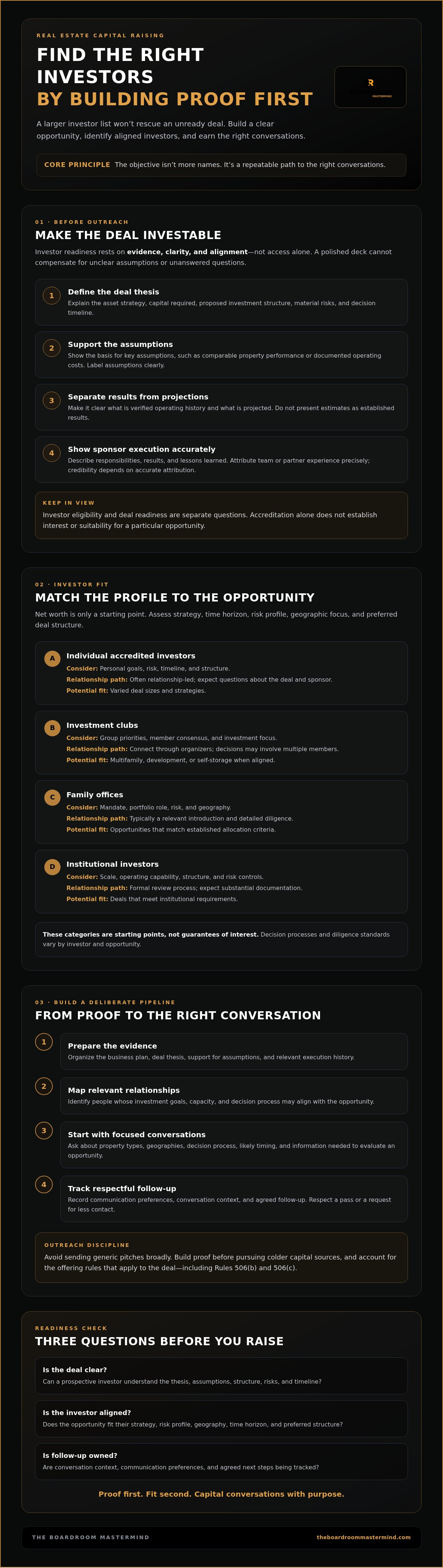
- Before finding high net worth real estate investors, clarify your deal thesis, operating assumptions, and evidence of execution.
- Compare individual accredited investors, investment clubs, family offices, and institutions to identify profiles that may align with your opportunity.
- Build a deliberate pipeline by mapping relevant relationships, preparing clear materials, and tracking follow-up instead of sending generic pitches.
- Use a readiness check to assess deal clarity, investor fit, and follow-up ownership. Build proof before pursuing colder capital sources.
Before Finding High Net Worth Real Estate Investors, Make the Deal Investable
An individual considering a private investment is evaluating where to place capital. A sponsor has a different assignment: make the opportunity clear enough for a prospective investor to assess its strategy, risks, and fit. Finding high net worth real estate investors before doing that work can turn outreach into an avoidable credibility test.
Investor readiness rests on evidence, clarity, and alignment, not access alone. A polished deck can’t compensate for unclear operating assumptions or unanswered questions. Before approaching prospects, prepare a business plan, a defined deal thesis, support for key assumptions, and a documented record of relevant execution.
What serious investors need to understand about your deal
Explain the asset strategy, capital required, proposed investment structure, material risks, and decision timeline. Separate verified operating history from projections. Label assumptions and show their basis, such as comparable property performance or documented operating costs, rather than presenting estimates as established results.
Investor eligibility and deal readiness are separate questions. An Accredited investor is a foundational classification in private offerings, but eligibility alone doesn’t establish that an investor suits a particular opportunity. Your materials should help each prospect assess the deal on its own terms.
How to establish sponsor credibility before outreach
Organize your execution history into a concise account of what you managed, your responsibilities, the results, and what you learned. Be precise about your role. If the track record belongs to a team member or partner, say so. Credibility depends on accurate attribution, not inflated claims.
Apply the same discipline to explaining how capital fits the plan. For additional context, Real Estate Private Equity: The Architect’s Guide to Institutional Scale explores capital structure at a broader level. Before sending a pitch, check the assumptions and anticipate diligence questions. A clear, candid case gives the right prospects a basis for a serious conversation.
Match High Net Worth Real Estate Investors to the Opportunity
Net worth is only a starting point. Investor fit depends on mandate alignment, not net worth alone. Assess each prospect’s strategy, time horizon, risk profile, geographic focus, and preferred deal structure before deciding whether a conversation makes sense. The SEC’s accredited investor definition can help clarify eligibility for certain private offerings, but it doesn’t establish interest or suitability.
Which investor category fits your real estate deal?
These categories are starting points, not guarantees of interest. Decision processes and diligence standards vary by investor and opportunity.
| Investor category | Likely decision factors | Relationship path and diligence | Potential fit |
|---|---|---|---|
| Individual accredited investors | Personal goals, risk, timeline, and structure | Often relationship-led; expect questions on the deal and sponsor | May suit varied deal sizes and strategies |
| Investment clubs | Group priorities, member consensus, and investment focus | Connect through organizers; decision-making may involve multiple members | Could consider multifamily, development, or self-storage if aligned |
| Family offices | Mandate, portfolio role, risk, and geography | Typically requires a relevant introduction and detailed diligence | May fit opportunities matching established allocation criteria |
| Institutional investors | Scale, operating capability, structure, and risk controls | Formal review process; expect substantial documentation | Potentially relevant where the deal meets institutional requirements |
How to qualify a potential investor respectfully
Ask focused questions: What property types and geographies do you consider? What is your decision process and likely timing? What information do you need to evaluate an opportunity? Record the prospect’s communication preferences, the context of the conversation, and any agreed follow-up. Respect a pass or a request for less contact. A well-kept relationship can matter more than a premature pitch.
Experienced peer perspectives can help you pressure-test your investor-fit assumptions. Explore The Boardroom Mastermind as a place to learn more about the company’s work with experienced real estate investors and entrepreneurs.
Build a High Net Worth Investor Pipeline Without Cold, Generic Pitching
A prospect list is a collection of names. A qualified investor pipeline tracks fit, engagement, and agreed next steps. Finding high net worth real estate investors is more productive when each conversation builds understanding instead of delivering the same pitch to everyone. Start by teaching and listening, especially with people already in your professional network.
Start with relationships, then expand deliberately
Use a structured sequence. Each step creates a stronger basis for the next:
- Define the target profile: Specify the strategy, geography, risk profile, and investment structure that suit the deal.
- Map warm relationships: Review professional peers, prior partners, investment clubs, and trusted referral paths. Ask for relevant introductions, not mass distribution of your pitch.
- Prepare materials: Assemble concise deal information, including the thesis, key assumptions, risks, and answers to likely questions.
- Start conversations: Ask about investment priorities and listen for alignment before presenting the opportunity. Share useful context without pressure.
- Track follow-up: Record the next action and respect the prospect’s preferred timing and communication channel.
Broader outreach belongs later, once your deal materials are ready and you can follow through consistently. Sponsors considering family offices can also explore Attracting Family Office Investment for Your Deals for a closer look at that investor category.
Use a process to keep investor conversations moving
Track each contact’s fit, questions, next action, and permission-based follow-up date. Keep the stages distinct: conversation, soft commitment, documents, and wired capital. Don’t treat curiosity as a commitment; update a prospect’s status only when their actions support it. A tracker can make gaps visible, such as contacts with no agreed next step or requested documents that haven’t been sent.
The Capital Raising Playbook includes a raise tracker designed around a 100-name sweep and those stages, from conversation through soft commitment and documents to wired capital. Use a tracker to make follow-up accountable, not to turn every name into a sales target.
Experienced peer perspectives can also help you review how your process works and where follow-up breaks down. Explore The Boardroom to learn more about its community for experienced real estate investors and entrepreneurs.
Turn Investor Readiness Into a Repeatable Capital-Raising Strategy
Use a short readiness check before expanding outreach: Can you explain the deal and support its assumptions? Have you identified the investor profiles that align with its strategy and structure? Is someone responsible for recording conversations and managing follow-up? If any answer is no, address that constraint first. Finding high net worth real estate investors becomes more systematic when each step builds on evidence instead of urgency.
The Capital Raising Playbook, Member Edition, Confidential, outlines a five-rung Capital Raising Ladder. Its central principle is to build proof before moving toward larger, colder sources of capital. At the first rung, the Internal Network, the emphasis is on teaching rather than pitching. The playbook lists typical check sizes for that rung as $25 K - $250 K. Use the ladder to build credibility and demonstrate execution before widening the audience, rather than assuming access or funding outcomes.
Supporting tools help turn deal preparation into a working process. The pro forma template covers sources and uses, a five-year operating pro forma, cash-on-cash, equity multiple, IRR, and a sensitivity grid. The waterfall calculator supports calculations for preferred return, split, promote, and exit scenarios. Recorded deal walkthroughs can also be used by the AI Stack to draft materials such as a one-pager, FAQ, investor hooks, and webinar outlines. Review all assumptions and drafts for accuracy before sharing them.
When a peer group can strengthen your decision-making
Experienced peers can challenge assumptions you’ve grown accustomed to, ask questions a prospective investor may raise, and offer strategic perspectives on your process. That input can sharpen your judgment, but it doesn’t promise introductions or fundraising results. To consider how peer advisory can support leadership decisions, explore the benefits of a peer advisory group and review The Boardroom case studies.
Choose a next step based on your current constraint
- If readiness is weak: Refine the deal thesis, document operating evidence, clarify assumptions, and resolve unanswered questions before expanding outreach.
- If the process is ready: Check whether your target profiles, conversation records, and follow-up ownership work together as a repeatable system.
For experienced operators considering a more structured capital-raising process, explore The Boardroom. The next move is not always more outreach. It’s the move that closes the gap between your current process and a credible, disciplined capital-raising strategy.
Build a More Deliberate Path to Investor Relationships
Finding high net worth real estate investors is not a numbers game. It’s a disciplined process: make the deal clear, define who it fits, and build relationships through thoughtful conversations and consistent follow-up. When your evidence or outreach process isn’t ready, strengthen it before widening your reach.
The Capital Raising Playbook offers a ladder-based approach to building proof before approaching larger, colder sources of capital. For experienced operators, a clear process can help keep deal preparation, investor conversations, and follow-up connected.
If you’re ready to explore a more systematic approach to raising equity for larger projects, explore The Boardroom. Build with clarity, earn trust through execution, and let each investor conversation move your strategy forward.
Frequently Asked Questions
How do you find high-net-worth investors for real estate?
Finding high net worth real estate investors starts with a specific deal and a defined investor profile, including strategy, time horizon, risk tolerance, geography, and structure. Map relevant warm relationships and professional referral paths, then prepare clear materials before requesting a meeting. Use early conversations to test fit and learn what diligence may involve. Record each contact’s questions, next step, and permission-based follow-up. A purchased list or generic pitch can’t replace preparation and trust.
Where do real estate sponsors meet high-net-worth investors?
Potential relationship paths include existing business relationships, investment clubs, professional advisers, prior partners, and referrals from people familiar with your work. The right channel depends on the opportunity and the investor’s preferences, so tailor your approach instead of treating every contact alike. Explain why you’re reaching out and what you’d like to learn. A group, event, or introduction may create a conversation, but none guarantees access to investors or funding.
What information should you prepare before approaching real estate investors?
Prepare a concise deal overview that states the investment thesis, proposed structure, capital need, timeline, and key risks. Include operating assumptions and their basis, along with relevant sponsor and team execution history. Clearly separate documented past performance from projections; label estimates rather than presenting them as facts. Organize supporting records so prospective investors can evaluate the opportunity. Have qualified legal and financial professionals review materials where appropriate, and avoid unsupported claims about returns or certainty.
How can a real estate sponsor build credibility with investors?
Build credibility by documenting execution, communicating transparently, and making the opportunity straightforward to understand and diligence. Be precise about your role, the team’s experience, operating assumptions, and known risks. When investors ask questions, respond with evidence and distinguish what’s verified from what remains a projection. Follow through reliably on promised information and next steps. A polished presentation helps organize the case, but it can’t replace performance, clarity, or alignment.

Disclaimer
Mr. Clothier is an expert in real estate investing. As such his experiences are not necessarily typical to the standard real estate investor and whose results may vary. The successes shared on this site are not considered typical. Most individuals who order the educational materials and systems probably do not follow any of the techniques or strategies and consequently make little to no money due to their inaction. The company is in the process of determining the typical success of its clients. Stories shared herein are for example purpose only and should not be construed as "guarantees" of success. Results will vary based on background, education, and experience and actions taken.
This site is not a part of the Google/Facebook website or Google/Facebook Inc. Additionally, this site is NOT endorsed by or affiliated with Google/Facebook in any way. GOOGLE/FACEBOOK is a trademark of GOOGLE/FACEBOOK, Inc.
INCOME DISCLAIMER: This website and the items it distributes contain business strategies, marketing methods and other business advice that, regardless of referenced results and experience, may not produce the same results (or any results) for you. The Boardroom Mastermind makes absolutely no guarantee, expressed or implied, that by following the advice or content available from this web site you will make any money or improve current profits, as there are several factors and variables that come into play regarding any given business. Primarily, results will depend on the nature of the product or business model, the conditions of the marketplace, the experience of the individual, and situations and elements that are beyond your control. As with any business endeavor, you assume all risk related to investment and money based on your own discretion and at your own potential expense.
LIABILITY DISCLAIMER: By reading this website or the documents it offers, you assume all risks associated with using the advice given, with a full understanding that you, solely, are responsible for anything that may occur as a result of putting this information into action in any way, and regardless of your interpretation of the advice. You further agree that The Boardroom Mastermind, its affiliates, subsidiaries, officers and agents, cannot be held responsible in any way for the success or failure of your business as a result of the information provided. It is your responsibility to conduct your own due diligence regarding the safe and successful operation of your business. In summary, you understand that we make absolutely no guarantees regarding income as a result of applying this information, as well as the fact that you are solely responsible for the results of any action taken on your part as a result of any given information. In addition, you agree that our content is to be considered "for entertainment purposes only". Always seek the advice of a professional when making legal, financial, tax, or business decisions.
BUSINESS OPPORTUNITY: All products and services offered by The Boardroom Mastermind are intended to provide prospective purchasers with general business strategies, marketing methods and other general advice for business development and training. At no point is The Boardroom Mastermind soliciting anyone to enter into a new business nor is it representing, either expressly or by implication, that it will provide locations for a business, provide outlets, accounts, or customers, or purchase any of the goods or services made by the purchaser.
The products being offered through this promotion are packages of informational tools to help you learn about business and deal making strategies.


