
Financial KPIs for Scaling a Real Estate Business: The CEO’s Strategic Dashboard
Most real estate operators aren't actually CEOs; they're high-paid tactical laborers who are one market shift away from a liquidity crisis. You've likely reached a point where more deals don't equal more freedom. Instead, they just create more noise. You feel like the primary bottleneck in your own growth, watching inconsistent cash flow fluctuate even as your volume hits record highs. It’s a common plateau for those who rely on intuition rather than architecture. Transitioning to a professional leadership role requires a shift in how you view your data. You must master the specific financial kpis for scaling a real estate business that allow you to lead with calculated confidence.
This article provides the high-level strategic framework necessary to manage an 8-figure empire. We’ll move beyond basic bookkeeping to explore the leverage points that ensure predictable growth, even as mortgage rates sit near 6.49% and the national market continues to rebalance. You’ll learn how to build a CEO dashboard that cuts through the operational fog. This gives you the clarity to make data-driven decisions while your leadership team handles the execution. Here is how you reclaim your time, avoid the trap of over-leveraging, and secure your professional legacy.
Key Takeaways
- Identify why intuition-based management fails at institutional scale and how to pivot toward a system-driven financial mindset.
- Master the capital stack by balancing aggressive growth with disciplined debt-to-equity ratios and net income efficiency.
- Discover the essential financial kpis for scaling a real estate business that reveal the true cost of your pipeline and leadership overhead.
- Establish a quarterly boardroom audit to stress-test your assumptions and ensure your expansion remains predictable and profitable.
Beyond the Hustle: Why Scaling Requires a Financial Mindset Shift
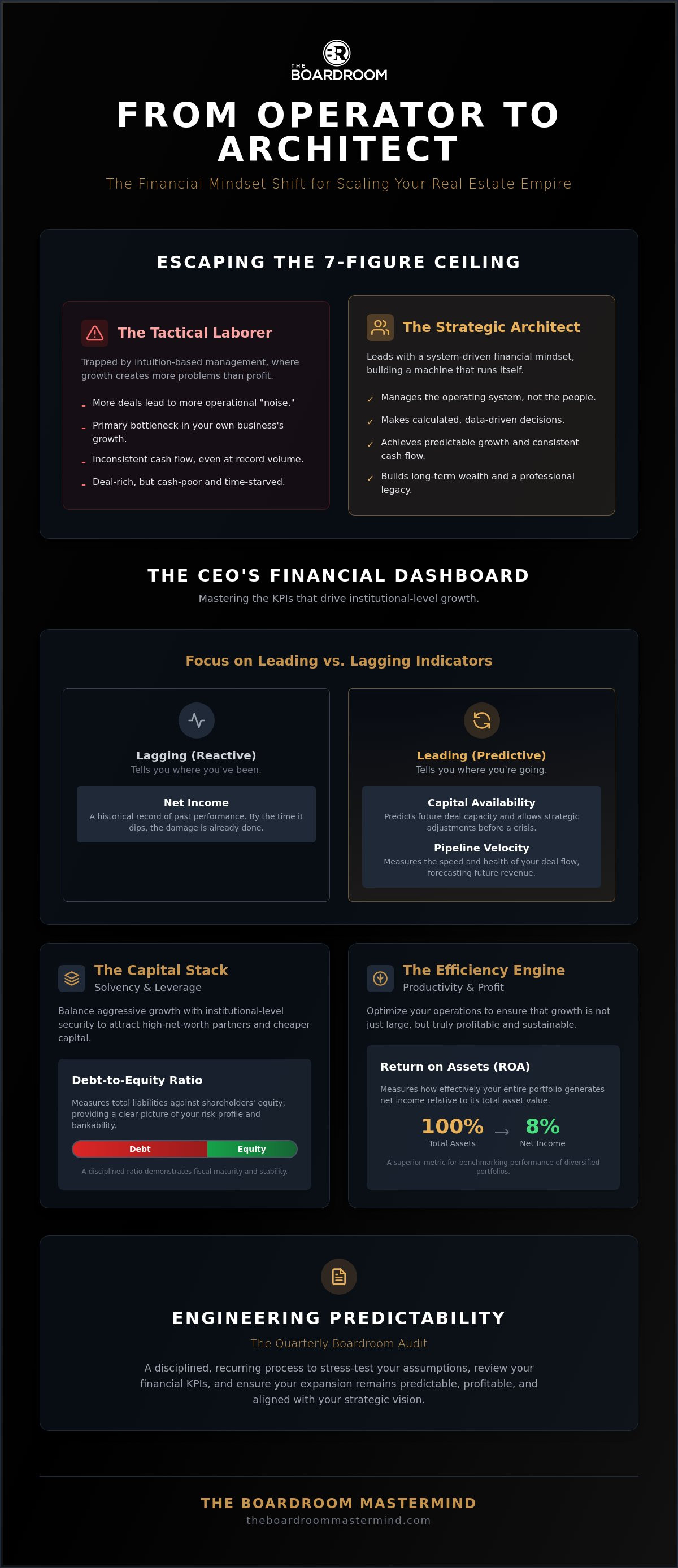
You've likely hit the "7-figure ceiling." It's that frustrating plateau where intuition-based management, the very thing that got you here, suddenly becomes your greatest liability. At institutional scale, gut feelings must be replaced by hard data. Scaling isn't about doing more deals; it's about building a machine that does deals for you. If you continue to track deal volume as your primary success metric, you'll remain trapped in a cycle of being deal-rich but cash-poor. True expansion requires mastering the specific financial kpis for scaling a real estate business that prioritize leverage, efficiency, and long-term sustainability over mere activity.
To better understand this concept, watch this helpful video:
The CEO's primary directive is the transition from managing people to managing the business operating system. When you focus on the system, the numbers tell a story that your team cannot. Without this shift, you're just a high-level operator wearing a CEO title, constantly putting out fires instead of designing the fireproofing. Professional real estate benchmarking allows you to compare your performance against institutional standards, ensuring your growth is actually profitable rather than just large.
Leading vs. Lagging Indicators for Real Estate CEOs
Net income is a lagging indicator. It tells you where you've been; it doesn't tell you where you're going. By the time you see a dip in net profit, the damage was likely done months ago. Strategic CEOs focus on leading indicators, such as capital availability and pipeline velocity. These metrics predict future deal flow and allow you to adjust your strategy before a crisis hits. If you don't know your numbers, you don't know your future.
The Cost of Operational Blindness
A lack of financial clarity creates the "hustler's trap." You work harder, but the returns diminish because you aren't optimizing for efficiency. This blindness leads to over-leveraging and inconsistent cash flow, even during high-volume months. The CEO Mindset Shift is the move from tactical deal-making to strategic wealth architecture.
The Capital Stack: KPIs for Institutional-Level Solvency and Leverage
Scaling an 8-figure empire demands more than just aggressive acquisition. It requires a sophisticated understanding of your capital stack. As you move toward institutional scale, your focus must shift from simple cash-on-cash returns to broader solvency metrics. These are the financial kpis for scaling a real estate business that determine whether you are a stable enterprise or a house of cards waiting for a market correction. High-level execution is about maintaining the balance between growth and security.
Professional investors and lenders look for a disciplined Debt-to-Equity Ratio. This metric measures your total liabilities against shareholders' equity, providing a clear picture of your risk profile. While leverage is a powerful tool for growth, over-extension is the fastest way to lose everything during a downturn. By monitoring essential financial metrics like these, you demonstrate the fiscal maturity required to attract high-net-worth partners and institutional capital.
Optimizing Your Debt-to-Equity for Rapid Expansion
Your "risk floor" is the minimum equity threshold required to weather a market dip without triggering a liquidity event. Maintaining a healthy ratio isn't just about safety; it's about bankability. When your solvency metrics are transparent and disciplined, you build the institutional trust necessary to access cheaper capital. This is a prerequisite for those looking to transition into real estate private equity.
Asset Productivity: The ROA Benchmark
Return on Assets (ROA) measures how effectively your entire portfolio generates net income relative to its total value. It's a superior metric for diversified portfolios because it highlights operational efficiency across the board. If your ROA is stagnating while your deal volume increases, you have an efficiency leak. Identifying these underperforming assets allows you to prune the portfolio and reallocate capital to higher-yield opportunities.
Maintaining a significant "War Chest" of cash on hand is equally vital. In a rebalancing market where inventory is rising, the ability to close an 8-figure deal with speed is a competitive advantage that no spreadsheet can replicate. If you're ready to stress-test your capital structure among peers, consider exploring The Boardroom experience to see how elite leaders audit their solvency assumptions.
The Efficiency Engine: Metrics That Dictate Your Speed of Expansion
Scaling a business at speed is a dangerous game if your internal systems aren't optimized. Most operators focus solely on the top line. They ignore the "burn" that follows rapid expansion. To move from a tactical operator to an 8-figure CEO, you must treat your company as a high-performance engine. This requires tracking the financial kpis for scaling a real estate business that measure internal efficiency rather than just external deal volume. If you don't monitor these metrics, you're essentially driving a car with a leak in the fuel tank; the faster you go, the sooner you'll stall.
Mastering the Operating Expense Ratio
The Operating Expense Ratio (OER) is the pulse of your operational health. It tracks the percentage of your gross income consumed by overhead, including the cost of your leadership team. Scaling your overhead too fast is a primary cause of bankruptcy for otherwise profitable firms. High-growth CEOs benchmark their OER against industry leaders to identify operational bloat before it compromises their agility. A lean, efficient machine allows for aggressive reinvestment when market opportunities arise.
CAC and Predictable Deal Flow
Your Cost of Acquisition (CAC) dictates the viability of your expansion. It’s the total marketing and sales spend required to bring a single deal into your pipeline. You must systemize your marketing spend to ensure a predictable return on every dollar deployed. CAC is the most critical metric for scaling to 500+ units per year because it determines the literal price of your growth.
Beyond the initial transaction, you must calculate the LTV (Long-Term Value) of every acquisition. This shift in perspective ensures you aren't just flipping for quick cash. You're building a sustainable portfolio. Cash Flow from Operations must remain the bedrock of your strategy, ensuring the business is self-sustaining without constant capital injections. If your core model doesn't work at scale, more capital will only accelerate your failure.
Ready to audit your efficiency with other high-level executives? Apply to join The Boardroom Mastermind and gain the clarity needed to scale with precision.
Engineering Predictability: Auditing Your KPIs at the Boardroom Level
Data without accountability is merely a collection of numbers. If you only review your financials once a year, you aren't leading; you're reacting to history. Scaling an 8-figure empire requires a relentless cadence of verification. You must ensure that your financial kpis for scaling a real estate business are actually moving the needle in real time. A quarterly audit isn't just a best practice. It's the survival mechanism of the elite.
True strategic clarity rarely happens in a vacuum. You need the perspective of peers who operate at your level or higher. This is where The Boardroom Mastermind Membership becomes a critical strategic asset for the modern CEO. When you allow other 8-figure founders to audit your financial assumptions, you expose the blind spots that internal teams are often too close to see. It’s the difference between simple data collection and decisive executive action.
The final litmus test for any CEO is the "30-day rule." Can you step away from the business for a month without the machine grinding to a halt? If your financial reporting is robust, the answer is yes. Your dashboard should provide enough transparency that your leadership team can execute while you focus on the horizon. If the business breaks in your absence, you haven't built a company; you've built a job.
The Quarterly Intensive Framework
At Boardroom meetings, we use a specific framework to audit business models and identify hidden profit leaks. We don't just look at the top line. We analyze the interplay between your acquisition costs and your operating expenses to ensure the engine is firing on all cylinders. A Board of Advisors provides the necessary friction to interpret these metrics for long-term impact rather than short-term gains. This level of scrutiny turns a volatile business into a predictable asset.
From Metrics to Legacy
Financial clarity is the ultimate shortcut to personal freedom. When you trust your data, you reclaim your time. You can finally exit the tactical day-to-day and focus on the high-impact visionary work that builds a lasting legacy. Business expansion should never come at the cost of your well-being; it should be the vehicle that secures it. Ready to audit your business at the highest level? Explore the Boardroom Experience.
Architecting Your 8-Figure Legacy
Transitioning from a tactical operator to a strategic CEO isn't a matter of effort; it's a matter of architecture. By mastering the financial kpis for scaling a real estate business, you move beyond the "hustler's trap" and into a space of calculated expansion. You now understand that your capital stack, efficiency metrics, and quarterly audit cadence are the pillars that support a truly self-sustaining enterprise. Predictability is not an accident. It's the result of disciplined systems and high-level oversight.
Knowledge alone won't secure your position at the top. You need the friction and perspective that only comes from a peer-level board of advisors. Apply for The Boardroom Mastermind to Audit Your Scaling Strategy and join an elite network of 7, 8, and 9-figure investors dedicated to operational excellence. Our quarterly in-person intensives provide the proven framework you need to transition from day-to-day management to visionary leadership. The clarity you seek is available to those ready to lead with institutional precision. Your next level of growth starts here.
Frequently Asked Questions
What are the most important financial KPIs for a scaling real estate business?
The most critical financial kpis for scaling a real estate business include the Debt-to-Equity ratio, Return on Assets (ROA), and Cost of Acquisition (CAC). While many operators focus on top-line revenue, these metrics reveal the true solvency and efficiency of your enterprise. Scaling requires shifting your gaze from simple deal volume to net yield and capital availability. High-level CEOs prioritize these indicators to ensure every new acquisition strengthens the balance sheet rather than diluting it.
How do I calculate the Cost of Acquisition (CAC) in real estate?
You calculate Cost of Acquisition by dividing your total marketing and sales expenses by the number of deals successfully closed within a specific period. This figure must include everything from lead generation spend and software subscriptions to the salaries of your acquisitions team. If you aren't tracking this at a granular level, you're flying blind. A precise CAC allows you to predict exactly how much capital is required to hit your next unit milestone.
Why is the Debt-to-Equity ratio critical for real estate investors?
The Debt-to-Equity ratio is the ultimate litmus test for your company's solvency and long-term stability. It measures your total liabilities against the equity held by shareholders, indicating how much of your growth is fueled by borrowed capital versus actual ownership. In a rebalancing market with 30-year fixed rates near 6.49%, over-leveraging is a fatal error. Maintaining a disciplined ratio ensures you remain bankable and resilient during inevitable economic shifts.
What is a 'good' Operating Expense Ratio for a growing real estate company?
A "good" Operating Expense Ratio (OER) typically ranges between 35% and 45% for residential portfolios, though this varies by asset class and market. As you scale and build out a leadership team, your overhead will naturally increase; however, the goal is to maintain an OER that allows for healthy net margins. If your ratio climbs toward 50% without a corresponding increase in efficiency, you're likely suffering from operational bloat that will hinder your expansion.
How often should a real estate CEO audit their financial metrics?
You should perform a deep-dive audit of your financial kpis for scaling a real estate business at least once per quarter, supplemented by high-level monthly reviews. A quarterly cadence provides enough data to identify trends without getting bogged down in weekly noise. This rhythm allows you to make strategic pivots before minor efficiency leaks become catastrophic failures. Elite CEOs use these intensives to stress-test their assumptions against current market realities and peer performance.


