
Executive Compensation Models: Engineering the Architecture of 8-Figure Scale
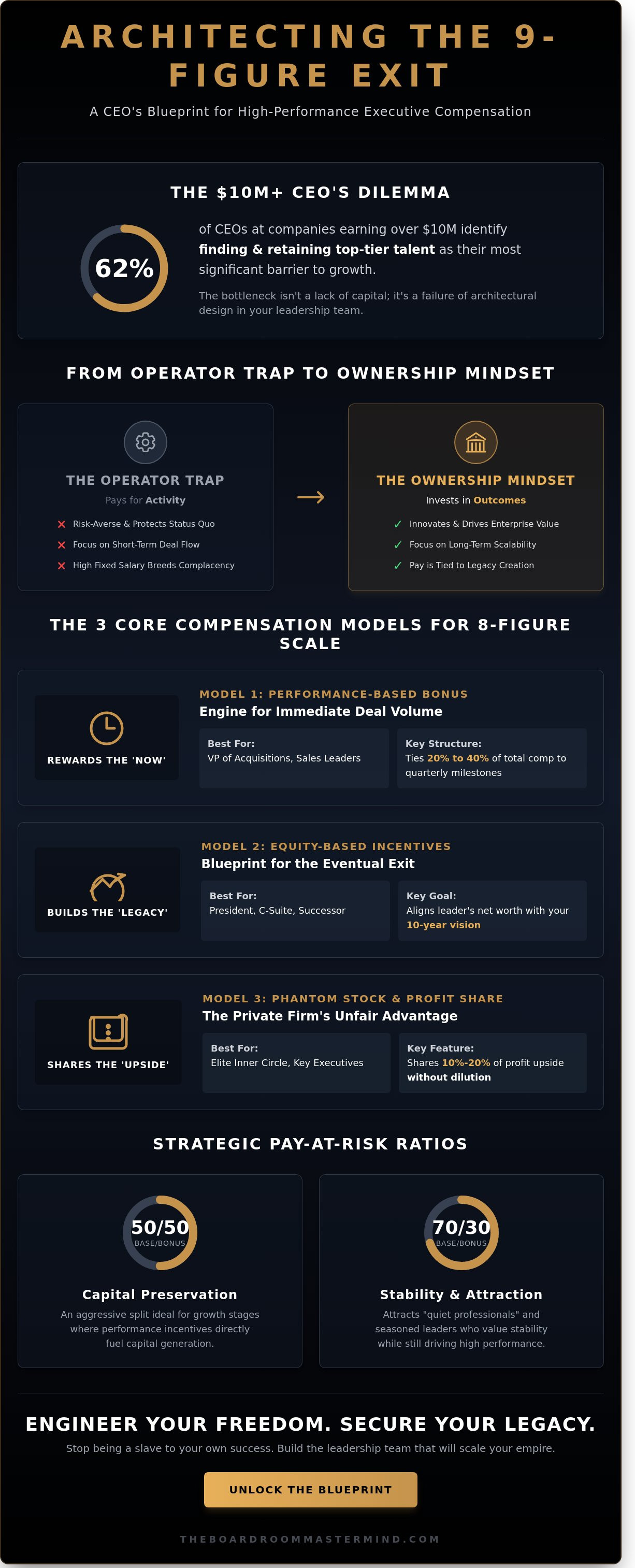
The reason you're still the primary bottleneck in your company isn't a lack of talent in the market; it's a failure of architectural design. According to a 2023 leadership survey by Vistage, 62% of CEOs at companies earning over $10 million identify finding and retaining top-tier talent as their most significant barrier to growth. You feel the weight of this daily. You want a leadership team that treats the business like their own, yet you're uncertain how to implement executive compensation models that align their hunger with your legacy without sacrificing control. If you fail to solve this, you remain a slave to your own success. If you master it, you unlock the path to 9-figure scale.
It's a frustrating paradox to possess the capital for expansion but lack the human leverage to execute it. This article provides the blueprint to break that cycle. You'll discover how to structure sophisticated pay packages that attract elite talent and facilitate your transition from operator to owner. We'll analyze the specific frameworks for profit-sharing, performance-based incentives, and phantom equity that turn your boardroom into a powerhouse of 8-figure execution. Prepare to engineer a compensation strategy that secures your freedom while compounding your impact.
Key Takeaways
- Discover why conventional salary structures anchor your leadership in operator stagnation and how to pivot toward an architecture that demands high-level innovation.
- Evaluate the three core executive compensation models to determine which strategic framework best drives immediate deal volume versus long-term enterprise value.
- Master the "Succession Framework" to install a President who executes with a founder’s mindset, utilizing self-funding structures that eliminate the "A-player" affordability gap.
- Execute a seamless transition to high-performance pay structures without triggering culture shock, ensuring your elite team remains focused on scale rather than disruption.
- Navigate the high-level architecture of phantom stock and deferred compensation to secure your wealth while engineering a definitive exit from daily operations.
Why Generic Executive Compensation Models Fail High-Growth Real Estate Empires
Your executive compensation models aren't just payroll line items. They're the architectural blueprints for your 9-figure vision. Most real estate founders make the mistake of treating leadership pay like a standard overhead expense. This is a fatal error. High-growth empires require a shift from paying for activity to investing in outcomes. Standard salary-plus-bonus structures are designed for steady-state corporations; they're toxic for 8-figure firms. When you rely on generic models, you inadvertently build a team of high-priced managers who protect the status quo instead of visionaries who drive enterprise value.
This creates a fundamental mismatch in your operations. Your business requires long-term equity growth to achieve a true exit, yet your pay structure likely rewards short-term deal flow. A 'Hustler' mindset pays for tasks completed. A 'CEO' mindset invests in the outcomes that build a legacy. If you want your leadership to innovate like owners, you must stop paying them like operators.
The 'Operator Trap' in Traditional Pay Structures
Traditional pay structures often lead to the 'Operator Trap' where high fixed salaries make your leadership team risk-averse. They stop innovating because they have too much to lose and not enough to gain by disrupting your current systems. This focus on 'activity' over 'scalability' is a silent killer of momentum. If you aren't careful, you'll find yourself stuck with the true cost of a bad hire. In a high-stakes real estate environment, this mistake often exceeds $1,000,000 in lost opportunity and cultural decay. You need a model that incentivizes the uncomfortable growth required to hit 8-figure milestones.
Defining Total Rewards for the Elite Inner Circle
To attract the elite, you must look beyond the simple paycheck. A comprehensive Executive Compensation Overview includes base salary, short-term incentives (STI), and long-term incentives (LTI). However, the A-players in your inner circle prioritize autonomy and legacy over a slightly higher base salary. While a base salary provides stability, it's the LTI and the promise of shared equity that turn a talented operator into a dedicated partner. Your executive compensation models must reflect this reality by offering a path to wealth, not just a path to a paycheck. This is how you engineer a team that scales without the stress.
Comparing the 3 Core Executive Compensation Models for 8-Figure Scale
Engineering an 8-figure exit requires moving beyond standard payroll. You need executive compensation models that solve for both immediate cash flow and long-term enterprise value. If you're building a legacy, you aren't just paying for time; you're buying execution. Successful CEOs recognize that the wrong structure doesn't just cost money; it misaligns the entire leadership team.
- Performance-Based Bonus Model: This is your engine for immediate deal volume. It's built for the VP of Acquisitions who needs to move $50M in assets annually. It rewards the "now" by tying 20% to 40% of total comp to specific quarterly milestones.
- Equity-Based Model: This focuses on the eventual exit. It transforms a high-level operator into a stakeholder, aligning their net worth with your 10-year legacy.
- Phantom Stock/Profit Participation: This is the "unfair advantage" for private firms. It allows you to share 10% to 20% of the profit upside or "synthetic" equity without surrendering a single voting share or diluting your cap table.
Cash-Heavy vs. Equity-Driven Incentives
Choosing between these executive compensation models isn't just an HR task; it's a strategic move for the boardroom. Determining your "Pay-at-Risk" ratio depends on your growth stage. A 50/50 split is common when capital preservation is the priority. As you scale toward a nine-figure legacy, shifting toward a 70/30 base-to-bonus ratio helps attract "quiet professionals" who value stability. In real estate environments, you should mirror the structures found in this Real Estate Private Equity guide to align with institutional capital. Data on Performance-Driven Compensation Packages confirms that packages failing to balance these incentives often lead to short-term thinking that erodes long-term value.
The Role of Performance Triggers
Protect your downside by setting strict EBITDA or Net Operating Income (NOI) targets. This prevents "bonus bloat" during market downturns. If the company doesn't hit 85% of its NOI goal, the bonus pool shouldn't trigger. Implement a 4-year vesting cliff to ensure your executive team is committed to the long-term vision. It's the most effective way to achieve scaling without the stress while maintaining your position in the inner circle of elite achievers.
Engineering Your Exit: How to Structure Pay to Replace Yourself
Your exit isn't a date on a calendar. It's a structural reality built into your payroll. Most founders stay trapped in the operator role because they view leadership as an expense rather than a self-liquidating asset. To achieve 8-figure scale and beyond, you need a Succession Framework that forces your President to think, act, and execute like a shareholder. This transition requires sophisticated executive compensation models that align long-term legacy with immediate performance metrics.
The Self-Funding Executive Model
Stop asking if you can afford an A-player. Ask if your business can afford the stagnation of a B-player. The Self-Funding Executive Model eliminates the financial risk of high-level hires by tying their rewards to actualized growth. You should structure bonuses so they only trigger after the executive has generated a 3x to 5x return on their total cost. By implementing strict thresholds, you ensure the company remains profitable and liquid before any incentive pools are distributed. If the growth isn't there, the high-end payout doesn't exist. This creates a zero-downside environment for the owner while providing uncapped upside for the performer.
Retention Strategies: Beyond the Paycheck
Protecting your empire from talent poaching by larger institutional players requires "Golden Handcuffs." These are deferred compensation structures or shadow equity plans that vest over 3 to 5 years, making the cost of leaving mathematically painful. However, elite leaders at the 8-figure level value more than just a bank balance. They crave proximity and professional evolution. Providing your executives with access to the Boardroom Experience serves as a powerful non-monetary benefit. It offers them an elite networking environment and strategic intelligence that a standard corporate role cannot provide.
Transparency in this architecture builds the trust required for an elite high-performance culture. When the rules of the game are clear, politics disappear. You aren't just paying for labor; you're buying back your freedom and ensuring the business survives your departure. This clarity creates an environment where the transition from operator to owner becomes a logical conclusion rather than a risky gamble.
Implementing Your Model: From Theory to Boardroom Execution
Execution is where strategy meets reality. If you pivot your executive compensation models overnight without a clear communication plan, you risk decapitating your leadership layer. Transitioning requires a phased approach. Start by framing the shift as an upgrade to their earning potential rather than a restriction on their current cash flow. Use transparent sessions to explain how the new architecture aligns their personal wealth with the firm’s 9-figure trajectory. When your team sees that their upside is tied to the enterprise value they help create, the "culture shock" evaporates.
The technical implementation carries heavy legal and tax weight. Deferred compensation and phantom stock are elite tools for retention, but they require precision. Section 409A compliance is a non-negotiable hurdle. One misstep in the timing of deferral elections or valuation methods can trigger a 20% penalty tax for your executives. Consult with tax counsel specializing in high-growth real estate entities to ensure your agreements are bulletproof. You are building a legacy, not a tax liability.
The Annual Compensation Audit
Your model is not a static document. It must evolve alongside your business operating system to remain effective. Every 12 months, you must compare your internal retention data against industry benchmarks for 8-figure real estate firms. If your top-tier talent isn't earning at least 15% above the market average while hitting their KPIs, your model is failing. Use the Boardroom Collective Intelligence to see how other scaling CEOs are structuring their wins. Data from the field prevents you from overpaying for mediocrity or underpaying for excellence.
The Final Shift: From Payer to Partner
Real scale happens when you stop being a payer and start being a partner. You aren't just buying a manager's time. You're architecting a strategic alliance centered on a legacy-building mission. Moving from an employer-employee mindset to a partnership framework changes the psychological contract of the office. It turns your C-suite into owners who think about the 10-year exit rather than the next commission check.
Your compensation strategy is the ultimate litmus test for your leadership's belief in your 9-figure future. If you don't bet on your team, they won't bet on you. It's time to stop guessing and start engineering. Join the elite few who have mastered the architecture of scale at The Boardroom Mastermind.
Architecting Your Eight-Figure Legacy
High-growth real estate empires don't survive on entry-level payroll structures. Moving from operator to owner requires a shift from transactional pay to performance-based alignment. By implementing sophisticated executive compensation models, you secure the elite talent necessary to manage 8-figure operations while protecting your own exit strategy. It's about building a machine that functions without your daily interference. Precision in your leadership architecture is the difference between a business that owns you and one that builds your legacy.
You don't have to navigate these structural shifts alone. Join an inner circle of 7, 8, and 9-figure real estate investors who have already solved these scaling bottlenecks. The Boardroom Mastermind provides exclusive access to elite scaling frameworks and quarterly in-person business intensives designed to refine your executive engine. If you're ready to stop guessing and start engineering, apply for The Boardroom Mastermind to Audit Your Leadership Architecture today. Your ascent to the next level is a matter of strategic design. The path is clear for those with the right access.
Frequently Asked Questions
What is the typical base salary for a COO in an 8-figure real estate business?
A COO in an 8-figure real estate firm typically commands a base salary ranging from $175,000 to $250,000. This figure represents the foundational floor of the compensation package. You're paying for a strategic architect who manages $10 million plus in annual revenue. High-performance models often add 20% to 50% in performance bonuses based on specific EBITDA targets. It's about buying back your time with elite talent.
How do phantom stock plans differ from traditional equity in a private company?
Phantom stock plans provide a cash bonus tied to the company's share value without granting actual legal ownership or voting rights. Traditional equity requires issuing K-1s and grants a portion of the company's capital. In these executive compensation models, phantom stock acts as a synthetic equity tool. It delivers the financial upside of a 5% or 10% stake while keeping the cap table clean. This ensures you maintain total control.
What are 'Golden Handcuffs' and how do I implement them effectively?
Golden Handcuffs are financial incentives designed to retain elite talent through multi-year vesting schedules or deferred bonuses. To implement them effectively, use a 4-year cliff or a rolling 3-year performance bonus. If an executive leaves before the 48-month mark, they forfeit 100% of the unvested amount. This strategy secures your leadership team during critical scaling phases. It turns high-level employees into long-term partners in your legacy.
Can I use profit-sharing models without giving away legal ownership of my LLC?
You can implement profit-sharing via a Net Profit Interest agreement that pays out a percentage of annual earnings without transferring LLC membership units. This keeps 100% of the legal control in your hands. Use a defined pool, such as 15% of EBITDA, to reward your inner circle. It aligns their focus on the bottom line without complicating your exit strategy. You get the loyalty of a partner without the legal headache.
How often should I review and adjust my executive compensation models?
Review your executive compensation models every 12 months to ensure they align with current market data and your 3-year growth trajectory. A static model is a liability. If your revenue grows by 40% in a single year, your incentives must evolve to reflect the increased complexity of the operation. Conduct these audits during Q4 to set the architecture for the upcoming fiscal year. Precision in your numbers drives precision in your results.


