
Evaluating New Real Estate Markets: A Due-Diligence Framework
What if the market with the strongest headline growth is the wrong place to deploy your next dollar? Evaluating new real estate markets isn’t a contest in population charts or rent forecasts. It’s a test of whether local deal economics, capital access, sourcing, and execution capacity fit your operating model. A promising report can still hide assumptions you can’t verify or reproduce on the ground.
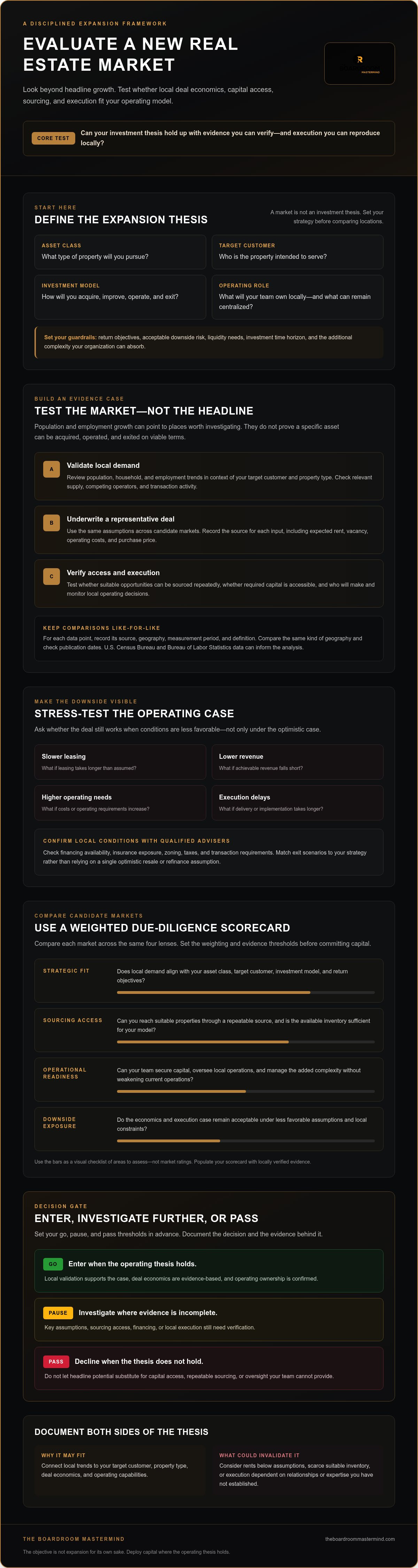
Expansion brings more than acquisition risk. It can divide attention, strain existing systems, and expose gaps in local management. The answer isn’t simply to collect more market data. It’s to apply a consistent underwriting process. This framework shows you how to compare candidate markets using aligned assumptions, test whether your sourcing, financing, and management capabilities can travel, and set evidence thresholds before committing capital. You’ll finish with a documented decision to enter, investigate further, or pass. The objective isn’t expansion for its own sake. It’s deploying capital where the operating thesis holds.
Key Takeaways
- Start with a defined expansion thesis: specify the asset class, target customer, investment model, and operating role before assessing a market.
- When evaluating new real estate markets, validate demand and representative deal economics using comparable data definitions, dates, and assumptions.
- Use a weighted scorecard to compare strategic fit, sourcing access, operational readiness, and downside exposure across candidate markets.
- Set go, pause, and pass thresholds in advance, then confirm local validation and operating ownership before committing capital.
Evaluating a New Real Estate Market Starts With an Expansion Thesis
A market isn’t an investment thesis. It’s a set of local conditions your strategy must be able to navigate. Before evaluating new real estate markets, specify the asset class, target customer, investment model, and your role in sourcing, financing, improving, and operating the asset. A multifamily acquisition strategy serving long-term renters, for example, requires different demand evidence and capabilities than a strategy focused on renovating homes for resale.
A market thesis combines your strategy, customer, deal economics, and execution assumptions. Each must hold for the investment to work. This keeps expansion grounded in your business model rather than an attractive ranking or broad growth narrative.
Set the investment and operating criteria before comparing markets
Write down the requirements a candidate market must meet: return objectives, acceptable downside risk, liquidity needs, and investment time horizon. Then list the capabilities your strategy depends on. Can your team source suitable properties, secure appropriate capital, and oversee local operations? Define which functions need local ownership, which can remain centralized, and how much additional complexity your organization can absorb without weakening current operations.
Turn these requirements into screening questions. For example: Can you identify a repeatable source of suitable properties? Can you explain who will make local operating decisions and how those decisions will be monitored? If a market requires capital you can’t access or oversight you can’t provide, headline potential won’t close the gap.
Distinguish a promising market from a promising headline
Population and employment growth can indicate where to investigate, but they don’t prove that a specific asset can be acquired, operated, and exited on viable terms. Test the connection between those trends, your target customer, and your property type. When underwriting a deal, use consistent valuation methods. Real estate appraisal provides a framework for assessing property value, but local evidence and strategy-specific assumptions still need to support your numbers.
Document both sides of the thesis: why the market may fit, and what evidence would invalidate that view. Could achievable rents fall short of your assumptions? Is suitable inventory scarce? Would local execution depend on relationships or expertise you haven’t established? Naming disconfirming evidence before you’re committed makes the comparison more disciplined and less vulnerable to confirmation bias.
Test Demand, Deal Economics, and Execution Conditions in Each Market
Once your expansion thesis is defined, test it against local evidence. Population and household trends can help show who may need your property type; employment data adds context about economic conditions. For each candidate market, record the source, geography, measurement period, and definition. U.S. Census Bureau and Bureau of Labor Statistics data can inform the analysis, but check publication dates and compare like with like. A city boundary and a broader metro area can tell very different stories.
A market is only as attractive as the deal economics your evidence can support. Underwrite a representative property using the same assumptions across markets. Record the source for each input, such as expected rent, vacancy, operating costs, and purchase price. Then test how the case changes if leasing is slower, revenue is lower, operating needs are higher, or execution is delayed. Match exit scenarios to your strategy rather than relying on a single optimistic resale or refinance assumption.
Compare evidence and sourcing conditions
Demand indicators are only part of the picture. Examine relevant property supply, competing operators, and transaction activity to understand what inventory is available and how active the market is. Then check whether your sourcing channels can reach the opportunities your model requires. Ask where recent suitable opportunities came from, what access is needed to pursue them, and whether you can repeat that process. A market may show demand yet remain difficult to enter if suitable properties are scarce or access depends on local relationships you haven’t built. A practical due diligence checklist can help organize property-level questions alongside market research.
Underwrite execution and downside conditions
Confirm financing availability, insurance exposure, zoning, taxes, and transaction requirements with qualified advisers familiar with the market. Don’t treat these as footnotes: they can affect feasibility, timing, and operating complexity. Stress-test the deal under less favorable conditions, then ask whether your team can still execute without pulling focus from existing assets.
Use the same evidence standards for each candidate, and invite a trusted peer to challenge assumptions before they harden into a commitment. Experienced operators may use strategic collaboration with peers to pressure-test an expansion thesis and surface execution gaps.
Compare Candidate Real Estate Markets With a Weighted Due-Diligence Scorecard
A scorecard makes market comparisons more disciplined, but only if every candidate is judged by the same standards. Build a side-by-side view using shared data sources, time periods, and underwriting assumptions. Score each market on strategic fit, demand evidence, deal economics, sourcing access, operational readiness, and downside exposure. For every criterion, record the evidence behind the score, not just the number.
Set the weights before reviewing results. If your strategy depends on reliable local sourcing, give that factor more influence than a broad demand indicator. If management capacity is the constraint, weight operational readiness accordingly. Define what each score means in advance. A high score for sourcing access, for example, should require evidence of reachable opportunities, not simply confidence that a network can be built.
Make evidence quality visible
Label findings as verified, provisional, or unknown. Verified means supported by current, relevant evidence; provisional means plausible but still requiring confirmation; unknown means the information is missing. Assign an owner and next step to every material gap. Keep unanswered questions visible instead of letting a polished total score disguise uncertainty. This kind of capital-allocation discipline also connects to the principles of Real Estate Private Equity: The Architect’s Guide to Institutional Scale.
Use the weighted result to identify which markets merit deeper diligence, not to hand judgment over to a spreadsheet. A strong total can still conceal a critical weakness, such as attractive economics paired with no credible operating plan. When evaluating new real estate markets, review both the score and the assumptions that produced it. Which conclusion would change if a provisional input proved wrong?
For experienced investors, peer review can pressure-test the weights and expose blind spots before they shape an expansion decision. Explore strategic collaboration with experienced real estate operators as a setting to challenge your market scorecard.
Turn Market Evaluation Into a Controlled Entry, Pause, or Pass Decision
A market score is useful only if it leads to a controlled decision. Before committing capital or announcing expansion, define what qualifies as a go, what evidence would trigger a pause, and which conditions warrant a pass. Set those thresholds before enthusiasm or sunk costs start shifting the standard. A go decision might require validated deal economics, a credible sourcing path, and a named owner for local operations. If a key assumption remains unverified, pause and assign a clear next step rather than treating uncertainty as approval.
Validate the market before scaling your commitment
Make the first move a limited test of the thesis, not an assumption of full-scale entry. Depending on your strategy, that could mean testing local sourcing channels, reviewing a focused set of representative opportunities, or confirming operating support with qualified local professionals. Compare what you learn with the original underwriting assumptions. Record what changed, why it changed, and whether the revised case still meets your criteria.
Set review dates and monitor early warning indicators tied to your thesis, such as weaker-than-underwritten revenue, slower leasing, rising operating demands, or delays in securing viable opportunities. If a trigger is reached, revisit the decision. Don’t let a calendar milestone substitute for evidence.
Use experienced peer challenge to pressure-test assumptions
Structured discussion with experienced operators can expose blind spots in your reasoning, from overconfidence in local sourcing to underestimating management demands. Peer challenge strengthens judgment; it doesn’t replace market research, qualified advice, or deal-level diligence. Explore The Boardroom Mastermind experience to understand its strategic peer environment, and consider whether that perspective could help you scrutinize an expansion thesis.
Evaluating new real estate markets is ultimately a capital-allocation decision, but it’s also a test of organizational capacity. Enter when the evidence and execution plan align. Pause when material questions remain. Pass when the thesis depends on assumptions your business can’t support. Explore The Boardroom Mastermind as a setting for strategic collaboration with experienced real estate investors and entrepreneurs.
Make Your Next Market Move With Conviction
Expansion deserves more than a compelling growth story. Start with a precise investment thesis, test demand and deal economics against comparable evidence, and use a weighted scorecard to separate verified strengths from unresolved risks. Then make a deliberate choice: enter, pause for more diligence, or pass. That is the discipline behind evaluating new real estate markets without confusing market potential with your ability to execute.
The Boardroom is an elite peer group and educational platform for experienced real estate investors and entrepreneurs. Its quarterly in-person intensives bring members together to audit business models and focus on growth through strategic collaboration, accountability, and leadership development. If your next market decision would benefit from that level of scrutiny, explore The Boardroom.
Build growth around evidence, operational capacity, and a clear rationale. The right decision is the one your business can execute with confidence.
Frequently Asked Questions
How do you evaluate a new real estate market?
Start by defining the investment strategy, asset type, target customer, and operating role you intend to pursue. Then evaluate demand, property supply, representative deal economics, sourcing access, local operating requirements, and downside risks using comparable evidence. Document assumptions and unresolved questions. Set clear thresholds for entering, pausing, or passing so the decision reflects your business’s ability to execute, not just the market’s growth story.
What factors matter most when comparing real estate markets?
The most important factors depend on your strategy. Compare demand for your target property type, viable deal economics, access to suitable opportunities, financing conditions, local operating capacity, and risks that could weaken returns or delay execution. Use the same definitions, data periods, and underwriting assumptions across markets. Weight criteria according to what drives your model, and distinguish verified evidence from estimates or unanswered questions.
How can I tell whether a real estate market is oversaturated?
Look for signs that supply and competition may be outpacing demand for the specific asset or customer you target. Examine relevant inventory, competing operators, leasing or sales conditions, transaction activity, and whether representative deals still meet your underwriting criteria. No single indicator proves oversaturation. Confirm what local data actually measures, investigate changes over time, and test whether your sourcing and operating advantage remains credible.
Should I invest in a new market before visiting it?
A visit isn’t a substitute for underwriting, but local validation can reveal operating realities that market data won’t show. Before committing, verify property assumptions, sourcing access, local expertise, and operating requirements with qualified people on the ground. If you can’t visit, identify who can validate those conditions and what evidence they’ll provide. Treat unverified local assumptions as open diligence, not as confirmed facts.
How many markets should a real estate investor evaluate at once?
There’s no universal number. Evaluate only as many markets as your team can compare with consistent data and meaningful diligence. A focused shortlist is often more useful than a broad scan that leaves key assumptions untested. Consider your available time, sourcing capacity, and ability to validate local operations. If adding another candidate weakens the quality of analysis, narrow the field before proceeding.

Disclaimer
Mr. Clothier is an expert in real estate investing. As such his experiences are not necessarily typical to the standard real estate investor and whose results may vary. The successes shared on this site are not considered typical. Most individuals who order the educational materials and systems probably do not follow any of the techniques or strategies and consequently make little to no money due to their inaction. The company is in the process of determining the typical success of its clients. Stories shared herein are for example purpose only and should not be construed as "guarantees" of success. Results will vary based on background, education, and experience and actions taken.
This site is not a part of the Google/Facebook website or Google/Facebook Inc. Additionally, this site is NOT endorsed by or affiliated with Google/Facebook in any way. GOOGLE/FACEBOOK is a trademark of GOOGLE/FACEBOOK, Inc.
INCOME DISCLAIMER: This website and the items it distributes contain business strategies, marketing methods and other business advice that, regardless of referenced results and experience, may not produce the same results (or any results) for you. The Boardroom Mastermind makes absolutely no guarantee, expressed or implied, that by following the advice or content available from this web site you will make any money or improve current profits, as there are several factors and variables that come into play regarding any given business. Primarily, results will depend on the nature of the product or business model, the conditions of the marketplace, the experience of the individual, and situations and elements that are beyond your control. As with any business endeavor, you assume all risk related to investment and money based on your own discretion and at your own potential expense.
LIABILITY DISCLAIMER: By reading this website or the documents it offers, you assume all risks associated with using the advice given, with a full understanding that you, solely, are responsible for anything that may occur as a result of putting this information into action in any way, and regardless of your interpretation of the advice. You further agree that The Boardroom Mastermind, its affiliates, subsidiaries, officers and agents, cannot be held responsible in any way for the success or failure of your business as a result of the information provided. It is your responsibility to conduct your own due diligence regarding the safe and successful operation of your business. In summary, you understand that we make absolutely no guarantees regarding income as a result of applying this information, as well as the fact that you are solely responsible for the results of any action taken on your part as a result of any given information. In addition, you agree that our content is to be considered "for entertainment purposes only". Always seek the advice of a professional when making legal, financial, tax, or business decisions.
BUSINESS OPPORTUNITY: All products and services offered by The Boardroom Mastermind are intended to provide prospective purchasers with general business strategies, marketing methods and other general advice for business development and training. At no point is The Boardroom Mastermind soliciting anyone to enter into a new business nor is it representing, either expressly or by implication, that it will provide locations for a business, provide outlets, accounts, or customers, or purchase any of the goods or services made by the purchaser.
The products being offered through this promotion are packages of informational tools to help you learn about business and deal making strategies.


