
Entrepreneur Peer Advisory Board: How to Choose the Right Strategic Circle
What if the most useful challenge to your next strategic decision came not from a consultant, but from an experienced owner who understands the stakes? An entrepreneur peer advisory board can create that kind of setting, but access alone isn’t value. You need peers who can question your assumptions, respect confidentiality, and help you stay accountable to your decisions. Otherwise, it’s networking with a calendar invite.
Major choices are hard to pressure-test in isolation, and a long contact list won’t guarantee execution. This guide explains what peer advice can and can’t do, how it differs from networking, coaching, and a formal board, and what to examine before joining. You’ll find practical questions for assessing member fit, meeting structure, trust, and follow-through. Use them to decide whether a peer commitment fits your business’s next stage and whether a focused community such as The Boardroom Mastermind aligns with your priorities.
Key Takeaways
- An entrepreneur peer advisory board is built around structured decision pressure-testing, not simply expanding your network.
- Assess members’ experience and relevance, then ask how meetings are facilitated, confidentiality is handled, and commitments are revisited.
- Peer perspectives can expose assumptions, but you remain responsible for deciding which insights apply to your business.
- A peer group is most useful when you bring meaningful decisions, welcome challenge, and are prepared to contribute and follow through.
What Is an Entrepreneur Peer Advisory Board and Its Purpose?
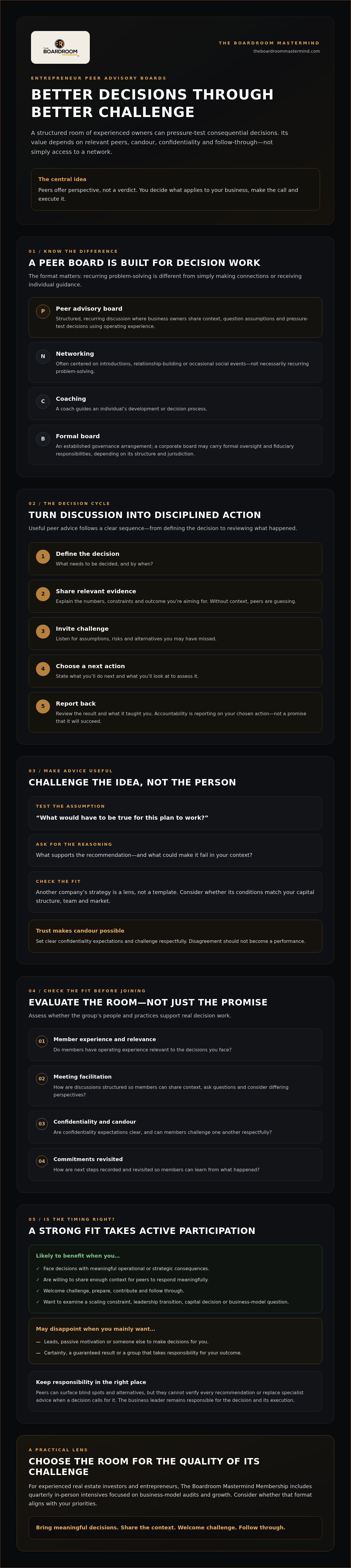
An entrepreneur peer advisory board is a structured forum where business owners share context, challenge one another’s assumptions, and pressure-test consequential decisions. It offers perspective, not a verdict. Unlike a formal advisory board, which advises an organization through an established governance arrangement, a peer group draws on members’ operating experience. A corporate board may carry formal oversight and fiduciary responsibilities, depending on its structure and jurisdiction.
A peer group also differs from paid coaching, where a coach guides an individual’s development or decision process, and from networking, where the main aim may be to build connections. Peer discussion can help you examine a scaling constraint, leadership transition, capital decision, or business-model question. But peers don’t own the outcome. You decide what applies, make the call, and execute it.
How Is a Peer Advisory Board Different From Networking?
Networking often centers on introductions, relationship-building, or occasional social events. An entrepreneur peer advisory board is designed for recurring problem-solving. Members bring a challenge, explain the context, and make room for questions and differing perspectives. Follow-up adds discipline: reporting back on an action gives the group a chance to examine what happened, not just what sounded promising in the meeting.
Who Is Most Likely to Benefit?
The strongest fit is an experienced entrepreneur facing decisions with real operational or strategic consequences, and willing to share enough context for peers to respond meaningfully. That may include leaders moving from day-to-day operator responsibilities toward broader CEO leadership. If you mainly want leads, passive motivation, or someone else to make decisions for you, a peer group may disappoint. It requires candour, preparation, and contribution.
Choose the room for the quality of its challenge, not a promise of certainty. The group can surface blind spots and alternatives, but it can’t verify every recommendation or replace specialist advice when a decision calls for it. Accountability matters, but responsibility stays with the business leader.
How Does an Entrepreneur Peer Advisory Board Create Strategic Value?
An entrepreneur peer advisory board creates value through a disciplined decision cycle, not a steady stream of opinions. Before a meeting, define the decision you need to make and gather the facts that bear on it. Explain your constraints, hear questions that test your assumptions, choose a next action, then report back on what happened. Without context, peers are guessing. Without follow-through, useful insight can disappear as soon as the meeting ends.
- Define the decision: What needs to be decided, and by when?
- Share relevant evidence: Explain the numbers, constraints, and outcome you’re aiming for.
- Invite challenge: Listen for assumptions, risks, or alternatives you may have missed.
- Choose an action: State what you’ll do next and what you’ll look at to assess it.
- Report back: Review the result and what it taught you.
Peers from different operating contexts can spot blind spots because they may not share all your assumptions. Their experience is a lens, not a template. A strategy that worked in another company may not suit your capital structure, team, or market. Ask what conditions made it work there, then test whether those conditions exist in your business before adopting the recommendation.
What Makes Peer Advice Useful Rather Than Anecdotal?
Present the decision, constraints, evidence, and desired outcome before discussion begins. Then distinguish questions that expose an assumption, such as “What would have to be true for this plan to work?” from advice based mainly on another member’s preferences. Ask peers to explain the reasoning behind a recommendation and what could make it fail in your context. Candour depends on trust: members need clear confidentiality expectations and the willingness to challenge respectfully, without turning disagreement into a performance.
How Does Accountability Support Execution?
Peer accountability means reporting back on the action you chose, not promising that it will succeed. A useful commitment names a next step and when you’ll revisit it. Vague encouragement does neither. Follow-up asks what happened, what changed, and what the operator learned. It doesn’t guarantee results or transfer responsibility to the group.
For experienced real estate investors and entrepreneurs considering a structured setting, The Boardroom Mastermind Membership includes quarterly in-person intensives focused on business-model audits and growth. Explore the peer collaboration and business-model focus to assess whether that format aligns with your priorities.
How to Evaluate an Entrepreneur Peer Advisory Board Before Joining
Evaluate the room before committing your time. An entrepreneur peer advisory board should offer relevant challenge, clear expectations, and a format that fits the decisions you need to make. Ask for specifics, not just promises of access or growth. A useful first test is whether the group can explain how a member brings a challenge, how discussion is handled, and what happens after the meeting.
- 1. Member stage and experience: Who participates, and are they handling comparable business complexity and leadership responsibilities?
- 2. Industry relevance: Do members understand your operating context, or can they ask useful questions without assuming their market works like yours?
- 3. Facilitation: Who guides discussion, how are challenges selected, and what happens when the group lacks relevant expertise?
- 4. Confidentiality: Ask what privacy expectations members agree to and how the group handles sensitive business information.
- 5. Cadence and format: Confirm how often members meet, whether sessions are in person or virtual, and what preparation and participation are expected.
- 6. Follow-through: Find out how members revisit decisions and commitments. A strong discussion matters less if there’s no opportunity to reflect on execution.
Which Questions Should You Ask About Fit and Trust?
Ask how members are expected to participate, whether they can challenge one another directly, and how confidentiality is handled in practice. Look for operators whose experience matches the complexity of your decisions. Ask what members are expected to bring to a session and how they follow up afterward. Separate specific practices, such as a stated meeting structure, from broad marketing promises that don’t explain how the group works.
How Can You Tell Whether the Format Fits Your Business?
Compare the meeting structure with the decisions you need to bring and the time your operating responsibilities allow. A recurring format may support sustained accountability; occasional introductions alone may not. The Boardroom Mastermind Membership includes quarterly in-person intensives focused on auditing business models and growth. Review the quarterly intensive experience to understand that format, then explore the Boardroom Mastermind Membership as a potential fit for your priorities.
When a Peer Advisory Board Makes Sense for Your Next Stage
A peer group may fit when you’re facing consequential decisions, are willing to have your assumptions challenged, and can contribute as well as receive. Its value depends on the room: relevant peers, trust, preparation, and consistent follow-through. Without those, an entrepreneur peer advisory board can become another calendar commitment rather than a strategic asset.
Be candid about the trade-offs. Strong peer discussion takes time and requires you to share enough context for others to respond usefully. Advice remains perspective, not professional authority. For legal, tax, financial, or other specialist questions, consult a qualified expert rather than treating group discussion as a substitute.
What Should You Expect From a High-Level Peer Community?
For experienced real estate investors and entrepreneurs, The Boardroom Mastermind Membership combines peer collaboration with an educational platform and business-model auditing. Its quarterly in-person intensive meetings provide structured time to examine how the business operates and focus on growth. The community also emphasizes accountability and leadership development, including the transition from a “hustler” mindset to a professional CEO role. Those elements can support a member’s development, but outcomes still depend on each member’s decisions and execution.
What Is a Sensible Next Step?
Before comparing memberships, write down the strategic challenge you need help thinking through. Is it a growth constraint, a business-model question, or a transition in your leadership role? Then assess whether a group’s members, meeting format, and expectations match that need. If you’re not ready to prepare, participate, and report back, wait until you can engage fully.
If the format aligns with your priorities, explore The Boardroom Mastermind Membership as one option for your next stage.
Choose the Circle That Moves You Forward
The right entrepreneur peer advisory board isn’t valuable because it puts more names in your network. Its value comes from trusted challenge, relevant experience, and the discipline to act on what you learn. Look for peers who understand the scale of your decisions, a structure that supports honest discussion, and clear expectations for preparation and follow-through. The final call, and the execution, remain yours.
For experienced real estate investors and entrepreneurs, The Boardroom Mastermind Membership brings together a peer community and educational platform. Quarterly in-person intensives in various cities across the United States create structured time for business-model audits, accountability, and leadership development. The community is focused on helping experienced operators strengthen their strategic perspective and move toward a professional CEO role, not on promising a particular outcome.
Start with the decision you need to pressure-test, then assess whether the people and format fit the business you’re building. If The Boardroom Mastermind aligns with your next stage, explore The Boardroom Mastermind Membership.
Frequently Asked Questions
What is an entrepreneur peer advisory board?
An entrepreneur peer advisory board is a recurring forum where business owners discuss strategic challenges and draw on one another’s operating experience. Members share relevant context, ask questions, and offer perspectives, while each owner remains responsible for decisions and execution. It isn’t a substitute for specialist advice or formal corporate governance. Its practical value comes from useful perspectives, trustworthy discussion, and a commitment to act on decisions.
How is a peer advisory board different from a mastermind group?
The terms are sometimes used interchangeably, so examine how each group actually operates. “Peer advisory board” often describes a more structured setting with recurring meetings, confidentiality expectations, and a defined approach to discussing challenges. “Mastermind” can describe a looser forum for brainstorming and idea-sharing. The label alone doesn’t establish quality: ask about preparation, discussion norms, member participation, and how the group revisits decisions.
Who should join an entrepreneur peer advisory board?
It’s generally a stronger fit for an experienced owner with consequential business questions who’s willing to share context, hear candid challenge, and contribute perspective to others. Leaders looking for contacts alone, passive encouragement, or someone to make decisions for them may not find the format useful. The Boardroom Mastermind Membership is designed for experienced real estate investors and entrepreneurs seeking peer collaboration, business education, and leadership development.
How do I choose the right peer advisory group?
Compare members’ experience, the relevance of their perspectives, confidentiality expectations, facilitation, meeting cadence, and follow-through. Ask who participates, how members bring forward challenges, and what happens when the group lacks expertise on a topic. Then consider whether the time and format fit your responsibilities. Before joining, identify one current strategic decision the group could help you examine and assess the structure against that need.

Disclaimer
Mr. Clothier is an expert in real estate investing. As such his experiences are not necessarily typical to the standard real estate investor and whose results may vary. The successes shared on this site are not considered typical. Most individuals who order the educational materials and systems probably do not follow any of the techniques or strategies and consequently make little to no money due to their inaction. The company is in the process of determining the typical success of its clients. Stories shared herein are for example purpose only and should not be construed as "guarantees" of success. Results will vary based on background, education, and experience and actions taken.
This site is not a part of the Google/Facebook website or Google/Facebook Inc. Additionally, this site is NOT endorsed by or affiliated with Google/Facebook in any way. GOOGLE/FACEBOOK is a trademark of GOOGLE/FACEBOOK, Inc.
INCOME DISCLAIMER: This website and the items it distributes contain business strategies, marketing methods and other business advice that, regardless of referenced results and experience, may not produce the same results (or any results) for you. The Boardroom Mastermind makes absolutely no guarantee, expressed or implied, that by following the advice or content available from this web site you will make any money or improve current profits, as there are several factors and variables that come into play regarding any given business. Primarily, results will depend on the nature of the product or business model, the conditions of the marketplace, the experience of the individual, and situations and elements that are beyond your control. As with any business endeavor, you assume all risk related to investment and money based on your own discretion and at your own potential expense.
LIABILITY DISCLAIMER: By reading this website or the documents it offers, you assume all risks associated with using the advice given, with a full understanding that you, solely, are responsible for anything that may occur as a result of putting this information into action in any way, and regardless of your interpretation of the advice. You further agree that The Boardroom Mastermind, its affiliates, subsidiaries, officers and agents, cannot be held responsible in any way for the success or failure of your business as a result of the information provided. It is your responsibility to conduct your own due diligence regarding the safe and successful operation of your business. In summary, you understand that we make absolutely no guarantees regarding income as a result of applying this information, as well as the fact that you are solely responsible for the results of any action taken on your part as a result of any given information. In addition, you agree that our content is to be considered "for entertainment purposes only". Always seek the advice of a professional when making legal, financial, tax, or business decisions.
BUSINESS OPPORTUNITY: All products and services offered by The Boardroom Mastermind are intended to provide prospective purchasers with general business strategies, marketing methods and other general advice for business development and training. At no point is The Boardroom Mastermind soliciting anyone to enter into a new business nor is it representing, either expressly or by implication, that it will provide locations for a business, provide outlets, accounts, or customers, or purchase any of the goods or services made by the purchaser.
The products being offered through this promotion are packages of informational tools to help you learn about business and deal making strategies.


