
Effective Delegation for Leaders: The Architect’s Guide to 8-Figure Scale
If your business cannot survive a 30 day absence from your desk, you don't own an asset; you own a high-stress job that pays well. You've likely realized that effective delegation for leaders is not a luxury but a survival requirement for those aiming for 8-figure scale. You feel the weight of every decision resting on your shoulders, convinced that finding A-players who care as much as you do is a statistical impossibility. It's a reality where 75% of entrepreneurs identify as the primary bottleneck in their own growth strategy.
You've worked too hard to build a company that breaks the moment you step away. This article provides the architectural blueprint to transition from a high-stakes operator to a visionary CEO who commands 9-figure growth through leverage. We will analyze the specific frameworks for auditing your output, securing elite talent who treat your legacy as their own, and implementing the systems required for a self-sustaining enterprise that thrives while you focus on high-level strategy. It's time to stop managing tasks and start architecting a legacy that compounds without your constant intervention.
Key Takeaways
- Identify the "Operator’s Trap" and learn why your current level of hustle is the primary bottleneck preventing your transition to 8-figure scale.
- Shift from micromanagement to true ownership by adopting a strategic "Outcome vs. Task" framework that prioritizes high-stakes deal-making over $50/hr tasks.
- Discover the "Who, Not How" philosophy to recruit elite leadership and Integrators who own results, allowing you to stop managing people and start architecting growth.
- Master effective delegation for leaders to reclaim the mental bandwidth required for legacy-defining plays and institutional-scale opportunities.
The 7-Figure Ceiling: Why Your Lack of Delegation is Killing Your Scale
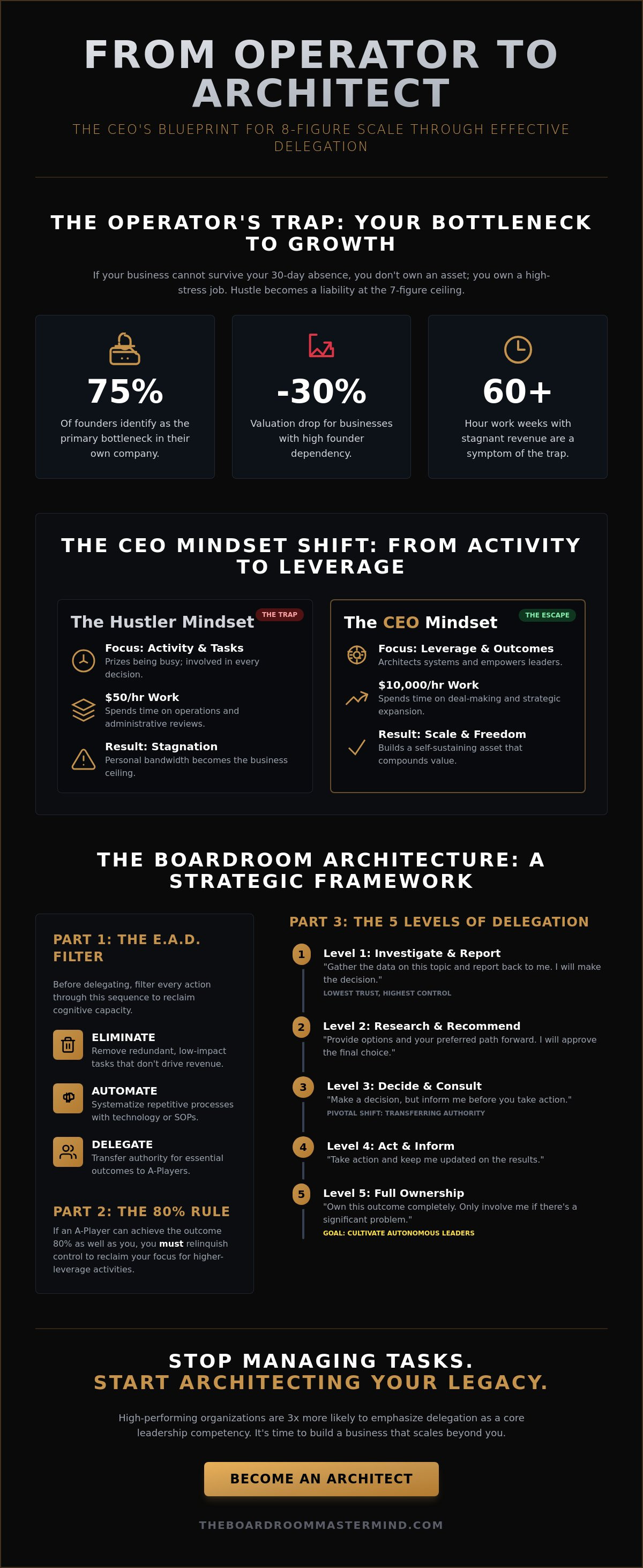
You hit a ceiling at the seven-figure mark because your hustle is no longer an asset. It's a liability. This is the Operator’s Trap. When every decision flows through you, growth stops at the limit of your personal bandwidth. Realizing what is delegation actually entails is the first step toward the eight-figure transition. Effective delegation for leaders isn't about offloading chores; it's about reclaiming your cognitive capacity for high-value architecture. If you're still the primary engine of your business, you haven't built a company; you've built a high-stress job with expensive overhead.
The math of scaling is unforgiving. Every hour you spend reviewing $50/hr administrative tasks is an hour stolen from $10,000/hr deal-making or strategic expansion. The Hustler mindset prizes activity; the CEO mindset prizes leverage. If your calendar is a graveyard of low-impact meetings, your business valuation is suffering. Common symptoms include a 60-hour work week with stagnant revenue and a team that waits for your permission before taking a single step. You're the bottleneck, and until you change, the business stays small.
The Myth of the Indispensable Founder
Believing no one can do it as well as you is a confession of systemic failure. It means you haven't built a process; you've built a cult of personality. Investors discount businesses where the founder is the primary engine. In a 2023 analysis of mid-market exits, companies with high founder dependency saw valuations drop by 30% or more. Indispensability is a cage that prevents your exit and limits your legacy.
Calculating the ROI of Your Time
Audit your last 30 days. Categorize every task by its potential revenue impact. If 85% of your time is spent on operations rather than innovation, you're hemorrhaging capital. Time Leverage is the ratio of business growth to founder hours invested. Master this, and the path to an eight-figure legacy becomes a matter of engineering rather than effort. You can explore how elite peers handle this transition through the Boardroom experience. Effective delegation for leaders requires moving from the center of the wheel to the architect of the machine.
The Boardroom Architecture: A Strategic Framework for Effective Delegation
Scalability dies in the friction of micromanagement. To reach an 8-figure valuation, your role must shift from chief problem solver to chief architect. Effective delegation for leaders requires a fundamental shift from managing tasks to architecting outcomes. Before you hire your next executive, you must filter every action through the EAD framework. You eliminate the redundant, automate the repetitive, and only then delegate the essential. Research from the Institute for Corporate Productivity shows that high-performing organizations are 3 times more likely to emphasize delegation as a core leadership competency than their lower-performing peers.
You aren't just offloading work; you're transferring authority. Most founders fail because they transfer the labor but retain the decision-making power. This creates a bottleneck that stifles growth. The 80% Rule dictates that if an A-player can complete a task 80% as well as you, you must relinquish control. That 20% gap is the investment you pay for your own freedom and the ability to focus on high-leverage strategy. If you're ready to see how this framework transforms operations, explore our recent case studies of 8-figure transitions.
Task-Level vs. Outcome-Level Delegation
Task-level delegation is a trap that leads to burnout. It requires constant supervision and turns your team into order-takers. Outcome-level delegation creates autonomous leaders. Instead of providing a checklist, you define the desired result and the constraints. This is the essence of effective delegation for leaders: building a system where your team owns the "how" while you maintain the "why." When you delegate the outcome, you empower your inner circle to innovate and execute without your constant presence.
The 5 Levels of Delegation for High-Growth Leaders
Trust isn't a binary switch; it's a ladder. You move team members through five distinct stages to ensure precision without sacrificing speed:
- Level 1: Investigate and report. The team member gathers data, but you decide.
- Level 2: Research and recommend. They provide options and a preferred path.
- Level 3: Decide and consult. They make the choice but check in before acting.
- Level 4: Action and notify. They execute and inform you of the results.
- Level 5: Full autonomy. They own the outcome entirely.
Graduating an employee to Level 5 is the only way to build a business that functions as a predictable asset rather than a demanding job.
Building Your A-Player Leadership Team: Who to Entrust with Your Empire
Scaling to 8 figures requires a fundamental shift in perspective. You're no longer looking for assistants to follow orders; you're recruiting experts to own outcomes. This is the "Who, Not How" philosophy in action. Successful effective delegation for leaders depends entirely on the caliber of the individuals in your inner circle. If you're still answering technical questions about property acquisitions or marketing funnels, you haven't delegated; you've merely outsourced your stress.
In a founder-led real estate business, the most critical hire is often the Integrator or COO. This individual serves as the bridge between your high-level vision and daily execution. They manage the "How" so you can focus on the "Where next." A-Players don't need hand-holding. They bring ownership, operate with high velocity, and maintain absolute strategic alignment with your legacy goals. Surround yourself with people who make you the least intelligent person in the room regarding their specific department.
- Ownership: They treat the department budget and KPIs as if it were their own capital.
- Speed: They prioritize rapid execution over perfectionist stalling.
- Strategic Alignment: Every move they make supports the 10-year vision.
Hiring for the Gap, Not the Task
Elite scaling happens when you stop hiring for tasks and start hiring to fill strategic gaps. Identify the specific seat on the bus that, once filled, removes the primary bottleneck to your next $10M in revenue. Whether it's a Director of Operations or a Head of Capital Markets, these roles should be profit centers, not overhead. To see how top-tier founders structure these high-level hires, explore The Boardroom Mastermind Experience.
The Feedback Loop: Maintaining Excellence Without Micromanaging
True freedom comes from "management by exception." You don't need to be in every meeting if you have robust KPIs and scorecards in place. Quarterly business audits ensure your leadership team remains aligned with the visionary’s trajectory. This system allows you to spot 5% deviations before they become 50% disasters. When your team owns the metrics, you own the empire. Effective delegation for leaders is about building a machine that runs better when you aren't in the room.
Ready to build your high-performance executive suite? Join the inner circle and master the frameworks used by 9-figure founders to achieve unrivaled scale.
Implementing the Business Operating System: From Operator to Visionary Owner
The transition from operator to owner is the single most critical evolution in the life of a high-growth entrepreneur. Most CEOs remain trapped in the "Operator's Loop," where growth is capped by their personal bandwidth. By establishing a robust business operating system, you shift your focus from working in the business to working on it. This shift isn't a luxury; it's a strategic necessity for those targeting 8-figure and 9-figure exits. Real, effective delegation for leaders serves as the foundation for this transition. It transforms your company from a job you own into a scalable asset that compounds value without your constant intervention.
When you master this system, you unlock the capacity for "Legacy Plays." These are the institutional-scale deals and market-moving partnerships that require 100% of your cognitive energy. If you're bogged down in tactical execution, you'll miss the 40% growth opportunities that only appear when the CEO's vision is clear. You aren't just offloading tasks. You're buying back your time to architect the future.
The Power of Proximity and Peer Accountability
Elite performance is rarely achieved in isolation. To perfect your systems, you need a "Boardroom" of peers who have already navigated the complexities of scaling past the initial 7-figure mark. This collective intelligence acts as your unfair advantage, providing the validation and pressure needed to refine your strategies. You can explore how this environment breaks through growth barriers in The 7-Figure Ceiling: A CEO Guide to Exclusive Mastermind Groups. High-level peer accountability ensures your systems are battle-tested before they're deployed.
Next Steps: Auditing Your Leadership Capacity
Start your leadership audit today by identifying the bottom 80% of your current activities. If a task doesn't directly contribute to high-level strategy or 9-figure legacy building, it must be delegated or eliminated. Real growth happens when you stop being the bottleneck. Effective delegation for leaders requires a ruthless commitment to your highest and best use. It's time to move toward a model where your business works for you. Take the final step in your evolution and apply to join The Boardroom Mastermind to secure your seat at the table.
Architect Your Exit From the Day-to-Day
Scaling to 8 figures requires more than just harder work; it demands a total shift in your operational architecture. You've seen how the 7-figure ceiling is built on the back of the founder who refuses to let go. By implementing a robust Business Operating System and identifying the A-players who can own your outcomes, you transition from a frantic operator to a strategic visionary. Effective delegation for leaders isn't just a management tactic. It's the only way to protect your time while compounding your impact.
True scale is achieved through collective intelligence and proven frameworks. Members of our inner circle gain direct access to a network of 8 and 9-figure real estate investors who have already solved the problems you're facing. Through quarterly in-person business audits and intensive strategic sessions, we provide the blueprint to move you from the front lines to the boardroom. Don't let your current success become your future cage. Your next level of growth is waiting for a leader who is ready to lead.
Scale your empire without the stress; Apply for The Boardroom Mastermind
The path to your legacy is ready for you to walk it.
Frequently Asked Questions
How do I know what I should delegate first as a CEO?
You must prioritize delegating tasks that fall below your hourly value threshold, typically anything generating less than $1,000 per hour for 8-figure CEOs. Audit your calendar using the 80/20 rule to identify administrative bottlenecks or technical execution that consumes your focus. If a task is repeatable and documented, it belongs on someone else's desk. This is the foundation of effective delegation for leaders who want to transition from operator to architect. Focus your energy exclusively on high-leverage strategy and deal-making.
What is the biggest mistake leaders make when delegating to a new team?
The biggest mistake is confusing delegation with total abdication. According to a 2023 Harvard Business Review study, 33% of managers are perceived as unable to delegate effectively because they provide zero guardrails. You can't just toss a project over the fence and hope for the best. You need a structured reporting cadence. Establish specific 30, 60, and 90-day benchmarks to ensure the team aligns with your vision before you step back completely.
How can I trust my team to make million-dollar decisions without my approval?
High-stakes trust is built through systemic alignment rather than gut feelings. Implement a decision matrix that grants autonomy based on specific risk levels. For instance, allow executives to authorize expenditures up to $50,000 without a signature, provided it aligns with the annual strategic plan. When your team understands the logic behind the goal, they can execute with the same precision you would. It's about building a collective intelligence that scales beyond your personal bandwidth.
Is it better to delegate to a virtual assistant or a high-level executive?
Choose your leverage based on the nature of the bottleneck. A virtual assistant handles the 40 hours of low-level coordination that clutters your week. Conversely, a high-level executive, such as a COO, owns the P&L and drives the 15% annual growth targets. Effective delegation for leaders requires knowing the difference between buying back time and buying back mental space. VAs manage your schedule; executives manage your legacy and protect your time for elite decision-making.
What happens if a delegated task fails or results in a loss?
Treat the failure as a diagnostic event to identify a breakdown in the system rather than a personal failing of the individual. Failure is data. If a delegated task results in a $10,000 loss, you must analyze whether the process was flawed or the talent was misapplied. A 2022 industry report suggests that 70% of execution failures stem from unclear expectations. Don't pull the task back. Instead, optimize the system and tighten the feedback loop to ensure the error never repeats.


