
Economic Forecasting for Real Estate: CEO Strategic Guide
Relying on trailing market data to steer an enterprise portfolio is financial malpractice. True economic forecasting for real estate investors isn't an academic exercise or a guessing game about the next Federal Reserve rate pivot. It's an active CEO discipline designed to insulate your capital and exploit structural inefficiencies across the cycle.
You already recognize the operational strain. Conflicting institutional forecasts stall major capital deployment, while mortgage rates near 7% and volatile debt costs tighten margins across existing assets. Looking backward only leaves your portfolio exposed to macro shocks.
It's time to take control of your macro assumptions. In this guide, you'll master how to interpret leading indicators, stress-test your portfolio against sustained downturns, and capitalize on shifting market cycles. We'll explore how to build an executive economic dashboard, underwrite recession-proof deals, and position your balance sheet to acquire prime distressed assets when competitors get forced out.
Key Takeaways
- Establish an executive-level dashboard to master economic forecasting for real estate investors, separating predictive macro drivers from lagging market reports.
- Identify why institutional quantitative models break during systemic shifts, and how ground-level lease concessions reveal market turns months in advance.
- Stress-test portfolio underwriting against severe macroeconomic shocks, modeling a 200-basis-point debt increase alongside expanded vacancy and rent contractions.
- Transition from tactical deal operator to portfolio CEO by utilizing high-level peer advisory to deploy capital into distressed assets when market cycles pivot.
What Is Economic Forecasting for Real Estate Investors?
At the executive tier, economic forecasting for real estate investors is not market speculation; it is an active risk-architecture system. Most operators rely on lagging market sentiment like trailing comp reports and historical transaction volume, effectively steering multi-million-dollar portfolios through a rear-view mirror. Mastering institutional real estate economics models predictive macroeconomic signals to project yield compression, asset performance, and debt liquidity before the broader market adjusts. Treating economic forecasting for real estate investors as an executive mandate shifts your strategy from reactive chasing to proactive, cycle-aware capital preservation.
Core Macroeconomic Indicators Every Real Estate CEO Must Track
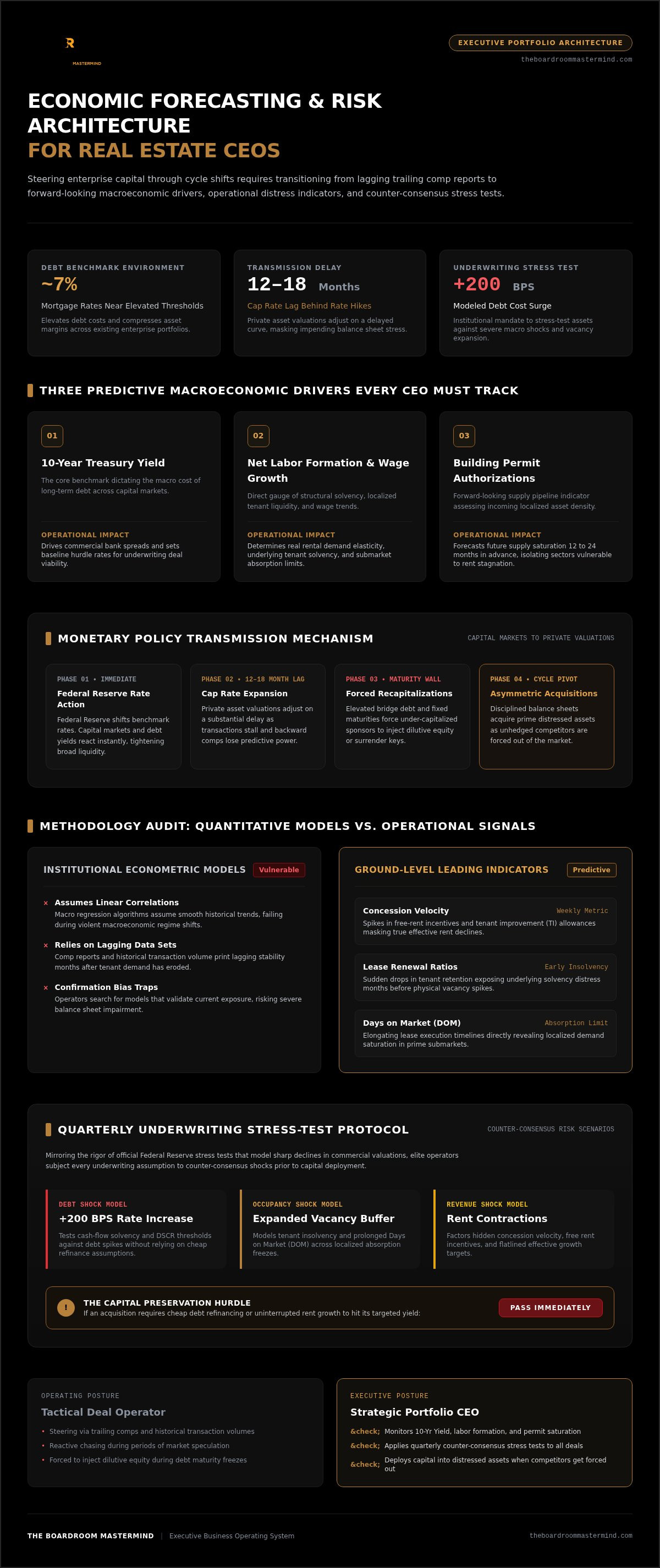
Executive clarity starts with cutting through noise and monitoring three primary forward-looking drivers:
- 10-Year Treasury Yield: Dictates the benchmark cost of long-term debt, driving commercial bank spreads and baseline underwriting hurdle rates.
- Net Labor Formation and Wage Growth: Determines real rental demand elasticity, tenant solvency, and absorption limits across specific submarkets.
- Building Permit Authorizations: Forecasts future supply saturation twelve to twenty-four months ahead, exposing sectors vulnerable to rent stagnation.
The Monetary Policy Transmission Mechanism to Property Values
When the Federal Reserve shifts its benchmark rate, capital markets respond immediately, but private asset valuations adjust on a delay. Expanding cap rates typically lag interest rate hikes by twelve to eighteen months. As commercial debt yields remain elevated, bridge debt and fixed maturities force under-capitalized sponsors to either inject dilutive equity or surrender keys. These debt maturity walls trigger forced recapitalizations, creating asymmetric acquisition opportunities for disciplined balance sheets.
Evaluating Forecasting Methodologies: Quantitative Models vs. Real-World Signals
Institutional econometric regressions look sophisticated on pitch decks, but they routinely break during violent macroeconomic regime shifts. Elite economic forecasting for real estate investors demands balancing broad macro models with unvarnished operational intelligence. Quantitative models assume linear historical correlations. Ground-level asset performance proves liquidity disruptions happen in sudden, non-linear breaks.
Econometric Modeling Versus Leading Operational Indicators
Macro algorithms miss the earliest signals of distress. While backward-looking data sets print lagging stability, operational metrics reveal deteriorating fundamentals months before transactions register price corrections. Track these boots-on-the-ground operational signals weekly:
- Concession Velocity: Spikes in free-rent incentives or tenant improvement allowances masking true effective rent declines.
- Lease Renewal Ratios: Sudden drops in retention exposing tenant insolvency before physical vacancy spikes.
- Days on Market (DOM): Elongating lease execution timelines signaling demand saturation in prime submarkets.
Eliminating Narrative and Confirmation Bias in Portfolio Strategy
Operators frequently hunt for macro projections that validate their current asset exposure. That confirmation bias destroys balance sheets. The official Federal Reserve stress test results specifically model severe economic downturns, including sharp declines in commercial asset valuations, to expose systemic institutional weaknesses. You must apply that same rigor to your balance sheet.
Implement an institutional business operating system that subjects every underwriting assumption to counter-consensus risk scenarios quarterly. If an acquisition requires cheap debt refinancing or uninterrupted rent growth to hit its targeted yield, pass immediately. Vetting operational assumptions alongside high-performing peers inside The Boardroom Mastermind ensures your capital deployment relies on stress-tested execution rather than market optimism.
How to Stress-Test Real Estate Underwriting Against Economic Shocks
Theoretical risk models won't keep your properties performing during a capital freeze. True economic forecasting for real estate investors turns macro forecasts into practical underwriting stress tests that protect investor capital. Static models rely on arbitrary 50-basis-point buffers. Professional execution requires running multi-variable scenario matrices that expose how leverage behaves under real market friction.
Designing Dynamic Sensitivity Models for Debt and Exit Cap Rates
Ditch linear models. Underwrite every acquisition against worst-case macroeconomic outcomes by executing these critical calculations:
- Model a 200-Basis-Point Debt Spike: Model your refinancing debt costs at least 200 basis points above prevailing market rates. If current debt sits at 7%, stress-test debt service at 9%.
- Run Dual-Shock Sensitivity Matrices: Test simultaneous vacancy expansion of 500 basis points alongside a severe 5% to 8% contraction in effective gross rents.
- Audit Stressed DSCR Floors: Recalculate your Debt Service Coverage Ratio under these compressed cash flows to confirm it maintains a minimum 1.25x buffer without requiring emergency cash injections.
Study the disciplined institutional capital mechanics in real estate private equity to match debt maturity structures directly to business plans, fully eliminating short-term refinancing vulnerability.
Capital Preservation and Operating Cash Flow Defense
Liquidity secures survival when market cycles pivot. Maintain dedicated operating reserves equal to at least six months of gross property expenses before committing equity to new acquisitions. Prioritize verifiable in-place cash yield over aggressive, speculative appreciation assumptions. Structure interest-rate hedges on floating liabilities to cap downside exposure completely.
Ready to upgrade your underwriting framework alongside eight- and nine-figure operators? Apply for The Boardroom Mastermind Membership to vet your capital structures alongside elite peers who scale through every market phase.
Executing Cycle-Tested Strategies: The Strategic Advisory Edge
Market dislocations create generational wealth for well-capitalized operators who move with conviction. Transitioning from a transactional dealmaker to an enterprise portfolio CEO requires disciplined macroeconomic cycle awareness. While mid-market competitors freeze during liquidity contractions, elite sponsors exploit market dislocations. Advanced economic forecasting for real estate investors is not about dodging cycles; it is about calibrating your balance sheet to seize prime assets at a discount when liquidity evaporates.
Strategic Asset Allocation Across Expanding and Contracting Cycles
Capital preservation dictates portfolio longevity. As macroeconomic cycles mature, adjust your capital allocation across three phases:
- Late-Cycle Realignment: Transition from high-leverage value-add acquisitions to cash-flowing defensive assets that generate dependable net operating income.
- Dry Powder Accumulation: Build liquidity reserves during peak market pricing, ignoring speculative bidding wars to ensure your balance sheet remains agile.
- Distressed Capital Deployment: Step into recapitalization vacuums when debt maturities force over-leveraged sponsors to liquidate institutional assets.
Calibrating Economic Strategy Inside The Boardroom Mastermind
Strategic isolation is the ultimate liability for an enterprise CEO. Academic white papers and third-party consultants provide theoretical models, but they don't deploy balance sheet capital or live with the downside consequences. Vetting underwriting models alongside peers who actively control multi-million-dollar portfolios exposes hidden operational blind spots before closing.
Understanding the benefits of a peer advisory group gives you access to real-time debt structures and institutional execution strategies from operators scaling seven, eight, and nine figures. Founded by veteran entrepreneur Kent Clothier, The Boardroom Mastermind provides quarterly in-person intensive strategy sessions and an elite accountability network. Sharpening your execution inside this closed door ensures your portfolio dominates every market phase.
Master the Macro Cycle and Command Your Market
Macroeconomic shifts don't destroy real estate enterprises; fragile capital structures do. Realizing the full potential of economic forecasting for real estate investors means replacing passive speculation with aggressive sensitivity stress-testing, defensive liquidity buffers, and disciplined cycle awareness. When you track forward-looking operational indicators and underwrite for severe debt volatility, market dislocations stop being existential threats and become your primary acquisition vehicles.
Navigating high-stakes market pivots shouldn't happen in executive isolation. Through quarterly closed-door strategy intensives nationwide, our curated network of 7-, 8-, and 9-figure real estate operators collaborates to audit underwriting assumptions, refine scalable operating systems, and deploy dry powder with precision.
Stop reacting to trailing market reports and start engineering your balance sheet for sustained competitive superiority. The next market shift will reward operators who prepare today. Apply for The Boardroom Mastermind and secure the strategic peer advisory needed to dominate every phase of the cycle.
Frequently Asked Questions
How do real estate investors use economic forecasting in daily acquisitions?
Real estate CEOs apply economic forecasting directly to acquisition hurdles by adjusting debt spreads, exit cap rates, and rent-growth ceilings before underwriting deals. Instead of using standard market averages, disciplined operators evaluate macro liquidity and debt capital availability in real time. This ensures every pipeline opportunity clears rigorous profitability thresholds even during aggressive economic downturns, preventing the deployment of investor equity into overvalued assets.
Which economic indicators provide the most reliable signals for property markets?
The most predictive macroeconomic signals are the 10-Year Treasury yield, regional net job growth, and local building permit authorizations. For comprehensive economic forecasting for real estate investors, track these leading indicators over trailing transaction sales volume. The 10-Year Treasury yield drives borrowing rates, employment formation dictates tenant absorption capacity, and building permit trends show oncoming asset supply up to twenty-four months before deliveries hit.
Why do traditional econometric forecasts frequently miss real estate cycle turning points?
Traditional econometric models rely on historical regression equations that assume linear market behaviors, failing entirely when financial regimes rapidly shift. These institutional forecasts miss boots-on-the-ground inflection points like rising tenant concessions, slowing collections, and declining lease renewal rates. By the time broad institutional reports confirm a market contraction, property valuations have already dropped and over-leveraged sponsors are trapped facing sudden capital calls.
How should real estate operators stress-test their portfolios against rising interest rates?
Operators stress-test debt resilience by modeling refinancing rates at 200 basis points above prevailing terms while simulating simultaneous gross rent drops. Effective economic forecasting for real estate investors requires auditing whether debt service coverage ratios remain safely above 1.25x under depressed net operating income. Maintaining six months of gross operating expense reserves ensures your properties withstand extended capital market disruptions without diluting equity or risking foreclosure.
What role does peer advisory play in navigating macroeconomic market volatility?
High-level peer advisory eliminates executive isolation by providing real-time operational data from active portfolio operators across national markets. Reviewing macroeconomic assumptions alongside experienced 7- to 9-figure peers inside networks like The Boardroom Mastermind reveals emerging debt trends and structural vulnerabilities before they impact your balance sheet. This collaborative vetting gives enterprise CEOs the calculated confidence to preserve liquidity and acquire distressed assets decisively.

Disclaimer
Mr. Clothier is an expert in real estate investing. As such his experiences are not necessarily typical to the standard real estate investor and whose results may vary. The successes shared on this site are not considered typical. Most individuals who order the educational materials and systems probably do not follow any of the techniques or strategies and consequently make little to no money due to their inaction. The company is in the process of determining the typical success of its clients. Stories shared herein are for example purpose only and should not be construed as "guarantees" of success. Results will vary based on background, education, and experience and actions taken.
This site is not a part of the Google/Facebook website or Google/Facebook Inc. Additionally, this site is NOT endorsed by or affiliated with Google/Facebook in any way. GOOGLE/FACEBOOK is a trademark of GOOGLE/FACEBOOK, Inc.
INCOME DISCLAIMER: This website and the items it distributes contain business strategies, marketing methods and other business advice that, regardless of referenced results and experience, may not produce the same results (or any results) for you. The Boardroom Mastermind makes absolutely no guarantee, expressed or implied, that by following the advice or content available from this web site you will make any money or improve current profits, as there are several factors and variables that come into play regarding any given business. Primarily, results will depend on the nature of the product or business model, the conditions of the marketplace, the experience of the individual, and situations and elements that are beyond your control. As with any business endeavor, you assume all risk related to investment and money based on your own discretion and at your own potential expense.
LIABILITY DISCLAIMER: By reading this website or the documents it offers, you assume all risks associated with using the advice given, with a full understanding that you, solely, are responsible for anything that may occur as a result of putting this information into action in any way, and regardless of your interpretation of the advice. You further agree that The Boardroom Mastermind, its affiliates, subsidiaries, officers and agents, cannot be held responsible in any way for the success or failure of your business as a result of the information provided. It is your responsibility to conduct your own due diligence regarding the safe and successful operation of your business. In summary, you understand that we make absolutely no guarantees regarding income as a result of applying this information, as well as the fact that you are solely responsible for the results of any action taken on your part as a result of any given information. In addition, you agree that our content is to be considered "for entertainment purposes only". Always seek the advice of a professional when making legal, financial, tax, or business decisions.
BUSINESS OPPORTUNITY: All products and services offered by The Boardroom Mastermind are intended to provide prospective purchasers with general business strategies, marketing methods and other general advice for business development and training. At no point is The Boardroom Mastermind soliciting anyone to enter into a new business nor is it representing, either expressly or by implication, that it will provide locations for a business, provide outlets, accounts, or customers, or purchase any of the goods or services made by the purchaser.
The products being offered through this promotion are packages of informational tools to help you learn about business and deal making strategies.


