
Due Diligence Checklist for Large Property Portfolios: The 2026 Institutional Blueprint
Aggregate sampling works for small-scale syndicators, but it destroys enterprise balance sheets on eight-figure acquisitions. You already know that seller-reported pro formas routinely mask deferred maintenance, skewed rent rolls, and municipal zoning blind spots across scattered sites. In a disciplined lending environment where institutions enforce strict 1.25x DSCR thresholds, casual underwriting creates catastrophic operational drag. Executing an exhaustive due diligence checklist for large property portfolios isn't routine administrative paperwork; it is an enterprise CEO's primary risk-containment asset.
This institutional blueprint equips you to master the comprehensive portfolio due diligence checklist elite real estate operators use to protect capital and underwrite 8-figure acquisitions. You'll discover how to systematically audit physical plant conditions across scattered sites to eliminate post-closing CapEx surprises, validate defensible underwriting down to individual lease covenants, and engineer a seamless operational handoff into your existing property management infrastructure. Here is the operational framework required to scale institutional assets with complete clarity.
Key Takeaways
- Deploy forensic lease-by-lease verification standards and 36-month historical financials to expose skewed seller numbers before capital is committed.
- Implement synchronized, standardized engineering assessments across every scattered parcel to eliminate post-closing deferred maintenance and budget shocks.
- Uncover hidden zoning liabilities, cross-collateralization traps, and restrictive covenants by deploying an institutional due diligence checklist for large property portfolios.
- Stress-test acquisition underwriting against shifting debt costs while architecting a day-one operational roadmap for seamless portfolio management integration.
Financial and Operational Due Diligence: Auditing Portfolio Performance
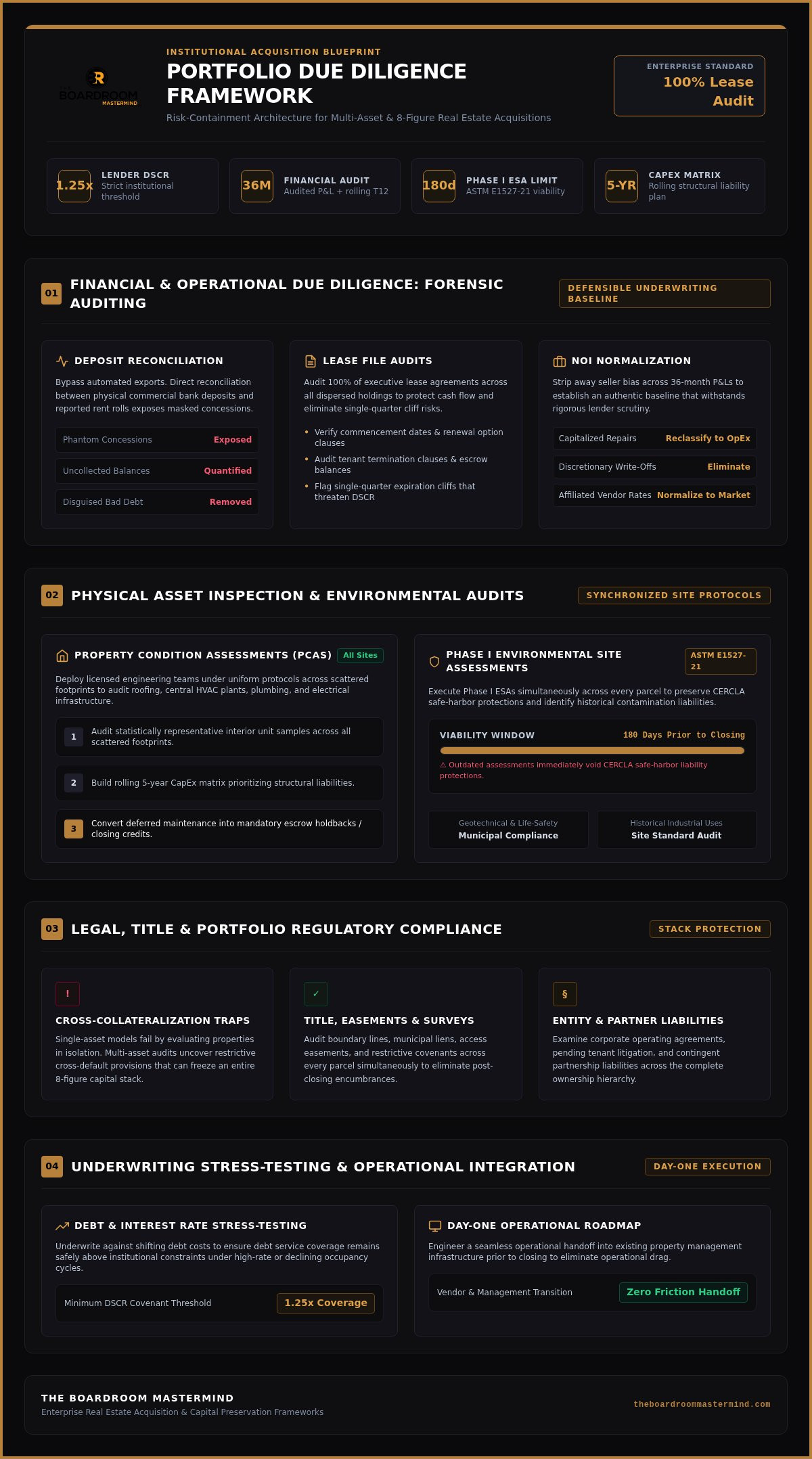
Generic checklists collapse when scaling across multi-asset transactions. Relying on seller-provided summary spreadsheets across twenty dispersed assets isn't strategy; it's negligence. Institutional underwriting demands enforcing foundational due diligence principles across every property simultaneously. Secure 36 months of audited operating statements alongside rolling trailing-twelve-month (T12) figures. Never rely purely on automated accounting exports. You must reconcile collections directly against physical commercial bank deposits to expose phantom concessions, uncollected balances, and disguised bad debt.
Rent Roll Reconciliation and Lease File Audits
A rigorous due diligence checklist for large property portfolios requires auditing 100% of executive lease agreements. Verify commencement dates, renewal options, tenant termination clauses, and security deposit escrows against current ledger balances. Identify expiration cliffs immediately. Concentrated lease expirations inside a single quarter threaten debt coverage and destabilize cash flow predictability. Direct reconciliation between tenant payments and operating accounts exposes delinquency trends that automated deal-screening tools routinely overlook.
Expense Audits and Historical Net Operating Income Normalization
Uncovering authentic Net Operating Income (NOI) means stripping away seller bias. Normalize historical financials by reclassifying capitalized operational repairs, removing discretionary personal write-offs, and adjusting for below-market affiliated vendor services. Scrutinize utility billing variances, municipal tax assessments, and recurring maintenance tickets across all parcels. Enterprise operators evaluate master service agreements and portfolio-wide vendor contracts to establish defensible baselines that withstand rigorous lender underwriting.
Physical Asset Inspection: Portfolio-Wide Site and Environmental Assessment
Synchronized execution separates institutional operators from reactive syndicators. When acquiring multi-asset holdings, deploying independent local inspectors ad hoc creates catastrophic blind spots. An actionable due diligence checklist for large property portfolios coordinates licensed engineering teams to inspect all sites under a uniform protocol, turning physical discoveries into immediate purchase price adjustments.
Property Condition Assessments and Immediate Capital Expenditure Scopes
Commission Property Condition Assessments (PCAs) across every site to audit roofing envelopes, central HVAC plants, plumbing systems, and electrical infrastructure. Replace superficial walkthroughs with deep technical scoping:
- Audit statistically representative interior samples across scattered footprints.
- Build a rolling 5-year capital expenditure matrix prioritizing immediate structural liabilities.
- Convert identified deferred maintenance into mandatory escrow holdbacks or definitive closing credits.
Environmental Screening and Specialized Technical Audits
Order Phase I Environmental Site Assessments (ESAs) under active ASTM E1527-21 standards simultaneously across every parcel. Reports carry a strict 180-day viability window prior to closing; outdated assessments void Comprehensive Environmental Response, Compensation, and Liability Act (CERCLA) safe-harbor protections. Where historical industrial uses surface, cross-reference municipal compliance against current site assessment standards, geotechnical data, and life-safety codes. Mastering these physical audits is standard practice among top-tier operators inside The Boardroom Mastermind, where rigorous capital preservation drives every acquisition decision.
Legal, Title, and Regulatory Compliance Across Multi-Asset Holdings
Legal entanglements multiply exponentially across multi-property acquisitions. A single overlooked municipal lien or restrictive cross-collateralization clause can freeze an entire eight-figure capital stack. Single-asset checklists collapse here because they treat individual holdings in a vacuum. Institutional risk mitigation requires auditing corporate operating agreements, pending tenant litigation, and contingent partnership liabilities across the entire ownership structure simultaneously.
Title Commitments, Easements, and Survey Boundary Analysis
Deploying an institutional due diligence checklist for large property portfolios requires pulling underlying exception documents on every parcel. Never accept standard schedule B exceptions at face value. Ensure updated ALTA boundary surveys match recorded legal descriptions, confirm access rights, and verify zero structural encroachments. Scrutinize legacy lender covenants, blanket liens, and subordinate debt instruments across the balance sheet. If a property carries clouded title or mechanic liens, mandate that the seller cures or bonds off the defect prior to closing escrow.
Municipal Zoning and Regulatory Compliance Verification
Demand formal municipal zoning verification letters to establish that each asset maintains legal conforming status. If any property operates under a legal non-conforming designation, analyze local rebuild provisions immediately. Municipal ordinances frequently revoke grandfathered rights if casualty damage exceeds 50%, putting your equity at risk. Concurrently audit unclosed building permits, pending code citations, and municipal rent registry mandates across all jurisdictions. To audit complex portfolio structures alongside seasoned enterprise operators, apply for The Boardroom Mastermind membership.
Underwriting Stress-Testing and Post-Acquisition Operational Roadmaps
Due diligence doesn't conclude when the inspection contingency clears. Institutional CEOs realize that static spreadsheets fail the moment macro conditions shift. In a lending environment where lenders enforce 1.25x debt service coverage ratio (DSCR) minimums on multifamily and 1.30x to 1.40x on commercial assets alongside 7% to 10% debt yields, your acquisition model must withstand severe downside pressure before closing escrow.
Capital Stack Sensitivity and Debt Covenant Underwriting
An institutional due diligence checklist for large property portfolios stress-tests financial performance against rising debt costs and contracting yields. Run clear sensitivity matrices:
- Model DSCR under 15% revenue compression and 20% operational expense expansion.
- Stress-test SOFR benchmark fluctuations, variable borrowing spreads, and upcoming refinancing cliffs.
- Audit existing financing for severe prepayment penalties, yield maintenance, or cumbersome assumption provisions.
The 90-Day Transition Blueprint and Operational Infrastructure
Static audit reports mean nothing without a dynamic operational handoff. Execute a structured 90-day onboarding plan that maps property management software migrations to preserve tenant payment continuity from day one. Audit inherited property staff immediately, retender vendor contracts, and deploy clear performance scorecards. Enterprise operators apply elite systems to scale multi-property acquisitions with predictable precision. Discover how top portfolio operators execute institutional standards by joining The Boardroom Mastermind.
Institutionalize Your Acquisition Protocol for Enterprise Scale
Acquiring multi-property assets demands moving beyond tactical hustle into enterprise risk architecture. A battle-tested due diligence checklist for large property portfolios safeguards your balance sheet by replacing aggregate sampling with forensic cash flow verification, synchronized technical inspections, and seamless post-closing operational roadmaps. When you systematically audit individual lease covenants and stress-test underwriting against severe debt shifts, acquisition volatility transforms into predictable enterprise yield.
Executing high-stakes transactions doesn't require underwriting in isolation. Tap into a vetted national network of 7, 8, and 9-figure operators closing institutional-scale transactions. Through confidential peer reviews of complex portfolios and quarterly national intensives delivering advanced enterprise scaling strategies, you gain the elite systems needed to expand your holdings. Scale your acquisitions with the nation's top real estate leaders at The Boardroom Mastermind and secure your portfolio with total operational certainty.
Frequently Asked Questions
How long does a thorough due diligence process take for a large property portfolio?
A thorough portfolio review typically spans 45 to 60 days, expanding to 90 days for complex multi-entity transactions or acquisitions requiring regulatory antitrust reviews. Single-asset syndications often rush through inspections in 30 days, but multi-site transactions require concurrent engineering, title examinations across jurisdictions, and extensive lease file matching. Compressing this timeline without institutional systems risks inheriting major unhedged liabilities across your capital stack.
What is the biggest operational blind spot when evaluating multi-asset portfolios?
The biggest blind spot is assuming operational uniformity across scattered management platforms. Sellers often mask localized operational inefficiencies through aggregate accounting that obscures poorly performing individual properties. Deploying an institutional due diligence checklist for large property portfolios exposes operational variances in vendor pricing, utility allocations, and localized delinquency rates. Evaluating every asset individually prevents inheriting fragmented management infrastructure that erodes enterprise cash flow.
How should an acquisition team handle deferred maintenance across scattered property sites?
Acquisition teams must standardize engineering assessments rather than relying on disparate local reports. Aggregate all immediate and five-year projected capital needs into a unified capital expenditure schedule. Quantify the exact financial impact of physical deficiencies, then use documented mechanical and structural findings to negotiate direct contract purchase price reductions or formal seller-funded escrow holdbacks before waiving your inspection contingencies.
Why is rent roll verification against physical bank records critical in portfolio due diligence?
Auditing lease ledgers directly against physical commercial bank deposits is the only reliable way to uncover uncollected receivables and disguised tenant concessions. Sellers frequently present pro forma rent rolls that inflate economic occupancy by hiding free-rent agreements, delinquent balances, or related-party leases. Reconciling deposits ensures your due diligence checklist for large property portfolios establishes a verified net operating income baseline that satisfies strict institutional underwriting requirements.
What environmental assessments are mandatory when acquiring a commercial or multifamily portfolio?
Every parcel requires an ASTM E1527-21 compliant Phase I Environmental Site Assessment to secure CERCLA liability protection. To remain legally valid for closing, these reports must be conducted within 180 days of the acquisition date. If a Phase I identifies recognized environmental conditions from historical activities or adjacent properties, immediately commission specialized Phase II subsurface testing to quantify liabilities before finalizing loan commitments.

Disclaimer
Mr. Clothier is an expert in real estate investing. As such his experiences are not necessarily typical to the standard real estate investor and whose results may vary. The successes shared on this site are not considered typical. Most individuals who order the educational materials and systems probably do not follow any of the techniques or strategies and consequently make little to no money due to their inaction. The company is in the process of determining the typical success of its clients. Stories shared herein are for example purpose only and should not be construed as "guarantees" of success. Results will vary based on background, education, and experience and actions taken.
This site is not a part of the Google/Facebook website or Google/Facebook Inc. Additionally, this site is NOT endorsed by or affiliated with Google/Facebook in any way. GOOGLE/FACEBOOK is a trademark of GOOGLE/FACEBOOK, Inc.
INCOME DISCLAIMER: This website and the items it distributes contain business strategies, marketing methods and other business advice that, regardless of referenced results and experience, may not produce the same results (or any results) for you. The Boardroom Mastermind makes absolutely no guarantee, expressed or implied, that by following the advice or content available from this web site you will make any money or improve current profits, as there are several factors and variables that come into play regarding any given business. Primarily, results will depend on the nature of the product or business model, the conditions of the marketplace, the experience of the individual, and situations and elements that are beyond your control. As with any business endeavor, you assume all risk related to investment and money based on your own discretion and at your own potential expense.
LIABILITY DISCLAIMER: By reading this website or the documents it offers, you assume all risks associated with using the advice given, with a full understanding that you, solely, are responsible for anything that may occur as a result of putting this information into action in any way, and regardless of your interpretation of the advice. You further agree that The Boardroom Mastermind, its affiliates, subsidiaries, officers and agents, cannot be held responsible in any way for the success or failure of your business as a result of the information provided. It is your responsibility to conduct your own due diligence regarding the safe and successful operation of your business. In summary, you understand that we make absolutely no guarantees regarding income as a result of applying this information, as well as the fact that you are solely responsible for the results of any action taken on your part as a result of any given information. In addition, you agree that our content is to be considered "for entertainment purposes only". Always seek the advice of a professional when making legal, financial, tax, or business decisions.
BUSINESS OPPORTUNITY: All products and services offered by The Boardroom Mastermind are intended to provide prospective purchasers with general business strategies, marketing methods and other general advice for business development and training. At no point is The Boardroom Mastermind soliciting anyone to enter into a new business nor is it representing, either expressly or by implication, that it will provide locations for a business, provide outlets, accounts, or customers, or purchase any of the goods or services made by the purchaser.
The products being offered through this promotion are packages of informational tools to help you learn about business and deal making strategies.


