
Creating a Real Estate Investment Committee: The CEO’s Blueprint for Institutional Scale
Your personal "gut feeling" is the greatest liability in your firm's quest for eight-figure scale. While your intuition built the foundation, it's now the very bottleneck preventing your transition from a high-stakes operator to a true strategic CEO. Creating a real estate investment committee isn't about adding a layer of bureaucracy; it's about institutionalizing your expertise into a repeatable, high-performance engine. You've likely felt the weight of being the sole arbiter of every acquisition, and you know the silent fear that a single catastrophic deal error could erase years of progress.
It's time to move beyond the tactical weeds and step into a role of strategic oversight. You'll learn how to decentralize deal-making and build a committee that functions with the precision of a top-tier institution. We'll examine the specific architecture required to standardize your evaluation criteria, ensuring your firm maintains institutional-grade credibility for future capital raises. This is your blueprint for transitioning from the person who does the deals to the leader who owns the system.
Key Takeaways
- Break the CEO bottleneck by shifting from personal deal approval to a formal system of institutional governance and capital allocation.
- Master the architecture of creating a real estate investment committee by defining core roles that balance acquisition ambition with rigorous risk management.
- Replace "gut instinct" with standardized investment memos designed to provide the clarity and depth required for eight-figure scale.
- Elevate your firm’s credibility with capital partners by utilizing external seats and unbiased deal auditing to ensure objective decision-making.
- Reclaim your time for strategic oversight by transforming your committee into a leadership engine that develops top-tier talent.
The Institutional Shift: Why Creating a Real Estate Investment Committee is Mandatory for Scale
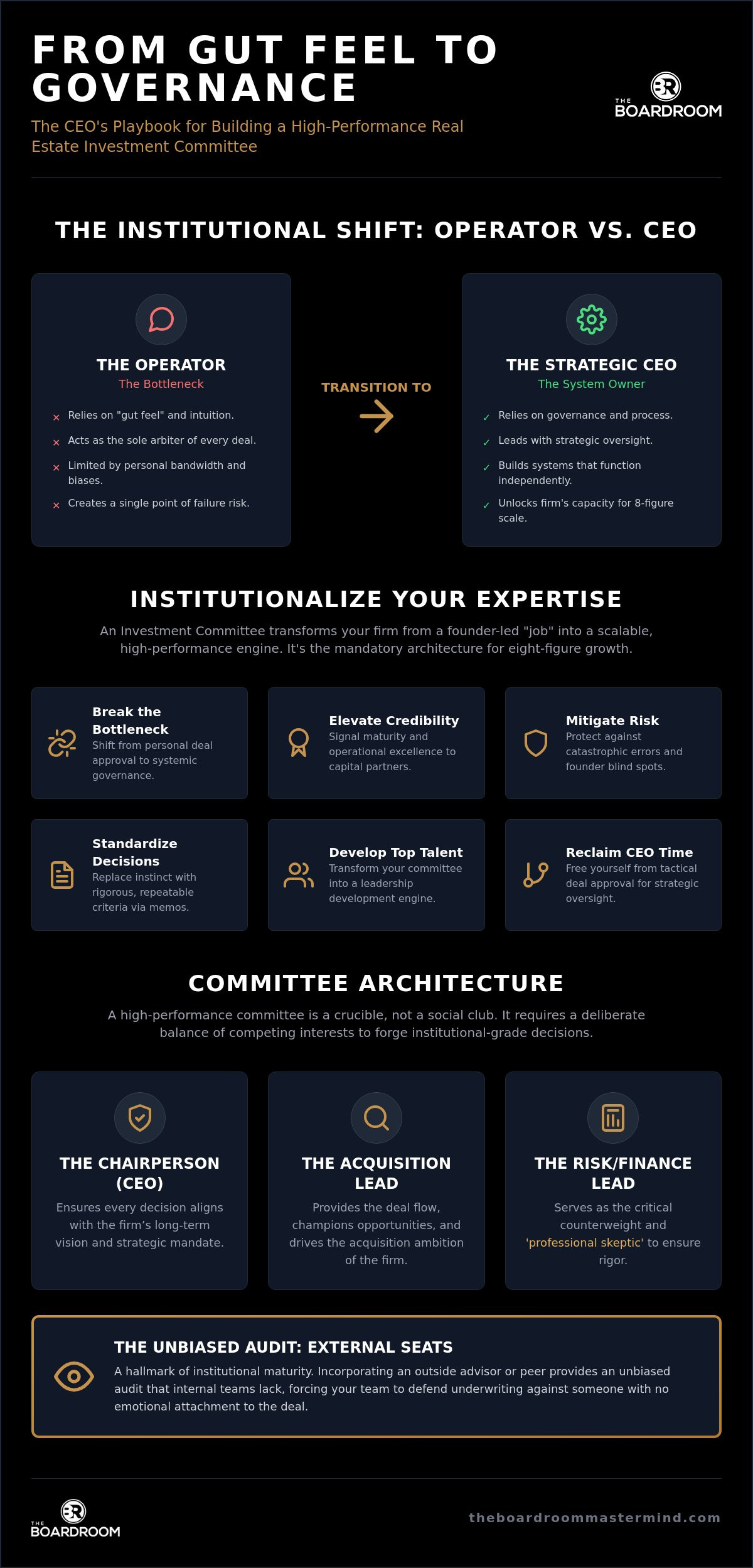
Scale requires a fundamental departure from the "hustler" mentality that got you here. In the early days, your speed and intuition were your greatest assets. Now, they're your primary constraints. An Investment Committee serves as the formal governing body responsible for reviewing and approving capital allocations. It ensures every dollar deployed aligns with a rigorous strategic mandate rather than a founder's whim. Without this structure, you're not running a firm; you're managing a job.
The CEO bottleneck is a silent killer of growth. If every deal must pass through your personal filter, your firm's capacity is limited by your bandwidth and your biases. Transitioning to a model of institutional standards means building a system that functions without your constant tactical intervention. Creating a real estate investment committee is the first step in decentralizing deal-making and protecting your company from the inherent risks of single-point failure.
To better understand the mechanics of this transition, watch this helpful briefing:
The Operator vs. CEO Decision-Making Model
Operators rely on "gut feel" to survive. CEOs rely on governance to thrive. This shift is essential for anyone pursuing autonomy and impact at the highest levels. By removing yourself as the sole arbiter, you force your team to defend their assumptions against a multi-perspective review process. This isn't just about vetting deals; it's about vetting the logic behind them. It protects the company from your own personal blind spots while elevating the performance of your entire leadership team.
Institutional Credibility for Capital Raising
High-level real estate private equity demands a commitment to fiduciary duty. When you approach family offices or institutional lenders, they aren't just betting on your personality. They're betting on your process. A formal committee signals maturity and operational excellence. It proves that your firm is built for permanence and can withstand the scrutiny of sophisticated partners. Creating a real estate investment committee provides the transparency and risk mitigation required to secure the capital needed for eight and nine-figure expansion.
Structuring Your Committee: Composition, Roles, and Governance
Creating a real estate investment committee requires a deliberate balance of competing interests. It's not a social club. It's a crucible. Your committee must consist of three primary pillars: the Chairperson, the Acquisition Lead, and the Risk/Finance Lead. The Chairperson, typically the CEO, ensures every decision aligns with the firm’s long-term vision. The Acquisition Lead provides the deal flow. The Risk Lead, often your CFO, provides the critical counterweight. This internal tension is by design. It ensures that no deal is approved purely on momentum or "gut feel."
Incorporating external seats is a hallmark of institutional maturity. Bringing in an outside advisor or a peer from an elite peer group provides an unbiased audit that internal teams often lack. This external perspective is a cornerstone of best practices for investment committees; it forces your team to defend their underwriting against someone with no emotional attachment to the transaction. When you are creating a real estate investment committee, you are building a defense mechanism against your own optimism.
Selecting Your A-Player Committee Members
Your committee needs a professional skeptic. If everyone in the room loves the deal, you haven't built a committee; you've built an echo chamber. A high-performance IC requires at least one member whose primary role is to find the reasons not to do the deal. This friction refines a mediocre opportunity into an institutional-grade acquisition. Effective leadership team development ensures these diverse perspectives are represented at every level of governance, protecting your capital and your reputation.
Meeting Cadence and Governance Standards
Momentum is a competitive advantage. Your committee should meet on a fixed weekly or bi-weekly cadence to ensure deal flow doesn't stagnate. Establish a clear "Deal Threshold"—a specific dollar amount or risk profile that triggers committee involvement. Anything below this threshold can be handled via delegated authority, while anything above requires a formal quorum. Whether you choose a unanimous or majority-rule voting structure, the goal is decisiveness. Indecision is a luxury your firm cannot afford as you scale toward nine figures.
The Anatomy of the Investment Committee Memo: Standardizing Deal Flow
The Investment Committee (IC) memo is the physical manifestation of your firm’s intellectual rigor. While most operators settle for a basic pro-forma, a CEO at scale demands a document that functions as a clinical audit. Creating a real estate investment committee requires a standardized template that eliminates ambiguity and highlights the "deal killers" before capital is at risk. This document is the primary tool for institutionalizing your standards, ensuring that every deal is judged on a level playing field rather than the varying enthusiasm of an acquisitions lead.
Every memo must lead with a strategic mandate. Why does this specific asset belong in your portfolio today? Institutional-grade market analysis goes beyond generic census data to provide deep-tier insights into submarket absorption, replacement costs, and localized supply constraints. Standardizing your financial modeling, specifically how you calculate terminal cap rates and sensitivity to interest rate fluctuations, ensures your committee makes decisions based on hard logic rather than optimistic projections.
Step-by-Step Guide to Creating the IC Memo
The process begins with the acquisitions team gathering granular data and verifying the sponsorship track record. This synthesis must be objective. Use the "5-minute rule" to ensure the executive summary provides a clear investment rationale, the capital stack, and the projected exit strategy. If you want to see how elite operators build these systems, you can apply for The Boardroom Mastermind Membership to audit our proprietary frameworks and decision-making templates.
The "Red Team" Review
A "Red Team" review is the ultimate stress-test for your projections. This phase requires your finance lead to challenge every assumption, from rent growth percentages to exit cap rates. Common mistakes like ignoring market cycles or underestimating CAPEX requirements are exposed here. By forcing your team to argue against their own deal, you ensure only the most resilient opportunities survive the committee process. This level of scrutiny is what separates institutional players from tactical operators.
From Tactical Approval to Strategic Oversight: Leading the Committee
Your evolution as a leader culminates in the transition from deal-maker to system-owner. The CEO’s primary responsibility is no longer the discovery of individual assets; it is the curation of the environment where those assets are vetted. Creating a real estate investment committee serves as the engine room of this transition. It integrates seamlessly into your broader Business Operating System, transforming your firm into a predictable, scalable enterprise that functions with institutional precision.
Success is measured by the "Track Record of Decisions," not just the "Track Record of Deals." Outcomes can be influenced by temporary market tailwinds, but the quality of your decision-making process is the only variable you truly control. Leading the committee requires you to step back. You must observe the team dynamic, identify logic gaps, and ensure that institutional standards are upheld without your direct intervention. This is how you build a firm that outlasts your personal involvement and commands the respect of high-level capital partners.
Maintaining High-Performance Accountability
Accountability is the bedrock of institutional scale. Use the committee as a training ground to hold your leadership team responsible for their underwriting and projections. A mandatory "Post-Mortem" process is essential for long-term growth. By reviewing past committee decisions against actual property performance, you refine your criteria and eliminate systemic biases. This feedback loop ensures your team isn't just making guesses; they're developing a refined, data-driven sense of risk and reward.
The Power of Proximity and Peer Review
Isolation is the enemy of excellence at the eight and nine-figure levels. Even with a robust internal committee, elite founders require external pressure to maintain their competitive edge. Seeking an external peer group provides an unbiased audit of your internal governance that you cannot achieve in a vacuum. For those operating at the highest tiers of financial success, The Boardroom Mastermind functions as the ultimate investment committee. It offers the proximity to high-achieving peers needed to stress-test your business model and ensure your trajectory remains both aggressive and sustainable.
Securing Your Path to Nine-Figure Dominance
Moving from the frantic energy of a tactical operator to the calculated oversight of a strategic CEO requires more than just better deals. It requires a superior system. By creating a real estate investment committee, you've established the governance necessary to decentralize decision-making and protect your firm from the inherent risks of personal bias. You've replaced the uncertainty of "gut feel" with the clinical precision of standardized memos and rigorous peer review. This institutional shift is the critical bridge to achieving the autonomy and impact you've already worked so hard to build.
If you're ready to audit your current business architecture alongside an exclusive network of 7, 8, and 9-figure investors, it's time to seek a higher tier of professional proximity. Our quarterly in-person intensives are designed specifically for battle-tested leaders committed to the Operator-to-CEO transition. You don't have to navigate the complexities of scale in isolation. The path to your next major financial milestone is the logical conclusion when you have the right systems and the right access.
Apply to Join The Boardroom Mastermind and Audit Your Business Architecture and finalize your blueprint for institutional growth today.
Frequently Asked Questions
What is the primary purpose of a real estate investment committee?
The primary purpose is to institutionalize your firm’s capital allocation process and mitigate the risk of individual bias. By creating a real estate investment committee, you move away from subjective instinct and toward a rigorous, data-driven audit of every potential acquisition. It ensures that every deal survives a multi-perspective review, protecting your firm’s capital and enhancing its credibility with institutional partners and family offices.
How many people should be on an investment committee for a mid-sized firm?
A mid-sized firm typically benefits from a committee of three to five core members. This size is large enough to provide diverse perspectives, such as risk management and acquisitions, while remaining small enough to maintain decisive momentum. Including an odd number of voters prevents deadlocks and ensures a clear path to approval. This structure allows for an external peer or advisor to provide an unbiased audit of your internal logic.
Does the CEO always have the final say in an investment committee?
No, the CEO should not always have the final say if the goal is true institutional scale. While you will likely act as the Chairperson, the committee’s strength lies in its collective veto power. If you retain absolute authority over every transaction, you remain the bottleneck. High-performance committees often use a majority or unanimous voting structure to ensure the system, not just the founder, validates the deal’s merits.
What is the difference between an investment committee and a board of directors?
An investment committee is a tactical body focused specifically on the vetting and approval of real estate assets and capital deployment. In contrast, a board of directors oversees the broader corporate strategy, governance, and long-term health of the entire company. While creating a real estate investment committee addresses deal-level risk, the board manages high-level fiduciary duties and executive accountability across all departments of your organization.
How often should an investment committee meet?
Consistency is the driver of deal flow momentum, so committees should ideally meet on a weekly or bi-weekly cadence. Fixed schedules prevent the urgent from crowding out the important and ensure that your acquisitions team has a predictable timeline for deal approval. If your deal volume is currently lower, a monthly session may suffice, but high-growth firms require a more frequent rhythm to stay competitive in fast-moving markets.


