
Collective Genius vs. The Boardroom: Choosing the Architecture for 8-Figure Scale
Most seven-figure real estate investors are actually just high-paid employees of their own chaos. You have reached a level of success that most only dream of, yet you find yourself trapped by the very systems you built to set you free. If your business requires your constant presence to function, you haven't built an empire; you've built a cage. Deciding between collective genius vs the boardroom is not merely a choice of networking groups. It is a fundamental decision about the future architecture of your wealth and your role within it.
You understand that what got you to seven figures will not get you to nine. You're looking for more than just another room full of people doing deals; you're looking for a peer group that demands a higher level of strategic oversight and operational excellence. This guide breaks down the critical differences between these two elite circles. We will explore how each group approaches the transition from operator to CEO. By the end, you'll know exactly which environment provides the high-level accountability and predictable growth systems necessary to scale your business into a self-sustaining asset.
Key Takeaways
- Learn why scaling beyond the seven-figure ceiling requires a total shift from being a high-paid operator to a strategic business architect.
- Analyze the operational differences in collective genius vs the boardroom to determine whether you need transaction volume or executive systems.
- Discover how the quarterly business audit serves as a critical mechanism for identifying bottlenecks and reclaiming your professional autonomy.
- Identify the specific "litmus test" questions that reveal which elite community aligns with your 2026 revenue and lifestyle targets.
Beyond the Hustle: The Landscape of High-Level Real Estate Masterminds
The evolution of the mastermind group concept has shifted from simple peer support to a rigorous engine for wealth architecture. For the seven-figure investor, the challenge isn't finding more deals; it's surviving the deals you already have. You've reached a point where tactical advice on lead generation is no longer the bottleneck. Instead, you face a structural deficit. The decision between collective genius vs the boardroom isn't just about which logo you prefer. It's a strategic choice about whether you want to optimize your current hustle or dismantle it to build a true enterprise.
To better understand the underlying power of high-level collaboration, watch this analysis:
Traditional coaching programs often fail at this stage because they focus on incremental improvements. They teach you how to run faster on the treadmill. Elite masterminds, however, focus on the treadmill's design. There is a fundamental difference between transactional networking, where you trade tips, and operational collaboration, where you audit the very foundations of your business. Your choice between collective genius vs the boardroom will dictate your operational reality for the next three years.
The Operator vs. CEO Dilemma
Many high-volume wholesalers find themselves trapped in a cycle of constant activity. You're doing dozens of deals a year, but your presence is required for every critical decision. More deals simply lead to more noise and less freedom. Breaking this cycle requires elite proximity. You need to be in a room where the standard isn't just your gross revenue, but your professional autonomy. Shifting your identity from a founder who does everything to an executive who oversees systems is the only way to reach eight or nine figures. This transition isn't about working harder; it's about the architecture of your oversight.
Analyzing the Collective Genius Model: The Power of High-Volume Networking
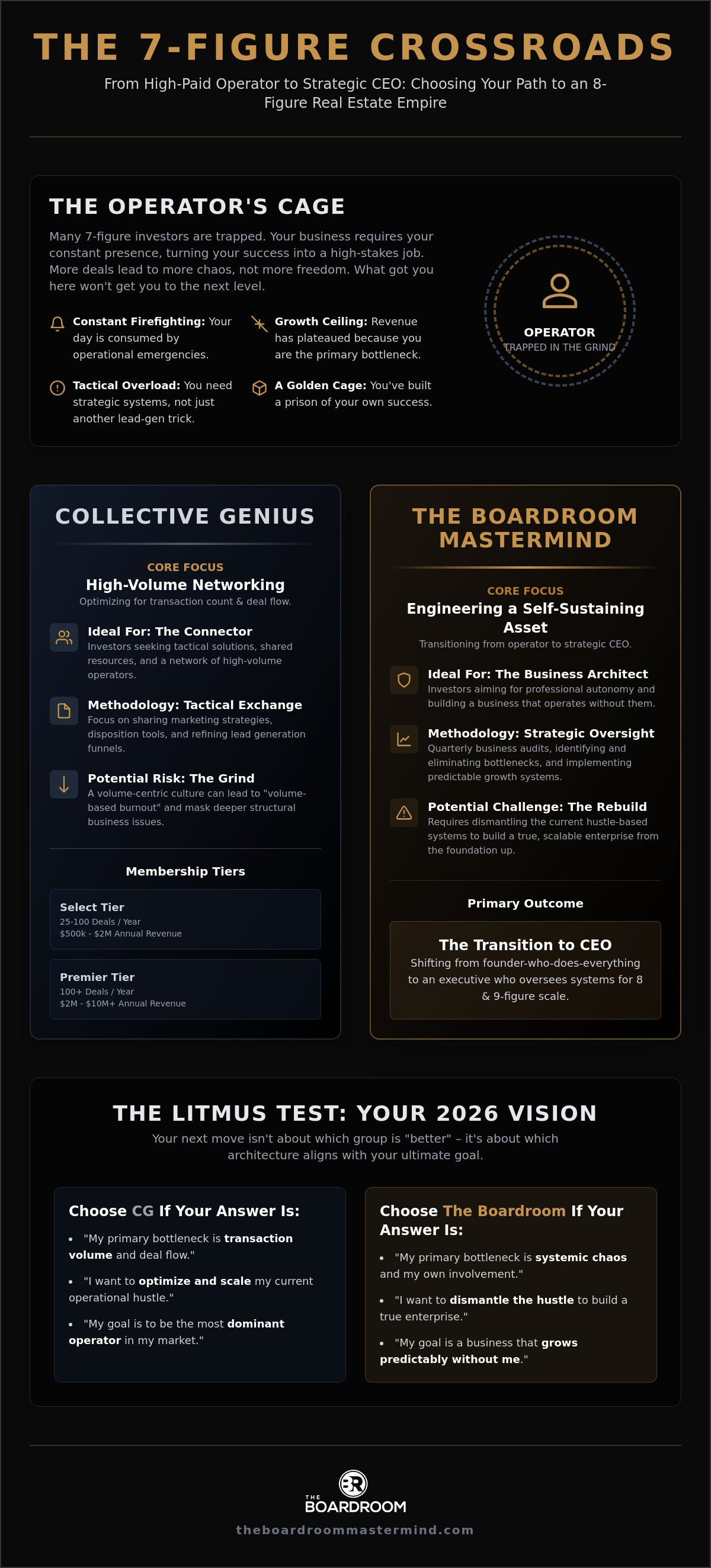
Collective Genius, spearheaded by Jason Medley, has long served as the central hub for high-volume real estate investors. It is a community built on the bedrock of the wholesale and fix-and-flip industries. The organization excels at fostering a "Giving/Receiving" culture where members exchange tactical secrets to maintain market dominance. When you weigh collective genius vs the boardroom, you're looking at a fundamental choice between optimizing for transaction count or optimizing for executive freedom. CG is the engine for those who want to move more dirt and close more doors.
The membership structure is strictly segmented to ensure elite proximity. For example, the "Select" tier targets investors with $500k to $2M in annual revenue or 25 to 100 deals. The "Premier" tier is reserved for those generating $2M to $10M+ or closing over 100 transactions annually. This creates a room full of active operators who understand the day-to-day friction of a high-growth real estate business. It's an environment designed for the "connector" who values shared resources and immediate tactical solutions.
The CG Philosophy: Giving to Get
The core of this community is a mindset that prioritizes contribution. Members are expected to bring their best marketing strategies and disposition tools to the table. The Power of Mastermind Groups is most evident here, as curated networking allows investors to bypass years of trial and error. It is a space where the most aggressive wholesalers in the country collaborate to crush operational bottlenecks and refine their lead generation funnels.
Potential Limitations for the Aspiring CEO
There is a inherent risk in a volume-centric peer group. When your primary metric of success is transaction count, you can easily fall into the "volume-based burnout" trap. High-intensity environments often celebrate the grind, which can mask structural weaknesses in your business architecture. If you're looking to stop being the engine of your business and start being the architect, you might find yourself seeking a more strategic peer group. Transactional dominance is a powerful tool, but it doesn't always translate to long-term sustainability or personal autonomy.
The Boardroom Mastermind: Engineering the Transition to 8-Figure Scale
While transaction volume provides the fuel, architecture provides the vehicle. The Boardroom Mastermind, led by Kent Clothier, is not a networking group; it's a strategic infrastructure designed for those ready to move from hustler to CEO. This community is built specifically for the transition to 8 and 9-figure operations. Restricted access is a core feature here. With a rejection rate of approximately 95% of applicants, the room is curated to ensure that every member is a peer, not a student. This level of exclusivity is backed by academic research on executive peer groups, which highlights how high-level collaboration accelerates professional maturity and strategic clarity.
When comparing collective genius vs the boardroom, the distinction lies in the outcome. One optimizes for the next deal; the other optimizes for the next decade. If you find yourself stuck at the 7-figure ceiling, you don't need more leads. You need a better business model.
The Quarterly Intensive: A Strategic Business Audit
The primary mechanism for growth within this group is the quarterly business audit. These in-person intensives focus on auditing your model rather than just sharing deal tips. By subjecting your operations to the scrutiny of 9-figure peers, you identify the bottlenecks that your own bias hides. This recurring collaboration prevents the stagnation common in high-growth environments. You can get a closer look at this process by exploring the Inside the Boardroom Experience.
Architecture Over Activity
Scaling requires a shift from tactical management to strategic oversight. This transition is facilitated by a proprietary Business Operating System. Instead of reacting to market shifts, members implement peer-vetted frameworks that make growth predictable. This architecture allows you to step away from the daily grind without the business collapsing. If you're ready to stop being the engine and start being the architect, apply to join The Boardroom Mastermind and secure your place among the elite.
The ROI of Proximity: How to Choose Your Elite Circle in 2026
Choosing between collective genius vs the boardroom requires an objective analysis of your current operational capacity and your ultimate exit strategy. It is a binary decision. You are either optimizing for a higher volume of transactions or you are optimizing for a higher quality of life through institutional architecture. The return on investment for these high-ticket masterminds is never found in the membership fee; it's found in the delta between your current revenue and your untapped potential. If you remain the primary engine of your business, you're not an owner. You're an employee with a very expensive title.
To determine your path, apply this litmus test to your current operation:
- Scalability: Does your revenue increase if you stop answering your phone for thirty days?
- Metrics: Are you tracking deal count as your primary KPI, or are you focused on net profit per employee?
- Leadership: Do you have a middle-management layer that makes decisions without your input?
Your answers reveal whether you need a tactical boost or a strategic overhaul. Determining Is The Boardroom Mastermind Right For You? depends entirely on your willingness to stop being the "hustler" and start being the executive.
When to Choose Collective Genius
Collective Genius is the premier choice if your primary focus is market share in the wholesaling and flipping sectors. It serves the high-volume operator who wants to sharpen their tactical edge. If your goal is to dominate your local market through sheer transaction count and marketing aggression, this community provides the necessary peer-vetted tools. It is an environment built for those who thrive on the energy of the deal and the constant movement of a high-volume pipeline.
When to Choose The Boardroom
The Boardroom is the logical destination for those ready to graduate from "investor" to "enterprise owner." This is the room for the leader who has already conquered seven figures and now seeks the operational freedom of an eight or nine-figure scale. When weighing collective genius vs the boardroom, choose the latter if you prioritize leadership development, business auditing, and predictable systems. It is designed for the visionary who values time and privacy as much as profit. Here, the focus is on building a business that serves your life, rather than a business that consumes it.
Architecting Your Exit from the Day-to-Day
The decision between collective genius vs the boardroom ultimately rests on your definition of success. If your ambition is defined by transaction volume and tactical market dominance, you now have the roadmap to pursue that path. However, if your goal is to build a self-sustaining enterprise that functions independently of your daily involvement, you require a different set of blueprints. You must choose between the frantic energy of the operator and the calculated precision of the CEO. A business that requires your constant presence isn't an achievement; it's a bottleneck.
Scaling to eight or nine figures demands elite proximity and rigorous accountability. Through quarterly business audits and access to an exclusive 8-9 figure network, you can implement the proprietary scaling frameworks necessary to reclaim your time. The path to professional autonomy is reserved for those willing to audit their model and refine their architecture. It's time to stop working in the engine room and start leading from the helm. Apply for The Boardroom Mastermind: The Elite Peer Group for 8-Figure Scale and begin your transition today. Your future as a strategic architect starts now.
Frequently Asked Questions
What is the minimum revenue required for The Boardroom Mastermind?
The Boardroom Mastermind is specifically architected for investors operating at the seven, eight, and nine-figure levels. While we don't publish a static revenue floor, our rigorous application process ensures that every member possesses the deal volume and operational complexity necessary to contribute to high-level strategic audits. If you're still in the "hustle" phase of your career, this environment may not align with your current needs.
How does the quarterly intensive in The Boardroom differ from a standard conference?
Standard conferences focus on passive consumption, but the quarterly intensive is a proactive business audit. You won't spend three days sitting in a dark room listening to speakers; instead, you'll engage in high-stakes collaboration with peers to dismantle and rebuild your business architecture. These sessions are designed to identify the specific bottlenecks preventing you from achieving professional autonomy and predictable scale.
Can I be a member of both Collective Genius and The Boardroom?
You can hold memberships in both organizations if your resources and schedule allow for the commitment. Many sophisticated owners use Collective Genius for tactical deal flow while utilizing The Boardroom for executive systems and leadership development. However, when evaluating collective genius vs the boardroom, you must decide which group currently aligns with your primary objective: more deals or more freedom.
Is Kent Clothier personally involved in The Boardroom meetings?
Kent Clothier is the primary facilitator and is deeply involved in every quarterly intensive. He doesn't just appear for a keynote; he actively participates in the business auditing process and strategic collaboration sessions. This direct access to a battle-tested visionary ensures that the frameworks being implemented are grounded in real-world, high-stakes execution rather than theoretical management.
What is the primary difference between CG and The Boardroom for wholesalers?
The primary difference lies in the focus on transaction volume versus business architecture. Collective Genius is an excellent engine for wholesalers who want to maximize their deal count and dominate their local market through aggressive networking. The Boardroom is the destination for wholesalers who want to transition into the CEO role and build a company that runs without their daily presence. One optimizes the hustle; the other engineers your exit from it.


