
Business Operating System: The Architecture of 8-Figure Real Estate Scaling
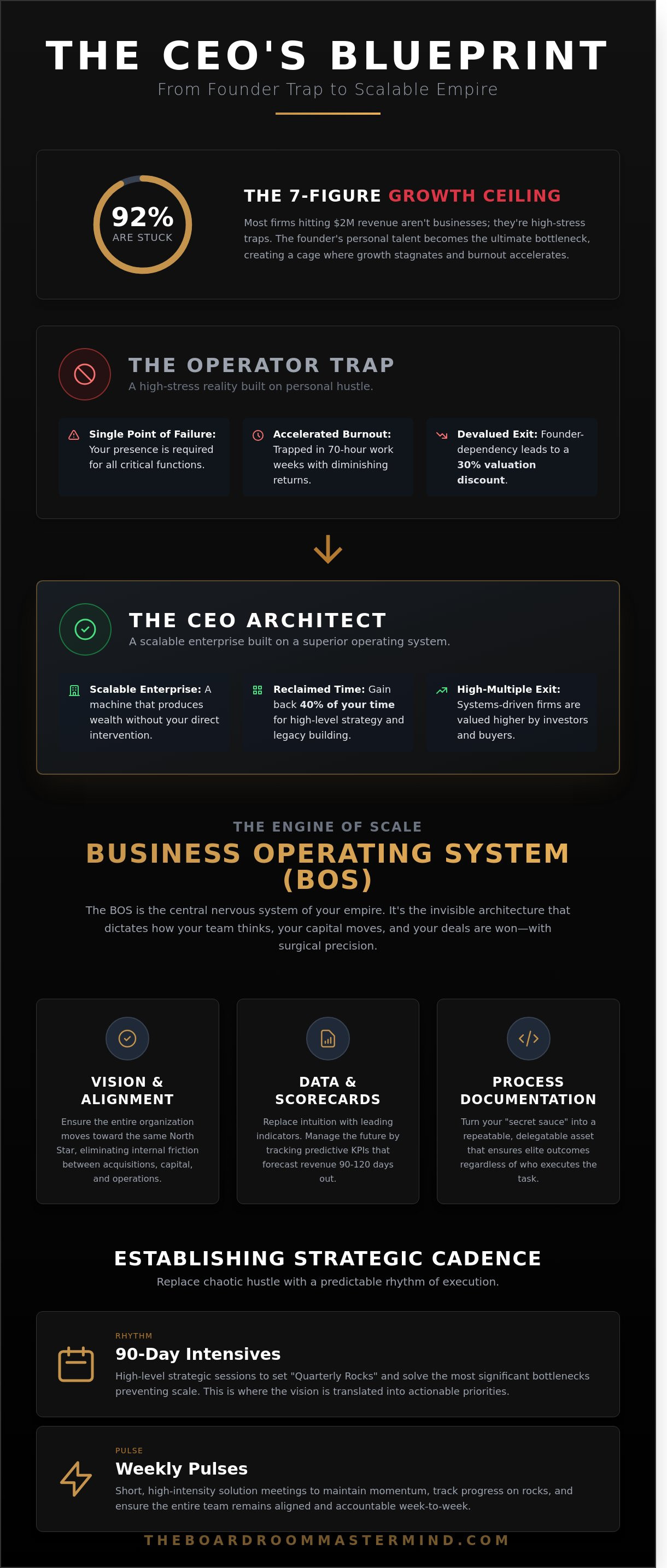
Most real estate firms hitting the $2 million revenue mark aren't actually businesses; they're high-stress traps where the founder remains the single point of failure. If your presence is required for every high-level closing, you haven't built a legacy, you've built a cage. It's a documented reality for the 92% of operators who find themselves stuck behind a 7-figure growth ceiling. To break through, you must stop acting as the engine and start acting as the architect. Implementing a standardized business operating system is the only way to shift from a chaotic hustle to a scalable enterprise that functions with surgical precision.
You already know that more leads won't solve a broken process, it will only accelerate the burnout you're feeling after 70-hour work weeks. We're going to show you how to install the structural framework that secures predictable margins and prepares your firm for a high-multiple exit. This briefing outlines the exact steps to transition from operator to CEO, ensuring your business generates elite results while you reclaim 40% of your time for high-level strategic play and collective intelligence.
Key Takeaways
- Discover how to install a high-performance business operating system that functions as the central nervous system of your 8-figure real estate empire.
- Establish a strategic cadence of quarterly intensives and weekly pulses to replace frantic hustle with a rhythmic, predictable path to scale.
- Shift from a personality-driven business to a functional architecture by implementing an Accountability Chart that defines clear ownership for every critical role.
- Evaluate the trade-offs between custom architectures and off-the-shelf frameworks to ensure your systems drive growth rather than creating "system bloat."
- Master the transition from operator to owner by leveraging elite peer groups to beta-test your workflows and accelerate your path to an exit-ready legacy.
What is a Business Operating System for the Real Estate CEO?
You didn't build a seven-figure real estate firm by accident. You built it through sheer force of will and individual talent. However, if you intend to cross the chasm to $10 million or $50 million in annual revenue, your personal grit is no longer the primary driver of growth. It's the primary bottleneck. To scale effectively, you must implement a business operating system. This is the central nervous system of your investment empire. It's the invisible architecture that dictates how your team thinks, how your capital moves, and how your deals are won.
Most operators confuse a few scattered SOPs with a true system. A genuine Business Operating System (BOS) is far more comprehensive. It governs your culture, dictates your long-term strategy, and enforces an uncompromising execution rhythm. There's a fundamental distinction between "hustling" for deals and "architecting" a business. Hustling is a job that requires your constant presence; architecting is the act of building a machine that produces wealth without your direct intervention. For the elite CEO, the BOS is the non-negotiable prerequisite for moving from seven to eight figures.
The Core Components of an Elite BOS
- Vision and Alignment: You must ensure the entire "Boardroom" is moving toward the same North Star. If your acquisitions team targets a 12% IRR while your capital partners demand 18%, the internal friction will stall your momentum.
- Data and Scorecards: Stop managing by intuition. You need leading indicators, such as the number of qualified offers submitted per week, to predict your revenue 90 to 120 days into the future.
- Process Documentation: This is the process of turning your "secret sauce" into a repeatable, delegatable asset. It ensures that a high-level outcome is achieved regardless of which team member is executing the task.
Why Your Current Growth is Your Greatest Risk
The "Founder Trap" is a documented phenomenon where your personal talent becomes the ultimate ceiling for the company. When every critical decision must pass through your desk, the business can only grow as fast as your cognitive bandwidth. Statistics from mid-market private equity firms show that founder-dependent businesses often see a 30% discount in valuation during exit negotiations compared to those with institutionalized systems. Investors and banks value systems over individual genius. They want to see that your business operating system can generate predictable returns even if you take a ninety-day sabbatical.
A business operating system is the structural framework for predictable scaling that synchronizes your talent, strategy, and capital into a singular, high-performance engine.
The 5 Pillars of a Scalable Business Architecture
Scaling to $10 million and beyond isn't a product of more effort. It's the result of a superior business operating system. Most founders are trapped in the "Founder's Trap" because they lack a repeatable framework to manage complexity. To break through, you must install a rigid architecture that governs how your team thinks, communicates, and executes. This isn't about micro-management; it's about creating a machine that runs without your constant intervention.
Your strategic cadence is the heartbeat of the organization. This involves a 90-day intensive to set quarterly rocks and a weekly pulse to maintain momentum. Without this rhythm, your team drifts into tactical silos. You must replace "update meetings" with high-intensity solution sessions. If a meeting doesn't result in a solved bottleneck, it's a drain on your equity. Implementing a formal organizational structure ensures that every function, from lead generation to dispositions, has a single point of accountability. In an 8-figure firm, roles are defined by outcomes, not by the personalities of the people filling them. When two people are responsible for one metric, nobody is responsible.
Pillar 1: Visionary and Integrator Alignment
The friction between the "big-picture" founder and the execution-focused leader is where most growth dies. The Visionary dreams at 30,000 feet, while the Integrator builds the runway. If these two aren't in lockstep, the company suffers from "initiative fatigue." You must bridge the gap by allowing the Integrator to filter the Visionary's 20 weekly ideas into three actionable priorities. This level of elite leadership is a hallmark of those who have moved beyond the 7-figure ceiling and into true market dominance. It's the transition from being the smartest person in the room to having the best system in the industry.
Pillar 2: The Data-Driven Scorecard
Gut feelings are liabilities in a high-stakes real estate environment. You need a scorecard of 5 to 15 leading indicators that predict your future bank balance. Are your acquisitions teams hitting a 12% lead-to-contract ratio? Is your cost per closed deal under $4,500? When you manage by the numbers, you create a culture of radical transparency. Data doesn't have an ego; it only has results. By tracking these metrics weekly, you identify a 15% dip in lead quality before it turns into a quarterly revenue crisis. If you're ready to stop guessing and start governing, it's time to audit your current architecture with peers who have already solved these puzzles.
BOS Implementation: How to Build Your Operating System
Building an elite organization requires moving from accidental success to engineered scale. You don't build a business operating system through hope; you build it through a rigorous, five-phase deployment. This is the transition from being a high-paid technician to becoming a true owner of a high-yield asset. At the eight-figure level, your role is no longer to do the work, but to design the machine that does the work.
The implementation follows a logical sequence designed to strip away inefficiency:
- The Audit Phase: We expose the friction. This involves identifying exactly where manual processes are failing and where human error is costing you six figures in lost opportunity.
- The Architecture Phase: We map the high-level workflows. You must visualize the entire real estate model from lead generation to exit, ensuring every handoff is seamless.
- The Alignment Phase: This is where we secure the buy-in. Your leadership team must commit to a single way of working; there is no room for "rogue" operators in a scaling firm.
- The Execution Phase: We roll out the operational cadence. This establishes the meeting pulse and reporting metrics that keep the entire organization in sync.
- The Optimization Phase: We conduct quarterly reviews to prune complexity. Scaling often adds unnecessary weight; we use these 90-day cycles to increase leverage and simplify the stack.
Step 1: Auditing Your Current Bottlenecks
Most CEOs at the seven-figure mark are still trapped in the "technician" role. They spend roughly 40% of their bandwidth on tasks that a $25-an-hour assistant could handle. To break this cycle, you must conduct a comprehensive time audit. Track every minute for 14 days to see where your energy is leaking. You'll likely find "single points of failure" in your acquisitions process, where a single person leaving could freeze your entire pipeline. An audit is the diagnostic tool for future freedom.
Step 2: Designing the Accountability Chart
Traditional org charts are relics of 20th-century bureaucracy that focus on titles rather than results. In a modern business operating system, we move to function-based accountability. This ensures every core process has one, and only one, owner. If two people are responsible for a metric, nobody is. By clarifying who owns the "Seat," you eliminate the "I thought he was doing it" excuse that kills momentum. This clarity is essential when scaling operations beyond a single local market, as it allows the CEO to maintain oversight without needing to be physically present in every boardroom.
Off-the-Shelf vs. Custom Real Estate Operating Systems
Generic frameworks like EOS® or Scaling Up provide a functional baseline. They don't provide a competitive moat. High-level real estate requires a deal-centric cadence that most off-the-shelf products ignore. Traditional SaaS models focus on linear growth and monthly recurring revenue. Real estate focuses on the lumpy, high-stakes 90-day acquisition cycle. If your business operating system slows down a $15 million closing because of a rigid meeting structure, the system is the bottleneck. This is system bloat. It's the moment the process consumes the profit.
The elite operator understands that a system is a tool for velocity, not a substitute for leadership. When the "operating system" becomes more important than the deal flow, you've built a bureaucracy, not a business. Collective intelligence is the only antidote to this stagnation. By leveraging the shared experiences of peers who've already broken the $50 million barrier, you can prune unnecessary rituals and focus on the levers that actually move the needle.
When EOS® Isn’t Enough
Standardized frameworks often fail during high-velocity market shifts. You aren't just managing people; you're managing capital stacks and interest rate sensitivity. Sophisticated founders utilize a hybrid approach. They take the accountability of EOS® and fuse it with the agility of private equity. At The Boardroom, we audit these frameworks through collective intelligence to ensure your business operating system serves the deal. We replace generic "Rocks" with capital deployment targets and debt-restructuring milestones that reflect the reality of 8-figure scaling.
Integrating Private Equity Standards
Scaling to 8 figures requires institutional discipline. Your BOS must satisfy the 42-point due diligence checklists of sovereign wealth funds or family offices. This means "Exit-Ready" documentation from day one. You aren't just flipping houses; you're building an enterprise-grade asset. For a deep dive into these structures, see our guide on Real Estate Private Equity: The Architect’s Guide to Institutional Scale.
By Q4 2024, the gap between "mom-and-pop" operations and institutional-grade firms will widen significantly. Your systems dictate which side of that line you fall on. Clean data, transparent reporting, and automated investor distributions aren't luxuries. They're the requirements for entry into the upper echelons of the industry.
Stop guessing and start architecting your exit. Apply for a seat in the Boardroom to refine your institutional architecture today.
The Boardroom Approach: Scaling Without the Stress
Scaling to $10 million and beyond requires more than just increased effort. It demands a fundamental shift in identity. Most real estate operators remain trapped in the "hustle" phase because their growth depends entirely on their personal presence. A true business operating system functions as the architecture that allows a company to breathe, grow, and profit without the founder’s constant intervention. This isn't just about efficiency; it's about building a legacy that survives your daily input.
Elite peer groups serve as the ultimate beta test for your strategic framework. In these high-stakes environments, your peers stress-test your assumptions before you deploy capital. Quarterly intensives provide the necessary reset to maintain your strategic rhythm. These 90-day sprints ensure the team stays aligned with the vision while the CEO focuses on high-level leverage points. When the system is fully optimized, the founder becomes the most optional person in the room. If you can't walk away for 30 days without revenue dipping, you don't own a business; you own a high-paying job.
Transitioning to a Professional CEO
The transition from a seven-figure hustler to an eight-figure wealth architect is a psychological evolution. You must stop being the operator and embrace three primary roles: Vision, Culture, and Capital. Internal data from top-tier firms shows that CEOs who dedicate 70% of their time to these three pillars see a 40% increase in enterprise value within 24 months. You maintain an unfair advantage by staying in close proximity to other high-level operators. This collective intelligence allows you to skip the expensive mistakes that stall most growth trajectories, moving you from the frantic energy of the field to the calm of the boardroom.
Joining the Inner Circle
Execution is the only bridge between a strategic plan and a tangible result. Without external accountability, even the most sophisticated business operating system will eventually degrade. You need a room that demands excellence and refuses to accept excuses. This is where the elite separate themselves from the crowd through a rigorous cycle of optimization.
- Quarterly Audits: Every 90 days, your systems are scrutinized by peers to ensure they remain scalable and leak-proof.
- Peer Accountability: Direct feedback from operators at your level keeps you focused on "working on" the legacy rather than "working in" the distractions.
- Strategic Optimization: Fine-tune your operational rhythm to ensure maximum output with minimum personal stress.
Your ascent to a nine-figure legacy is the logical conclusion of the right systems and the right room. If you're ready to stop grinding and start leading, it's time to change your environment. Apply for The Boardroom Mastermind and secure your seat at the table where the world’s highest achievers build the future.
Architect Your 9-Figure Legacy
Your growth has reached its ceiling because you're still the engine of your own machine. Scaling to 8 and 9 figures requires a shift from tactical execution to architectural design. By implementing a robust business operating system, you move beyond the daily friction of real estate operations and into the role of a true visionary. You've identified the 5 pillars of scalability and weighed the merits of custom architecture against generic software. Now, the only variable remaining is your environment.
The transition from Operator to CEO isn't a solo journey. It requires the collective intelligence of those who have already breached the 9-figure threshold. Through our 4 quarterly in-person strategy intensives, you gain access to proven frameworks that turn chaos into compounding wealth. You don't just need more information; you need the unfair advantage of a peer network generating over $100M in annual revenue. This is where high-level execution meets legacy building. It's time to stop grinding and start commanding.
The blueprint for your empire is ready. Join the Elite: Apply for The Boardroom Mastermind and Scale Your Empire. Your next level of freedom starts today.
Frequently Asked Questions
What exactly is a business operating system (BOS)?
A business operating system is the centralized framework of processes, tools, and rhythms that synchronize your entire team toward a single vision. It's the DNA of your company. Without it, you're relying on individual heroics rather than a repeatable machine. This system ensures that 100% of your staff operates from the same playbook, turning chaotic daily tasks into predictable, high-level outcomes.
Does my real estate business need a BOS if we are already profitable?
Profitability is a baseline, but true scalability requires a system. If your presence is required for the business to net $1,000,000 in profit, you don't own a company; you own a high-paying job. Research shows that businesses with documented systems trade at 2x or 3x higher multiples than those reliant on founder intuition. A system allows you to transition from operator to owner.
How long does it take to fully implement an operating system?
Full implementation typically requires a 12-month commitment to achieve total cultural integration. While you'll see immediate efficiency gains within the first 90 days, the compounding effect of a business operating system takes four full quarters to mature. This timeline accounts for three critical stages: installation, optimization, and mastery. It's a marathon designed for those building a 9-figure legacy.
Can I build a business operating system myself or do I need a coach?
You can build it yourself, but the opportunity cost of slow execution often exceeds $500,000 in lost revenue. Elite CEOs use mentors to bypass the trial-and-error phase. A coach provides the outside-in perspective necessary to identify the 15% of operational bottlenecks you're too close to see. Speed is a competitive advantage that the self-taught rarely achieve in a volatile market.
What is the difference between an SOP and a business operating system?
An SOP is a single instruction manual for a specific task; a business operating system is the entire engine that powers those tasks. Think of SOPs as individual components like pistons or gears. The system is the vehicle's architecture that tells those parts how to move together toward a 10-year goal. You need both to scale beyond the $10,000,000 mark successfully.
How does a BOS help with scaling from 7 to 8 figures?
Scaling to 8 figures requires moving from a hub-and-spoke model to a decentralized leadership structure. This framework provides the data-driven clarity needed to manage 25 or more employees without micromanagement. By establishing 5 key performance indicators for every role, you create an environment where the business scales through logic and systems rather than sheer hustle or brute force.
Will a business operating system make my company too rigid?
Systems don't restrict creativity; they provide the floor upon which innovation is built. By automating 80% of your repetitive tasks, you free up your team's mental energy for high-level strategic thinking. Discipline equals freedom in the boardroom. A structured system ensures that 100% of core operations are handled, allowing you to pivot quickly when a $5,000,000 opportunity arises.
What are the most common mistakes when implementing a BOS?
The most frequent error is over-engineering the system, making it too complex for 90% of the team to follow. Another mistake is failing to lead from the front. If the CEO doesn't follow the rhythms, the system dies in 30 days. Successful implementation requires 100% executive commitment, ensuring every meeting and decision flows through the established framework without any exceptions.


