
Business Development for Real Estate Investors: The 8-Figure Scaling Architecture
Most real estate investors don't actually own a business; they own a high-stress job that happens to involve property. You've likely reached a ceiling where your personal output is the primary bottleneck for growth. It's a common trap to believe that more activity equals more scale, but true business development for real estate investors requires a fundamental shift in architecture. With 30-year fixed mortgage rates hovering around 6.57% and the permanent restoration of 100% bonus depreciation via the OBBBA, the current landscape demands sophisticated systems over raw effort.
You probably agree that the frantic energy of tactical management is no longer sustainable for the legacy you intend to build. You deserve a predictable, systemized acquisition machine that functions without your manual intervention. This article reveals how to transition from a high-volume operator to a strategic CEO by building a self-sustaining growth engine. We will explore the specific frameworks used to attract institutional-grade capital and the professional leadership structures necessary to ensure your vision is executed with precision while you reclaim your time and focus on high-level strategy.
Key Takeaways
- Distinguish between the noise of volume-based marketing and the precision of strategic business development for real estate investors to break through the 8-figure ceiling.
- Implement a dual-track architecture that separates deal flow from capital raising, allowing both functions to scale independently of your personal output.
- Identify and eliminate the founder bottleneck by installing a specialized leadership team designed to execute high-level growth strategies without daily intervention.
- Leverage the power of proximity by aligning with elite peer groups that provide the strategic shortcuts and "unfair advantage" of 9-figure operational insights.
Defining Business Development for Real Estate Investors at Scale
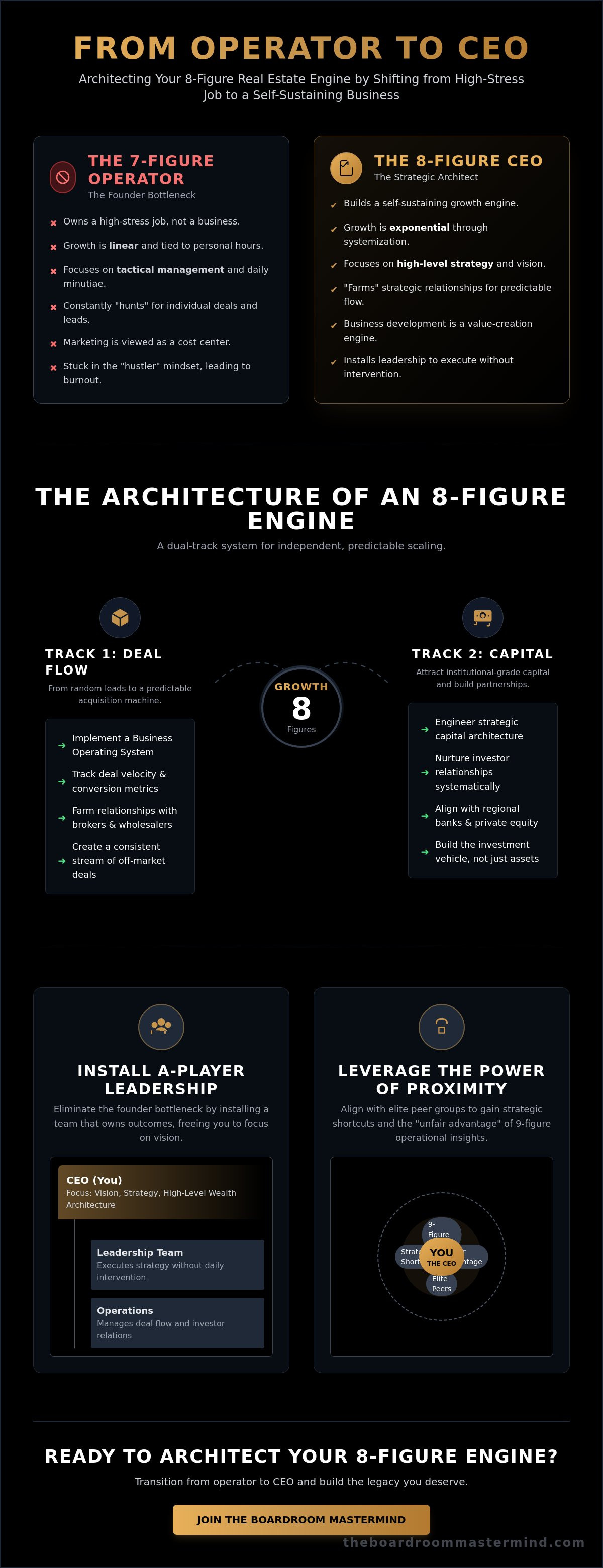
Marketing is the tactical hunt for individual leads. Business development for real estate investors is the strategic engineering of partnerships and capital architecture. While marketing focuses on the immediate transaction, business development builds the infrastructure for perpetual growth. It's the difference between cold calling a list and establishing a recurring pipeline with a regional bank or a private equity firm. Marketing is a cost center; business development is a value-creation engine.
Many founders remain trapped in the "hustler" mindset, believing that more personal effort is the only way to increase revenue. This is the primary barrier to 8-figure scaling. If you're the only person capable of closing a complex deal or securing a new equity partner, you don't have a business. You have a high-paying job. Genuine growth requires you to stop chasing leads and start engineering the systems that attract them. This shift is difficult because it requires relinquishing control of the tactical to focus on the structural.
To understand why the traditional real estate operator model often fails to scale, watch this strategic breakdown:
The CEO’s primary responsibility in BD is setting the vision and designing the architecture, not managing the minutiae of daily operations. You must move from the tactical to the strategic. What is Business Development? At this level, business development for real estate investors is defined as the institutional process of creating long-term value through relationships, markets, and capital. It requires a shift from linear activity to exponential systemization, where the value of the company is found in its processes rather than its people's individual heroics.
The 7-Figure Ceiling: Why Your Current Tactics Are Failing
Operator burnout is the most common symptom of a business that has outgrown its founder's capacity. When your growth is linear, meaning more deals require more of your personal hours, you'll eventually hit a hard ceiling. This friction isn't a sign of market weakness; it's a sign of structural failure. The tactics that got you to seven figures aren't the ones that will get you to eight. Transitioning to the next tier requires moving beyond the 7-Figure Ceiling: A CEO Guide to Exclusive Mastermind Groups by adopting a CEO-led blueprint for scale that prioritizes autonomy over activity.
The Architecture of an 8-Figure Business Development Engine
Scaling to eight figures requires structural integrity, not just increased effort. You can't rely on the same fragmented methods that built your first million. True business development for real estate investors functions on a dual-track engine: one track focused on acquisitions and the other on capital. If these two cylinders aren't firing in unison, your growth will remain erratic and dependent on your personal energy. Complexity is the enemy of scale; simplicity is the mark of a master.
A-Players don't just fill seats; they own outcomes. To reach institutional levels, you must install leaders who execute the BD strategy without your daily intervention. This team should be managing the flow of deals and the nurturing of investor relationships while you focus on high-level wealth architecture. Transitioning into this space means understanding Real Estate Private Equity: The Architect’s Guide to Institutional Scale, where the focus shifts from individual assets to the strength of the investment vehicle itself.
Systemizing Acquisitions: From Random Leads to Predictable Flow
Stop hunting and start farming. Operators who "hunt" for deals are always one bad month away from a dry pipeline. Scaling requires you to farm strategic relationships with wholesalers and brokers who provide a consistent stream of off-market opportunities. You need a dedicated Business Operating System to track deal velocity and conversion metrics. If you can't measure your acquisition speed, you can't manage your growth. Predictability is the only foundation for an 8-figure enterprise.
Capital Architecture: Attracting High-Net-Worth and Institutional Partners
The shift from one-off hard money loans to discretionary funds is the hallmark of a sophisticated firm. With 30-year fixed mortgage rates currently between 6.37% and 6.57%, and lenders expecting 20% to 30% equity for new deals, your capital stack must be institutional-grade. Sophisticated investors aren't just looking at the property; they're looking at your firm's "Bankability." They want to see a leadership team that understands the tax advantages of the OBBBA, which permanently restored 100% bonus depreciation for qualifying property.
Building this level of trust requires more than a pitch deck. It requires a professional presence that signals you are a peer to high-net-worth individuals. Utilizing SBA resources for business growth can provide foundational structures, but true institutional scale comes from engineering a fund that family offices find irresistible. If you're ready to see how these systems look in practice, explore our member case studies to see the architecture of real-world scale.
Transitioning from Operator to CEO: The Strategic Implementation
The transition from operator to CEO is a psychological and structural evolution. Most real estate investors remain stuck because they are the primary engine for every deal; they are the hunter, the closer, and the manager. To scale to eight figures, you must audit your current model and identify the bottlenecks. Usually, the bottleneck is you. Professional business development for real estate investors requires a fundamental shift from doing the work to designing the work. You need a Leadership Team specifically built to manage the high-level functions of deal flow and capital relations.
Establishing key performance indicators (KPIs) that measure strategic growth is essential. Instead of tracking raw activity like "calls made," focus on the number of institutional partnerships initiated or the velocity of capital commitment. These metrics reflect the health of your wealth architecture. Delegation in BD is not about abdication, but about creating an unbreakable system of accountability. If your presence is required for the machine to function, you haven't built a business; you've built a cage.
The CEO Audit: Reclaiming Your Time for High-Level Strategy
Your first step is creating a "Stop Doing" list. If a task doesn't directly contribute to 8-figure wealth architecture or strategic vision, it must be delegated immediately. This includes tactical networking that could be handled by working with Economic Development Organizations to identify emerging markets and local opportunities. Schedule quarterly business audits to ensure that rapid growth doesn't lead to operational drift or stagnation.
Building the BD Culture: Incentivizing Your Team for Scale
Culture is the invisible architecture of your firm. You must move beyond basic commission structures that only reward the next transaction. Implement compensation models for acquisitions managers and capital raisers that reward portfolio health and long-term equity growth. This aligns their personal success with your 8-figure vision. Foster a culture of Calculated Confidence where your executive team feels empowered to make high-stakes decisions based on your established systems. If you're ready to see how elite investors engineer this transition, explore our member success stories to see the blueprint in action.
The Power of Proximity: Engineering Your Elite Network for BD
Scale is rarely a solo endeavor. While the systems we've discussed provide the mechanics for growth, proximity provides the necessary velocity to outpace the general market. Business development for real estate investors often stalls not because of a lack of effort, but because of a lack of perspective. You cannot solve an 8-figure problem with a 7-figure mindset. Being in a room with individuals operating at 9-figure levels creates an environment where complex challenges are solved in minutes rather than months.
Proximity is the ultimate shortcut. It grants you The Unfair Advantage: Strategic Benefits of a Peer Advisory Group. It's about more than just networking; it's about strategic alignment and radical accountability. A high-ticket mastermind isn't a place for entry-level education. It's a boardroom for execution where established leaders audit each other's wealth architecture. This level of access ensures that your scaling efforts are precise, predictable, and permanent.
Why Established Investors Need a 'Boardroom' Environment
Success at the highest tiers is often isolating. Your local network likely doesn't understand the complexities of institutional capital or the structural requirements of an 8-figure business development for real estate investors. When your peers have already navigated the March 2026 FinCEN rules for all-cash residential transactions, you gain a level of clarity that isn't available in the general marketplace. You need a peer-level strategic audit to prevent stagnation and ensure your leadership team is performing at peak capacity.
Quarterly intensives act as a forced reset for your growth engine. They pull you out of the tactical weeds and refocus your energy on high-level strategy. This environment allows you to stress-test your systems against the experience of those who have already achieved what you are building. It's the difference between working on your business and being trapped inside it. Explore The Boardroom Mastermind Experience and audit your path to 8 figures.
Architecting Your 8-Figure Legacy
The transition from a high-volume operator to a strategic CEO is a deliberate architectural shift. You've seen how business development for real estate investors requires moving beyond tactical marketing to build institutional-grade systems for acquisitions and capital. By installing a professional leadership team that owns outcomes rather than just tasks, you create the structural integrity necessary to hold 8-figure growth without your constant manual intervention. The systems are the machine; your vision is the fuel.
True scale is rarely achieved in isolation. The most significant breakthroughs often occur during high-level strategic audits with peers who have already conquered the complexities of 9-figure operations. You deserve a boardroom environment that challenges your assumptions and provides the proven frameworks for transitioning from Operator to CEO. If you're ready to gain access to a network of 7, 8, and 9-figure real estate entrepreneurs and participate in quarterly in-person business audits with elite peers, the path is open. Apply to Join The Boardroom Mastermind and Scale Your Empire. Your next level of impact is waiting for you to build the structure that can sustain it.
Frequently Asked Questions
What is the difference between marketing and business development in real estate?
Marketing is the tactical acquisition of individual leads, while business development for real estate investors is the strategic engineering of long-term partnerships and capital architecture. Marketing focuses on the immediate transaction. Business development focuses on creating a self-sustaining engine through institutional relationships. It's the difference between hunting for a single deal and farming a network that provides deal flow and capital in perpetuity.
When should a real estate investor hire their first Business Development Manager?
You should hire a Business Development Manager when your personal involvement in tactical outreach becomes the primary bottleneck for scaling. If you're stuck managing broker relationships or chasing individual investors, you aren't acting as a CEO. This hire is necessary once your firm reaches the 7-figure ceiling and requires a dedicated professional to own the execution of growth strategies while you focus on high-level wealth architecture.
How do I attract institutional capital for my real estate deals?
Attracting institutional capital requires shifting from a hustler mentality to a bankable firm structure. Sophisticated partners look for a professional leadership team, transparent reporting, and a deep understanding of tax advantages like the 100% bonus depreciation restored by the OBBBA. You must prove your firm has the structural integrity to handle 8-figure deployments. They aren't just buying a deal; they're investing in your operational systems.
What are the best business development strategies for scaling to 8 figures?
Scaling to 8 figures requires a dual-track engine that separates acquisitions from capital raising. You must move from random lead generation to farming strategic relationships with top-tier brokers and wholesalers. Concurrently, you need to build a capital track that focuses on discretionary funds and family office partnerships. This architecture ensures that deal velocity and capital commitment are always in sync, allowing for predictable, exponential growth without founder intervention.
Is a mastermind group worth the investment for an established real estate CEO?
An elite mastermind is a critical strategic asset for a CEO who has outgrown general mentorship. It provides a boardroom environment for peer-level strategic audits and radical accountability. When you're in the room with investors operating at 9-figure levels, you gain access to shortcuts for complex challenges like the new 2026 FinCEN reporting rules. It's about proximity to elite decision-makers who have already solved the problems you're currently facing.


