
Business Continuity Plan for Real Estate Company: Engineering Operational Permanence
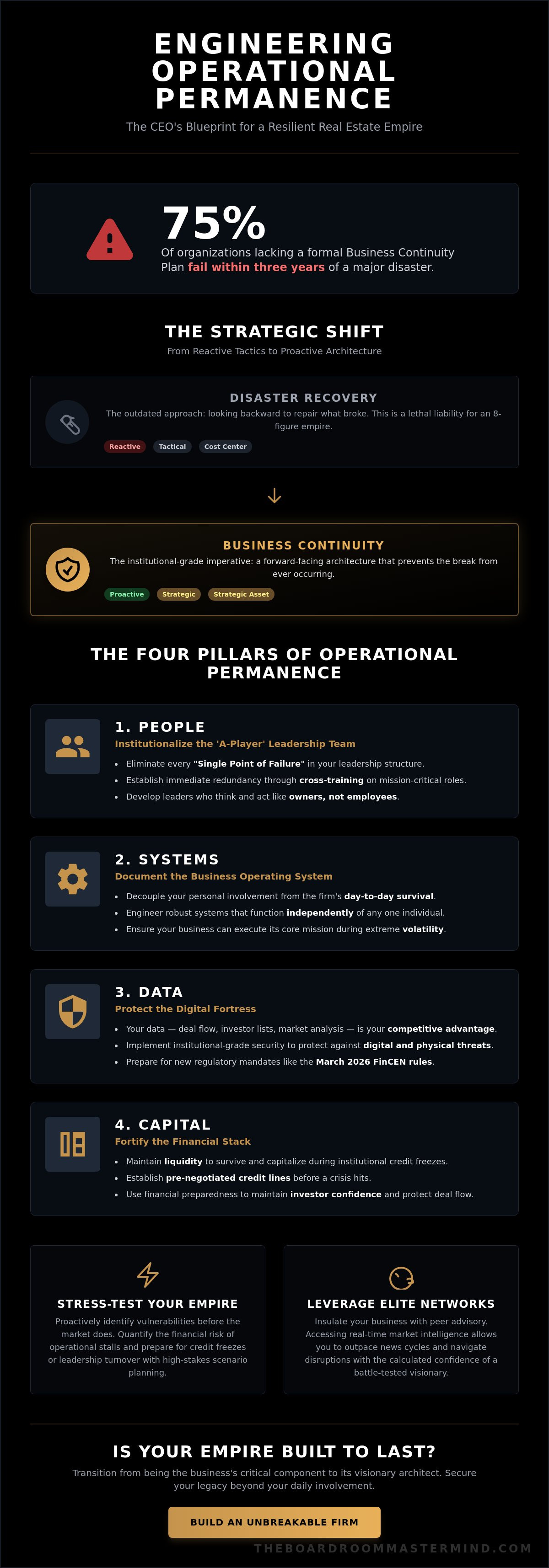
Seventy-five percent of organizations that lack a formal business continuity plan fail within three years of a major disaster. For a high-stakes real estate leader, this isn't just a statistic; it's a direct threat to the wealth architecture you've spent decades building. You've scaled your portfolio through grit, yet most firms remain dangerously tethered to the founder's daily involvement. Developing a comprehensive business continuity plan for real estate company operations is the only way to transition from a vulnerable, person-dependent business to a permanent, institutional-grade empire.
It's a sobering reality that a single market shock or a new regulatory mandate, such as the March 2026 FinCEN reporting rules, can wipe out years of equity if your systems aren't battle-tested. You've earned the right to a business that thrives without your constant oversight. This briefing outlines how to engineer operational permanence and protect your deal flow during periods of extreme volatility. We'll examine the strategic frameworks for asset protection, vendor resilience, and the documented crisis responses that separate industry titans from the merely successful.
Transition from reactive recovery to proactive operational permanence by implementing a business continuity plan for real estate company resilience. This strategic framework ensures your mission-critical functions continue without interruption, regardless of market volatility.
Identify and eliminate single points of failure within your leadership team while documenting a robust business operating system that decouples your personal involvement from the firm's survival. Institutional-grade security requires systems that run independently of any one individual.
Stress-test your empire using Business Impact Analysis and high-stakes scenario planning. Quantify the financial risk of operational stalls and prepare for credit freezes or leadership turnover before they occur to ensure your equity remains protected.
Insulate your business through elite peer advisory networks. Accessing real-time market intelligence allows you to outpace traditional news cycles and navigate disruptions with the calculated confidence of a battle-tested visionary.
Beyond Disaster Recovery: Defining Business Continuity for the 8-Figure Real Estate CEO
Disaster recovery is a reactive tactic. Business continuity is a strategic imperative. While the former focuses on restoring technical infrastructure after a crisis, a business continuity plan for real estate company operations ensures that mission-critical functions continue without a single second of downtime. For the 8-figure CEO, "fixing" is too late. You need to be "functioning" through the storm. Recovery is the act of looking backward to repair what broke; continuity is the forward-facing architecture that prevents the break from ever occurring.
Real estate firms face unique structural vulnerabilities. High capital intensity, extreme market sensitivity, and a dangerous reliance on founder-led decision-making create a fragile ecosystem. If a key lender pulls back or a regulatory shift occurs, a business without a plan faces immediate paralysis. According to this comprehensive guide to business continuity planning, the goal is to maintain essential services under any circumstances. Adopting this mindset transforms your operational security from a cost center into a strategic asset that significantly increases company valuation and investor trust. Sophisticated investors don't just buy cash flow; they buy the certainty of its persistence.
The Shift from Tactical Survival to Strategic Resilience
Winging it is the hallmark of a hustler. It works when you're managing five doors, but it's a lethal liability when you're scaling an 8-figure empire. Reactive fire-fighting drains your most valuable resource: time. Transitioning to proactive wealth architecture requires you to build systems that anticipate disruption rather than merely responding to it. True success isn't measured by how hard you work, but by how well the machine works without you. Operational permanence is the ability for a business to execute its core mission regardless of external volatility or internal leadership changes. By engineering this resilience, you stop being the bottleneck and start being the architect of a legacy that outlasts your daily involvement. This is how you move from tactical survival to an institutional-grade operation.
The Four Pillars of Operational Permanence in Real Estate
Operational permanence isn't a theory; it's the result of rigorous structural engineering. If your firm relies on your personal presence to sign every closing or approve every draw, you haven't built an empire. You've built a cage. A sophisticated business continuity plan for real estate company resilience rests on four non-negotiable pillars: People, Systems, Data, and Capital. When these pillars are properly reinforced, your business ceases to be a collection of activities and becomes a self-sustaining asset. It's the difference between a fragile operation that cracks under pressure and an institutional-grade powerhouse that absorbs market shocks and continues to expand.
Your capital stack is particularly sensitive during institutional freezes. Maintaining liquidity and pre-negotiated credit lines is essential for survival when traditional lending markets tighten. While others scramble for cash, a resilient firm uses its documented FEMA's business continuity framework to maintain investor confidence and secure bridge funding. This level of preparation ensures that your deal flow never stalls, even when the broader economy does. It's about protecting your high-ticket assets and ensuring your wealth architecture remains unshakeable.
Institutionalizing the 'A-Player' Leadership Team
Succession isn't just for retirement. It's for survival. You must identify every "Single Point of Failure" in your leadership team and establish immediate redundancy. If your COO is the only person with the keys to the kingdom, your empire is one accident away from collapse. Cross-training key roles ensures that your executive team can execute the BCP without your direct input. For those ready to scale, building a leadership team that operates with autonomy is the first step toward true operational freedom. You need leaders who think like owners, not employees who wait for instructions.
Protecting the Digital Fortress: Data and Deal Flow
Your data is your competitive advantage. Deal pipelines, investor lists, and historical financial records must be secured within a digital fortress. Cloud-based CRM and project management tools aren't just conveniences; they're the requirements for remote operational continuity. Ensure redundancy in your lead generation channels so a single platform outage doesn't kill your pipeline. If one source of deals dries up, your systems should automatically pivot to secondary channels. This level of digital resilience ensures that your empire stays profitable regardless of technical disruptions or external platform shifts.
The Annual Business Continuity Audit: Stress-Testing Your Empire
A plan that sits on a shelf is a liability. To ensure your business continuity plan for real estate company operations actually holds up under fire, you must subject it to a rigorous annual audit. This isn't a cursory review of your insurance policies. It's a high-stakes stress test designed to expose the fractures in your operational foundation before they lead to a total collapse. You don't want to discover your weaknesses during a market crash; you want to identify them while you have the luxury of time and capital to fix them.
- Step 1: Conduct a Business Impact Analysis (BIA). Identify which specific processes would cause the most catastrophic financial damage if halted for 48 hours. Is it your acquisition pipeline? Your investor distributions? Quantify the bleeding in dollars, not just "downtime."
- Step 2: Scenario Planning. Simulate the worst-case scenarios. What happens if there's a 30% market correction in your primary asset class? How does the firm function during a total credit freeze? What happens if your COO resigns tomorrow?
- Step 3: Gap Analysis. Compare your current systems against the requirements of these scenarios. Be brutally honest. If your current infrastructure can't handle a sudden loss of leadership, you have a critical gap that needs immediate attention.
- Step 4: Update the 'Crisis Command' Protocol. Distill your response into a one-page decision-making tree. Your executive team shouldn't be reading a 50-page manual during a crisis; they should be following a clear, authoritative path of action.
Scenario Planning for Market Volatility and Operational Gaps
Real estate CEOs must audit their capital stack with the same intensity they audit their deal flow. Resilience against interest rate shifts and institutional lending freezes is the baseline for permanence. You need to distinguish between leading indicators, such as shifts in lender sentiment or days on market, and lagging indicators like monthly revenue. If you aren't monitoring the leading signals, you're already behind the curve. For a comprehensive framework on auditing your infrastructure, review our guide on the Business Operating System. It provides the architecture required for 8-figure scaling without the typical founder-dependency bottlenecks.
Building an unshakeable empire requires more than just high-level strategy; it requires the right room of peers to challenge your assumptions. If you're ready to stress-test your business among the industry's elite, apply for The Boardroom experience to secure your operational future.
Leveraging Elite Networks to Insulate Your Business Against Disruption
Isolation is the silent killer of the 8-figure empire. When a crisis hits, most founders retreat into a silo, making high-stakes decisions based on fragmented data and emotional pressure. This is a strategic error. For an elite leader, a business continuity plan for real estate company resilience must extend beyond internal systems to include an external ecosystem of high-level intelligence. You don't just need a manual; you need a board of advisors who operate at your level and have already navigated the cycles you're currently facing. True security comes from knowing your strategy has been vetted by peers who have as much to lose as you do.
Peer advisory provides real-time market intelligence that outpaces traditional news cycles by months. While the general public waits for official reports, elite networks are already sharing shifts in lender behavior and deal flow trends. A high-ticket mastermind serves as your external Board of Advisors, providing a redundant layer of leadership when your internal team is compromised or overwhelmed. This is where The Boardroom Mastermind Membership becomes your ultimate strategic asset. It's not just a community; it's an insurance policy for your decision-making, ensuring that your empire remains unshakeable even when the path forward seems unclear.
The Power of Proximity During Market Shifts
Accessing the collective wisdom of peers who've survived previous economic cycles is the fastest way to shorten your learning curve during a disruption. You don't have to guess how to pivot when you're in the room with those who've already done it. Our Quarterly In-Person Intensives act as a forced audit of your business continuity and growth strategy, ensuring you stay ahead of the curve. Explore our case studies to see how elite investors systemize for resilience and maintain dominance regardless of external volatility. Success at this level is about who you know and how fast you can adapt. Don't wait for the next market shift to realize you're standing alone.
Securing Your Legacy Through Operational Permanence
Constructing a robust business continuity plan for real estate company operations is the definitive step in transitioning from a high-stakes job to a self-sustaining empire. You've seen how to decouple your personal involvement through the four pillars of permanence and how to expose vulnerabilities before they become catastrophes through rigorous stress-testing. At this level of success, your focus must shift from tactical survival to the long-term preservation of your wealth architecture. A business that requires your constant intervention isn't an asset; it's a liability.
True resilience is forged in the company of peers who operate at the highest tiers of financial success. By joining an elite network of 7, 8, and 9-figure investors, you gain access to the real-time intelligence and systemization tools found in the Boardroom Digital Portal. Our Quarterly In-Person Intensives provide the forced audits necessary to ensure your growth strategy remains unshakeable. It's time to move beyond the bottleneck of founder-dependency and engineer a firm that thrives in any climate.
Audit your business model and join the elite at The Boardroom Mastermind
The path to the next level is clear for those with the right access. Your empire is ready for its final transformation.
Frequently Asked Questions
What are the most common risks in a real estate business continuity plan?
The most significant risks include sudden leadership voids, institutional credit freezes, and major regulatory shifts such as the March 2026 FinCEN reporting requirements. While many firms focus on physical disasters, the greater threat to an 8-figure empire is often an operational bottleneck caused by founder-dependency. A comprehensive business continuity plan for real estate company resilience must address these strategic vulnerabilities to ensure deal flow remains uninterrupted during periods of extreme market volatility.
How often should a real estate company update its BCP?
You should update your plan at least once every twelve months or immediately following a significant organizational change. This includes the acquisition of major assets, shifts in executive leadership, or entering new geographic markets. An annual audit ensures your protocols remain aligned with the current technology and regulatory environment. Routine testing prevents the strategy from becoming a static document that fails when the stakes are at their highest.
What is the difference between a disaster recovery plan and a business continuity plan for real estate?
Disaster recovery focuses on the technical restoration of IT systems and data after a failure; business continuity ensures the entire operation remains functional during the event. Recovery is a reactive repair process. Continuity is a proactive architecture that maintains mission-critical functions such as rent collection and acquisition pipelines. For a high-growth firm, the goal isn't just to recover what was lost, but to never stop executing your core mission.
How can a small real estate team implement a BCP without a large corporate budget?
Small teams can achieve operational permanence by prioritizing the documentation of core processes and implementing cross-training for every "Single Point of Failure" role. You don't need a massive budget to create a robust business continuity plan for real estate company growth. Start by identifying the three functions that would cause the most financial damage if stopped for 48 hours. Documenting these workflows ensures your business doesn't collapse if a key team member is suddenly absent.
Does a business continuity plan help with real estate business valuation?
A documented BCP significantly enhances business valuation by reducing the risk profile for potential investors or buyers. Sophisticated purchasers look for institutional-grade security that isn't dependent on the founder's daily presence. By demonstrating that your firm can function through market volatility or leadership transitions, you justify a higher multiplier. It signals to the marketplace that you've built a permanent asset rather than a temporary revenue stream.


