
Building a Real Estate Investment Thesis: The Architecture of 8-Figure Scale
The difference between a high-volume hustler and a sovereign portfolio architect isn't the size of their bank account; it's the rigor of their mandate. Most investors operate in a state of reactive exhaustion, chasing every lead while wondering why their growth has stalled despite record median home prices hitting $429,300 as of May 2026. You likely recognize the feeling of being the primary bottleneck in your own operation, where every decision requires your manual intervention because there's no objective standard for a "yes." Building a real estate investment thesis is the only way to break this cycle. It transforms your business from a series of disconnected transactions into a precision-engineered engine for 8-figure wealth.
You've achieved success that puts you in the top tier of the market, but the tactics that got you here won't scale in a "higher for longer" interest rate environment where mortgage rates hover near 6.5%. This guide will show you how to craft an institutional-grade framework that professionalizes your profile and provides absolute clarity on which deals to reject instantly. We'll break down the specific architecture of a winning thesis, ensuring your strategy resonates with family offices and partners who demand more than just a "good deal." It's time to stop chasing and start building with intent.
Key Takeaways
- Replace reactive decision-making with a strategic mandate that serves as your organization's North Star for 8-figure growth.
- Master the art of building a real estate investment thesis that aligns 2026 macro-economic trends with your specific micro-level "Buy Box" requirements.
- Identify your "Red Lines" to filter out high-effort distractions and ensure every acquisition contributes to long-term wealth rather than operational drag.
- Implement a rigorous audit of past transactions to uncover where your capital actually generates returns versus where it simply consumes your time.
- Leverage high-level peer proximity to stress-test your assumptions and avoid the costly blind spots inherent in a solo founder's echo chamber.
The Architecture of Scale: What is a Real Estate Investment Thesis?
A real estate investment thesis is far more than a preferred asset class or a vague desire for cash flow. It is a formal, written mandate that outlines your specific intent, your overarching strategy, and the immutable boundary conditions that govern your capital. For those operating at the 8-figure level, this document serves as the North Star. It separates the professional architect from the reactive hustler. While the hustler waits for the phone to ring and evaluates deals on an ad-hoc basis, the architect has already decided what the portfolio must look like in five years. They don't just participate in real estate investing; they engineer a specific financial outcome through the deliberate process of building a real estate investment thesis.
The deal-chaser is a slave to the market's leftovers. They are perpetually reactive, lured by "good deals" that ultimately create a fragmented, unmanageable portfolio of assets that don't talk to each other. Building a real estate investment thesis forces a shift from this tactical desperation to strategic oversight. It requires you to define exactly what you will not buy, which is often more important than what you will. The investment thesis is the constitutional document that dictates every future allocation of capital and every hour of your team's labor.
The CEO Mindset: Why Your Current Lack of Thesis is Your Ceiling
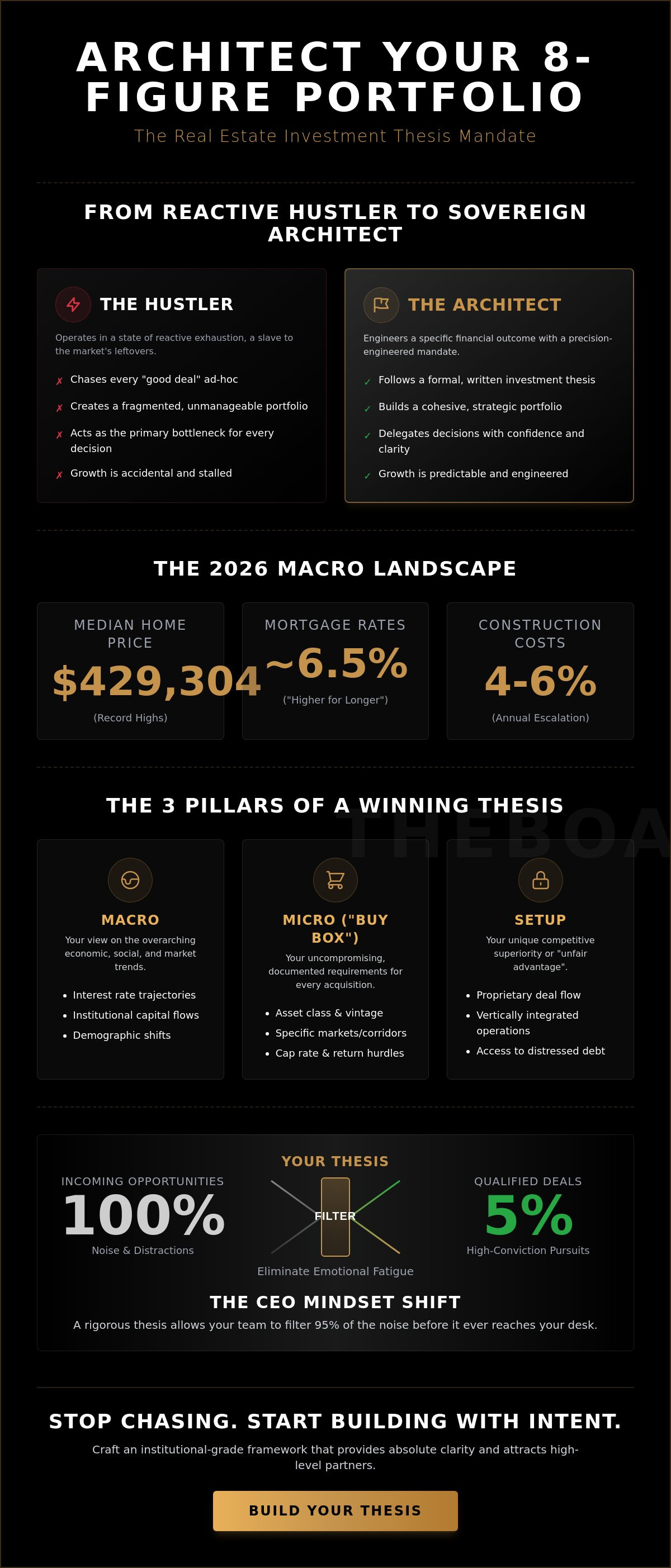
When you lack a formal thesis, you are the ultimate bottleneck. Every lead requires your specific intuition to validate. This opportunistic approach might have worked to get you to your first few million, but it is the primary reason you feel stuck in the day-to-day operations. Transitioning from The Operator to CEO Mindset Shift in Real Estate requires a framework that can be followed without your presence. A rigorous thesis allows your leadership team to filter 95% of the noise before it ever reaches your desk. It provides the clarity needed to delegate high-stakes decisions with confidence, ensuring that growth is predictable rather than accidental.
The Components of a High-Stakes Thesis: Micro, Macro, and Setup
Constructing a portfolio that withstands market cycles requires more than optimism; it demands a clinical breakdown of the variables you can control and those you must anticipate. In the current 2026 landscape, the macro environment is defined by a "higher for longer" interest rate reality. With 30-year fixed-rate mortgages averaging 6.5% to 6.6% and median home prices hitting record highs of $429,304 in June 2026, the margin for error has vanished. Your thesis must account for these trajectories, acknowledging that institutional capital is shifting toward income-driven returns rather than speculative appreciation. If your strategy relies on 4% debt, your thesis is already obsolete.
High-level execution relies on the integration of Micro, Macro, and Setup components. At the micro level, you must define an uncompromising "Buy Box." This includes specific asset classes, vintages, and cap rate requirements that align with your long-term wealth goals. Are you targeting 1990s-vintage multifamily in high-growth corridors, or are you pivoting to data centers and life sciences? Building a real estate investment thesis means documenting these parameters so your acquisition team knows exactly what to ignore. When you define your micro-level constraints with precision, you eliminate the emotional fatigue of evaluating deals that don't fit your architecture.
The "Setup" is where you identify your unique competitive superiority. This is your unfair advantage. Perhaps it is your proprietary access to distressed debt or a vertically integrated management team that compresses operational costs. Without a clear setup, you are just another bidder in a crowded market. Protecting an 8-figure portfolio requires a robust margin of safety. This isn't just about equity cushions; it's about stress-testing your cash flow against 2026 construction cost escalations of 4% to 6% and potential labor shortages. You are building a fortress, not a tent.
The Capital Stack: Structuring for Institutional Scale
Your thesis dictates your capital requirements. As you scale, the conversation shifts from simple bank loans to sophisticated debt and equity structures. Understanding Real Estate Private Equity: The Architect’s Guide to Institutional Scale is essential for presenting your vision to family offices. These partners aren't just looking for assets; they are looking for a repeatable investment engine. A professionalized thesis demonstrates that you have the systems in place to manage their capital with the same rigor they apply to their own enterprises. If you want to play at the highest level, your thesis must reflect a deep understanding of capital stack optimization. Many elite owners find that joining The Boardroom Mastermind Membership provides the peer-level insights necessary to refine these complex structures for maximum impact.
How to Build and Stress-Test Your Investment Thesis
Building a real estate investment thesis requires a clinical look in the rearview mirror before you can map the road ahead. Begin with a rigorous audit of every transaction from the past 24 months. You must identify the specific deals where you actually generated alpha versus those that simply consumed your team's bandwidth for marginal gains. Often, investors find that 80% of their operational friction comes from 20% of their assets that never fit a cohesive strategy. This audit isn't just about profit. It's about identifying the specific activities that prevent you from scaling to 8 and 9 figures.
Discipline is defined by your "Red Lines." These are the specific market conditions, geographic boundaries, or asset flaws that trigger an immediate rejection. In an environment where median home prices hit record highs in June 2026, your margin for error is razor-thin. If a deal violates a red line, it doesn't matter how high the projected IRR looks; you walk away. This level of decisiveness is what separates the sovereign architect from the desperate deal-chaser. You must also quantify your exit strategy before the first dollar of capital is deployed. Whether you're targeting a 3-year velocity play or a 10-year legacy hold, the thesis must dictate the endgame. Synthesize these findings into a two-page executive summary. If your leadership team cannot understand your mandate in five minutes, it isn't a strategy; it's a suggestion.
The Annual Business Audit: Keeping the Thesis Current
A static thesis is a liability. It must be a living document that adapts to the shifting 2026 landscape, from new FinCEN reporting rules for all-cash transactions to localized structural integrity laws. Implementing a Business Operating System: The Architecture of 8-Figure Real Estate Scaling ensures that your thesis remains the central nervous system of your company. Use leading indicators like localized construction cost escalations or inventory shifts to signal when it's time for a strategic pivot. Elite operators don't wait for the market to force their hand. They anticipate the move. To refine your own strategic mandate alongside peers who have already mastered this transition, apply for The Boardroom Mastermind Membership today.
The CEO’s Edge: Validating Your Thesis Through Proximity
Isolation is the ultimate liability for the 8-figure founder. When you operate in a vacuum, your strategic mandate becomes an echo chamber where flawed logic is mistaken for conviction. Building a real estate investment thesis is a rigorous exercise, but its true value is only realized when it survives the scrutiny of peers who operate at your level or higher. While theoretical models might suggest regression analysis as a path to value, they lack the battle-tested intuition of a visionary who has navigated multiple real-world cycles. Conviction without external validation is merely a gamble.
True validation requires proximity to high-level benchmarks. This is the "Boardroom Effect." It’s the moment a peer who manages a 9-figure portfolio identifies a structural flaw in your debt assumptions or a blind spot in your localized market analysis. Perhaps you’ve underestimated the operational drag of the 2026 Florida condo structural integrity laws or miscalculated the impact of the 100% bonus depreciation restored under the OBBBA. These aren't just details; they are the variables that determine whether your portfolio is a fortress or a house of cards. By exposing your thesis to collaborative auditing, you transition from a tactical manager who hopes for the best to a strategic visionary who engineers it.
Engineering Your Elite Network
Your network must do more than affirm your current trajectory. It must challenge your fundamental assumptions. An elite advisory group acts as a pressure test for your business architecture, forcing you to defend your "Red Lines" and refine your capital stack against 2026 market realities. This level of friction is necessary to sharpen your competitive edge and ensure your growth remains sustainable. You can explore The Unfair Advantage: Strategic Benefits of a Peer Advisory Group for Elite Founders to understand how these dynamics accelerate scaling.
The final stage of building a real estate investment thesis is a peer-driven stress test. It’s about moving beyond what you think you know and accessing the collective intelligence of a room where 8 and 9-figure exits are the standard. Don't let your strategy stagnate in isolation. Experience the power of a high-level business audit at our next Boardroom Intensive and finalize the architecture of your scale.
Mastering the Mandate: Your Path to 8-Figure Sovereignty
The transition from a high-volume operator to a strategic architect is a deliberate choice to stop chasing deals and start engineering outcomes. By building a real estate investment thesis, you create the boundary conditions necessary to scale without sacrificing your personal well-being. You've learned how to audit past performance, define clinical "Red Lines," and leverage the macro-economic shifts of 2026 to your advantage. Now, the final component is the elite proximity required to ensure your strategy is bulletproof.
Strategy without scrutiny is a liability. To professionalize your investment profile for 8 and 9-figure scaling, you need a room that challenges your assumptions. Led by Kent Clothier, this exclusive network of 7, 8, and 9-figure real estate entrepreneurs provides the environment needed for rigorous strategic auditing. Through our quarterly in-person business intensives, you gain the clarity to reject the noise and focus on legacy. Apply to Join The Boardroom Mastermind and scale your empire to 8 figures. Your next level of growth is the logical conclusion for those with the right access.
Frequently Asked Questions
What is the difference between an investment thesis and a buy box?
An investment thesis is your overarching strategic mandate, while a buy box is the tactical filter used to execute it. Your thesis defines the economic rationale and market trajectory you're betting on. The buy box simply lists the asset class, vintage, and location requirements that fit that bet. Building a real estate investment thesis provides the "why" that justifies every "what" in your buy box.
How often should a real estate CEO update their investment thesis?
A real estate CEO should perform a formal audit of their thesis annually, though significant macro shifts require immediate adjustments. In an environment where 30-year mortgage rates average 6.5% to 6.6%, a static document is a liability. You must treat your thesis as a living Business Operating System. It needs to reflect current capital costs, construction escalations, and regulatory changes like the 2026 FinCEN reporting requirements to remain valid.
Can a small-scale investor use an 8-figure investment thesis framework?
Every institutional giant began with a rigorous framework, making this architecture essential for investors at any stage. Small-scale investors who adopt 8-figure frameworks avoid the trap of reactive deal-chasing. By building a real estate investment thesis early, you professionalize your operation before the stakes are at their peak. This discipline ensures that your first five deals aren't just profitable; they're the strategic foundation for your next fifty.
What are the biggest mistakes founders make when building their first thesis?
The most common failure is building a thesis around a specific deal rather than a market reality. Founders often fall into the "echo chamber" trap, where they ignore leading indicators because they've already committed emotionally to an asset. Another critical error is failing to define "Red Lines." Without immutable boundary conditions, your thesis becomes a suggestion rather than a mandate, leading to a fragmented portfolio that creates massive operational drag.
How do I communicate my investment thesis to potential lenders or partners?
Present your thesis as a two-page executive summary that highlights your "Setup" and "Margin of Safety." Lenders and family offices aren't just looking for property data; they're looking for a repeatable decision-making engine. Clearly articulate how your strategy exploits current market gaps and protects capital against volatility. When you speak the language of wealth architecture rather than tactical management, you signal that you're a peer to high-level financial institutions.


