
Building a High-Level Business Network: Proximity Engineering for 8-Figure Scale
Your current network is no longer an asset; it is a ceiling. If you are consistently the most successful person in your circle, you aren't leading; you're stagnating. Most entrepreneurs mistake frantic activity for progress, wasting hundreds of hours at generic events that offer nothing but surface-level pleasantries and zero ROI. Building a high-level business network isn't about collecting business cards or digital connections. It's about proximity engineering. This is the calculated process of placing yourself in restricted environments where 8-figure deals are the baseline and institutional-level insights are the standard currency.
You already understand that the tactical hustle that secured your first seven figures won't be what carries you to the next tier of wealth architecture. It's a frustrating plateau where a lack of high-level accountability acts as a silent anchor on your operations. This guide details how to transition from a frantic operator to a composed CEO by treating your peer group as a strategic asset. We will examine the frameworks for accessing elite deal flow and engineering a network that demands your evolution, ensuring your professional environment finally matches your financial ambitions.
Key Takeaways
- Identify why being the most successful person in your circle is a strategic liability that keeps you trapped in tactical management rather than CEO-level oversight.
- Shift from passive interactions to proximity engineering by prioritizing curated access and rigorous business model auditing over generic networking events.
- Implement a "Revenue vs. Value" matrix to audit your current circle, a critical step in building a high-level business network that functions as a strategic asset.
- Locate the restricted environments where 8 and 9-figure decisions are made, moving beyond surface-level talk toward high-stakes deal flow and institutional insights.
- Leverage quarterly in-person intensives to dismantle operational bottlenecks and secure the high-level accountability required for exponential financial growth.
The Proximity Gap: Why Your Current Network Is Your Growth Ceiling
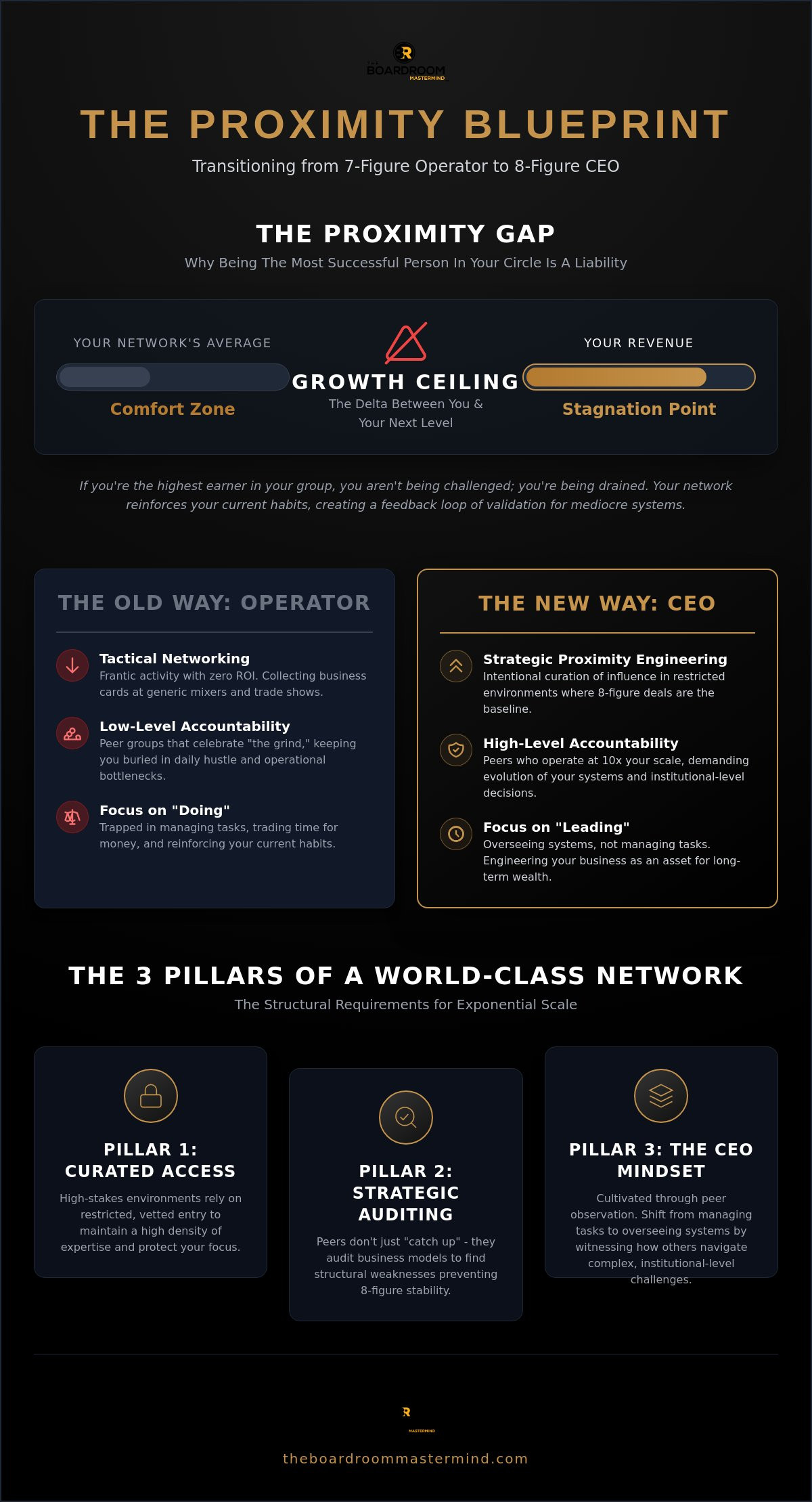
Stop measuring your network by the volume of contacts in your CRM. At the 7-figure mark, your growth is no longer limited by your work ethic; it's limited by your environment. The Proximity Gap is the delta between your current annual revenue and the average scale of your inner circle. If you're the highest earner in your group, you've reached a terminal velocity. You aren't being challenged; you're being drained. Being the smartest person in the room is a strategic liability for any founder aiming for an 8-figure exit. It creates a feedback loop of validation for mediocre systems and operational bottlenecks.
Building a high-level business network is not about collecting business cards at generic mixers. That's tactical networking, a low-leverage activity for operators who still trade time for money. Strategic proximity engineering is the intentional curation of influence. It requires moving away from open-access events toward restricted environments where entry is earned through performance. Consider the distinction:
- Tactical Networking: Seeking referrals, attending trade shows, and focusing on immediate lead generation.
- Strategic Proximity: Accessing institutional-level deal flow and auditing your business model alongside peers who operate at 10x your scale.
The "7-figure ceiling" is rarely a product of poor marketing. It's a symptom of a network that reinforces your current habits rather than demanding their evolution. If your circle doesn't challenge your operational structure, it's quietly endorsing your stagnation.
The Cost of Low-Level Accountability
Peer groups composed of "operators" keep you buried in the daily hustle. They celebrate the grind because they're stuck in it themselves. This creates a psychological anchor. When you lack peers who understand 8-figure stakes, you lose the mental bandwidth to make bold, institutional-level decisions. You end up playing small because everyone around you is doing the same. Without high-level accountability, you'll continue to manage the business you have instead of building the enterprise you want.
Proximity Engineering: The Three Pillars of a World-Class Network
Proximity engineering is the intentional curation of peers who force a 10x expansion in your thinking. It isn't a passive byproduct of your career; it's a structural requirement for scale. Building a high-level business network requires three distinct pillars that ensure your time is invested, not just spent. If your current circle doesn't provide these, you aren't networking; you're just socializing.
Pillar 1: Curated Access. A room that anyone can enter is a room you should leave. High-stakes environments rely on restricted entry to maintain a density of expertise. When every member is vetted for their financial performance and operational maturity, the signal-to-noise ratio remains high. This exclusivity isn't about ego. It's about protecting the most valuable resource you have: your focus.
Pillar 2: Strategic Auditing. In a world-class network, peers don't just "catch up." They audit each other's business models. They look for the structural weaknesses that prevent a 7-figure company from reaching 8-figure stability. This process requires a level of transparency that only exists in a trusted, high-net-worth community where members are peers, not competitors.
Pillar 3: The CEO Mindset. This mindset is cultivated through peer observation. You stop managing tasks and start overseeing systems when you see how other leaders navigate complex acquisitions or institutional-level challenges. This shift is essential for those looking to join an elite peer group focused on long-term wealth architecture.
The Transition from Operator to CEO
The primary bottleneck for most founders is their inability to let go of the "hustler" identity. High-level networks facilitate the shift from "doing" to "leading" by providing a blueprint for delegation and strategic oversight. When you are surrounded by CEOs who have successfully scaled to nine figures, your perspective on daily operations changes. You begin to see your business as an asset to be engineered, not a job to be performed. For a deeper dive into this transition, read The 7-Figure Ceiling: A CEO Guide to Exclusive Mastermind Groups. Building a high-level business network ensures you aren't just working harder, but working on a higher plane of execution.
From Tactical Networking to Strategic Alliances: An Execution Plan
Execution is where most founders fail. They understand the theory of proximity but lack a repeatable system to filter their environment. Building a high-level business network is an exercise in ruthless optimization. It requires a transition from passive social interactions to the intentional engineering of strategic alliances. Stop guessing who should be in your inner circle. Start applying a framework that treats your network as a high-yield asset.
- Step 1: Audit your circle using a "Revenue vs. Value" matrix. Plot your current peers based on their financial scale and the strategic value they provide. If a contact doesn't challenge your operational model or offer institutional-level insights, they're a legacy connection that may be anchoring you to your current revenue ceiling.
- Step 2: Identify the rooms where 8 and 9-figure decisions are made. These aren't found in public forums or generic business mixers. Look for restricted-access environments where the barrier to entry is high, ensuring that every person in the room has skin in the game.
- Step 3: Develop a "Contribution First" strategy. Elite entrepreneurs don't need more friends; they need more solutions. Tailor your value proposition around deal flow, access to private capital, or specialized expertise that solves complex operational bottlenecks.
- Step 4: Implement a quarterly "Network Audit." Building a high-level business network is not a one-time event. Your proximity must always stay ahead of your current growth to pull you toward the next milestone.
If your current circle doesn't force you to think bigger, it's time to re-engineer your environment. Secure your seat in a room designed for 8-figure scale.
Evaluating the ROI of Peer Advisory Groups
Measuring the return on proximity requires looking beyond immediate referrals. The true value lies in compressed timeframes and avoided mistakes. A single insight from a peer who has already scaled past your current plateau can save you eighteen months of trial and error. This is one of the primary benefits of a peer advisory group for established founders. When you operate within a high-stakes environment, you gain the clarity to make decisive moves that others find paralyzingly complex. You aren't just buying access; you're buying a shortcut to the next level of wealth architecture.
The Boardroom Asset: Engineering Proximity for Real Estate Leaders
The Boardroom Mastermind Membership is the premier proximity asset for real estate investors who have outgrown the noise of the general marketplace. If your ambition exceeds your current environment, you don't need more tips; you need a structural overhaul. Building a high-level business network within this community provides the specific leverage required to scale from a high-earning operator to a true CEO. It is the logical destination for those who demand more than surface-level mentorship.
Our quarterly in-person intensives serve as a rigorous business audit. This isn't a social gathering. It's a high-stakes interrogation of your current systems, deal flow, and capital structures. When you present your business to a board of 8-figure advisors, you gain an unfair advantage that cannot be replicated through solo effort. They identify the bottlenecks you're too close to see. They provide the institutional-level insights that turn a fragile operation into a scalable enterprise. You aren't just joining a group; you're acquiring a board of directors.
The core outcome of this proximity is the definitive transition from hustler to CEO. You stop chasing the next deal and start engineering the systems that produce them. This shift is the difference between temporary success and permanent wealth architecture. By building a high-level business network with peers who operate at 10x your scale, you ensure your professional growth is a matter of strategy, not luck.
Why Restricted Access Matters
Exclusivity is the only way to ensure peer-level quality. Every applicant for The Boardroom Mastermind Membership undergoes a rigorous vetting process to confirm they are operating at a high level. We protect the room so that every conversation you have is with a peer who understands the weight of your decisions. This barrier to entry maintains the integrity of the collective expertise. If you want to see the caliber of leaders you'll be joining, view our Member Spotlight. We ensure that only those committed to 8-figure scale gain entry, preserving the room as a sanctuary for high-level execution.
Engineer Your Next Level of Scale
You've seen that your network acts as either a launchpad or a limit. By identifying your Proximity Gap and implementing a rigorous audit of your circle, you move beyond the surface-level noise of generic networking. Building a high-level business network is the only way to ensure your environment demands the same level of excellence as your financial goals. It's about trading the frantic energy of a solo operator for the strategic clarity of a battle-tested CEO who understands wealth architecture. If you're still the most successful person in your circle, you're operating at a dangerous disadvantage.
The Boardroom Mastermind Membership provides the restricted access and high-level accountability required to break through the 7-figure ceiling. With an elite peer group of 7, 8, and 9-figure entrepreneurs and quarterly in-person intensive strategy sessions, we offer a proven track record in scaling real estate empires. Stop managing the business you have and start engineering the enterprise you want. Apply for The Boardroom Mastermind and upgrade your proximity today. Your next stage of growth is inevitable when you have the right board behind you.
Frequently Asked Questions
What is the difference between a networking group and a high-level mastermind?
A networking group focuses on broad referrals and casual connections, whereas a high-level mastermind is a strategic asset designed for business auditing and peer-level accountability. While generic groups often lack a barrier to entry, an elite mastermind requires rigorous vetting to ensure every member operates at scale. You aren't there to pass business cards; you're there to dismantle operational bottlenecks and gain institutional insights from peers who have already conquered your current challenges.
How do I know if I have outgrown my current business network?
You've outgrown your network when you're consistently the most successful person in the room or when your peers no longer challenge your strategic decisions. If your circle celebrates your current revenue instead of questioning your operational efficiency, they're validating your stagnation. Building a high-level business network becomes mandatory when your current group lacks the vernacular of 8-figure scaling or the experience to handle institutional-level deal flow and complex acquisitions.
Why is proximity considered the "ultimate shortcut" for scaling to 8 figures?
Proximity compresses time by providing direct access to proven frameworks and avoiding the expensive mistakes of solo experimentation. A single conversation with an 8-figure founder can reveal structural flaws in your business model that might've taken years to identify alone. This advantage allows you to skip the trial-and-error phase, moving directly into high-leverage execution with the confidence that your strategy is backed by the validation of high-net-worth peers.
What specific value can I offer to a network of people more successful than me?
High-level peers value specialized expertise, unique deal flow, and private capital access over generic networking pleasantries. You don't need to be the wealthiest person in the room to provide value; you need to offer a perspective or resource that solves a specific operational problem. Whether it's a proprietary marketing system or a unique acquisition strategy, your contribution lies in your ability to act as a strategic partner rather than a passive observer.
How much time should a CEO dedicate to high-level networking and proximity engineering?
A CEO should treat building a high-level business network as a core strategic function, dedicating roughly 10% to 15% of their calendar to high-leverage proximity. This isn't about daily social media outreach. It involves focused, quarterly intensives and deep-dive strategy sessions that yield long-term ROI. By stepping away from tactical management for these high-stakes interactions, you ensure your business remains aligned with the systems required for 8-figure sustainability and beyond.

Disclaimer
Mr. Clothier is an expert in real estate investing. As such his experiences are not necessarily typical to the standard real estate investor and whose results may vary. The successes shared on this site are not considered typical. Most individuals who order the educational materials and systems probably do not follow any of the techniques or strategies and consequently make little to no money due to their inaction. The company is in the process of determining the typical success of its clients. Stories shared herein are for example purpose only and should not be construed as "guarantees" of success. Results will vary based on background, education, and experience and actions taken.
This site is not a part of the Google/Facebook website or Google/Facebook Inc. Additionally, this site is NOT endorsed by or affiliated with Google/Facebook in any way. GOOGLE/FACEBOOK is a trademark of GOOGLE/FACEBOOK, Inc.
INCOME DISCLAIMER: This website and the items it distributes contain business strategies, marketing methods and other business advice that, regardless of referenced results and experience, may not produce the same results (or any results) for you. The Boardroom Mastermind makes absolutely no guarantee, expressed or implied, that by following the advice or content available from this web site you will make any money or improve current profits, as there are several factors and variables that come into play regarding any given business. Primarily, results will depend on the nature of the product or business model, the conditions of the marketplace, the experience of the individual, and situations and elements that are beyond your control. As with any business endeavor, you assume all risk related to investment and money based on your own discretion and at your own potential expense.
LIABILITY DISCLAIMER: By reading this website or the documents it offers, you assume all risks associated with using the advice given, with a full understanding that you, solely, are responsible for anything that may occur as a result of putting this information into action in any way, and regardless of your interpretation of the advice. You further agree that The Boardroom Mastermind, its affiliates, subsidiaries, officers and agents, cannot be held responsible in any way for the success or failure of your business as a result of the information provided. It is your responsibility to conduct your own due diligence regarding the safe and successful operation of your business. In summary, you understand that we make absolutely no guarantees regarding income as a result of applying this information, as well as the fact that you are solely responsible for the results of any action taken on your part as a result of any given information. In addition, you agree that our content is to be considered "for entertainment purposes only". Always seek the advice of a professional when making legal, financial, tax, or business decisions.
BUSINESS OPPORTUNITY: All products and services offered by The Boardroom Mastermind are intended to provide prospective purchasers with general business strategies, marketing methods and other general advice for business development and training. At no point is The Boardroom Mastermind soliciting anyone to enter into a new business nor is it representing, either expressly or by implication, that it will provide locations for a business, provide outlets, accounts, or customers, or purchase any of the goods or services made by the purchaser.
The products being offered through this promotion are packages of informational tools to help you learn about business and deal making strategies.


