
Advanced Tax Strategies for Real Estate Investors 2026: Navigating the Post-TCJA Landscape
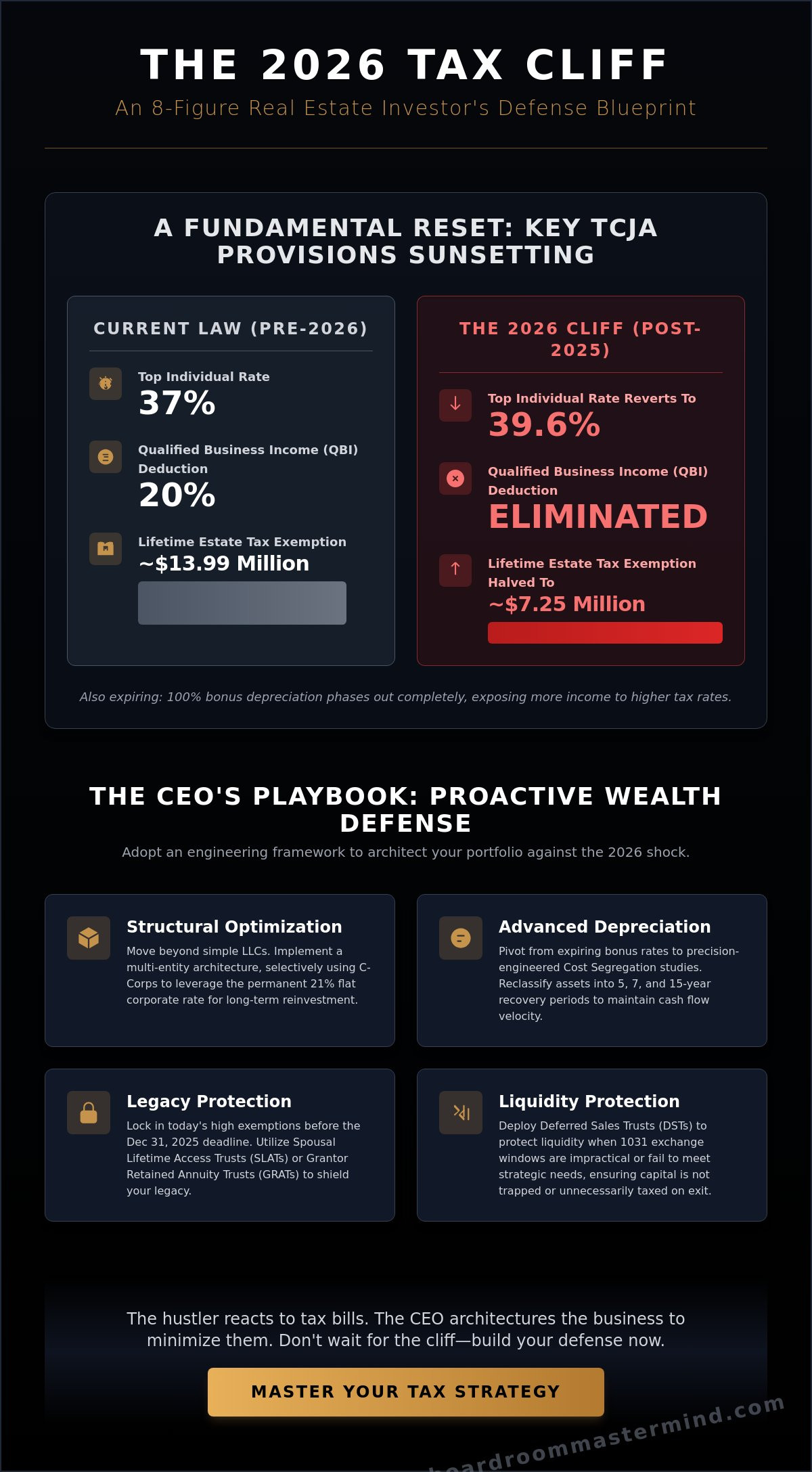
Most 8-figure real estate investors are walking into a 2026 tax trap they spent the last decade building. The sunsetting of the Tax Cuts and Jobs Act isn't a minor adjustment. It's a fundamental reset of the wealth architecture you've relied on. You've likely used the 20% QBI deduction and aggressive bonus depreciation to fuel your expansion, but those tools are evaporating. Without a proactive pivot, your portfolio is now exposed to a top individual rate of 39.6% and a halved estate tax exemption of approximately $7.25 million.
You understand that high-level growth requires more than just compliance; it demands tactical superiority. We'll show you how to master the advanced tax strategies for real estate investors 2026 demands to ensure your capital remains protected. This briefing provides a proactive blueprint for 2026 tax engineering. We'll cover sophisticated entity restructuring to replace lost deductions and estate planning maneuvers to guard your legacy against shrinking exemptions. It's time to move from tactical management to strategic oversight before the 2026 cliff arrives.
Key Takeaways
- Quantify the impact of the 2026 tax cliff, specifically the loss of the 20% QBI deduction and the return to pre-2018 individual rates.
- Transition your depreciation engine from expiring bonus rates to permanent cost segregation and Section 179D energy incentives.
- Deploy advanced tax strategies for real estate investors 2026 by restructuring simple holdings into a sophisticated, multi-entity wealth architecture.
- Utilize Deferred Sales Trusts to protect your liquidity when 1031 exchange windows close or fail to meet your strategic needs.
- Adopt the CEO’s playbook by treating tax strategy as a quarterly high-stakes intensive rather than a year-end administrative chore.
The 2026 Tax Cliff: Navigating the Sunset of the TCJA for High-Growth Portfolios
The era of "easy" tax savings is ending. On January 1, 2026, the core provisions of the Tax Cuts and Jobs Act (TCJA) sunset, creating a fiscal shock for high-net-worth investors. This isn't just a policy shift; it's a direct assault on the cash flow of 8-figure portfolios. You've likely grown accustomed to the 37% top marginal rate. In 2026, that rate reverts to 39.6%. When combined with the loss of the 20% Qualified Business Income (QBI) deduction, the effective tax hike for pass-through entities is staggering. Most investors are unprepared for this compounding effect. They're still operating with a tax-prep mindset while the landscape demands a CEO-level engineering framework.
The QBI Sunset: A 20% Hit to Your Bottom Line
The QBI deduction under Section 199A has been a cornerstone of real estate profitability since 2018. It allowed pass-through owners to shield a fifth of their income from federal taxes. That shield disappears in 2026. For investors operating through LLCs or S-Corps, this means every dollar of profit is suddenly more expensive to earn. You must evaluate structural pivots now. While pass-throughs were the gold standard for years, advanced tax strategies for real estate investors 2026 may require a selective shift toward C-Corp conversions. This allows specific assets to leverage the flat 21% corporate rate, which is particularly effective for portfolios focused on long-term reinvestment rather than immediate distributions. It's a move that requires precise calculation of your long-term exit goals.
Estate Tax Volatility: Protecting the 9-Figure Legacy
The wealth transfer window is closing. The lifetime estate and gift tax exemption is scheduled to plummet from $13.99 million per person in 2025 to approximately $7.25 million in 2026. If your portfolio exceeds these new thresholds, the IRS becomes your largest unintended beneficiary. Sophisticated estate planning isn't about avoidance; it's about aggressive engineering. You need to lock in current exemptions using Spousal Lifetime Access Trusts (SLATs) or Grantor Retained Annuity Trusts (GRATs) before the December 31, 2025, deadline. This strategy often involves detailed asset valuations based on the Modified Accelerated Cost Recovery System (MACRS) to ensure that depreciation schedules and cost basis are optimized before the estate is valued for transfer. Implementing advanced tax strategies for real estate investors 2026 ensures your legacy isn't liquidated to pay for a lack of foresight.
Transitioning from a "hustler" mindset to a "CEO" tax-engineering framework is mandatory. The former reacts to tax bills; the latter architectures the business to minimize them. This level of strategic oversight is exactly what we facilitate within The Boardroom Mastermind, where the focus is on systems and scalability rather than mere activity. You don't need a better accountant. You need a better architecture.
Advanced Depreciation & Energy Incentives: Engineering Cash Flow in 2026
The 100% bonus depreciation party has officially ended. By 2026, the phase-out reaches its conclusion, leaving many unprepared investors staring at a massive tax liability. Relying on the blunt instrument of immediate full expensing is no longer a viable option. Instead, elite portfolios must pivot toward precision engineering through sophisticated cost segregation. While the headline rate for bonus depreciation hits 0%, the underlying mechanics of IRS Publication 946 still allow for the reclassification of assets into 5, 7, and 15-year recovery periods. This isn't just an accounting exercise. It's a liquidity play. Mastering these advanced tax strategies for real estate investors 2026 demands is the only way to maintain the cash flow velocity required for institutional growth.
Section 179D: The New Frontier of Real Estate Deductions
Energy efficiency isn't just a "green" initiative; it's a high-yield tax strategy. Section 179D has evolved into a powerhouse for commercial and large multifamily retrofits. For those operating at scale, the deduction limits have significantly increased, rewarding systems that outperform standard energy benchmarks. If you're involved in government-owned projects, you can even have these deductions passed through to you as the primary designer or investor. This creates a secondary layer of tax efficiency that most generalists overlook, allowing you to offset income from your private holdings with credits generated from public-sector partnerships.
Cost Segregation in a Post-Bonus World
Why bother with a cost seg study if bonus depreciation is gone? The answer lies in the time value of money. Reclassifying property into shorter life cycles accelerates your deductions, creating immediate cash flow that can be redeployed into new 8-figure real estate deals. If you've sat on assets without a study, "Catch-up Depreciation" via Form 3115 allows you to claim missed deductions in a single year without amending prior returns. This unlocks immediate liquidity in existing portfolios. Strategic timing is everything. Triggering a study during the acquisition phase allows you to model your post-tax IRR with institutional accuracy. For those seeking to refine these frameworks alongside industry peers, attending one of our Quarterly In-Person Intensives provides the high-level briefing necessary to execute these moves with confidence.
Structural Optimization: Beyond the LLC to Multi-Entity Wealth Architecture
Scaling past the 8-figure mark requires moving beyond basic LLC structures. Auditing your business operating system isn't just about operations; it's about tax-efficient entity layering. If your current setup doesn't allow for the "Check-the-Box" election to optimize how multi-member LLCs are treated, you're likely leaving capital on the table. Family Limited Partnerships (FLPs) also serve as a critical tool for consolidating management while discounting asset values for gift and estate tax purposes. This becomes vital as exemptions shrink in 2026. These moves are core components of the advanced tax strategies for real estate investors 2026 requires for long-term wealth preservation.
The 1031 Exchange vs. The Deferred Sales Trust
Section 1031 is a powerful tool, but it's rigid. The 45-day identification and 180-day closing windows don't always align with a volatile market. A Deferred Sales Trust (DST) offers a sophisticated alternative for those who value flexibility over tradition. It allows you to "rescue" a failed 1031 exchange and defer capital gains indefinitely. This flexibility is a hallmark of Advanced Tax-Saving Methods for Real Estate used by high-net-worth owners. You aren't forced into a bad deal just to save on taxes. You control the timing of your reinvestment.
Captive Insurance for Real Estate Conglomerates
For real estate conglomerates, establishing a micro-captive insurance company is the ultimate strategic move. This turns necessary insurance premiums into tax-advantaged wealth reserves. It's a method to manage risk while building a secondary pool of capital that grows outside of your primary operations. This level of financial engineering separates the tactical managers from the strategic visionaries. If you're ready to audit your architecture and join an elite tier of high-achievers, explore The Boardroom Mastermind Membership.
The CEO’s Tax Playbook: Integrating Strategy into 8-Figure Scaling
Success at the 8-figure level isn't about working harder; it's about engineering a more efficient machine. While the average investor treats taxes as a year-end administrative burden, the elite CEO views them as a controllable variable in their wealth architecture. You don't just need a CPA to record history. You need a specialized tax strategist to write it. Shifting from tactical management to strategic oversight means moving away from reactive filing and toward proactive advanced tax strategies for real estate investors 2026 requires for survival. Your board of advisors must include a visionary who understands how to navigate the post-TCJA cliff before it hits your balance sheet. This isn't just about compliance. It's about competitive superiority.
The Quarterly Tax Audit: A CEO Requirement
Waiting until April to discuss last year's performance is a failure of leadership. High-growth portfolios require a quarterly intensive to pivot as market conditions and regulations shift. During these high-level briefings, you must track key performance indicators like your effective tax rate and the velocity of your depreciation recapture. If you aren't auditing your tax efficiency every 90 days, you aren't leading your business; you're just following the IRS's lead. This cadence allows you to deploy capital into new acquisitions or structural adjustments with the confidence that your tax liability is already optimized. It's the difference between being a passenger and being the pilot.
Leveraging Peer Intelligence for Financial Superiority
The most powerful tools aren't found in a textbook. They're shared in rooms where access is restricted to those operating at your level. Proximity is your greatest competitive advantage. Joining exclusive mastermind groups reveals "off-menu" strategies that generic firms won't mention. The Boardroom Mastermind experience connects you with a network of peers who've already solved the 2026 tax cliff. This restricted-access network serves as the ultimate shortcut to advanced wealth protection, ensuring that your attainment of a 9-figure legacy isn't just possible, but inevitable. Don't leave your growth to chance when you can rely on the collective expertise of battle-tested visionaries who value time and execution above all else.
Secure Your Legacy Before the 2026 Reset
The 2026 tax cliff isn't a theory; it's a scheduled financial event that will separate the tactical managers from the strategic visionaries. You've seen how the expiration of QBI and the shrinking of estate tax exemptions threaten to erode the wealth you've spent decades building. Mastery of the advanced tax strategies for real estate investors 2026 demands isn't just about preserving cash flow. It's about maintaining your competitive edge in an environment where the rules of engagement have changed. By integrating multi-entity architecture and accelerating depreciation through energy-efficient retrofits, you position your portfolio for permanence.
True financial superiority is never achieved in isolation. It requires proximity to those who've already navigated the complexities of institutional scale. If you're ready to move beyond standard accounting and into elite wealth engineering, it's time to join a room of your peers. Apply for The Boardroom Mastermind to Audit Your Wealth Architecture and gain direct access to 8 and 9-figure real estate founders. Through our quarterly in-person business intensives and exclusive peer-led business audits, you'll secure the shortcut to high-level execution. The path to the next level is clear for those with the right access. Your future growth depends on the decisions you make today.
Frequently Asked Questions
What is the "2026 Tax Cliff" and how does it specifically affect real estate investors?
The "2026 Tax Cliff" refers to the scheduled expiration of the Tax Cuts and Jobs Act provisions on January 1, 2026. For real estate investors, this triggers a reversion of the top individual income tax rate to 39.6% and a significant reduction in the standard deduction. It forces a move toward advanced tax strategies for real estate investors 2026 requires to offset the loss of the 20% QBI deduction and the expiration of the $10,000 SALT cap.
Will the Section 199A QBI deduction be extended beyond 2025?
As of June 2026, the Section 199A QBI deduction is officially set to expire at the end of the 2025 tax year. No federal legislation has been passed to extend this 20% deduction for pass-through entities into 2026. Investors must pivot their entity structuring now. This often involves evaluating C-Corp conversions or multi-entity layering to mitigate the sudden spike in taxable income that pass-through owners will face without this critical deduction.
How does the phase-out of bonus depreciation change my cost segregation strategy for 2026?
The phase-out of bonus depreciation reaches 20% in 2026 and is scheduled for total elimination thereafter. This shift makes permanent cost segregation more critical than ever. Instead of relying on immediate full expensing, you'll use cost segregation to reclassify assets into 5, 7, and 15-year recovery periods. This preserves the time value of money by accelerating depreciation over shorter windows, even without the blunt force of 100% bonus depreciation.
What are the best alternatives to a 1031 exchange if I cannot find a replacement property in time?
The Deferred Sales Trust (DST) serves as the premier alternative when the rigid 45-day identification window of a 1031 exchange fails. Unlike a 1031, a DST doesn't require an immediate property replacement. It allows you to defer capital gains tax by selling your asset to a trust in exchange for a structured promissory note. This provides the liquidity to wait for better market conditions while keeping your capital working in a tax-advantaged environment.
How can I protect my estate from the 2026 exemption reduction without losing control of my assets?
Protecting your estate requires locking in the current $13.99 million exemption before it drops to approximately $7.25 million on January 1, 2026. Utilizing a Spousal Lifetime Access Trust (SLAT) allows you to transfer assets out of your taxable estate while maintaining indirect access to the income through your spouse. This is a cornerstone of the advanced tax strategies for real estate investors 2026 landscape needs to prevent a massive liquidation event upon wealth transfer.


